Paper Tape Drive For A Live Performance Music Box

Music is a mystery to some of us. Sure, we know what we like when we hear it, but the idea of actually being able to make it baffles us. And the idea of being able to build new instruments to create it, like this paper-tape programmable music box (YouTube, embedded below), is beyond impressive.

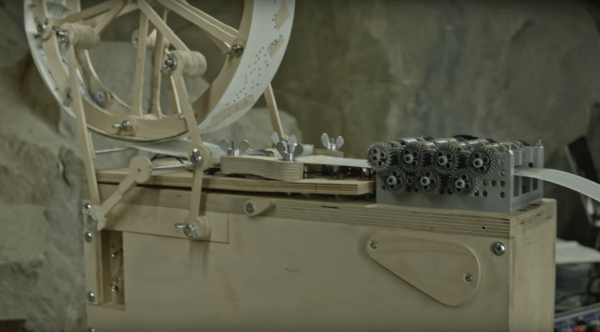
You’ll no doubt remember [Martin Molin] of the group “Wintergatan” and his astounding marble madness music machine. This instrument is on a much more modest scale and is centered around an off-the-shelf paper tape music box. But the cheap plastic drive gears kept failing under performance conditions, so [Martin] headed to what appears to be his cave-based workshop and started grinding. He prototyped a new paper drive from Lego Technics, and while it worked, it needed help to pull the paper. What followed was an iterative design process that culminated in a hybrid of plastic and metal Technic parts that drive the paper reliably, and a musical instrument that’s much more than just a tinny wind-up music box. Hear it in action below with another new instrument, the Modulin, which sounds a little like a Theremin but looks like – ah, just watch the video.

The build video hints at more details to come, and we’re hoping for a complete series like that for the marble machine. We’d also love to see details on the Modulin too – if there ever was a hacked musical instrument, that’s it.

Continue reading “Paper Tape Drive For A Live Performance Music Box”
LuaRadio Brings More Options To SDR

GNURadio is the swiss-army-knife of software-defined radio suites: it does everything and anything. It has a great GUI overlayer that makes creating radio flows fairly simple. There are only two areas where we could quibble with the whole system — it’s a gigantic suite of software, and it’s a lot harder to code up in Python than it is to use the GUI.

[Vanya Sergeev] started up his LuaRadio project to deal with these shortcomings. If you’re looking for the full-GUI experience, you’re barking up the wrong tree here. LuaRadio is aimed at keeping things easy to code and keeping the codebase small and tidy.

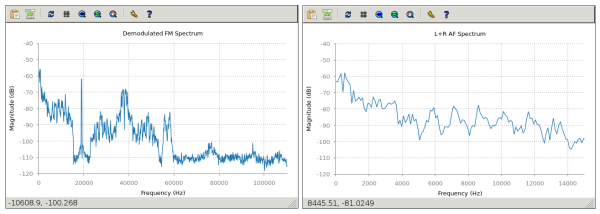
That doesn’t mean that it departs entirely from GNURadio’s very successful flow-graph programming paradigm, however, and if you’re comfortable with the procedure of hooking up a signal source to a filter block to an output, you’ll be doing fine here as well. Check out the obligatory FM radio demo — the “hello world” of SDR — and you’ll see how it works: instantiate the various blocks in code, and then issue “connect” commands to link them together.

LuaRadio’s main selling points are its size and the ease of programming it by hand. It’s got great documentation to boot. It’s written as a library that’s embeddable in your C code, so that you can write standalone programs that make use of its functionality.

LuaRadio is a new project and it doesn’t have a GUI either. It may not be the ideal introduction to SDR if you’re afraid of typing. (If you are new to SDR, start here.) But if you want to code up your SDR by coding, or run your radio on smaller devices, it’s probably worth a look. It’s at v0.1.1, so we’re looking forward to hearing more from LuaRadio in the future. Any of you out there use it? We’d love to hear in the comments.

A Pi Robot Without A Hat

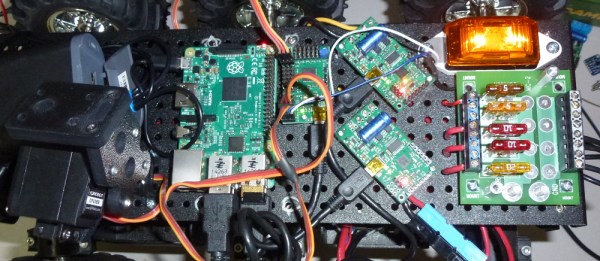
Daughter boards for microcontroller systems, whether they are shields, hats, feathers, capes, or whatever, are a convenient way to add sensors and controllers. Well, most of the time they are until challenges arise trying to stack multiple boards. Then you find the board you want to be mid-stack doesn’t have stackable headers, the top LCD board blocks the RF from a lower board, and extra headers are needed to provide clearance for the cabling to the servos, motors, and inputs. Then you find some boards try to use the pins for different purposes. Software gets into the act when support libraries want to use the same timer or other resources for different purposes. It can become a mess.

The alternative is to unstack the stack and use external boards. I took this approach in 2013 for a robotics competition. The computer on the robots was an ITX system which precluded using daughter boards, and USB ports were my interface of choice. I used a servo controller and two motor controllers from Pololu. They are still available and I’m using them on a rebuild, this time using the Raspberry Pi as the brain. USB isn’t the only option, though. A quick search found boards at Adafruit, Robotshop, and Sparkfun that use I2C.

Continue reading “A Pi Robot Without A Hat”

42,300 Transistor Megaprocessor Is Complete

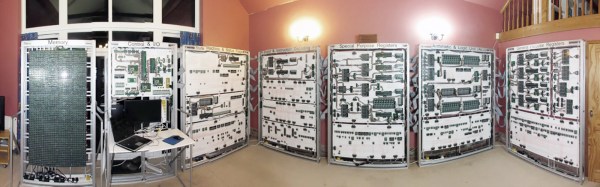
As it turns out, the answer is not 42, it’s 42.3 — thousand. That’s how many discrete transistors spread across the 30 m2 room housing this massive computation machine. [James Newman’s] Megaprocessor, a seriously enlarged version of a microprocessor, is a project we’ve been following with awe as it took shape over the last couple of years.

[James] documented his work in great detail, and by doing so, took us on a journey through the inner workings of microprocessors. His monumental machine is now finished, and it’s the ultimate answer to how a processor – and pretty much everything that contains a processor – works.

Continue reading “42,300 Transistor Megaprocessor Is Complete”

Build A 3D Printer Workhorse, Not An Amazing Disappointment Machine

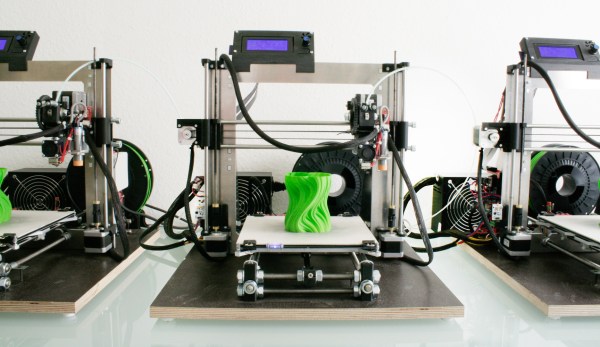
3D printers have become incredibly cheap, you can get a fully workable unit for $200 – even without throwing your money down a crowdfunded abyss. Looking at the folks who still buy kits or even build their own 3D printer from scratch, investing far more than those $200 and so many hours of work into a machine you can buy for cheap, the question “Why the heck would you do that?” may justifiably arise.

The answer is simple: DIY 3D printers done right are rugged workhorses. They work every single time, they never break, and even if: they are an inexhaustible source of spare parts for themselves. They have exactly the quality and functionality you build them to have. No clutter and nothing’s missing. However, the term DIY 3D printer, in its current commonly accepted use, actually means: the first and the last 3D printer someone ever built, which often ends in the amazing disappointment machine.

This post is dedicated to unlocking the full potential in all of these builds, and to turning almost any combination of threaded rods and plywood into a workshop-grade piece of equipment.

Continue reading “Build A 3D Printer Workhorse, Not An Amazing Disappointment Machine”

Using The Vive’s Lighthouse With DIY Electronics

The HTC Vive is the clear winner of the oncoming VR war, and is ready to enter the hallowed halls of beloved consumer electronics behind the Apple Watch, Smart Home devices, the 3Com Audrey, and Microsoft’s MSN TV. This means there’s going to be a lot of Vives on the secondhand market very soon, opening the doors to some interesting repurposing of some very cool hardware.

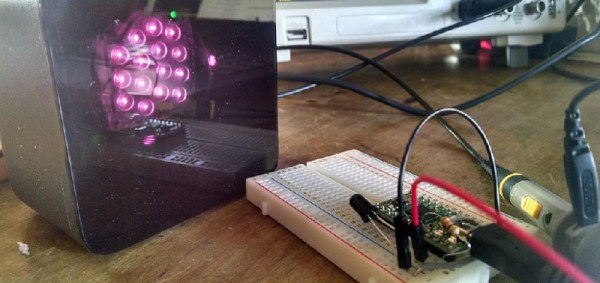
[Trammell Hudson] has been messing around with the Vive’s Lighthouse – the IR emitting cube that gives the Vive its sense of direction. There’s nothing really special about this simple box, and it can indeed be used to give any microcontroller project an orientation sensor.

The Vive’s Lighthouse is an exceptionally cool piece of tech that uses multiple scanning IR laser diodes and a bank of LEDs that allows the Vive to sense its own orientation. It does this by alternately blinking and scanning lasers from left to right and top to bottom. The relevant measurements that can be determined from two Lighthouses are the horizontal angle from the first lighthouse, the vertical angle from the first lighthouse, and the horizontal angle from the second lighthouse. That’s all you need to orient the Vive in 3D space.

To get a simple microcontroller to do the same trick, [Trammell] is using a fast phototransistor with a 120° field of view. This setup only works out to about a meter away from the Lighthouses, but that’s enough for testing.

[Trammell] is working on a Lighthouse library for the Arduino and ESP8266, and so far, everything works. He’s able to get the angle of a breadboard to a Lighthouse with just a little bit of code. This is a great enabling build that is going to allow a lot of people to build some very cool stuff, and we can’t wait to see what happens next.

Seeing The Truly Invisible With DIY Shortwave UV Imaging

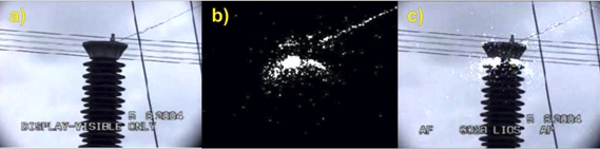
We’ve all seen how to peel IR filters off digital cameras so they can see a little better in the dark, but there’s so much more to this next project than that. How about being able to see things normally completely outside the visual spectrum, like hydrogen combustion or electrical discharges?

UV Electrical Discharge

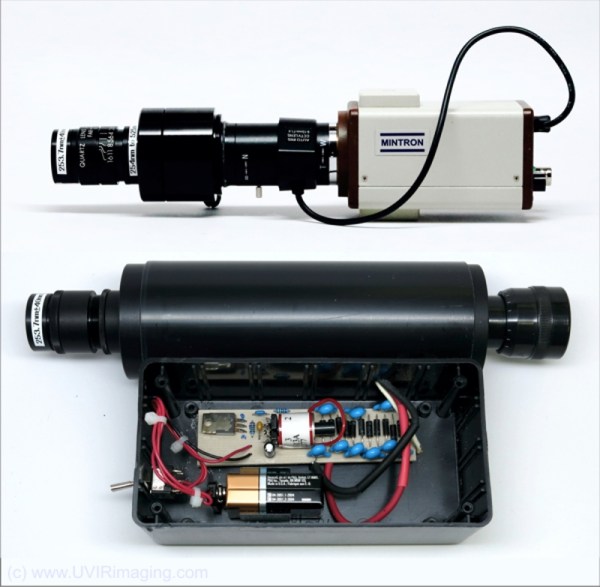
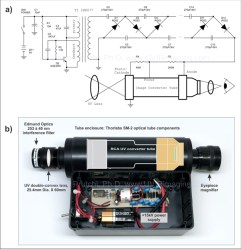
[David Prutchi] has just shared his incredible work on making his own shortwave ultraviolet viewers for imaging entirely outside of the normal visible spectrum – in other words, seeing the truly invisible. The project has not only fascinating application examples, but provides detailed information about how to build two different imagers – complete with exact part numbers and sources.

UV-Viewer-SmallIf you’re thinking UV is a broad brush, you’re right. [David Prutchi] says he is most interested in Solar Blind UV (SBUV):



Solar radiation in the 240 nm to 280 nm range is completely absorbed by the ozone in the atmosphere and cannot reach Earth’s surface…

Without interference from background light, even very weak levels of UV are detectable. This allows ultraviolet-emitting phenomena (e.g. electrical discharges, hydrogen combustion, etc.) to be detectable in full daylight.

There is more to the process than simply slapping a UV filter onto a camera, but happily he addresses all the details and the information is also available as a PDF whitepaper. [David Prutchi] has been working with imaging for a long time, and with his sharing of detailed build plans and exact part numbers maybe others will get in on the fun. He’s also previously shared full build plans for a Raspberry Pi based multispectral imager, [David’s] DOLPHi Polarization Camera was a finalist in the 2015 Hackaday Prize, and he spoke at the Hackaday SuperConference about the usefulness of advanced imaging techniques for things like tissue analysis in medical procedures, and landmine detection for the purposes of cleaning up hazardous areas.