Linux Fu: The Great Power Of Make

Over the years, Linux (well, the operating system that is commonly known as Linux which is the Linux kernel and the GNU tools) has become much more complicated than its Unix roots. That’s inevitable, of course. However, it means old-timers get to slowly grow into new features while new people have to learn all in one gulp. A good example of this is how software is typically built on a Linux system. Fundamentally, most projects use make — a program that tries to be smart about running compiles. This was especially important when your 100 MHz CPU connected to a very slow disk drive would take a day to build a significant piece of software. On the face of it, make is pretty simple. But today, looking at a typical makefile will give you a headache, and many projects use an abstraction over make that further obscures things.

In this article, I want to show you how simple a makefile can be. If you can build a simple makefile, you’ll find they have more uses than you might think. I’m going to focus on C, but only because that’s sort of the least common denominator. A make file can build just about anything from a shell prompt.

Continue reading “Linux Fu: The Great Power Of Make”

When Vortex Rings Collide

Intrigued by a grainy video from 1992, [Destin] from Smarter Every Day decided to jump in and fund his own research into the strange phenomenon of vortex ring collisions.

This hack started with a scientific publication and a video from back in 1992. The paper, written by Dr. T T Lim and TB Nichols, illustrated what happens when two vortex rings collide perfectly head-on. The rings collide and spread out forming a thin membrane. Then smaller rings form at a 90-degree angle to the original collision. It’s a beautiful effect when created with multicolored dye in water. But what causes it? There are theories about the fluid mechanics involved, but not much research has gone on since Dr. Lim’s paper.

[Destin] wanted to find out more about the effect, and get some video of it. Being the guy behind Smarter Every Day, he had the high-speed photography equipment and the funds to make that happen. Little did he know that this passion project would take four years to complete.

The initial prototype was built as part of a senior design project by a group of college students. While they did show the phenomenon, it was only barely visible, and not easily repeatable. [Destin] then got an engineer to design and build the experiment apparatus with him. It took numerous prototypes and changes, and years of development.

The final “vortex cannons” are driven by a computer controlled pneumatic cylinder which ensures both cannons get a perfect pulse of air. The air pushes a membrane which moves the dye and water out through an orifice. It’s a very finicky process, but when everything goes right, the result is a perfect collision. Just as in Dr. Lim’s video, the vortexes crash into each other, then form a ring on smaller vortexes.

Destin didn’t stop there. He’s made his data public, in the form of high-speed video – nearly 12 hours worth when played at normal speed. The hope is that researchers and engineers will now have enough information to better understand this phenomenon.

You can check out the videos after the break. If you’re a Smarter Every Day fan, we’ve covered [Destin’s] work in the past, including his backwards brain bike and his work with magnets.

Continue reading “When Vortex Rings Collide”

Analog Meters Become A Clock For Father’s Day

Around Father’s Day each year, we usually see a small spate of dad-oriented projects. Some are projects by dads or granddads for the kids, while others are gifts for the big guy. This analog meter clock fits the latter category, with the extra bonus of recognizing and honoring the influence [Micheal Teeuw]’s father had on him with all things technological.

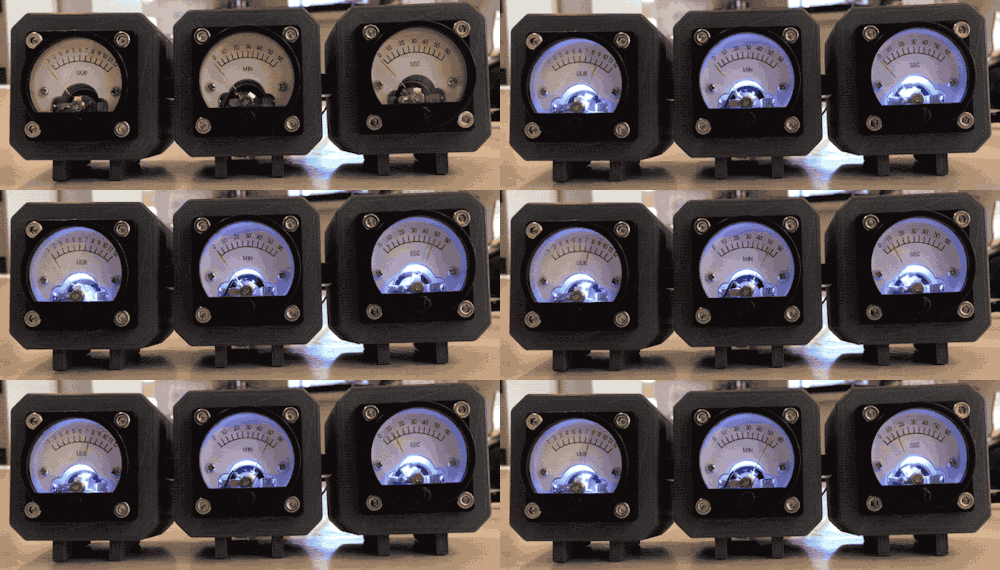
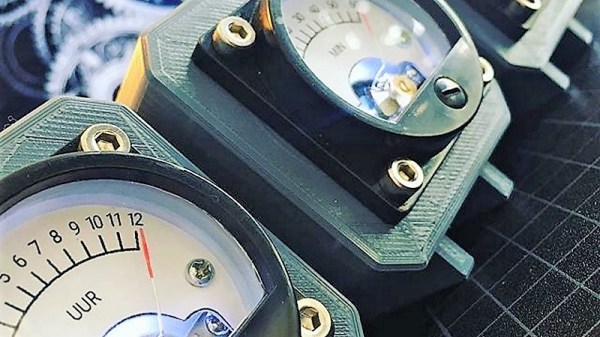
[Michael] had been mulling over a voltmeter clock, where hours, minutes and seconds are displayed on moving coil meters, for a while.  A trio of analog meters from Ali Express would lend just the right look to the project, but being 200-volt AC meters, they required a little modification. [Michael] removed the rectifying diode and filtering capacitor inside the movement, and replaced the current-limiting resistor with a smaller value to get 5 volts full-range deflection on the meters. Adobe Illustrator helped with replacing the original scales with time scales, and LEDs were added to the meters for backlighting. A TinyRTC keeps time and generates the three PWM signals to drive the meters. Each meter is mounted in its own 3D-printed case, the three of which are linked together into one sleek console. We love the look, which reminds us of an instrument cluster in an airplane cockpit.

Bravo to [Michael’s Dad] for getting his son into the tinkering arts, and cheers to [Michael] on the nice build. We like seeing new uses for old meters, like these server performance monitoring meters.

[via r/DIY]

Festo BionicFinWave underwater robot

[Festo]’s Underwater Robot Uses Body-Length Fins

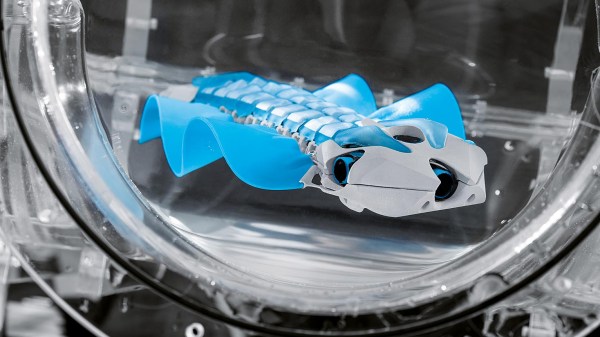
[Festo] have come up with yet another amazing robot, a swimming one this time with an elegant propulsion mechanism. They call it the BionicFinWave. Two fins on either side almost a body-length long create a wave which pushes water backward, making the robot move forward. It’s modeled after such fish as the cuttlefish and the Nile perch.

The BionicFinWave's fin mechanismWhat was their elegant solution for making the fins undulate? Nine lever arms are attached to each fin. Those lever arms are controlled by two crankshafts which extend from the front of the body to the rear, one for each side. A servo motor then turns each crankshaft. Since the crankshafts are independent, that means each fin operates independently. This allows for turning by having one fin move faster than the other. A third motor in the head flexes the body, causing the robot to swim up or down.

There’s also a pressure sensor and an ultrasonic sensor in the head for depth control and avoiding objects and walls. While these allow it to swim autonomously in its acrylic, tubular track, there is wireless communication for recording sensor data. Watch it in the video below as it effortlessly swims around its track.

[Festo] has created a lot of these marvels over the years. We’ve previously covered their bionic hopping kangaroo (we kid you not), their robot ants with circuitry printed on their exoskeleton, and perhaps the most realistic flapping robotic bird ever made.

Continue reading “[Festo]’s Underwater Robot Uses Body-Length Fins”

Computers Go Hollywood

Have you ever been watching a TV show or a movie and spotted a familiar computer? [James Carter] did and he created a website to help you identify which old computers appear in TV shows and movies. We came across this when researching another post about an old computer and wondered if it was any old movies. It wasn’t.

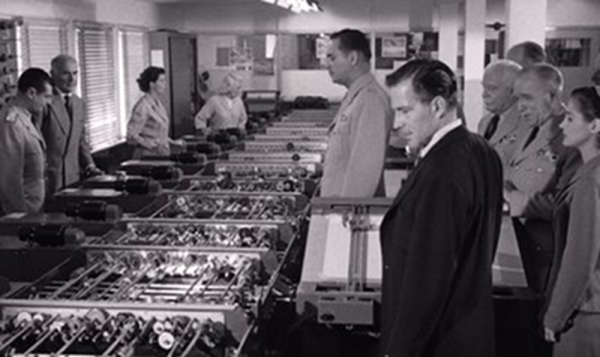
You can search by computer or by title. There are also ratings about how visible, realistic, and important the computer is for each item. The database only contains fictional works, not commercials or documentaries. The oldest entry we could find was 1950’s Destination Moon which starred a GE Differential Analyzer. Well, also John Archer, we suppose. We assume GE had a good agent as the same computer showed up in Earth vs. the Flying Saucers (1956) and When Worlds Collide (1951). You can see a clip of the computer’s appearance in Earth vs. the Flying Saucers, below.

Continue reading “Computers Go Hollywood”

Is It A Golden Gun If It’s Made Out Of Brass?

On today’s episode of ‘this is a really neat video that will soon be demonetized by YouTube’ comes this fantastic build from [John]. It is the Golden Gun, or at least it looks like a Golden Gun because it’s made out of melted down brass casings. It’s a masterclass demonstration of melting stuff down and turning a thirteen-pound blob of metal into a two-pound precision machined instrument.

This build began by simply cutting a wooden block, packing it in sand, and melting approximately 1425 shell casings of various calibers in a DIY furnace. The molten brass was then simply poured into the open mold. This is standard yellow brass, with about 70% copper and 30% zinc. There’s a bit of aluminum in there from the primers, and the resulting block isn’t terribly great for machining. [John] says this could be fixed by adding a few percent of lead to the melt. To all the jokesters suggesting he add some unfired bullets to the melt, don’t worry, we already have that covered.

chiseling a hole square, with a chisel.

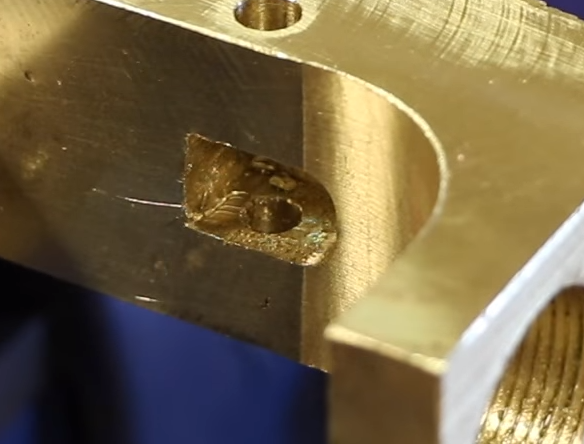
The machining went as you would expect it would with a large mill, but there are a few things that made this entire video worthwhile. For some of the holes, [John] had to square up the corners. The simplest and easiest way to do this is to break out a file. This is brass, though, and with some steel chisels hanging around the shop your mortise and tenon skills might come in handy. With the very careful application of force, [John] managed to put corners on a circle with a standard wood chisel. A bit later in the build video, a few more sharp corners were created by shoving a broach in the mill and jamming it down into the work.

When it comes to machining builds, this is high art. Yes, it’s the same as building an AR-15 out of a few hundred soda cans, but this one is made out of brass. It looks just great, and that final polish turns the entire project into something that looks like it’s out of a video game. Simply amazing.

If you’re looking for more ways to push your metalwork boundaries, give cast iron a try!

Continue reading “Is It A Golden Gun If It’s Made Out Of Brass?”

Simple Camera Slider Adds A Dimension Or Two To Your Shots

Camera sliders are a popular build, and properly executed they can make for impressive shots for both time-lapse sequences or real-time action. But they seem best suited for long shots, as dollying a camera in a straight line just moves subjects close to the camera through the frame.

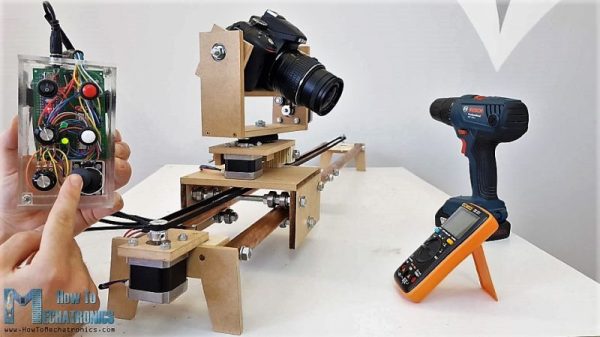
This slider with both pan and tilt axes can make moving close-ups a lot easier. With his extremely detailed build log, [Dejan Nedalkovski] shows how he went about building his with only the simplest of materials and tools. The linear rail is simply a couple of pieces of copper pipe supported by an MDF frame. The camera trolley rides the rails on common skateboard bearings and is driven by a NEMA-17 stepper, as are the pan and tilt axes. [Dejan] also provided a barn-door style pivot to tilt the camera relative to the rails, allowing the camera to slide up and down an inclined plane for really interesting shots. The controller uses an Arduino and a joystick to drive the camera manually, or the rig can be programmed to move smoothly between preset points.

This is a step beyond a simple slider and feels a little more like full-blown motion control. We’ve got a feeling some pretty dramatic shots would be possible with such a rig, and the fact that it’s a simple build is just icing on the cake.

Continue reading “Simple Camera Slider Adds A Dimension Or Two To Your Shots”