A DIY EMC Probe From Semi-Rigid Coax And An SDR

Do you have an EMC probe in your toolkit? Probably not, unless you’re in the business of electromagnetic compatibility testing or getting a product ready for the regulatory compliance process. Usually such probes are used in anechoic chambers and connected to sophisticated gear like spectrum analyzers – expensive stuff. But there are ways to probe the electromagnetic mysteries of your projects on the cheap, as this DIY EMC testing setup proves.

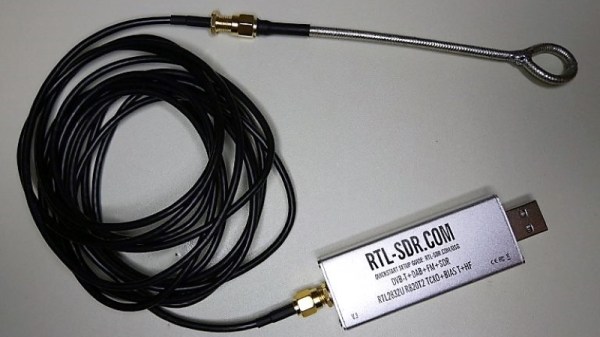
As with many projects, [dimtass]’ build was inspired by a video over on EEVblog, where [Dave] made a simple EMC probe from a length of semi-rigid coax cable. At $10, it’s a cheap solution, but lacking a spectrum analyzer like the one that [Dave] plugged his cheap probe into, [dimtass] went a different way. With the homemade probe plugged into an RTL-SDR dongle and SDR# running on a PC, [dimtass] was able to get a decent approximation of a spectrum analyzer, at least when tested against a 10-MHz oven-controlled crystal oscillator. It’s not the same thing as a dedicated spectrum analyzer – limited bandwidth, higher noise, and not calibrated – but it works well enough, and as [dimtass] points out, infinitely hackable through the SDR# API. The probe even works decently when plugged right into a DSO with the FFT function running.

Again, neither of these setups is a substitute for proper EMC testing, but it’ll probably do for the home gamer. If you want to check out the lengths the pros go through to make sure their products don’t spew signals, check out [Jenny]’s overview of the EMC testing process.

[via RTL-SDR.com]
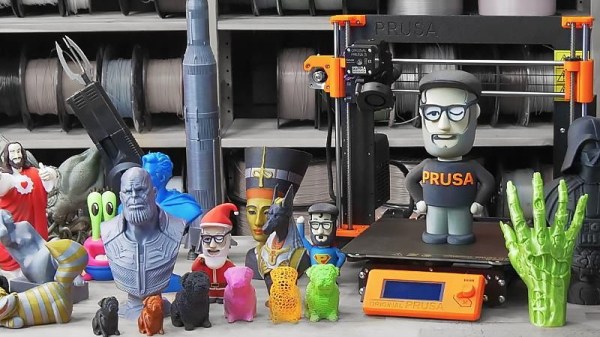
Prusa Launches Their Own 3D Model Repository

If you own a 3D printer, you’ve heard of Thingiverse. The MakerBot-operated site has been the de facto model repository for 3D printable models since the dawn of desktop 3D printing, but over the years it’s fallen into a state of disrepair. Dated and plagued with performance issues, many in the community have been wondering how long MakerBot is still going to pay to keep the lights on. Alternatives have popped up occasionally, but so far none of them have been able to amass a large enough userbase to offer any sort of real competition.

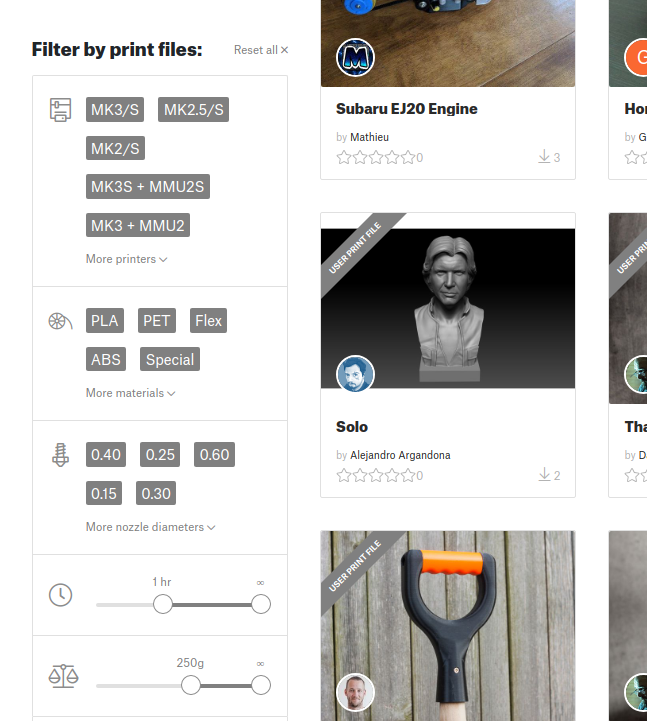
Sorting models by print time and material required.

But that might soon change. [Josef Průša] has announced a revamped community for owners of his 3D printers which includes a brand-new model repository. While clearly geared towards owners of Prusa FDM printers (support for the new SLA printer is coming at a later date), the repository is not exclusive to them. The immense popularity of Prusa’s products, plus the fact that the repository launched with a selection of models created by well known designers, might be enough to finally give Thingiverse a run for its money. Even if it just convinces MakerBot to make some improvements to their own service, it would be a win for the community.

The pessimists out there will say a Prusa-run model database is ultimately not far off from one where MakerBot is pulling the strings; and indeed, a model repository that wasn’t tied to a particular 3D printer manufacturer would be ideal. But given the passion for open development demonstrated by [Josef] and his eponymous company, we’re willing to bet that the site is never going to keep owners of other printers from joining in on the fun.

That being said, knowing that the users of your repository have the same printer (or a variant, at least) as those providing the designs does have its benefits. It allows for some neat tricks like being able to sort designs by their estimated print time, and even offers the ability to upload and download pre-sliced GCode files in place of traditional STLs. In fact, [Josef] boasts that this is the world’s only repository for ready-to-print GCode that you can just drop onto an SD card and print.

Regular Hackaday readers will know that we’ve been rather critical of the decisions made by MakerBot over the last few years, but to be fair we aren’t exactly alone in that respect. The community desperately needs a repository for printable models that’s in somebody else’s hands, and frankly we’re thrilled with the idea it could be [Josef Průša] leading the charge. His printers might not be perfect, and they certainly aren’t cheap, but they definitely don’t fail to impress. Here’s hoping this latest venture will be the same.

Continue reading “Prusa Launches Their Own 3D Model Repository”

Give Your Solar Garden Lights A Color Changing LED Upgrade

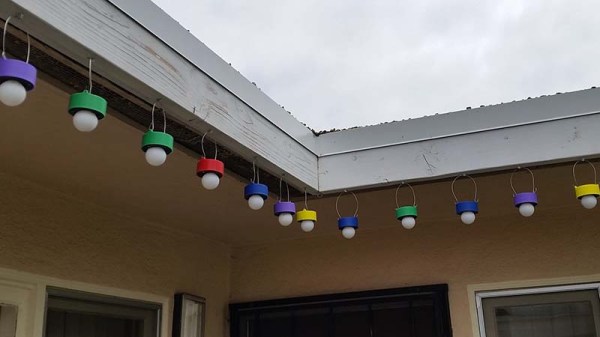
White LEDs were the technological breakthrough that changed the world of lighting, now they are everywhere. There’s no better sign of their cost-effective ubiquity than the dollar store solar garden light: a complete unit integrating a white LED with its solar cell and battery storage. Not content with boring white lights on the ground, [Emily] decided to switch up their colors with a mix of single-color LEDs and dynamic color-changing LEDs, then hung them up high as colorful solar ornaments.

The heart of these solar devices is a YX8018 chip (or one of its competitors.) While the sun is shining, solar power is directed to charge up the battery. Once the solar cell stops producing power, presumably because the sun has gone down, the chip starts acting as a boost converter (“Joule thief”) pushing a single cell battery voltage up high enough to drive its white LED. Changing that LED over to a single color LED is pretty straightforward, but a color changing LED adds a bit of challenge. The boost converter deliver power in pulses that are too fast for human eyes to pick up but the time between power pulses is long enough to cause a color-changing circuit to reset itself and never get beyond its boot-up color.

The hack to keep a color-changing LED’s cycle going is to add a capacitor to retain some charge between pulses, and a diode to prevent that charge from draining back into the rest of the circuit. A ping-pong ball serves as light diffuser, and the whole thing is hung up using a 3D-printed sheath which adds its own splash of color.

Solar garden lights are great basis for a cheap and easy introduction to electronics hacking. We’ve seen them turn into LED throwies, into a usable flashlight, or even to power an ATTiny microcontroller.

Continue reading “Give Your Solar Garden Lights A Color Changing LED Upgrade”

GPS Self-Adjusting Clock With An E-Ink Display

If you mention a clock that receives its time via radio, most people will think of one taking a long wave signal from a station such as WWVB, MSF, or DCF77. A more recent trend however has been for clocks that set themselves from orbiting navigation satellites, and an example comes to us from [KK99].  It’s a relatively simple hardware build in that it is simply an Arduino Nano, GPS module, and e-ink display module wired together, but it provides an interesting exercise in running through the code required for a GPS clock.

It does however give us a chance to remember the story from last year surrounding WWVB, as a budget proposal last year mooted the prospect of the closure of the Fort-Collins-based time signal transmitter. Were that to happen an estimated 50 million American clocks would lose their reference, and while their owners could always update them manually, there will always be time-based systems to which that won’t be applied for whatever reason.  Europeans meanwhile are safe in their time transmissions for now , but in case they think they have their mains grid to fall back on it’s worth remembering the time they lost six seconds.

GPS satellite image: USAF [Public domain].

Radio Piracy On The High Seas: Commercial Demand For Taboo Music

The true story of pirate radio is a complicated fight over the airwaves. Maybe you have a picture in your mind of some kid in his mom’s basement playing records, but the pirate stations we are thinking about — Radio Caroline and Radio Northsea International — were major business operations. They were perfectly ordinary radio stations except they operated from ships at sea to avoid falling under the jurisdiction of a particular government.

Back then many governments were not particularly fond of rock music. People wanted it though, and because people did, advertisers wanted to capitalize on it. When people want to spend money but can’t, entrepreneurs will find a way to deliver what is desired. That’s exactly what happened.

Of course, if that’s all there was to it, this wouldn’t be interesting. But the story is one of intrigue with armed boardings, distress calls interrupting music programs, and fire bombings. Most radio stations don’t have to deal with those events. Surprisingly, at least one of these iconic stations is still around — in a manner of speaking, anyway.

Continue reading “Radio Piracy On The High Seas: Commercial Demand For Taboo Music”

Power Measurement Oscilloscope Style

If you want to measure voltage you reach for a voltmeter. Current? An ammeter. Resistance? An ohmmeter. But what about measuring AC power? A watt meter? Usually. But if you know what to do, you could also reach for your oscilloscope. If you don’t know what to do, [Jim Pytel] has the video answers for you. Truth is, an oscilloscope can measure almost anything if you know how. [Jim] shows how to measure the voltage and current in a circuit and then it is simply a matter of doing a little math, something modern scopes can do very easily.

We like that [Jim] shows a circuit and how the math works before he verifies the math with the scope. Of course, theory doesn’t always match practice. The method uses a small current-sensing resistor that throws readings off a bit. The scope and signal generator are not perfect, either. However, the results match up pretty nicely with the computed results.

Continue reading “Power Measurement Oscilloscope Style”

3D Printering: The Quest For Printable Food

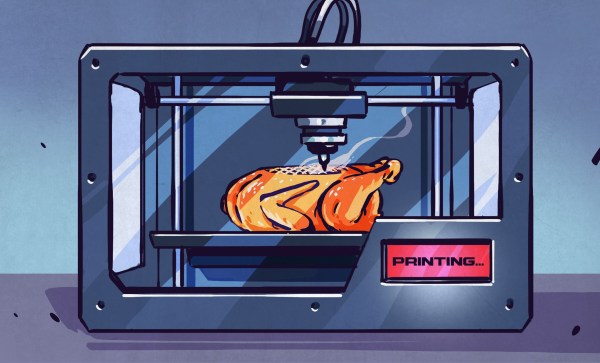
A video has been making the rounds on social media recently that shows a 3D printed “steak” developed by a company called NovaMeat. In the short clip, a machine can be seen extruding a paste made of ingredients such as peas and seaweed into a shape not entirely unlike that of a boot sole, which gets briefly fried in a pan. Slices of this futuristic foodstuff are then fed to passerby in an effort to prove it’s actually edible. Nobody spits it out while the cameras are rolling, but the look on their faces could perhaps best be interpreted as resigned politeness. Yes, you can eat it. But you could eat a real boot sole too if you cooked it long enough.

To be fair, the goals of NovaMeat are certainly noble. Founder and CEO Giuseppe Scionti says that we need to develop new sustainable food sources to combat the environmental cost of our current livestock system, and he believes meat alternatives like his 3D printed steak could be the answer. Indeed, finding ways to reduce the consumption of meat would be a net positive for the environment, but it seems his team has a long way to go before the average meat-eater would be tempted by the objects extruded from his machine.

But the NovaMeat team aren’t the first to attempt coaxing food out of a modified 3D printer, not by a long shot. They’re simply the most recent addition to a surprisingly long list of individuals and entities, not least of which the United States military, that have looked into the concept. Ultimately, they’ve been after the same thing that convinced many hackers and makers to buy their own desktop 3D printer: the ability to produce something to the maker’s exacting specifications. A machine that could produce food with the precise flavors and textures specified would in essence be the ultimate chef, but of course, it’s far easier said than done.

Continue reading “3D Printering: The Quest For Printable Food”