This Infinity Dodecahedron Build Shows All The Tricks

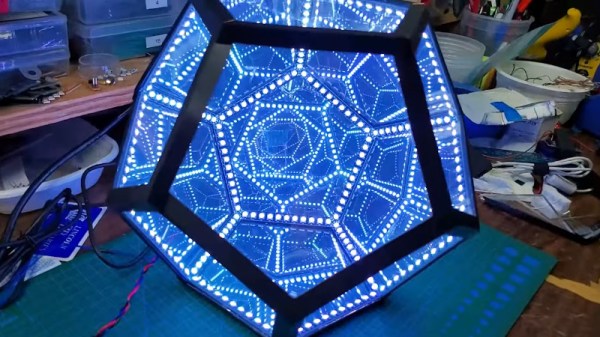
The infinity dodecahedron is one of those super eye-catching builds that many of us hardware hackers have on our ‘build one day’ project list. The very thought of actually doing it strikes a little fear into the heart of even the most intrepid maker, once you start to think about all the intricate little details and associated ways it could all go horribly wrong. Luckily for us, [Hari Wiguna] has documented his latest build as a long video build log, showing lots of neat tricks and highlighting many problems along the way. With the eventual goal of removing many of the issues that make such a build tricky, [Hari] hopes to make it practically easy. Let’s see how that turns out!

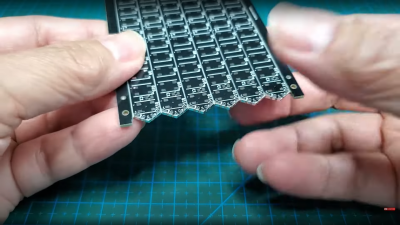
HASL-finished castellated (half hole) edge contacts make butt-jointing a breeze

A common route for such a build relies on appropriately shaped 3D printed frame parts, with some kind of clear plastic for the 12 faces, and LED strips stuck to the inside of each of the 30 edges. Whilst this works, [Hari] thought he could do a bit better, using butt-jointed PCBs as the frame material.

The PCBs handily double up as something to solder LEDs onto (because that’s what PCBs are mostly intended for!) as well as a way to pass power and data signals around the frame in a minimally visible way. As will become obvious from the lengthy discussion in the video, a few simple tricks here and there are needed to make this strategy work. With the recent proliferation of PCB modules using castellated edges for termination, the usual Chinese PCB fab services have all started offering very good value services for this feature. Once a PCB feature that was a specialized (read that as ‘expensive’) offering, it is now quite affordable on your average maker’s budget.

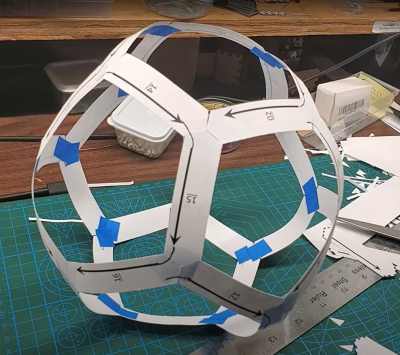
Data path planning? Just use paper and tape!

One immediate practical issue was how to pass the data connection around from edge to edge, given that there are three edges per vertex. The solution [Hari] came up with was simple, just duplicate the signals on each end of the PCB, so the data out signal can be tapped from either end, as required.

Even with 3D printed jigs to hold the PCBs at just the right angles, there’s still some wiggle and a little risk of edges not quite aligning, due to accumulated errors around the frame. It did come together in the end, with the expected spectacular visuals. We’re sure many of you will be waiting for [Hari] to release the next version of the design to the community, hopefully with even more of the ease-of-build issues resolved, because we want one even more now.

Naturally, this is by no means the first infinity platonic solid we’ve seen, here’s a smaller one for starters. If you remove the mirrors and LEDs, then you’re just left with a plain old dodecahedron, like this cool folding project.

Continue reading “This Infinity Dodecahedron Build Shows All The Tricks”

Flux: A Forty Foot Long Kinetic Art Piece

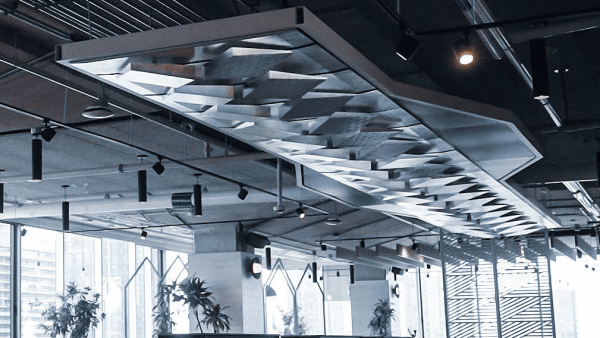
No office space is complete without some eye-catching art piece to gawp at whilst you mull over your latest problem. But LED-based displays are common enough to be boring these days. Kinetic art pieces are where it’s at, and this piece called Flux is a perfect example.

Commissioned for the Toronto office of a very popular e-commerce platform and constructed by [Nicholas Stedman], Flux consists of twenty identical planks on the ceiling, arranged in a line forty feet long. Each plank has a pair of rotating prisms, constructed from a stack of foam sheets, finished with metallic paint. The prisms are spun by individual stepper motors, each of which is driven by a TMC2160-based module, making them whisper-quiet.

A simple 3D printed bracket holds a small PCB holding an AMS AS5600 rotary magnetic encoder, onto the rear of the stepper motor. This allows for closed-loop feedback to the shared Arduino, which is very important for a sculpture such as this. Each Arduino is hooked up to a Raspberry Pi, running a simple application written in node.js which is responsible for coordinating movement, as well as uploading updated firmware images as required. A simple, but very effective build, we think!

Even more fun are kinetic art installations that are reactive to some data source, such as Adad, which visualizes lightning strike data. If these builds are just too big and complex, we’ve seen many examples of smaller desktop toys, such as this 3D printed tumbling chain demo for example.

Continue reading Flux: A Forty Foot Long Kinetic Art Piece”

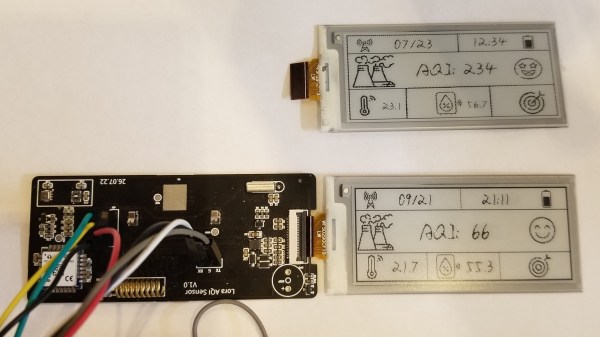
e-paper display showing hand-drawn fonts attached to a custom controller PCB

Recycling Junk E-tags Into A LoRaWAN AQI Sensor

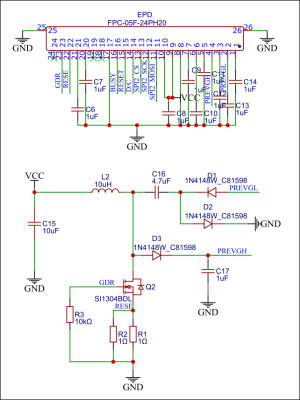
E-paper interfacing circuit is just a simple switched-mode power supply
Interfacing to E-paper displays is nothing to be scared of

[Aduecho] had seen those cheap eBay deals of e-paper-based pricing tags, and was wondering if they could be hacked to perform some other tasks. After splitting the case open, the controller chip was discovered to be a SEM9110, with some NFC hardware support but little else. [aduecho] was hoping to build some IoT-connected air quality indicator (AQI) units but the lack of a datasheet for SEM9110 plus no sensors in place meant the only real course of action was to junk the PCB and just keep the E-paper display and the batteries. These units appeared to be ‘new old’ stock, so there was a good chance that both would be fresh and ripe for picking.

The PCB [aduecho] came up with is mechanically the same as the original unit, but now sports a Seeed studio Wio-E5 LoRa module, which uses the STM32WLE5 from ST for the heavy lifting. This has what looks like a Semtech SX126x integrated on-die (we can’t think of a sane way an actual SX126x die could be flip-chip mounted, but you never know). Using this module is a snap, needing only very minimal antenna-matching components and a spot of decoupling to function. On the sensing side of things, a Bosch BME680 gas sensor handling the AQI measurements, and a Bosch BMI270 6-axis IMU, provides a gyro and accelerometer, for all those planned user interaction features. As can be seen from the schematic, interfacing the EPD is pretty straightforward, just a handful of parts are needed to generate the necessary bipolar gate voltages via a simple SMPS circuit. The display controller handles it all internally, programmed via an SPI interface.

One area we’re quite fond of in this project are the neat hand-drawn icons, and variable width font, giving the display a kind of note-like quality when drawn on the low-ish contrast e-paper display.

Air quality measurement projects grace these pages from time to time, like this hacked Ikea Vindriktning, and this very similar Wio-E5-based project we covered last month.

Hackaday Prize 2022: Solar Powered LoRa Weather Station For The Masses

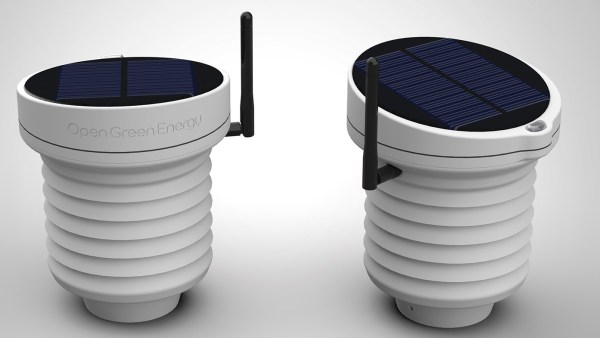
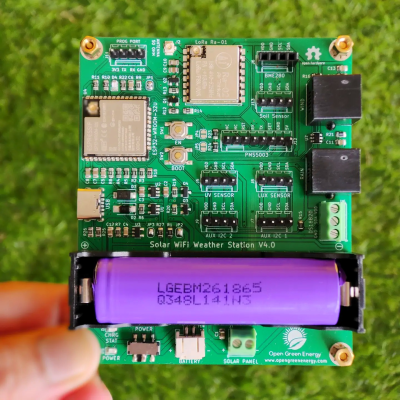
[Debasish Dutta] has designed a few weather stations in the past, and this, the fourth version of the system has had many of the feature requests from past users rolled in. The station is intended to be used with an external weather sensor unit, provided by Sparkfun. This handles wind speed and direction, as well as measuring rainfall. A custom PCB hosts an ESP32-WROOM module and an Ai-Thinker Ra-02 LoRa module for control and connectivity respectively. A PMS5003 sits on the PCB to measure those particulate densities, but most sensors are connected with simple 4-way I2C connectors. Temperature, humidity, and pressure are handled by a BME280 module, UV Index (SI1145), visible light (BH1750) even soil humidity and temperature with a cable-mounted SHT10 module.


All this is powered by a solar panel, which charges a 18650 cell, and keeps the show running during the darker hours. For debugging and deployment, a USB-C power port can also be used to provide charge. A 3D printed Stevenson screen type enclosure allows the air to circulate amongst the PCB-mounted sensor modules, without hopefully too much moisture making it in there to cause mischief.

On the data collection and visualization side, a companion LoRa receiver module is in progress, which is intended to pass along measurements to a variety of services. Think Home Assistant, ESP home, and that kind of thing. Software is still a work in progress, so maybe check back later to see how [Debasish] is getting on with that?

This kind of multi-sensor hosting project is nothing new here, here’s a 2019 Hackaday prize entry along the same lines. Of course, gathering and logging measurement data is only part of the problem, visualization of those measurements is also important. Why not use a mechanical approach, such as a diorama?

Cutting Metals With A Diode Laser?

Hobbyist-grade laser cutters can be a little restrictive as to the types and thicknesses of materials that they can cut. We’re usually talking about CO2 and diode-based machines here, and if you want to cut non-plastic sheets, you’re usually going to be looking towards natural materials such as leather, fabrics, and thin wood.

But what about metals? It’s a common beginner’s question, often asked with a resigned look, that they already know the answer is going to be a hard “no. ” However, YouTuber [Chad] decided to respond to some comments about the possibility of cutting metal sheets using a high-power diode laser, with a simple experiment to actually determine what the limits actually are.

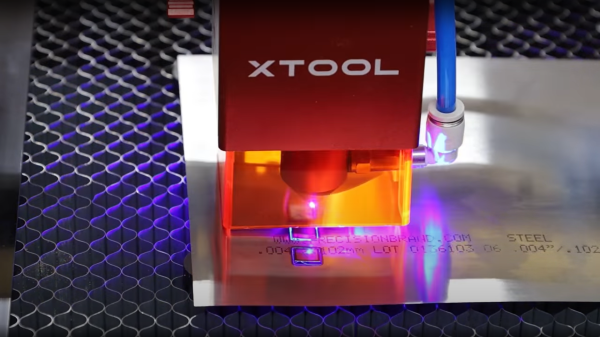
Using an XTool D1 Pro 20W as a testbed, [Chad] tried a variety of materials including mild steel, stainless, aluminium, and brass sheets at a variety of thicknesses. Steel shim sheets in thicknesses from one to eight-thousandths of an inch appeared to be perfectly cuttable, with an appropriate air assist and speed settings, with thicker sheets needing a good few passes. You can definitely see the effect of excess heat in the workpiece, resulting in some discoloration and noticeable warping, but those issues can be mitigated. Copper and aluminium weren’t touched by the beam at all, likely due to the extra reflectivity, but we do have to wonder if appropriate surface treatments could improve matters.

Obviously, we’ve seen that diode lasers can have an impact on metals, simply smearing a little mustard on the workpiece seems to make marking a snap. Whilst we’re on the subject of diode lasers, you can get a lot of mileage from just strapping such a laser module onto a desktop CNC.

Continue reading “Cutting Metals With A Diode Laser?”

A RPI HAT For Synchronized Measurements

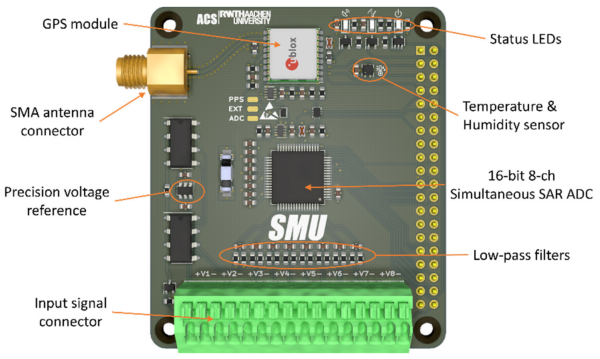
A team from the Institute for Automation of Complex Power System (ACS) at RWTH Aachen University have been working for a while on the analysis of widely distributed power systems. In a drive to move away from highly specialised (and expensive) electronics platforms, they have produced some instrumentation designed to operate with the Raspberry Pi platform, and an open source software stack. They call the platform the SMU (Synchronised Measurement Unit.) The SMU consists of a HAT sitting on an RPi3, inside a 3D printed box that is intended to attach to a DIN rail. After all, this is supposed to be an industrial platform.

Hardware wise, the star of the show is the Texas Instruments ADS8588S which is a 16-bit 8-channel simultaneous sampling ADC. This is quite a nice device, with 200 kSPS throughput and a per-channel programmable front end, packaged in a hacker-friendly 64-pin QFP. What makes this project interesting however, is how they solved the problem of controlling the sampled data acquisition and synchronisation.

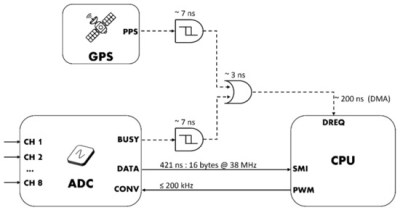
1-PPS and BUSY edges converted to levels, then OR’d to trigger the DMA

By programming the ADC into byte-parallel mode, then using the BCM2837 Secondary Memory Interface (SMI) block together with the DMA, samples are transferred into memory with minimal CPU overhead. An onboard U-Blox Max-M8 GNSS module provides a 1PPS (top of second pulse) signal, which is combined with the ADC busy signal in a very simple manner, enabling both sample rate control as well as synchronisation between multiple units spread out in an installation. They reckon they can get synchronisation to within 180 ns of top-of-second, which for measuring relatively slow-changing power systems, should be enough. The HAT PCB was created in KiCAD and can be found in the SMU GitHub hardware section, making it easy to modify to your needs, or at least adjust the design to match the parts you can actually get your hands on.

Continue reading “A RPI HAT For Synchronized Measurements”

Mokeylaser: A DIY Laser Engraver That You Can Easily Build

[Mark aka Mokey] borrowed his friend’s open-frame laser engraver for a while, and found it somewhat lacking in features and a bit too pricey for what it was. Naturally, he thought he could do better (video, embedded below.) After a spot of modelling in Fusion 360, and some online shopping at the usual places, he had all the parts needed to construct an X-Y bot, and we reckon it looks like a pretty good starting point. [Mark] had a Sainsmart FL55 5.5W laser module kicking around, so that was dropped into the build, together with the usual Arduino plus CNC shield combo running GRBL.

[Mark] has provided the full F360 source (see the mokeylaser GitHub) and a comprehensive bill-of-materials, weighing in at about $400, and based upon the usual 2040 aluminium extrusions. This makes MokeyLaser a reasonable starting point for further development. Future plans include upgrading the controller to something a bit more modern (and 32-bits) as well as a more powerful laser (we do hope he’s got some proper laser glasses!) and adding air assist. In our experience, air assist will definitely improve matters, clearing out the smoke from the beam path and increasing the penetration of the laser significantly. We think there is no need for more optical power (and greater risk) for this application. [Mark] says in the video that he’s working on an additional build video, so maybe come by later and check that out?

Obviously, MokeyLaser is by no means the only such beast we’ve featured, here’s the engravinator for starters. For even more minimalism, we covered a build with some smart optics doing all the work. But what if you don’t happen to have a 5W laser module “lying around” then perhaps try a more natural heat source instead?

Continue reading “Mokeylaser: A DIY Laser Engraver That You Can Easily Build”