[Tom Stanton] is right about one thing: flywheels make excellent playthings. Whether watching a spinning top that never seems to slow down, or feeling the weird forces a gyroscope exerts, spinning things are oddly satisfying. And putting a flywheel to work as a battery makes it even cooler.
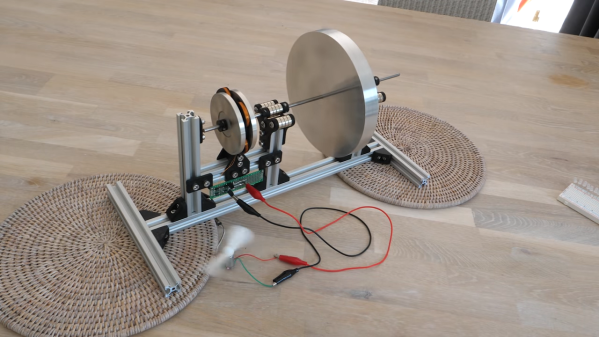
Of course, using a flywheel to store energy isn’t even close to being a new concept. But the principles [Tom] demonstrates in the video below, including the advantages of magnetically levitated bearings, are pretty cool to see all in one place. The flywheel itself is just a heavy aluminum disc on a shaft, with a pair of bearings on each side made of stacks of neodymium magnets. An additional low-friction thrust bearing at the end of the shaft keeps the systems suitably constrained, and allows the flywheel to spin for twelve minutes or more.
[Tom]’s next step was to harness some of the flywheel’s angular momentum to make electricity. He built a pair of rotors carrying more magnets, with a stator of custom-wound coils sandwiched between. A full-wave bridge rectifier and a capacitor complete the circuit and allow the flywheel to power a bunch of LEDs or even a small motor. The whole thing is nicely built and looks like a fun desk toy.
Especially over the last year and a half, most of us have gotten the feeling that there’s precious little distinction between our computers and ourselves. We seem welded together, inseparable even, attached as we are day and night to our machines as work life and home life blend into one gray, featureless landscape where time passes unmarked except by the accumulation of food wrappers and drink cans around our work areas. Or maybe it just seems that way.
Regardless, there actually is a fine line between machine and operator, and in most instances it’s that electromechanical accessory that we all love to hate: the keyboard. If you buy off the shelf, it’s never quite right — too clicky, not clicky enough, wrong spacing, bad ergonomics, or just plain ugly design. The only real way around these limitations is to join the DIY keyboard crowd and roll your own, specifically customized to your fingers and your needs — at least until you realize that it’s not quite perfect, and need to modify it again.
Hitting this moving target is often as much a software problem as it is a hardware issue, but as is increasingly the case these days, Python is ready to help. To go into depth on how Python can be leveraged for the custom keyboard builder, our good friends at Adafruit, including Limor “Ladyada” Fried, Phillip Torrone, Dan Halbert, Kattni Rembor, and Scott Shawcroft will stop by the Hack Chat. We suspect they’ll have some cool stuff to show off, in addition to sharing their tips and tricks for making DIY keyboards just right. If you’re building custom keebs, or even if you’re just “keyboard curious”, you won’t want to miss this one.
Tell the world that something is in short supply, and you can bet that people will start reacting to that news in the ways that make the most sense to them — remember the toilet paper shortage? It’s the same with the ongoing semiconductor pinch, except that since the item in short supply is (arguably) more valuable than toilet paper, the behavior and the risks people are willing to take around it are even more extreme. Sure, we’ve seen chip hoarding, and a marked rise in counterfeit chips. But we’d imagine that this is the first time we’ve seen chip smuggling quite like this. The smuggler was caught at the Hong Kong-Macao border with 256 Core i7 and i9 processors, valued at about $123,000, strapped to his legs and chest. It reminds us more of “Midnight Express”-style heroin smuggling, although we have to say we love the fact that this guy chose a power of 2 when strapping these babies on.
Speaking of big money, let’s say you’ve pulled off a few chip heists without getting caught, and have retired from the smuggling business. What is one to do with the ill-gotten gains? Apparently, there’s a big boom in artifacts from the early days of console gaming, so you might want to start spreading some money around there. But you’d better prepare to smuggle a lot of chips: last week, an unopened Legend of Zelda cartridge for the NES sold for $870,000 at auction. Not to be outdone, two days later someone actually paid $1.56 million for a Super Mario 64 cartridge, this time apparently still in the tamperproof container that displayed it on a shelf somewhere in 1996. Nostalgia can be an expensive drug.
And it’s not just video games that are commanding high prices these days. If you’ve got a spare quarter million or so, why not bid on this real Apollo Guidance Computer and DSKY? The AGC is a non-flown machine that was installed in LTA-8, the “lunar test article” version of the Landing Module (LM) that was used for vacuum testing. If the photos in the auction listing seem familiar, it’s with good reason: this is the same AGC that was restored to operating condition by Carl Claunch, Mike Stewart, Ken Shiriff, and Marc Verdiell. Sotheby’s estimates the value at $200,000 to $300,000; in a world of billionaire megalomaniacs with dreams of space empires, we wouldn’t be surprised if a working AGC went for much, much more than that.
Meanwhile, current day space exploration is going swimmingly. Just this week NASA got the Hubble Space Telescope back online, which is great news for astronomers. And on Mars, the Ingenuity helicopter just keeps on delivering during its “operations demonstration” mission. Originally just supposed to be a technology demonstration, Ingenuity has proven to be a useful companion to the Perseverance rover, scouting out locations of interest to explore or areas of hazard to avoid. On the helicopter’s recent ninth flight, it scouted a dune field for the team, providing photographs that showed the area would be too dangerous for the rover to cross. The rover’s on-board navigation system isn’t great at seeing sand dunes, so Ingenuity’s images are a real boon to mission planners, not to mention geologists and astrobiologists, who are seeing promising areas of the ancient lakebed to explore.
And finally, most of us know all too well how audio feedback works, and all the occasions to avoid it. But what about video feedback? What happens when you point a camera that a screen displaying the image from the camera? Fractals are what happens, or at least something that looks a lot like fractals. Code Parade has been playing with what he calls “analog fractals”, which are generated just by video feedback and not by computational means. While he’d prefer to do this old school with analog video equipment, it easy enough to replicate on a computer; he even has a web page that lets you arrange a series of virtual monitors on your screen. Point a webcam at the screen, and you’re off on a fractal journey that constantly changes and shifts. Give it a try.
Say what you want about Soviet technology, but you’ve got to admit there was a certain style to Cold War-era electronics. Things were perhaps not as streamlined and sleek as their Western equivalents, but then again, just look at the Nixie tube craze to see where collectors and enthusiasts stand on that comparison.
One particularly interesting artifact from the later part of that era was the lovely Elektronika MK-52 “microcalculator”. [Paul Hoets] has done a careful but thorough teardown of a fine example of this late-80s machine. The programmable calculator was obviously geared toward scientific and engineering users, but [Paul] relates how later versions of it were also used by the financial community to root out banking fraud and even had built-in cryptographic functions, which made encrypting text easy.
[Paul] has put together a video of the teardown, detailing the mostly through-hole construction and the interesting use of a daughter-board, which appears to hold the high-voltage section needed to drive the 11-character VFD tube. The calculator appears to be very well cared for, and once reassembled looks like it would be up for another ride on a Soyuz, where once it served as a backup for landing calculations.
We love the look of this machine and appreciate [Paul]’s teardown and analysis. But you say that the Cyrillic keyboard has you stumped and you need a bilingual version of the MK-52? That’s not a problem.
Good news this morning from low Earth orbit, where the Hubble Space Telescope is back online after a long and worrisome month of inactivity following a glitch with the observatory’s payload computer.
We recently covered the Hubble payload computer in some depth; at the time, NASA was still very much in the diagnosis phase of the recovery, and had yet to determine a root cause. But the investigation was pointing to one of two possible culprits: the Command Unit/Science Data Formatter (CU/SDF), the module that interfaces the various science instruments, or the Power Control Unit (PCU), which provides regulated power for everything in the payload computer, more verbosely known as the SI C&DH, or Scientific Instrument Command and Data Handling Unit.
In the two weeks since that report, NASA made slow but steady progress, methodically testing every aspect of the SI C&DH. It wasn’t until just two days ago, on July 14, that NASA made a solid determination on root cause: the Power Control Unit, or more specifically, the power supply protection circuit on the PCU’s 5-volt rail. The circuit is designed to monitor the rail for undervoltage or overvoltage conditions, and to order the SI C&DH to shut down if the voltage is out of spec. It’s not entirely clear whether the PCU is actually putting out something other than 5 volts, or if the protection circuit has perhaps degraded since the entire SI C&DH was replaced in the last service mission in 2009. But either way, the fix is the same: switch to the backup PCU, a step that was carefully planned out and executed on July 15th.
To their credit, the agency took pains that everyone involved would be free from any sense of pressure to rush a fix — the 30-year-old spacecraft was stable, its instruments were all safely shut down, and so the imperative was to fix the problem without causing any collateral damage, or taking a step that couldn’t be undone. And further kudos go to NASA for transparency — the web page detailing their efforts to save Hubble reads almost like a build log on one of our projects.
There’s still quite a bit of work to be done to get Hubble back into business — the science instruments have to be woken up and checked out, for instance — but if all goes well, we should see science data start flowing back from the space telescope soon. It’s a relief that NASA was able to pull this fix off, but the fact that Hubble is down to its last backup is a reminder Hubble’s days are numbered, and that the best way to honor the feats of engineering derring-do that saved Hubble this time and many times before is to keep doing great science for as long as possible.
As expensive as a new car is, it almost seems like a loss leader now to get you locked into exorbitantly expensive repairs at the dealership’s service department. That’s the reason a lot of us still try to do as much of the maintenance and repairs on our cars as possible — it’s just too darn expensive to pay someone else to do it.
Case in point: this story about a hapless Tesla owner who faced a massive repair bill on his brand new car. [Donald]’s tale of woe began when he hit some road debris with his two-wheel-drive Model 3. The object hit penetrated the plastic shield over the front of the battery pack, striking a fitting in the low-pressure battery cooling plumbing. The plastic fitting cracked, causing a leak that obviously needed repair. The authorized Tesla service center gave him the bad news: that he needed a new battery pack, at a cost of $16,000. Through a series of oversights, [Donald]’s comprehensive insurance on the car had lapsed, so he was looking at funding the repair, approximately half the cost of a new Model 3, out of pocket.
Luckily, he got in touch with [Rich Benoit] of The Electrified Garage, one of the few independent garages doing Tesla repairs and customizations. The video below is queued up to the part where they actually do the repair, which is ridiculously simple. After cutting off the remains of the broken fitting with a utility knife, [Rich]’s tech was able to cut a thread in both the fitting and the battery pack, and attach them together with a brass nipple from the plumbing section of the local home store. The total bill for the repair was $700, which still seems steep to us, but a far cry from what it could have been.
Hats off to [Rich] and his crew for finding a cost-effective workaround for this issue. And if you think you’ve seen his EV repairs before, you’re right. Of course, some repairs are more successful than others.
We’ve all seen electronic components that have been coaxed into releasing their small amount of Magic Smoke, which of course is what makes the thing work in the first place. But back in the old times, parts were made of glass and metal and were much tougher — you could do almost anything to them and they wouldn’t release the Magic Smoke. It was very boring.
Unless you knew the secret of “red plating”, of course, which [David Lovett] explores in the video below. We’ve been following [David]’s work with vacuum tubes, the aforementioned essentially smokeless components that he’s putting to use to build a simple one-bit microprocessor. His circuits tend to drive tubes rather gently, but in a fun twist, he let his destructive side out for a bit and really pushed a few tubes to see what happens. And what happens is pretty dramatic — when enough electrons stream from the cathode to the anode, their collective kinetic energy heats the plate up to a cherry-red, hence the term “red plating”.
[David] selected a number of victims for his torture chamber, not all of which cooperated despite the roughly 195 volts applied to the plate. Some of the tubes, though, cooperated in spades, quickly taking on a very unhealthy glow. One tube, a 6BZ7 dual triode, really put on a show, with something getting so hot inside the tube as to warp and short together, leading to some impressive pyrotechnics. Think of it as releasing the Magic Light instead of the Magic Smoke.
Having seen how X-ray tubes work, we can’t help but wonder if [David] was getting a little bit more than he bargained for when he made this snuff film. Probably not — the energies involved with medical X-ray tubes are much higher than this — but still, it might be interesting to see what kinds of unintended emissions red-plating generates.