Test Unknown Fuses Without Destroying Them

There’s a problem with fuses. On the face of it, testing would seem to be a one-shot deal — exceed the rated current and see if it blows. But once you know the answer, the device is useless. If only there were a way to test fuses without damaging them.

As it turns out there is, and [Kerry Wong] weaves quite a tale about his attempts to non-destructively test fuses. The fuses in question are nothing fancy — just the standard glass tube type, from a cheap assortment kit off Amazon. Therein lies the problem: can such cheap devices be trusted? Finding out requires diving much deeper into the technology of fuses than many people will have done, including understanding how the thermal and electrical characteristics of the fuse element behave.

[Kerry]’s test setup is simple, consisting of a constant current power supply and a voltmeter across the fuse to measure the voltage drop caused by the resistance of the fuse element. As he ramps up the current, the voltage drop increases linearly due to the increase in resistance of the alloy with increasing temperature. That only lasts up to a point, where the fuse resistance starts increasing exponentially. Pushing much past the point where the resistance has doubled would blow the fuse, so that’s the endpoint of his tests. Perhaps unsurprisingly, his no-name fuses all went significantly beyond their rated current, proving that you get what you pay for. See the video below for the tests and an analysis of the results.

It’s handy to know there’s a way to check fuses without popping them, and we’ll file this one away for future reference. Don’t forget that you should always check the fuse when troubleshooting, because you never know what the last person did to it.

Continue reading “Test Unknown Fuses Without Destroying Them”

Hackaday Links Column Banner

Hackaday Links: April 19, 2020

While the COVID-19 pandemic at least seems to be on a downward track, the dystopian aspects of the response to the disease appear to be on the rise. As if there weren’t enough busybodies and bluenoses shaming their neighbors for real or imagined quarantine violations on social media, now we have the rise of social-distancing enforcement drones. These have been in use in hot zones around the world, of course, but have only recently arrived in the US. From New Jersey to Florida, drones are buzzing about in search of people not cowering in fear in their homes and blaring messages about how they face fines and arrest for seeking a little fresh air and sunshine. We’re all in favor of minimizing contact with potentially infected people, but it seems like these methods might be taking things a bit too far.

If you somehow find yourself with some spare time and want to increase your knowledge, or at least expand your virtual library, Springer Publishing has some exciting news for you. The journal and textbook publisher has made over 400 ebook titles available for free download. We had a quick scan over the list, and while the books run the gamut from social sciences to astrophysics, there are plenty of titles that are right in the wheelhouse of most Hackaday readers. There are books on power electronics, semiconductor physics, and artificial intelligence, as well as tons more. They all seem to be recent titles, so the information isn’t likely to be too dated. Give the list a once-over and happy downloading.

Out of all the people on this planet, the three with the least chance of being infected with SARS-CoV-2 blasted off from Kazakhstan this week on Soyuz MS-16 to meet up with the ISS. The long-quarantined crew of Anatoly Ivanishin, Ivan Vagner, and Chris Cassidy swapped places with the Expedition 62 crew, who returned to Earth safely in the Soyuz MS-15 vehicle. It’s a strange new world they return to, and we wish them and their ISS colleagues all the best. What struck us most about this mission, though, was some apparently surreptitiously obtained footage of the launch from a remarkably dangerous position. We saw some analysis of the footage, and based on the sound delay the camera was perhaps as close as 150 meters to the launchpad. It’s hard to say if the astronauts or the camera operator was braver.

And finally, because neatness counts, we got this great tip on making your breadboard jumpers perfectly straight. There’s something satisfying about breadboard circuits where the jumpers are straight and exactly the length the need to be, and John Martin’s method is so simple you can’t help but use it. He just rolls the stripped jumpers between his bench and something flat; he uses a Post-it note pad but just about anything will do. The result is satisfyingly straight jumpers, ready to be bent and inserted. We bet this method could be modified to work with the stiffer wire normally used in circuit sculptures like those of Mohit Bhoite; he went into some depth about his methods during his Supercon talk last year, and it’s worth watching if you haven’t seen it yet.

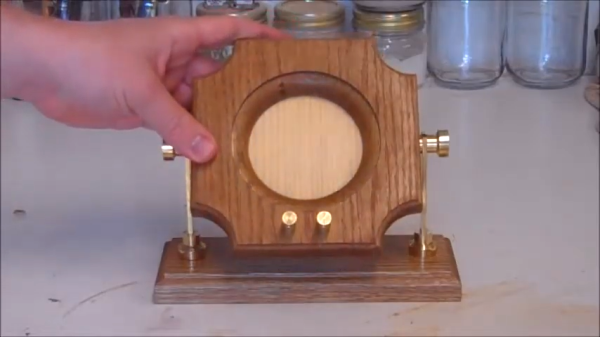
Wood And Carbon Rods Used For This Handsome And Effective Microphone

Anyone who was active in the phreaking scene or was even the least bit curious about the phone system back in the Ma Bell days no doubt remembers the carbon capsule microphone in the mouthpiece of many telephone handsets. With carbon granules sandwiched between a diaphragm and a metal plate, they were essentially sound-driven variable resistors, and they worked well enough to be the standard microphone for telephony for decades.

In an attempt to reduce complicated practices to their fundamentals, [Simplifier] has undertaken this surprisingly high-fidelity carbon microphone build that hearkens back to the early days of the telephone. It builds on previous work that was more proof of concept but still impressive. In both builds, the diaphragm of the microphone is a thin piece of wood, at first carved from a single block of softwood, then later improved by attaching a thin piece of pine to a red oak frame. The electrical side of the mic has four carbon rods running from the frame to the center of the diaphragm, where they articulate in a carbon block with small divots dug into it. As the diaphragm vibrates, the block exerts more or less pressure on the rods, varying the current across the mic and reproducing the sound. It works quite well, judging by the video after the break.

Congratulations to [Simplifier] for another great build and top-notch craftsmanship. We’ve seen homebrew vacuum tubes, conductive glass, and solar cells from him before, which sort of makes him the high-tech version of Primitive Technology. We’re looking forward to whatever comes next. Continue reading “Wood And Carbon Rods Used For This Handsome And Effective Microphone”

A Dangerous Demonstration Of The Power Of Radio

Terrestrial radio may be a dying medium, but there are still plenty of listeners out there. What would a commute to or from work be without a check of “Traffic on the Eights” to see if you need to alter your route, or an update of the scores from yesterday’s games? Getting that signal out to as many listeners as possible takes a lot of power, and this dangerous yet fascinating demo shows just how much power there is on some radio towers.

Coming to us by way of a reddit post, the short video clips show a crew working on a 15,000-Watt AM radio tower. They appear to be preparing to do tower maintenance, which means de-energizing the antenna. As the engineer explains, antennas for AM radio stations in the medium-wave band are generally the entire tower structure, as opposed to the towers for FM and TV stations, which generally just loft the antenna as high as possible above the landscape. The fun starts when the crew disconnects a jumper and an arc forms across the clamp and the antenna feed. The resulting ball of plasma acts like a speaker, letting us clearly hear the programming on the station. It’s like one of the plasma speakers we’ve seen before, albeit exceptionally more dangerous.

It’s an impressive display of the power coursing through broadcast towers, and a vivid reminder to not mess with them. Such warnings often go unheeded, sadly, with the young and foolish paying the price. There’s a reason they put fences up around radio towers, after all.

Continue reading “A Dangerous Demonstration Of The Power Of Radio”

Logging Into Linux With A 1930s Teletype

Buried deep within all UNIX-based operating systems are vestiges of the earliest days of computing, when “hardware” more often than not meant actual mechanical devices with cams and levers and pulleys and grease. But just because UNIX, and by extension Linux, once supported mechanical terminals doesn’t mean that getting a teletype from the 1930s to work with it is easy.

Such was the lesson learned by [CuriousMarc] with his recently restored Model 15 Teletype; we covered a similar Model 19 restoration that he tackled. The essential problem is that the five-bit Baudot code that they speak predates the development of ASCII by several decades, making a converter necessary. A task like that is a perfect job for an Arduino — [Marc] put a Mega to work on that — but the interface of the Teletype proved a bit more challenging. Designed to connect two or more units together over phone lines, the high-voltage 60-mA current loop interface required some custom hardware. The testing process was fascinating, depending as it did on an old Hewlett-Packard serial signal generator to throw out a stream of five-bit serial pulses.

The big moment came when he used the Teletype to log into Linux on a (more or less) modern machine. After sorting out the mysteries of the stty command, he was able to log in, a painfully slow process at 45.5 bps but still a most satisfying hack. The ASCII art — or is it Baudot art? — is a nice bonus.

We love restorations like these, and can practically smell the grease and the faint tang of ozone around this device. We’re not thrilled by the current world situation, but we’re glad [CuriousMarc] was able to use the time to bring off a great hack that honors another piece of our computing history.

Continue reading “Logging Into Linux With A 1930s Teletype”

PCB Bring-Up Hack Chat

Join us on Wednesday, April 15 at noon Pacific for the PCB Bring-Up Hack Chat with Mihir Shah and Liam Cadigan!

The printed circuit design process is pretty unique among manufacturing processes. Chances are pretty good that except for possibly a breadboard prototype, the circuit that sits before you after coming back from assembly has only ever existed in EDA software or perhaps a circuit simulator. Sure, it’s supposed to work, but will it?

You can — and should — do some power-off testing of new boards, but at some point you’re going to have to flip the switch and see what happens. The PCB bring-up process needs to be approached carefully, lest debugging any problems that crop up become more difficult than need be. Mihir and Liam from inspectAR will discuss the bring-up process in depth, offering tips and tricks to make things go as smoothly as possible, as well as demonstrating how the inspectAR platform can fit into that process, especially with teams that are distributed across remote sites. If your board releases the Magic Smoke, you’ll want to know if it’s your design or an assembly issue, and an organized bring-up plan can be a big help.

Note: Liam will be doing a simulcast web demo of inspectAR via Zoom. ​

join-hack-chatOur Hack Chats are live community events in the Hackaday.io Hack Chat group messaging. This week we’ll be sitting down on Wednesday, April 15 at 12:00 PM Pacific time. If time zones have got you down, we have a handy time zone converter.

Click that speech bubble to the right, and you’ll be taken directly to the Hack Chat group on Hackaday.io. You don’t have to wait until Wednesday; join whenever you want and you can see what the community is talking about.


Continue reading “PCB Bring-Up Hack Chat”

So What Is Protein Folding, Anyway?

The current COVID-19 pandemic is rife with problems that hackers have attacked with gusto. From 3D printed face shields and homebrew face masks to replacements for full-fledged mechanical ventilators, the outpouring of ideas has been inspirational and heartwarming. At the same time there have been many efforts in a different area: research aimed at fighting the virus itself.

Getting to the root of the problem seems to have the most potential for ending this pandemic and getting ahead of future ones, and that’s the “know your enemy” problem that the distributed computing effort known as Folding@Home aims to address. Millions of people have signed up to donate cycles from spare PCs and GPUs, and in the process have created the largest supercomputer in history.

But what exactly are all these exaFLOPS being used for? Why is protein folding something to direct so much computational might toward? What’s the biochemistry behind this, and why do proteins need to fold in the first place? Here’s a brief look at protein folding: what it is, how it happens, and why it’s important.

Continue reading “So What Is Protein Folding, Anyway?”