Make Physics Fun With A Trebuchet

What goes up must come down. And what goes way, way up can come down way, way too fast to survive the sudden stop. That’s why [Tom Stanton] built an altitude recording projectile into an oversized golf ball with parachute-controlled descent. Oh, and there’s a trebuchet too.

That’s a lot to unpack, but suffice it to say, all this stems from [Tom]’s obvious appreciation for physics. Where most of us would be satisfied with tossing a ball into the air and estimating the height to solve the classic kinematic equations from Physics 101, [Tom] decided that more extreme means were needed.

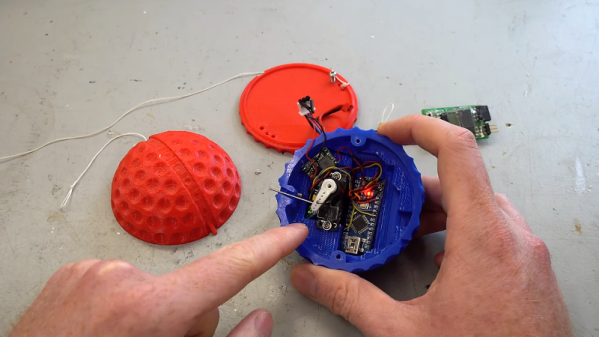
Having a compound trebuchet close at hand, a few simple mods were all it took to launch projectiles more or less straight up. The first payload was to be rocket-shaped, but that proved difficult to launch. So [Tom] 3D-printed an upsized golf ball and packed it with electronics to record the details of its brief ballistic flight. Aside from an altimeter, there’s a small servo controlled by an Arduino and an accelerometer. The servo retracts a pin holding the two halves of the ball together, allowing a parachute to deploy and return the package safely to Earth. The video below shows some pretty exciting launches, the best of which reached over 60 meters high.

The skies in the field behind [Tom]’s house are an exciting place. Between flying supercapacitors, reaction wheel drones, and low-altitude ISS flybys, there’s always something going on up there.

Continue reading “Make Physics Fun With A Trebuchet”

[Ben Krasnow] Makes A DSKY

There are hundreds if not thousands of artifacts from the Apollo program scattered around the globe, some twisted wrecks at the bottom of the ocean, others lovingly preserved and sitting in museums or in the hands of private collectors. All of what’s left is pretty much pure unobtainium, so if you want something Apollo-like, you’re probably going to have to make it yourself.

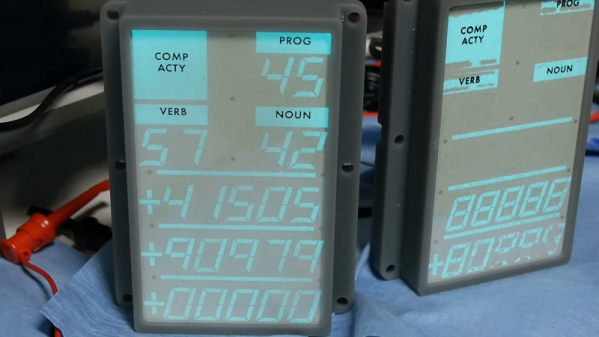
[Ben Krasnow] took up the challenge to make an electroluminescent Apollo-era DSKY display from scratch, with outstanding results. The DSKY, or “display and keyboard”, was the user interface for the Apollo Guidance Computer, the purpose-built digital navigation system that got a total of 24 men there and back again. [Ben] says it took a long time to recreate the display, and we can see why. He needed to master quite a few skills, including screen printing to get the glass-panel display working. The panel is a sandwich of phosphorescent paint, a dielectric, and conductive ink. The ink is silkscreened on the back to form the characters, all applied to indium tin oxide (ITO) conductive glass. A PCB with the same pattern of character segments lays behind that, driving each segment with 300 volts or so through a trio of HV507 high-voltage shift registers. It’s an impressive bit of engineering and gives off a decidedly not-homebrew vibe.

In the video below, [Ben] goes into detail about the trials he experienced on the way to this amazing endpoint, not least of which was frying chip after chip due to ineffective protection diodes in the shift registers. That’s an epic debugging story that’s worth the price of admission all by itself. It’s not the only DSKY in town, of course – [Fran Blanche] has been working on one for a while too – but there’s just something about that blue glow that we really like.

Continue reading “[Ben Krasnow] Makes A DSKY”

The $50 Ham: Dummy Loads, Part 2

In the last installment of “The $50 Ham” I built a common tool used by amateur radio operators who are doing any kind of tuning or testing of transmitters: a dummy load. That build resulted in “L’il Dummy”, a small dummy load intended for testing typical VHF-UHF handy talkie (HT) transceivers, screwing directly into the antenna jack on the radio.

As mentioned in the comments by some readers, L’il Dummy has little real utility. There’s actually not much call for a dummy load that screws right into an HT, and it was pointed out that a proper dummy load is commercially available on the cheap. I think the latter observation is missing the point of homebrewing specifically and the Hackaday ethos in general, but I will concede the former point. That’s why at the same time I was building L’il Dummy, I was building the bigger, somewhat more capable version described here: Big Dummy.

Continue reading “The $50 Ham: Dummy Loads, Part 2”

A Ping Pong Ball LED Video Wall

Constrained builds are often the most fun. Throw an artificial limit into the mix, like time limiting your effort or restricting yourself to what’s on hand, and there’s no telling what will happen.

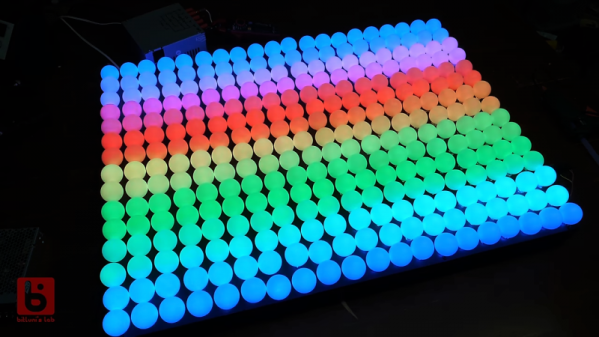
[bitluni] actually chose both of those constraints for this ping pong ball LED video display, and the results are pretty cool, even if the journey was a little rough. It seems like using sheet steel for the support of his 15 x 20 Neopixel display was a mistake, at least in hindsight. A CNC router would probably have made the job of drilling 300 holes quite a bit easier, but when all you have is a hand drill and a time limit, you soldier on. Six strings of Neopixels fill the holes, a largish power supply provides the 18 or so amps needed, and an Arduino knock-off controls the display. The ping pong ball diffusers are a nice touch, even if punching holes in them cost [bitluni] a soldering iron tip or two. The display is shown in action in the video below, mostly with scrolling text. If we may make a modest suggestion, a game of Pong on a ping pong ball display might be fun.

[bitluni] says that the display is on its way to Maker Faire Berlin this weekend, so stop by and say hi. Maybe he’ll have some of his other cool builds too, like his Sony Watchman Game Boy mashup, or the electric scooter of questionable legality.

Continue reading “A Ping Pong Ball LED Video Wall”

A Better Bowden Drive For Floppy Filaments

You might not think to use the word “rigid” to describe most 3D-printer filaments, but most plastic filaments are actually pretty stiff over a short length, stiff enough to be pushed into an extruder. Try the same thing with a softer plastic like TPE, though, and you might find yourself looking at this modified Bowden drive for elastomeric filaments.

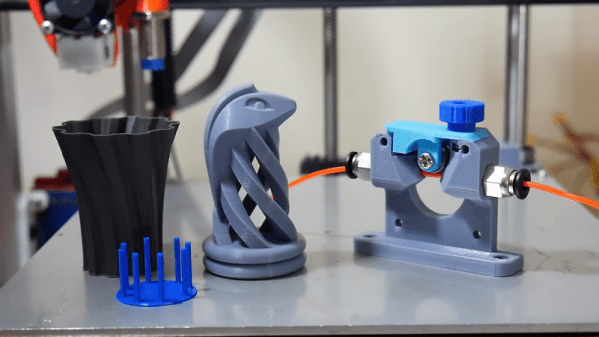
The idea behind the Bowden drive favored by some 3D-printer designers is simple: clamp the filament between a motor-driven wheel and an idler to push it up a pipe into the hot end of the extruder. But with TPE and similar elastomeric filaments, [Tech2C] found that the Bowden drive on his Hypercube printer was causing jams and under-extrusion artifacts in finished prints. A careful analysis of the stock drive showed a few weaknesses, such as how much of the filament is not supported on the output side of the wheel. [Tech2C] reworked the drive to close that gap and also to move the output tube opening closer to the drive. The stock drive wheel was also replaced with a smaller diameter wheel with more aggressive knurling. Bolted to the stepper, the new drive gave remarkably improved results – a TPE vase was almost flawless with the new drive, while the old drive had blobs and artifacts galore. And a retraction test print showed no stringing at all with PLA, meaning the new drive isn’t just good for the soft stuff.

All in all, a great upgrade for this versatile and hackable little printer. We’ve seen the Hypercube before, of course – this bed height probe using SMD resistors as strain gauges connects to the other end of the Bowden drive.

Continue reading “A Better Bowden Drive For Floppy Filaments”

The Great Ohio Key Fob Mystery, Or “Honey, I Jammed The Neighborhood!”

Hack long enough and hard enough, and it’s a pretty safe bet that you’ll eventually cause unintentional RF emissions. Most of us will likely have our regulatory transgression go unnoticed. But for one unlucky hacker in Ohio, a simple project ended up with a knock at the door by local authorities and pointed questions to determine why key fobs and garage door remotes in his neighborhood and beyond had suddenly been rendered useless, and why his house seemed to be at the center of the disturbance.

Few of us want this level of scrutiny for our projects, so let’s take a more in-depth look at the Great Ohio Key Fob Mystery, along with a look at the Federal Communications Commission regulations that govern what you can and cannot do on the airwaves. As it turns out, it’s easy to break the law, and it’s easy to get caught.

Continue reading “The Great Ohio Key Fob Mystery, Or “Honey, I Jammed The Neighborhood!””

The Clickiest Game Of Tetris You’ll Ever Play, On A Flip-Dot

Like many other classics it’s easy to come up with ways to ruin Tetris, but hard to think of anything that will make it better. Adding more clickiness is definitely one way to improve the game, and playing Tetris on a flip-dot display certainly manages to achieve that.

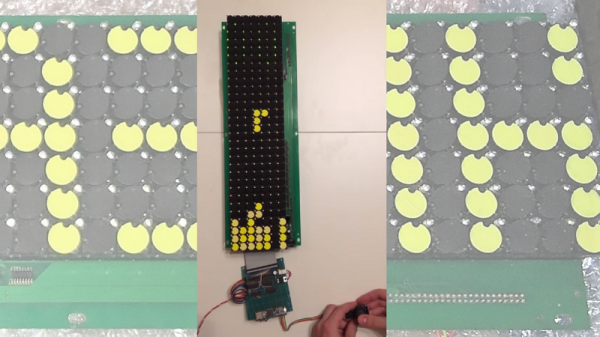
The surplus flip-dot display [sinowin] used for this version of Tetris is a bit of an odd bird that needed some reverse engineering to be put to work. The display is a 7 x 30 matrix with small dots, plus a tiny green LED for each dot. Those LEDs turned out to be quite useful for replicating the flashing effect used in the original game when a row of blocks was completed, and the sound of the dots being flipped provides audio feedback. The game runs on a Teensy through a custom driver board and uses a Playstation joystick for control. The video below, in perfectly acceptable vertical format, shows the game in action and really makes us want to build our own, perhaps with a larger and even clickier flip-dot display.

The best thing about Tetris is its simplicity: simple graphics, simple controls, and simple gameplay. It’s so simple it can be played anywhere, from a smartwatch to a business card and even on a transistor tester.

Continue reading “The Clickiest Game Of Tetris You’ll Ever Play, On A Flip-Dot”