Flexible PCB Robot Flops Around To Get Around

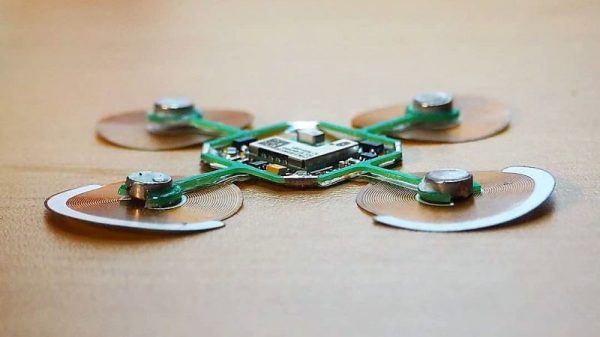
In his continuing quest to reduce the parts count of a robot as far as possible, [Carl Bugeja] has hit upon an unusual design: robots built of almost nothing but PCBs.

Admittedly, calling these floppy four-legged critters robots is still a bit of a stretch at this point. The video below shows that while they certainly move under their own power, there’s not a lot of control to the movement – yet. [Carl]’s design uses an incredibly fragile looking upper arm assembly made from FR4. Each arm holds a small neodymium magnet suspended over the center of a flexible PCB coil, quite like those we’ve seen him use before as actuators and speakers. The coils are controlled by a microcontroller living where the four legs intersect. After a few uninspiring tethered tests revealed some problems with the overly compliant FR4 magnet supports, [Carl] made a few changes and upped the frequency of the leg movements. This led to actual motion and eventually to untethered operation, with the bot buzzing around merrily.

There are still issues with the lack of stiffness of the magnet arms, but we’re optimistic that [Carl] can overcome them. We like this idea a lot, and can see all sort of neat applications for flapping and flopping locomotion.

Continue reading “Flexible PCB Robot Flops Around To Get Around”
Simple Timer Evolves Into Custom Kid’s Watch

Sporting a new wristwatch to school for the first time is a great moment in a kid’s life. When it’s a custom digital-analog watch made by your dad, it’s another thing altogether.

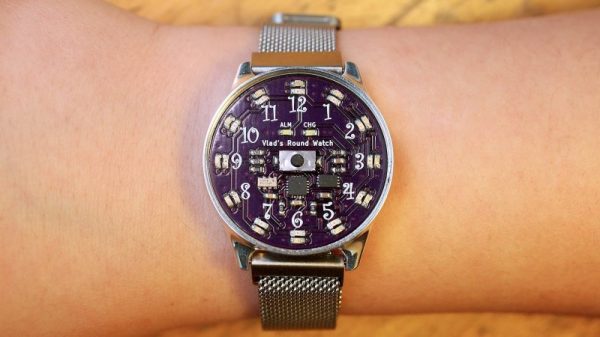
As [Chris O’Riley] relates, the watch he built for his son [Vlad] started out as a simple timer for daily toothbrushing, a chore to which any busy lad pays short shrift unless given the proper incentive. That morphed into an idea for a general purpose analog timepiece with LEDs taking the place of hands. [Chris] decided that five-minute resolution was enough for a nine-year-old, which greatly reduced the number of LEDs needed. An ATtiny841 tells a 28-channel I2C driver which LEDs to light up, and an RTC chip keeps [Vlad] on schedule. The beautiful PCB lives inside a CNC machined aluminum case; we actually commented to [Chris] that the acrylic prototype looked great by itself, but [Vlad] wanted metal. The watch has no external buttons; rather, the slightly flexible polycarbonate crystal bears against a PCB-mounted pushbutton to control functions.

With a snappy wristband, [Vlad] will be rolling fancy on the schoolyard. It’s a great looking piece that needed a wide range of skills to execute, as all watches do. Check out some other watch builds, like this lovely pure analog, another digital-analog hybrid, or this pocket watch that packs an Enigma machine inside.

Continue reading “Simple Timer Evolves Into Custom Kid’s Watch”

Common Chemicals Combine To Make Metallic Sodium

There’s no debating that metallic sodium is exciting stuff, but getting your hands on some can be problematic, what with the need to ship it in a mineral oil bath to keep it from exploding. So why not make your own? No problem, just pass a few thousand amps of current through an 800° pot of molten table salt. Easy as pie.

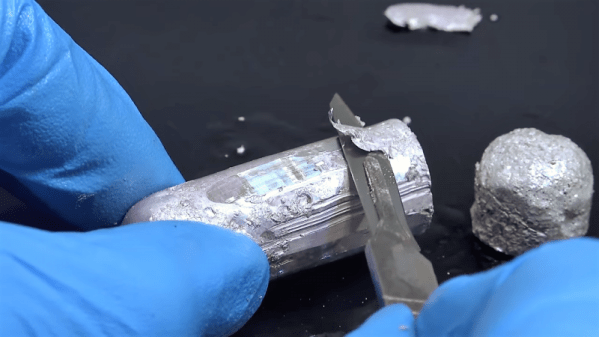
Thankfully, there’s now a more approachable method courtesy of this clever chemical hack that makes metallic sodium in quantity without using electrolysis. [NurdRage], aka [Dr. N. Butyl Lithium], has developed a process to extract metallic sodium from sodium hydroxide. In fact, everything [NurdRage] used to make the large slugs of sodium is easily and cheaply available – NaOH from drain cleaner, magnesium from fire starters, and mineral oil to keep things calm. The reaction requires an unusual catalyst – menthol – which is easily obtained online. He also gave the reaction a jump-start with a small amount of sodium metal, which can be produced by the lower-yielding but far more spectacular thermochemical dioxane method; lithium harvested from old batteries can be substituted in a pinch. The reaction will require a great deal of care to make sure nothing goes wrong, but in the end, sizable chunks of the soft, gray metal are produced at phenomenal yields of 90% and more. The video below walks you through the whole process.

It looks as though [NurdRage]’s method can be scaled up substantially or done in repeated small batches to create even more sodium. But what do you do when you make too much sodium metal and need to dispose of it? Not a problem.

Continue reading “Common Chemicals Combine To Make Metallic Sodium”

Putting The Brakes On High-Frequency Trading With Physics

In the middle of the East Coast’s slow broil in the summer of 2018, a curious phenomenon surfaced. As a tropical air mass settled in and smothered the metropolitan New York area, a certain breed of stock speculator began feeling the financial heat as the microwave signals linking together various data centers and exchanges began to slow down. These high-frequency traders rely on getting information a fraction of a second before other traders see the same thing and take advantage of minuscule price differences to make money hand over fist.

While you won’t catch us shedding many tears over the billions these speculators lost during the hot spell, we did find the fact that humidity can slow microwave propagation enough to make this a problem for them a fascinating subject, enough so that we covered it in some detail at the time. While financial markets come and go and the technology to capitalize them changes at a breakneck pace, physics stays the same, and it can make or break deals with no regard to the so-called fundamentals.

So it was with great interest that we happened upon Tom Scott’s recent video outlining how one new stock exchange is using physics to actually slow down stock trades, in an attempt to gain a competitive advantage over the other exchanges. In light of the billions lost over the summer to propagation delays amounting to a mere 10 microseconds, we couldn’t help but wonder how injecting a delay 35 times longer using a “magic shoebox” was actually good for business. It turns out to be an interesting story.

Continue reading “Putting The Brakes On High-Frequency Trading With Physics”

Reverse Engineering Keeps Keck Telescopes On Track

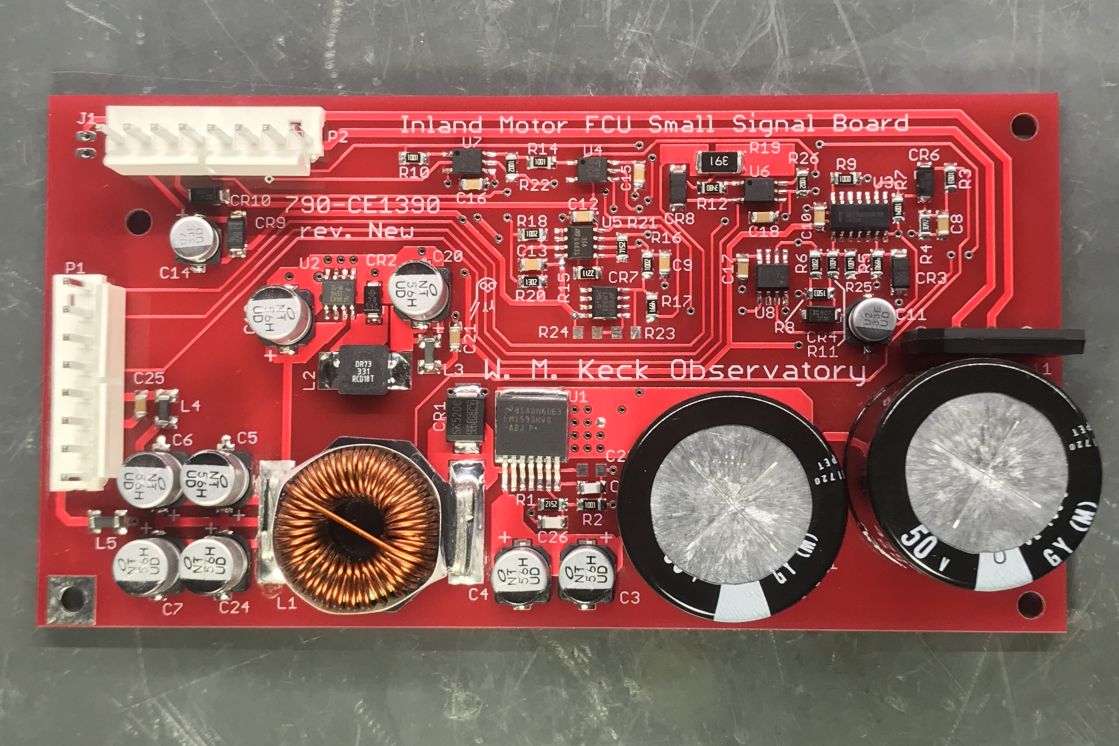
Perched atop a dormant volcano far above the roiling tropical air of the Big Island of Hawai’i sit two of the largest optical telescopes in the world. Each 10-meter main mirror is but a single part of a magnificent machine weighing in at some 400 tons that needs to be positioned with incredible precision. Keeping Keck 1 and Keck 2 in peak operating condition is the job of a team of engineers and scientists, so when the servo amplifiers running the twelve motors that move each scope started to show their age, [Andrew] bit the bullet and rebuilt the obsolete boards from scratch.

The Keck telescopes were built over three decades ago, and many of the parts, including the problematic servo amps, are no longer made. Accumulated wear and tear from constant use and repeated repairs had taken their toll on the boards, from overheated components to lifted solder pads. With only some barely legible schematics of the original amplifiers to go by, [Andrew] reverse engineered new amps. Some substitutions for obsolete components were needed, the PCB design was updated to support SMD parts, and higher-quality components were specified, but the end result is essentially new amplifiers that are plug-in replacements for the original units. This should keep the telescopes on track for decades to come.

Not to sound jealous, but it seems like [Andrew] has a great gig. He’s shared a couple of his Keck adventures before, like the time a failed LED blinded the telescope. He’s also had a few more down-to-earth hacks, like fixing a dodgy LCD monitor and making spooky blinkeneyes for Halloween.

Stethoscopes, Electronics, And Artificial Intelligence

For all the advances in medical diagnostics made over the last two centuries of modern medicine, from the ability to peer deep inside the body with the help of superconducting magnets to harnessing the power of molecular biology, it seems strange that the enduring symbol of the medical profession is something as simple as the stethoscope. Hardly a medical examination goes by without the frigid kiss of a stethoscope against one’s chest, while we search the practitioner’s face for a telltale frown revealing something wrong from deep inside us.

The stethoscope has changed little since its invention and yet remains a valuable if problematic diagnostic tool. Efforts have been made to solve these problems over the years, but only with relatively recent advances in digital signal processing (DSP), microelectromechanical systems (MEMS), and artificial intelligence has any real progress been made. This leaves so-called smart stethoscopes poised to make a real difference in diagnostics, especially in the developing world and under austere or emergency situations.

Continue reading “Stethoscopes, Electronics, And Artificial Intelligence”

All Things Enigma Hack Chat

Join us Wednesday at noon Pacific time for the All Things Enigma Hack Chat!

This week’s Hack Chat is a bit of a departure for us because our host, Simon Jansen, has tackled so many interesting projects that it’s hard to settle on one topic. Simon is a multidisciplinary hacker whose interests run the gamut from building an ammo-can Apple ][ to a literal steampunk Rickroller. How about a Bender Brewer? Or a MAME in a TARDIS? Or perhaps making an old phone play music to restore a car by? Oh, and remember that awesome ASCII animation of Star Wars: Episode IV? That was Simon.

So, a little hard to choose a topic, but we asked Simon to talk a bit about his recent Enigma watches. He has managed to put an electronic emulation of the Enigma cypher machine from World War II into both a wristwatch and, more recently, a pocket watch. They’re both gorgeous builds that required a raft of skills to complete. We’ll start there and see where the conversation takes us!

Please join us for this Hack Chat, where we’ll discuss:

  • Where the fascination with Enigma came from;
  • Tools, techniques, and shop setup;
  • Melding multiple, disparate skill sets; and
  • What sorts of new projects might we see soon?

You are, of course, encouraged to add your own questions to the discussion. You can do that by leaving a comment on the All Things Enigma Hack Chat and we’ll put that in the queue for the Hack Chat discussion.

join-hack-chatOur Hack Chats are live community events on the Hackaday.io Hack Chat group messaging. This week we’ll be sitting down on Wednesday, February 27, at noon, Pacific time. If time zones have got you down, we have a handy time zone converter.

Click that speech bubble to the right, and you’ll be taken directly to the Hack Chat group on Hackaday.io. You don’t have to wait until Wednesday; join whenever you want and you can see what the community is talking about.