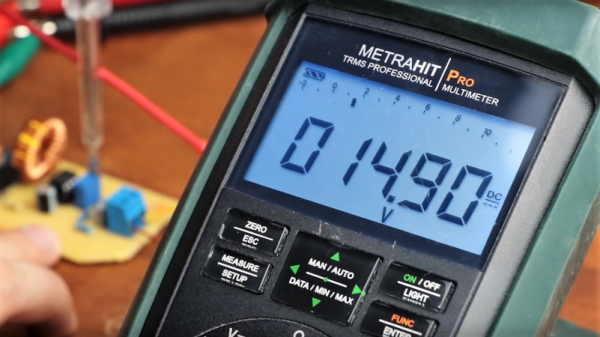
Hybrid Bench Power Supply Can Also Hit The Road

Everyone needs a bench power supply, and rolling your own has almost become a rite of passage for hackers. For a long time, the platform of choice for such builds seemed to be the ATX power supply from a computer. While we certainly still see those builds, a lot of the action has switched to those cheap eBay programmable DC-DC converters, with their particolored digital displays.

This hybrid bench and portable power supply is a good example of what can be accomplished with these modules, and looks like it might turn out to be a handy tool. [Luke] centered his build around the DPS3003, a constant current and constant voltage buck converter that can take up to 40-VDC input and outputs up to 32 volts at 3 amps. In bench mode, the programmable module is fed from a mains-powered 24-volt switching supply. For portable work, an 18-volt battery from a Makita drill slips into a 3D-printed adapter on the top of the case. The printed part contains a commercial terminal [Luke] scored on eBay, but we’d bet the entire thing could be 3D printed. And no problem if you change power tool brands — just print another adapter.

Those little eBay power supply modules have proven to be an enabling technology, at least judging by the number of clever ways we’ve seen them used lately. From this combination bench PSU and soldering iron supply to a portable PSU perched atop a battery, these things are everywhere. Heck, you can even reflash the firmware and make them do your bidding.

[via Dangerous Prototypes]

Tiny Transmitter Brings Out The Spy Inside You

When it comes to surveillance, why let the government have all the fun? This tiny spy transmitter is just the thing you need to jumpstart your recreational espionage efforts.

We kid, of course — you’ll want to stay within the law of the land if you choose to build [TomTechTod]’s diminutive transmitter. Barely bigger than the 337 button cell that powers it, the scrap of PCB packs a fair number of surface mount components, most in 0201 packages. Even so, the transmitter is a simple design, with a two transistor audio stage amplifying the signal from the MEMS microphone and feeding an oscillator that uses a surface acoustic wave (SAW) resonator for stability. The bug is tuned for the 433-MHz low-power devices band, and from the video below, it appears to have decent range with the random wire antenna — maybe 50 meters. [TomTechTod] has all the build files posted, including Gerbers and a BOM with Digikey part numbers, so it should be easy to make one for your fieldcraft kit.

If you want to dive deeper into the world of electronic espionage, boy, have we got you covered. Here’s a primer on microphone bugs, a history of spy radios, or how backscatter was used to bug an embassy.

Continue reading “Tiny Transmitter Brings Out The Spy Inside You”

Suitcase Computer Reborn With Raspberry Pi Inside

Fun fact, the Osborne 1 debuted with a price tag equivalent to about $5,000 in today’s value. With a gigantic 9″ screen and twin floppy drives (for making mix tapes, right?) the real miracle of the machine was its portability, something unheard of at the time. The retrocomputing trend is to lovingly and carefully restore these old machines to their former glory, regardless of how clunky or underpowered they are by modern standards. But sometimes they can’t be saved yet it’s still possible to gut and rebuild the machine with modern hardware, like with this Raspberry Pi used to revive an Osborne 1.

Purists will turn their nose up at this one, and we admit that this one feels a little like “restoring” radios from the 30s by chucking out the original chassis and throwing in a streaming player. But [koff1979] went to a lot of effort to keep the original Osborne look and feel in the final product. We imagine that with the original guts replaced by a Pi and a small LCD display taking the place of the 80 character by 24 line CRT, the machine is less strain on the shoulder when carrying it around. (We hear the original Osborne 1 was portable in the same way that an anvil is technically portable.) The Pi runs an emulator to get the original CP/M experience; it even runs Wordstar. The tricky part about this build was making the original keyboard talk to the Pi, which was accomplished with an Arduino that translates key presses to USB.

As an aside, if reading this has given you a twinge of nostalgia and you’re on the Eastern seaboard you may want to check out more vintage gear at the VCF East this weekend. If you hail from Europe, get your hack on with CP/M and a retrocomputing badge at Hackaday Belgrade one wee from now.

We’ve seen the Raspberry Pi pressed into retrocomputing duty before, of course. Here’s one used to emulate a Commodore 1541 disk drive, and another in the laptop Clive Sinclair never built.

Continue reading “Suitcase Computer Reborn With Raspberry Pi Inside”

The Pros And Cons Of Microcontrollers For Boost Converters

It never fails — we post a somewhat simple project using a microcontroller and someone points out that it could have been accomplished better with a 555 timer or discrete transistors or even a couple of vacuum tubes. We welcome the critiques, of course; after all, thoughtful feedback is the point of the comment section. Sometimes the anti-Arduino crowd has a point, but as [Great Scott!] demonstrates with this microcontroller-less boost converter, other times it just makes sense to code your way out of a problem.

Built mainly as a comeback to naysayers on his original boost-converter circuit, which relied on an ATtiny85, [Great Scott!] had to go to considerable lengths to recreate what he did with ease using a microcontroller. He started with a quick demo using a MOSFET driver and a PWM signal from a function generator, which does the job of boosting the voltage, but lacks the feedback needed to control for varying loads.

Ironically relying on a block diagram for a commercial boost controller chip, which is probably the “right” tool for the job he put together the final circuit from a largish handful of components. Two op amps form the oscillator, another is used as a differential amp to monitor the output voltage, and the last one is a used as a comparator to create the PWM signal to control the MOSFET. It works, to be sure, but at the cost of a lot of effort, expense, and perf board real estate. What’s worse, there’s no simple path to adding functionality, like there would be for a microcontroller-based design.

Of course there are circuits where microcontrollers make no sense, but [Great Scott!] makes a good case for boost converters not being one of them if you insist on DIYing. If you’re behind on the basics of DC-DC converters, fear not — we’ve covered that before.

Continue reading “The Pros And Cons Of Microcontrollers For Boost Converters”

Hawkeye, The 3D-Printed Tourbillon Movement

As if building tiny mechanisms with dozens of moving parts that all need to mesh together perfectly to work weren’t enough, some clock and watchmakers like to put their horology on hard mode with tourbillon movements. Tourbillons add multiple axes to the typical gear trains in an attempt to eliminate errors caused by the influence of gravity — the movement essentially spins on gimbals while tick-tocking away.

It feels like tourbillons are too cool to lock inside timepieces meant for the ultra-rich. [Alduinien] agrees and democratized the mechanism with this 3D-printed tourbillon. Dubbed “Hawkeye,” [Alduinien]’s tourbillon is a masterpiece of 3D printing. Composed of over 70 pieces, the mechanism is mesmerizing to watch, almost like a three-axis mechanical gyroscope.

The tourbillon is designed to be powered either by the 3D-printed click spring or by a small electric motor. Intended mainly as a demonstration piece, [Alduinien]’s Thingiverse page still only has the files for the assembled mechanism, but he promises to get the files for the individual pieces posted soon. Amateur horologists, warm up your 3D-printers.

Tourbillons are no stranger to these pages, of course. We’ve done an in-depth look at tourbillons for watches, and we’ve even featured a 3D-printed tourbillon clock before. What we like about this one is that it encourages exploration of these remarkable instruments, and we’re looking forward to seeing what people do with this design. For those looking for more background on clock escapements in general, [Manuel] wrote a great article on how we turned repetitive motion into timekeeping.

Continue reading “Hawkeye, The 3D-Printed Tourbillon Movement”

The Electrical Outlet And How It Got That Way

Right now, if you happen to be in Noth America, chances are pretty good that there’s at least one little face staring at you. Look around and you’ll spy it, probably about 15 inches up from the floor on a nearby wall. It’s the ubiquitous wall outlet, with three holes arranged in a way that can’t help but stimulate the facial recognition firmware of our mammalian brain.

No matter where you go you’ll find those outlets and similar ones, all engineered for specific tasks. But why do they look the way they do? And what’s going on electrically and mechanically behind that familiar plastic face? It’s a topic we’ve touched on before with Jenny List’s take on international mains standards. Now it’s time to take a look inside the common North American wall socket, and how it got that way.

Continue reading “The Electrical Outlet And How It Got That Way”

3D-Printing Saves Collectible Lures From A Fishy Ending

Give a man a fishing lure, and he catches fish until he loses the lure. Give a fisherman a 3D-printer, and he can print all the fishing lures he wants, especially replicas of those that are too valuable to actually use.

It may seem strange that some people collect fishing lures rather than use them, but when you look at [Hunter]’s collection, it’s easy to see why. Lures can be very artistic, and the Heddon River Runts in his collection are things of beauty and highly prized. They’re also highly effective at convincing fish to commit suicide, so rather than risk the originals, he and his dad 3D-printed replicas.

After modeling the body of the lure in Blender, they modified it with air pockets for buoyancy and located holes for attaching the treble hooks and lip spoon, which was fabricated from a scrap of brass from a rifle casing. The finished lure lacks the painted details and some of the charm of the original River Runt, but it has something Mr. Heddon couldn’t dream of in 1933 when he introduced it — it glows in the dark, thanks to the phosphorescent PLA filament used. That seems to be irresistible to the bass, who hit the lure so often that they got sick of taking pictures. See it in action in the video below.

[Hunter] and his dad have been busy exploring what 3D printing can do, replicating all sorts of Heddon lures. They’ve even got plans to design and print their own lures. But maybe archery is more your sportsman thing than fishing, in which case this PVC pipe compound bow or a recurve bow from skis would be something to check out.

Continue reading “3D-Printing Saves Collectible Lures From A Fishy Ending”