In-Band Signaling: Dual-Tone Multifrequency Dialing

One late night many decades ago, I chanced upon a technical description of the Touch-Tone system. The book I was reading had an explanation of how each key on a telephone sends a combination of two tones down the wire, and what’s more, it listed the seven audio frequencies needed for the standard 12-key dial pad. I gazed over at my Commodore 64, and inspiration hit — if I can use two of the C64’s three audio channels to generate the dual tones, I bet I can dial the phone! I sprang out of bed and started pecking out a Basic program, and in the wee hours I finally had it generating the recognizable Touch-Tones of my girlfriend’s phone number. I held the mouthpiece of my phone handset up to the speaker of my monitor, started the program, and put the receiver to my ear to hear her phone ringing! Her parents were none too impressed with my accomplishment since it came at 4:00 AM, but I was pretty jazzed about it.

Since that fateful night I’ve always wondered about how the Touch-Tone system worked, and in delving into the topic I discovered that it’s part of a much broader field of control technology called in-band signaling, or the use of audible or sub-audible signals to control an audio or video transmission. It’s pretty interesting stuff, even when it’s not used to inadvertently prank call someone in the middle of the night. Continue reading “In-Band Signaling: Dual-Tone Multifrequency Dialing”


Hackaday Prize Entry: Remote Control By Head Gestures

Some people may think they’re having a bad day when they can’t find the TV remote. Yet there are some people who can’t even hold a remote, let alone root around in the couch cushions where the remote inevitably winds up. This entry in the Assistive Technologies phase of the 2017 Hackaday Prize seeks to help such folks, with a universal remote triggered by head gestures.

Mobility impairments can range from fine motor control issues to quadriplegia, and people who suffer from them are often cut off from technology by the inability to operate devices. [Cassio Batista] concentrated on controlling a TV for his project, but it’s easy to see how his method could interface with other IR remotes to achieve control over everything from alarm systems to windows and drapes. His open-source project uses a web cam to watch a user’s head gestures, and OpenCV running on a CHIP SBC looks for motion in the pitch, yaw, and roll axes to control volume, channel, and power. An Arduino takes care the IR commands to the TV. The prototype works well in the video below; with the power of OpenCV we can imagine mouth gestures and even eye blinks adding to the controller’s repertoire.

The Assistive Tech phase wraps up tomorrow, so be sure to get your entries in. You’ll have some stiff competition, like this robotic exoskeleton. But don’t let that discourage you.

Continue reading “Hackaday Prize Entry: Remote Control By Head Gestures”

Poetry In Motion With A Sand-Dispensing Dot Matrix Printer

Hackaday gets results! Reader [John] saw our recent Fail of the Week post about a “sand matrix printer” and decided to share his own version, a sand-dispensing dot matrix printer he built last year.

Granted, [John]’s version is almost the exact opposite of [Vjie Miller]’s failed build, which sought to make depressions in the sand to print characters. [John]’s Sandscript takes a hopper full of dry, clean sand and dispenses small piles from six small servo-controlled nozzles. The hopper is mounted on a wheeled frame, and an optical encoder on one wheel senses forward motion to determine when to open each nozzle. As [John] slowly walks behind and to the side of the cart, a line of verse is slowly drizzled out onto the pavement. See it in action in the video below.

More performance art piece than anything else, we can see how this would be really engaging, with people following along like kids after the [Pied Piper], waiting to find out what the full message is. There’s probably a statement in there about the impermanence of art and the fleeting nature of existence, but we just think it’s a really cool build.

We’ve featured other sand writers before, like this high-resolution draw bot that also dispenses sandy verses, or this literal beach-combing art bot. Guess there’s just something about sand that inspires artists and hackers alike.

Continue reading “Poetry In Motion With A Sand-Dispensing Dot Matrix Printer”

Hackaday Prize Entry: Fighting Dehydration One Sip At A Time

Humans don’t survive long without water, and most people walk around in a chronic state of mild dehydration even if they have access to plenty of drinking water. It’s hard to stay properly hydrated, and harder still to keep track of your intake, which is the idea behind this water-intake monitoring IoT drinking straw.

Dehydration is a particularly acute problem in the elderly, since the sense of thirst tends to diminish with age. [jflaschberger]’s Hackaday Prize entry seeks to automate the tedious and error-prone job of recording fluid intake, something that caregivers generally have to take care of by eyeballing that half-empty glass and guessing. The HydrObserve uses a tiny turbine flowmeter that can mount to a drinking straw or water bottle cap. A Hall sensor in the turbine sends flow data to a Cypress BLE SoC module, which totalizes the volume sipped and records a patient identifier. A caregiver can then scan the data from the HydrObserve at the end of the day for charting and to find out if anyone is behind on their fluids.

There are problems to solve, not least being the turbine, which doesn’t appear to be food safe. But that’s a small matter that shouldn’t stand in the way of an idea as good as this one. We’ve seen a lot of good entries in the Assistive Technology phase of the 2017 Hackaday Prize, like a walker that works on stairs or sonic glasses for the blind. There are only a couple of days left in this phase — got any bright ideas?

Fight Mold And Mildew With An IoT Bathroom Fan

Delicious sheets of wallboard coated with yummy latex paints, all kept warm and moist by a daily deluge of showers and habitually forgetting to turn on the bathroom exhaust fan. You want mildew? Because that’s how you get mildew.

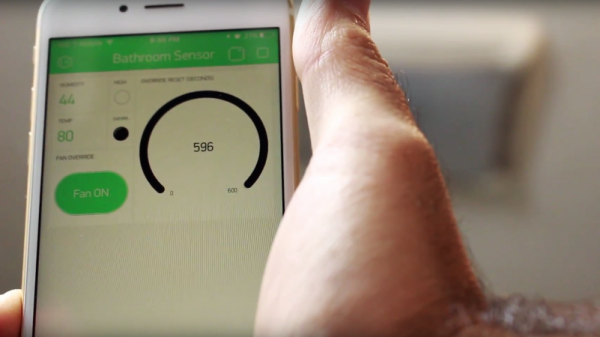
Fed up with the fuzzy little black spots on the ceiling, [Innovative Tom] decided to make bathroom ventilation a bit easier with this humidity-sensing IoT control for his bathroom exhaust fan. Truthfully, his build accomplishes little more than a $15 timer switch for the fan would, with one critical difference — it turns the fan on automatically when the DHT11 sensor tells the WeMos board that the relative humidity has gone over 60%. A relay shield kicks the fan on until the humidity falls below a set point. A Blynk app lets him monitor conditions in the bathroom and override the automatic fan, which is handy for when you need it for white noise generation more than exhaust. The best part of the project is the ample documentation and complete BOM in the description of the video below, making this an excellent beginner’s project.

No bathroom fan? Not a problem — this standalone humidity-sensing fan can help. Or perhaps you have other bathroom ventilation needs that this methane-sensing fan could help with?

Continue reading “Fight Mold And Mildew With An IoT Bathroom Fan”

A Compact, Portable Pantograph Camera Slider

Ho, hum, another camera slider, right? Wrong — here’s a camera slider with a literal twist.

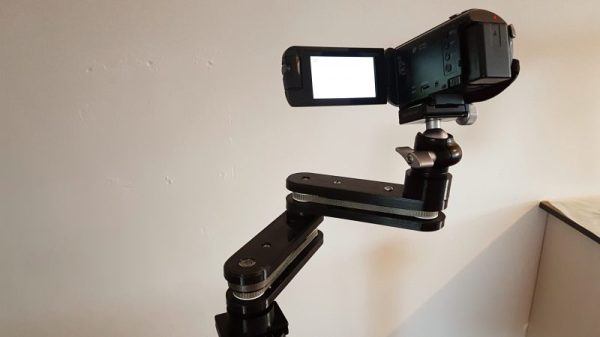
What sets [Schijvenaars]’ slider apart from the pack is that it’s not a slider, at least not in the usual sense. A slider is a mechanical contrivance that allows a camera to pan smoothly during a shot. Given that the object is to get a camera from point A to point B as smoothly as possible, and that sliders are often used for long exposures or time-lapse shots, the natural foundation for them is a ball-bearing linear slide, often powered by a stepper motor on a lead screw. [Schijvenaars] wanted his slider to be more compact and therefore more portable, so he designed and 3D-printed a 3-axis pantograph mechanism. The video below shows the slider panning the camera through a silky smooth 60 centimeters; a bonus of the arrangement is that it can transition from panning in one direction to the other without any jerking. Try that with a linear slider.

Granted, this slider is not powered, but given that the axes are synced with timing belts, it wouldn’t be difficult to add a motor. We’ve seen a lot of sliders before, from simple wooden units to complicated overhead cranes, but this one seems like a great design with a lot of possibilities.

Continue reading “A Compact, Portable Pantograph Camera Slider”

Repurposing Moving Coil Meters To Monitor Server Performance

Snazzy analog meters can lend a retro flair to almost any project, but these days they often seem to be retasked as indicators for completely different purposes than originally intended. That’s true for these Vu meters repurposed as gauges for a Raspberry Pi server, and we think the build log is as informative as the finished product is good-looking.

As [MrWunderbar] admits, the dancing needles of moving-coil meters lend hipster cred to a project, but getting his Vu meters to cooperate and display network utilization and disk I/O on his Raspberry Pi NAS server was no mean feat. His build log is full of nice details on how to measure the internal resistance of the meter and determine a proper series resistor. He also has a lengthy discussion of the relative merits of driving the meters using a PWM signal or using a DAC; in the end, [MrWunderbar] chose to go the DAC route, and the video below shows the desired rapid but smooth swings as disk and network usage change. He also goes into great depth on pulling usage parameters from psutil and parsing the results for display on the meters.

Looking for more analog meter goodness? We saw a similar CPU load meter a few months back, and there was this mash-up of Nixies and old meters for a solar energy CEO’s desk.

Continue reading “Repurposing Moving Coil Meters To Monitor Server Performance”