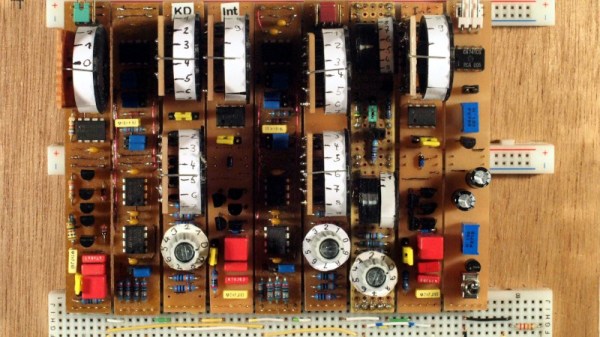
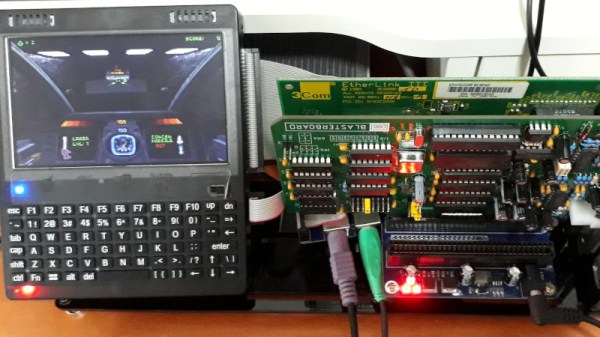
We are all used to modular construction in the analogue synth world, to the extent that there’s an accepted standard for it in EuroRack. But the same techniques are just as useful wherever else analogue circuits need to be configured on the fly, such as in an analogue computer. It’s something [Rainer Glaschick] has pursued, with his Flexible Analog Computer, an analogue computer made from a set of modules mounted on breadboard strips.
Standard modules are an adder and an integrator, with the adder also having inverter, comparator, and precision rectifier functions. The various functions can be easily configured by means of jumpers, and there are digital switches on board to enable or disable outputs and inputs. he’s set up a moon landing example to demonstrate the machine in practice.
There once was a time when to make a PCB in our community was to use CadSoft EAGLE, a PCB design package which neatly filled the entry level of that category with a free version for non-commercial designs. Upgrading it to the commercial version was fairly inexpensive, and indeed that was a path which quite a few designers making the step from hobby project to small production would take.
Last week I penned a cheesy fake relationship breakup letter to Ubuntu, my Linux distribution of choice for the last 15 years or so. It had well and truly delivered on its promise of a painless Linux desktop for most of that time, but the most recent upgrades had rendered it slow and bloated, with applications taking minutes to load and USB peripherals such as my film scanner mysteriously stopping working. I don’t have to look far to identify the point at which they adopted Snap packages as the moment when it all went wrong. I’d reached the point at which I knew our ways must part, and it was time to look for another distro.
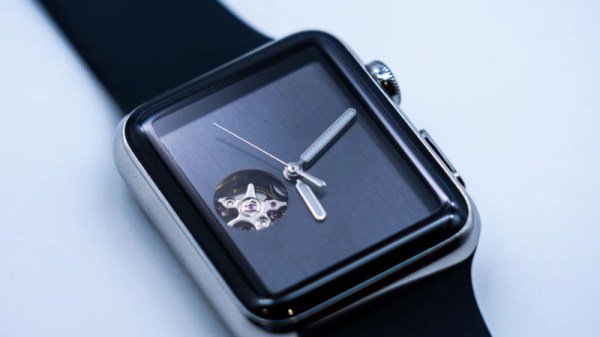
The Apple Watch has been on the market for long enough that its earlier iterations are now unsupported. Where some see little more than e-waste others see an opportunity, as has [NanoRobotGeek] with this mechanical watch conversion on a first-generation model.
What makes this build so special is its attention to detail. Into the Apple Watchcase has gone a Seiko movement, but it hasn’t merely been dropped into place. It uses the original Apple watch stem which is offset, so he’s had to create a linkage and a tiny pulley system to transfer the forces from one to the other. The rotor is custom-machined with am Apple logo, and the new watch face is a piece of laser-cut and heat treated zirconium. Even the watch movement itself needed a small modification to weaken the stem spring and allow the linkage to operate it.
The build is a long one with many steps, and we’re being honest when we say it would put our meager tiny machining skills to an extreme test. Sit down and take your time reading it, it really is a treat. Apple Watches may head to the tip after five years, but not this one!
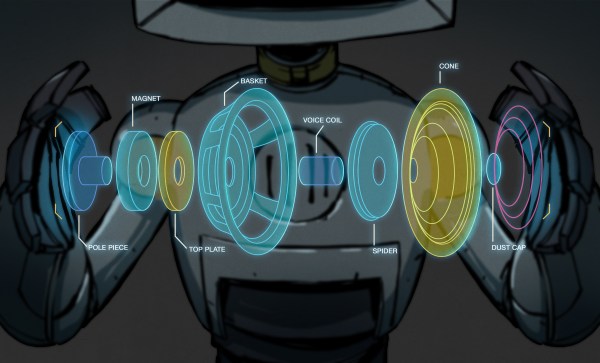
If you follow audiophile reviewers, you’ll know that their stock-in trade is a very fancy way of saying absolutely nothing of quantifiable substance about the subject while sounding knowledgeable about imagined differences between devices that are all of superlative quality anyway. If you follow us, we’ll tell you that the only reviews that matter are real-world measurements of audio performance, and blind listening tests. We don’t have to tell you how to listen to music, but perhaps it’s time in our Know Audio series to look at how audio performance is measured.
Before reaching for the bench, it’s first necessary to ask just what we are measuring. What are the properties which matter in an audio chain, or in other words, just what is it that makes an audio device good?
A few weeks ago our community was abuzz with the news of a couple of new portable computers available through AliExpress. Their special feature was that they are brand new 2023-produced retrocomputers, one with an 8088, and the other with a 386SX. Curious to know more? [Yeo Kheng Meng] has one of the 386 machines, and he’s taken it apart for our viewing pleasure.
What he found is a well-designed machine that does exactly what it claims, and which runs Windows 95 from a CF card. It’s slow because it’s an embedded version of the 386 variant with a 16-bit bus originally brought to market as a chip that could work with 16-bit 286-era chipsets. But the designer has done a good job of melding old and new parts to extract the most from this vintage chip, and has included some decidedly modern features unheard of in the 386 era such as a CH375B USB mass storage interface.
If we had this device we’d ditch ’95 and run DOS for speed with Windows 3.1 where needed. Back in the day with eight megabytes of RAM it would have been considered a powerhouse before users had even considered its form factor, so there’s an interesting exercise for someone to get a vintage Linux build running on it.
One way to look at it is as a novelty machine with a rather high price tag, but he makes the point that considering the hardware design work that’s gone into it, the 200+ dollar price isn’t so bad. With luck we’ll get to experience one hands-on in due course, and can make up our own minds. Our original coverage is here.
The future, as seen in the popular culture of half a century or more ago, was usually depicted as quite rosy. Technology would have rendered every possible convenience at our fingertips, and we’d all live in futuristic automated homes — no doubt while wearing silver clothing and dreaming about our next vacation on Mars.
Of course, it’s not quite worked out this way. A family from 1965 whisked here in a time machine would miss a few things such as a printed newspaper, the landline telephone, or receiving a handwritten letter; they would probably marvel at the possibilities of the Internet, but they’d recognise most of the familiar things around us. We still sit on a sofa in front of a television for relaxation even if the TV is now a large LCD that plays a streaming service, we still drive cars to the supermarket, and we still cook our food much the way they did. George Jetson has not yet even entered the building.
The Future is Here, and it Responds to “Alexa”
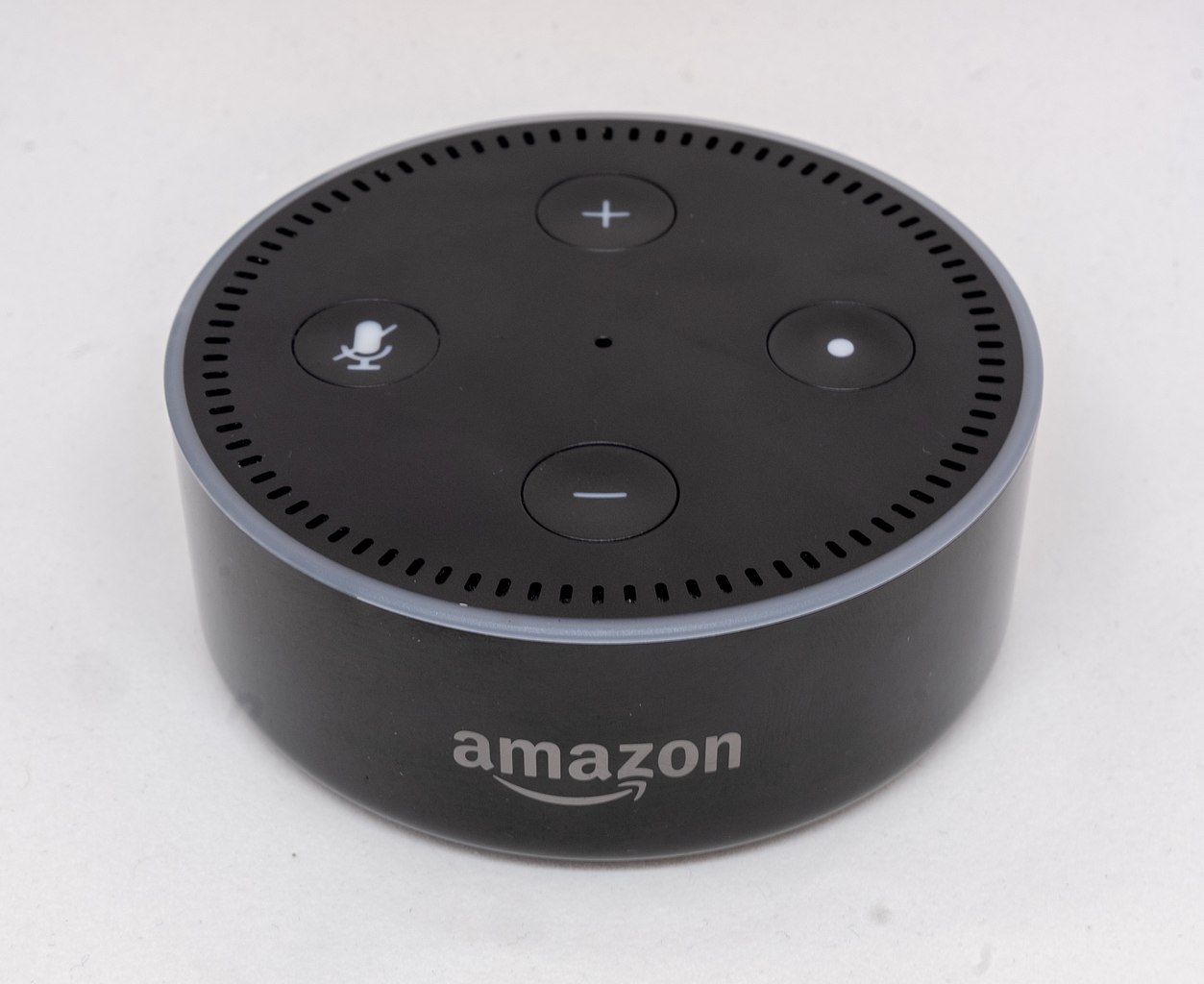
“Alexa, why haven’t you been a commercial success?” Gregory Varnum, CC BY-SA 4.0
There’s one aspect of the Jetsons future that has begun to happen though. It’s not the futuristic automation of projects such as Disneyland’s Monsanto house Of The Future, but instead it’s our current stuttering home automation efforts. We’re not having domestic robots in pinnies hand us rolled-up newspapers, but we’re installing smart lightbulbs and thermostats, and we’re voice-controlling them through a variety of home hub devices. The future is here, and it responds to “Alexa”.
But for all the success that Alexa and other devices like it have had in conquering the living rooms of gadget fans, they’ve done a poor job of generating a profit. It was supposed to be a gateway into Amazon services alongside their Fire devices, a convenient household companion that would help find all those little things for sale on Amazon’s website, and of course, enable you to buy them. Then, Alexa was supposed to move beyond your Echo and into other devices, as your appliances could come pre-equipped with Alexa-on-a-chip. Your microwave oven would no longer have a dial on the front, instead you would talk to it, it would recognise the food you’d brought from Amazon, and order more for you.
Instead of all that, Alexa has become an interface for connected home hardware, a way to turn on the light, view your Ring doorbell on models with screens, catch the weather forecast, and listen to music. It’s a novelty timepiece with that pod bay doors joke built-in, and worse that that for the retailer it remains by its very nature unseen. Amazon have got their shopping cart into your living room, but you’re not using it and it hardly reminds you that it’s part of the Amazon empire at all.
But it wasn’t supposed to be that way. The idea was that you might look up from your work and say “Alexa, order me a six-pack of beer!”, and while it might not come immediately, your six-pack would duly arrive. It was supposed to be a friendly gateway to commerce on the website that has everything, and now they can’t even persuade enough people to give it a celebrity voice for a few bucks.
The Gadget You Love to Hate
In the first few days after the Echo’s UK launch, a member of my hackerspace installed his one in the space. He soon became exasperated as members learned that “Alexa, add butt plug to my wish list” would do just that. But it was in that joke we could see the problem with the whole idea of Alexa as an interface for commerce. He had locked down all purchasing options, but as it turns out, many people in San Diego hadn’t done the same thing. As the stories rolled in of kids spending hundreds of their parents’ hard-earned on toys, it would be a foolhardy owner who would leave left purchasing enabled. Worse still, while the public remained largely in ignorance the potential of the device for data gathering and unauthorized access hadn’t evaded researchers. It’s fair to say that our community has loved the idea of a device like the Echo, but many of us wouldn’t let one into our own homes under any circumstances.
So Alexa hasn’t been a success, but conversely it’s been a huge sales success in itself. The devices have sold like hot cakes, but since they’ve been sold at close to cost, they haven’t been the commercial bonanza they might have hoped for. But what can be learned from this, other than that the world isn’t ready for a voice activated shopping trolley?
Sadly for most Alexa users it seems that a device piping your actions back to a large company’s data centres is not enough of a concern for them. It’s an easy prediction that Alexa and other services like it will continue to evolve, with inevitable AI pixie dust sprinked on them. A bet could be on the killer app being not a personal assistant but a virtual friend with some connections across a group of people, perhaps a family or a group of friends. In due course we’ll also see locally hosted and open source equivalents appearing on yet-to-be-released hardware that will condense what takes a data centre of today’s GPUs into a single board computer. It’s not often that our community rejoices in being late to a technological party, but I for one want an Alexa equivalent that I control rather than one that invades my privacy for a third party.