One of the most appealing aspects of USB-C is that it promises to be a unified power delivery system. You’ll no longer need to have a separate power cords for for your phone, camera, and laptop; physically they’ll all use USB-C connectors, and the circuitry in the charger will know how much juice to send down the line for each gadget. But in reality, we’ve all got at least a few pieces of older equipment that we’re not about to toss in the trash just because it doesn’t support the latest USB spec.
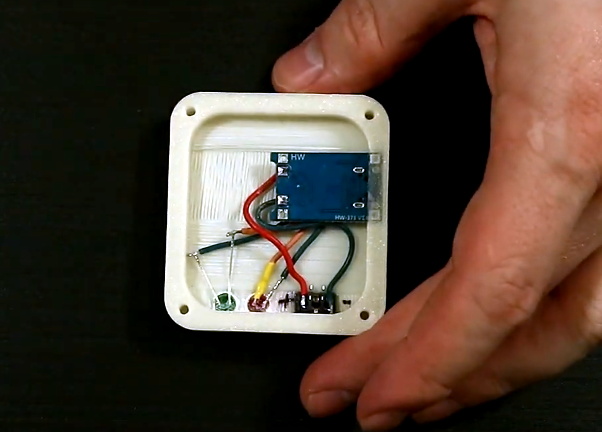
Note the relocated status LEDs.
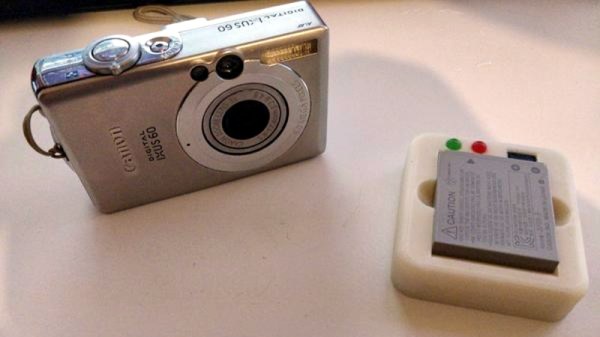
Case in point, the old Canon camera that [Purkkaviritys] modified to take infrared pictures. Instead of abandoning it, he decided to make a custom USB-C charger for its NB-4L batteries. Since they’re just single cell 3.7 V lithium-ions, all he had to do was wire them up to the ubiquitous TP4056 charger module and design a 3D printed case to hold everything together.
He did go the extra mile and replace the SMD charging indicator LEDs on the PCB with 5 mm LEDs embedded into the 3D printed enclosure, though you could certainly skip this step if you were in a hurry. We imagine if you print the enclosure in a light enough color, you should be able to see the original LEDs glowing through the plastic.
Several months after NASA Administrator Jim Bridenstine confirmed the project was in the works, sources are now reporting that Tom Cruise and director Doug Liman will officially be making the trip to the International Space Station in October of 2021 to film scenes for an as of yet untitled movie. Cruise and Liman previously worked together on the science fiction spectacle Edge of Tomorrow in 2014, which may give us a hint at what the duo are planning for their trip to the final frontier.
Industry insiders claim that the two film makers and potentially a female co-star will fly aboard a SpaceX Crew Dragon capsule under the command of Michael López-Alegría, a veteran astronaut who currently holds the American record for number and duration of extra-vehicular activities (EVAs). The mission is being organized by Axiom Space, which previously announced they would perform a series of privately funded flights to the ISS as a precursor to constructing their own commercial expansion to the orbiting laboratory.
This never happened.
Of course, with more than a year before liftoff, anything could happen. SpaceX has been linked, officially or otherwise, to several private trips to space that literally and figuratively never got off the ground.
Mars-One was touting concept art that showed a fleet of modified SpaceX Dragons on the Red Planet as far back as 2012, and Elon Musk himself once announced that the Falcon Heavy would send private passengers on a trip around the Moon by the end of 2018. But to date, a pair of NASA astronauts have been the only humans to actually fly on SpaceX hardware.
Undoubtedly, some will see this flight of fancy as a waste of valuable resources. After all, there’s no shortage of scientists and researchers who would be more deserving of trip to a space than Jerry Maguire. But according to Bridenstine, the hope is that a big budget Hollywood film featuring scenes shot on the ISS could do for NASA what Top Gun once did for the Navy:
There was a day when I was in elementary school and I saw Top Gun. From that day, I knew I was going to be a Navy pilot. If we can get Tom Cruise to inspire an elementary kid to join the Navy and be a pilot, why can’t we get Tom Cruise to inspire the next Elon Musk? That’s what we need.
While we might not all agree on who the next generation of engineers should look to for inspiration, the impact that Top Gun had on Navy recruitment in the 80s and 90s is well established. If sending Tom Cruise to space for a few weeks might help inspire more kids to look into a STEM education, it’s probably worth a shot. Though it seems like Tom Hanks and his fellow Apollo 13 crew mates did a respectable enough job celebrating the incredible engineering behind NASA’s greatest triumph without actually going into orbit themselves.
By now, you’ve likely heard that scientists have found a potential sign of biological life on Venus. Through a series of radio telescope observations in 2017 and 2019, they were able to confirm the presence of phosphine gas high in the planet’s thick atmosphere. Here on Earth, the only way this gas is produced outside of the laboratory is through microbial processes. The fact that it’s detectable at such high concentrations in the Venusian atmosphere means we either don’t know as much as we thought we did about phosphine, or more tantalizingly, that the spark of life has been found on our nearest planetary neighbor.
Venus, as seen by Mariner 10 in 1974
To many, the idea that life could survive on Venus is difficult to imagine. While it’s technically the planet most like Earth in terms of size, mass, composition, and proximity to the Sun, the surface of this rocky world is absolutely hellish; with a runaway greenhouse effect producing temperatures in excess of 460 C (840 F). Life, at least as we currently know it, would find no safe haven on the surface of Venus. Even the Soviet Venera landers, sent to the planet in the 1980s, were unable to survive the intense heat and pressure for more than a few hours.
While the surface may largely be outside of our reach, the planet’s exceptionally dense atmosphere is another story entirely. At an altitude of approximately 50 kilometers, conditions inside the Venusian atmosphere are far more forgiving. The atmospheric pressure at this altitude is almost identical to surface-level pressures on Earth, and the average temperature is cool enough that liquid water can form. While the chemical composition of the atmosphere is not breathable by Earthly standards, and the clouds of sulfuric acid aren’t particularly welcoming, it’s certainly not out of the realm of possibility that simple organisms could thrive in this CO2-rich environment. If there really is life on Venus, many speculate it will be found hiding in this relatively benign microcosm high in the clouds.
In short, all the pieces seem to be falling into place. Observations confirm a telltale marker of biological life is in the upper levels of the Venusian atmosphere, and we know from previous studies that this region is arguably one of the most Earth-like environments in the solar system. It’s still far too early to claim we’ve discovered extraterrestrial life, but it’s not hard to see why people are getting so excited.
But this isn’t the first time scientists have turned their gaze towards Earth’s twin. In fact, had things gone differently, NASA might have sent a crew out to Venus after the Apollo program had completed its survey of the Moon. If that mission had launched back in the 1970s, it could have fundamentally reshaped our understanding of the planet; and perhaps even our understanding of humanity’s place in the cosmos.
A Super Nintendo that has trouble showing sprites doesn’t make for a very good game system. As it turns out, Super Mario World is a lot less fun when the titular hero is invisible. So it’s no surprise that [jwotto] ended up tossing this partially functional SNES into the parts bin a few years back.
But he recently came up with a project that may actually benefit from its unusual graphical issues; turning the glitched console into a circuit bent video synthesizer. The system was already displaying corrupted visuals, so [jwotto] figured he’d just help things along by poking around inside and identifying pins that created interesting visual effects when shorted out.
Installing the new electronics into the SNES.
Once he mapped out the pins, he wired them all up to a transistor switching board that he’d come up with for a previous project. That would let an Arduino short out the pins on command while still keeping the microcontroller relatively isolated from the SNES. Then it was just a matter of writing some code that would fire off the transistors based on MIDI input.
The end result is a SNES that creates visual glitches along with the music, which [jwotto] can hook up to a projector when he does live shows. A particularly neat feature is that each game responds in its own way, so he can swap out the cartridge to show completely different visuals without having to change any of the MIDI sequencing.
Many of us have been inspired by the videos of the Falcon 9 booster, tall as an office building, riding a pillar of flame down to a pinpoint landing at Kennedy Space Center or on one of SpaceX’s floating landing pads in the ocean. It’s not often that we get to see science fiction fantasy become reality on such a short timescale, and while they might not be sold on the practicality of reusable rockets, even the most skeptical of observers have to admit it’s an incredible feat of engineering.
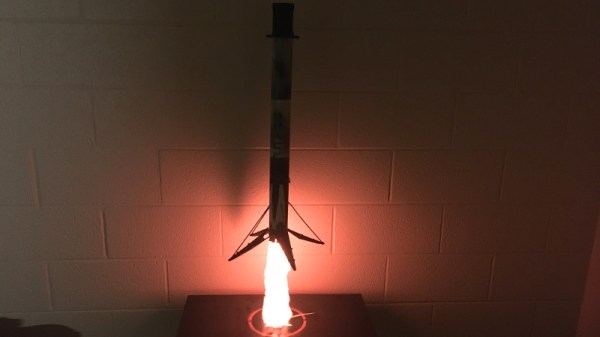
Though it can’t quite compare to the real thing, this 1:60 scale Falcon 9 lamp by [Sir Michael II] promises to bring a little of that excitement home every time you flick on the light. Combining a scratch built model of the reusable booster with some RGB LEDs, the hovering tableau recreates the tense final seconds before the towering rocket comes to a rest on its deployable landing legs. We imagine those last moments must seem like an eternity for the SpaceX engineers watching from home as well.
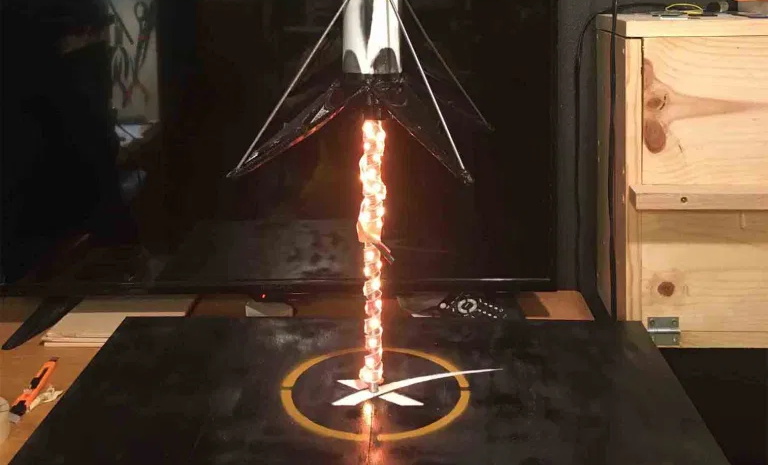
The LED “exhaust” without the fluff.
[Michael] walks readers through assembling the Falcon 9 model, which cleverly uses a 2 inch white PVC pipe as the fuselage. After all, why waste the time and material printing a long white cylinder when you can just buy one at the hardware store for a few bucks?
Dressed up with 3D printed details from Thingiverse user [twuelfing] and splashed with a bit of paint, it makes for a very convincing model. While the diameter of the pipe isn’t quite right for the claimed 1:60 scale, unless Elon Musk is coming over your place to hang out, we don’t think anyone will notice.
The rocket is attached to the pad with a piece of threaded steel rod, around which [Michael] has wrapped one meter of RGB LEDs controlled by an Arduino Uno. With some polyester fiber filler as a diffuser and a bit of code to get the LEDs flickering, he’s able to produce a realistic “flame” that looks to be coming from the Falcon 9’s center engine. While we admit it may not make a very good lamp in the traditional sense, it certainly gets extra points for style.
While the full steampunk aesthetic might be a bit much for most people, those antique gauges do have a certain charm about them. Unfortunately, implementing them on a modern project can be somewhat tricky. Even if you’ve got a stock of old gauges laying around, you’ve still got to modify the scale markings and figure out how to drive them with digital electronics. While we’ve seen plenty of people do it over the years, there’s no debating it’s a lot harder than just wiring up an I2C display.
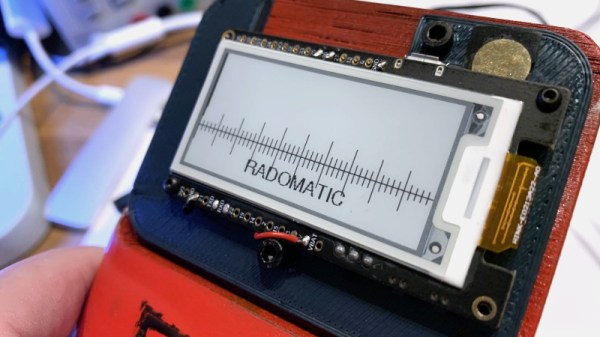
But maybe it doesn’t have to be. With his Rad-O-Matic, [Hans Jørgen Grimstad] created a pretty convincing “analog” gauge using a small e-ink panel. Of course it won’t fool anyone who gives it a close look, but at a glance, you could certainly be forgiven for thinking it was some kind of vintage indicator. Especially with the cracked and stained Fresnel lens he put in front of it.
For this project [Hans] used a LilyGo T5, which combines an ESP32 with a 2.13 inch electronic paper display. These are presumably meant to be development boards for digital signage applications, but they occasionally show up in hacker projects since they’re so easy to work with. The board pulls data from a RD200M radon sensor over a simple UART connection, and the current reading is indicated by a “needle” that moves across a horizontal scale on the display.
On its own, it wouldn’t look very vintage. In fact, quite the opposite. But [Hans] really helped sell the look on this project by designing and 3D printing a chunky enclosure and then weathering it to make it look like it’s been kicking around since the Cold War.
Over the last couple of years, we’ve seen a wave of impressive rugged mobile computing devices based on the ubiquitous Raspberry Pi. Sometimes they involve repurposing an existing heavy duty enclosure, and in others the Pi takes up residence in a 3D printed case which may or may not be as strong as it appears. In either event, they usually don’t lend themselves to duplication because of the time and expense involved in tracking down or printing all the parts required.
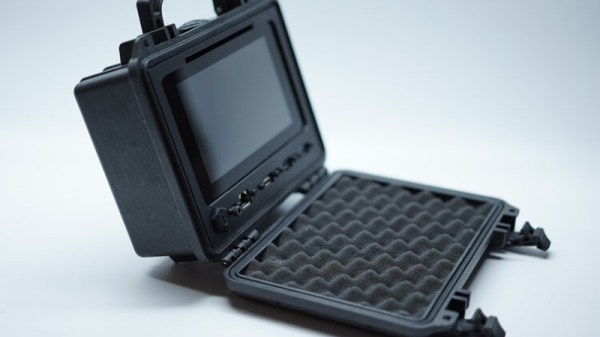
But the Raspberry Pi Quick Kit by [Jay Doscher] may change that. It represents what must surely be the simplest and fastest route to a building a rugged mobile ARM computer for your hacking adventures. Beyond the Pelican 1150 case that serves as the outer enclosure, you only need three printed parts and a handful of fasteners to complete the build. Of course you’ll need a Raspberry Pi and the official touch screen as well, but that’s sort of a given.
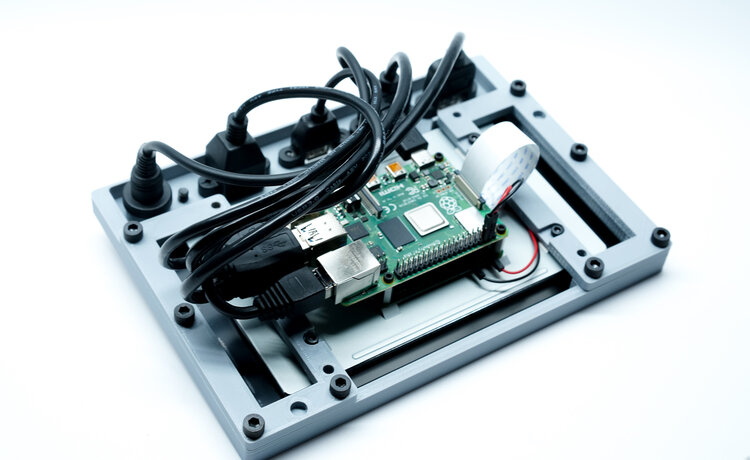
Electronics mounted to the 3D printed frame.
All of the electronics mount onto the three piece 3D printed frame, which is then press-fit into the opening of the Pelican case. Since you don’t need to pop any holes through the case itself, the assembled unit remains water and air tight. While [Jay] has recently shown off a very impressive 3D printed Pi enclosure, there’s really no beating a legitimate heavy duty storage case if you’re trying to protect the hardware.
When you want to use the Pi, just open the case and plug your power and accessories into the panel mount connectors under the display. There’s no integrated battery or keyboard on this build, but considering how small it is, that shouldn’t really come as a surprise.
[Jay] is targeting the Pi 4 for the Quick Kit, so that means WiFi and Bluetooth will come standard without the need for any external hardware. It looks like there might just be enough room to include an RTL-SDR receiver inside the case as well, but you’ll need to do a little redesigning of the 3D printed parts. If you do modify this design to pack in a few new tricks, we’d love to hear about it.