Driving A 16×2 LCD With Voltage Modulation

The basic 16×2 LCD is an extremely popular component that we’ve seen used in more projects than we could possibly count. Part of that is because modern microcontrollers make it so easy to work with; if you’ve got an I2C variant of the display, it only takes four wires to drive it. That puts printing a line of text on one of these LCDs a step or two above blinking an LED on a digital pin on the hierarchy of beginner’s electronics projects.
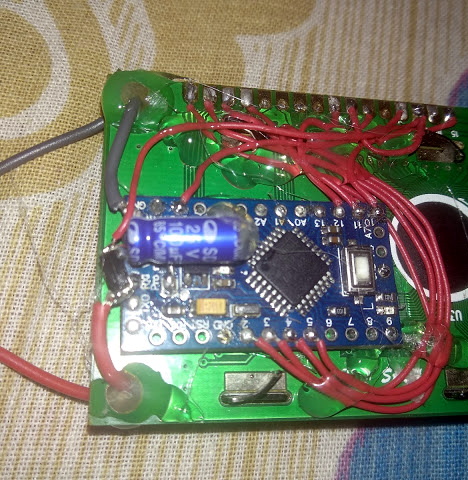
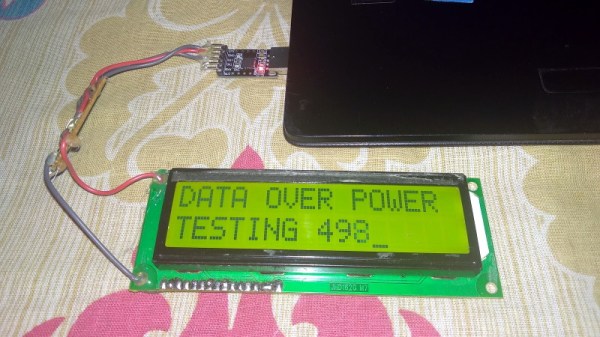
What’s that? Even four wires is too many? In that case, you might be interested in this hack from [Vinod] which shows how you can drive the classic 16×2 with data and power on the same pair of wires. You’ll still need a microcontroller “backpack” for the LCD to interpret the modulated voltage, but if you’ve got an application for a simple remote display, this is definitely worth checking out.

The basic idea is to “blink” the 5 V line so quick that a capacitor on the LCD side can float the electronics over the dips in voltage. As long as one of the pins of the microcontroller is connected to the 5 V line before the capacitor, it will be able to pick up when the line goes low. With a high enough data rate and a large enough capacitor as a buffer, you’re well on the way to encoding your data to be displayed.

For the transmitting side, [Vinod] is using a Python script on his computer that’s sending out the text for the LCD over a standard USB to UART converter. That’s fed into a small circuit put together on a scrap of perfboard that triggers a MOSFET off of the UART TX line.

We actually covered the theory behind this technique years ago, but it’s always interesting to see somebody put together a real-world example. There might not be too many practical uses for this trick in the era of dirt-cheap microcontrollers bristling with I/O, but it might make a fun gag at your hackerspace.

Continue reading “Driving A 16×2 LCD With Voltage Modulation”
Resistance Is Futile, You Want This LED Cube

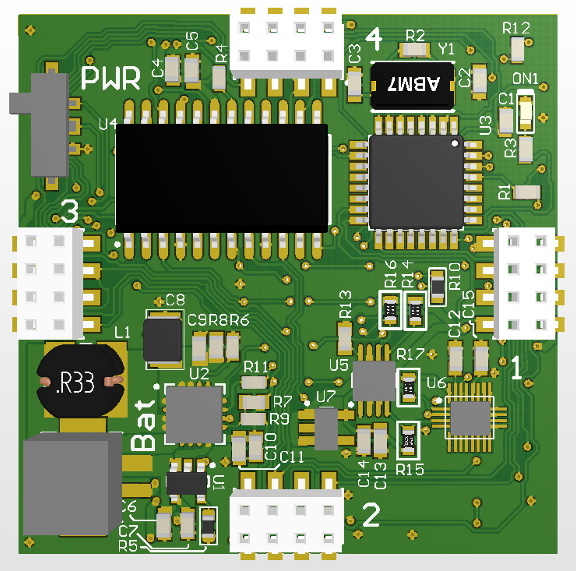
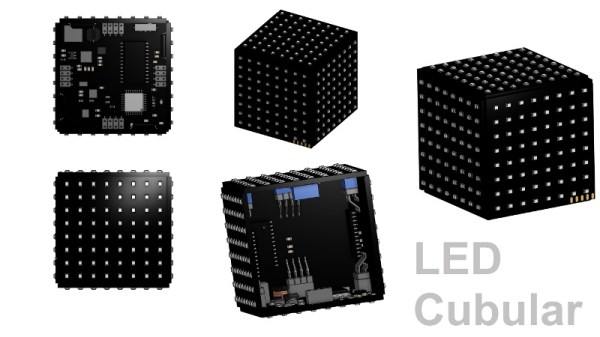
We’re suckers for a good desk toy here at Hackaday, so this 2019 Hackaday Prize entry from [Jack Flynn] certainly caught our eye. The idea is that by using professionally manufactured dual layer PCBs and only surface mount components, you can create a cube that has an LED matrix on each face and all of the electronics hidden within. We’re not entirely sure if there’s any practical application for such a device, but we know we’d certainly like to have one blinking madly away on our shelf regardless.

Before having any of the PCBs manufactured, [Jack] is putting a considerable amount of thought into the design so he doesn’t end up painting himself info a corner (which is of course eight times as bad when you’re building a cube). By importing the PCB files into OnShape, he’s able to “assemble” a virtual representation of the final product to better understand how everything will fit together. He wants to limit the amount of times the cube will need to be pulled apart, so everything from how it will sit in its 3D printed cradle to the placement of breakaway tabs that ensure the internal power switch is accessible are being carefully planned out.

The current design puts the “brains” on the bottom board, with every other panel holding a daisy-chained MAX7219 to drive its own individual 64 LED matrix. Initially the dimensions of the ATmega328p powered cube will be 42 x 42 x 42 mm, with a total of 384 LEDs. Ultimately, [Jack] hopes the modular nature of the design could allow the size of the cube to be increased, or perhaps even take on a different shape entirely.

Generally the LED cubes we see are of the more wiry variety, so it’s particularly interesting when they take on solid forms like this one. Given the nearly universal popularity of blinking LED gadgets, we think this particular project is well positioned to make the leap from one-off hack to a commercial product.

Continue reading “Resistance Is Futile, You Want This LED Cube”

RFID Payment Ring Made From Dissolved Credit Card

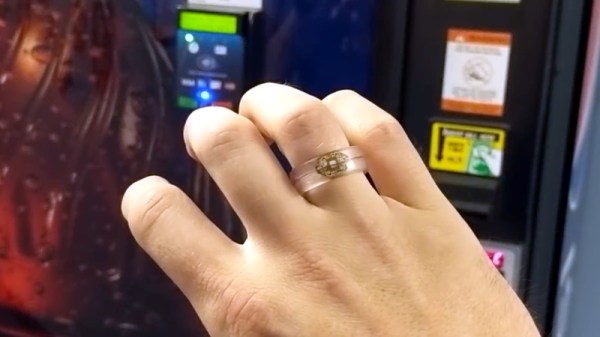
RFID payment systems are one of those things that the community seems to be divided on. Some only see the technology as a potential security liability, and will go a far as to disable the RFID chip in their card so that it can’t be read by a would-be attacker. Others think the ease and convenience of paying for goods by tapping their card or smartphone on the register more than makes up for the relatively remote risk of RFID sniffers. Given the time and effort [David Sikes] put into creating this contactless payment ring, we think it’s pretty clear which camp he’s in.

Alright, so the whole ring making part sounds easy enough, but how does one get an RFID chip that’s linked to their account? Easy. Just call the bank and ask them for one. Of course, they won’t just send you out a little RFID chip and antenna to mount in your hacked up project. (If only things were so simple!) But they will send you a new card if you tell them your old one is getting worn out and needs a replacement. All you have to do when it gets there is liberate the electronics without damaging them.

[David] found that an hour or so in an acetone bath was enough to dissolve the plastic and expose the epoxy-encased RFID chip, assuming you scrape the outer layers of the card off first. He notes that you can speed this part of the process up considerably if you know the exact placement and size of the RFID chip; that way you can cut out just the area you’re interested in rather than having to liquefy the whole card.

Once you have your chip, you just need to mount it into a ring. [David] has designed a 3D printable frame (if you’ve got a high-resolution SLA machine, that is) which accepts the chip and a new antenna made from a coil of 38 AWG magnet wire. With the components settled into the printed frame, its off to a silicone mold and the liberal application of epoxy resin to encapsulate the whole thing in a durable shell.

If a ring is not personal enough for you, then the next step is getting the RFID chip implanted directly into your hand. There are even folks at hacker cons who will do that sort of thing for you, if you’re squeamish.

Continue reading “RFID Payment Ring Made From Dissolved Credit Card”

Retrotechtacular: Balloons Go To War

To the average person, the application of balloon technology pretty much begins and ends with birthday parties. The Hackaday reader might be able to expand on that a bit, as we’ve covered several projects that have lofted various bits of equipment into the stratosphere courtesy of a high-altitude balloons. But even that is a relatively minor distinction. They might be bigger than their multicolored brethren, but it’s still easy for a modern observer to write them off as trivial.

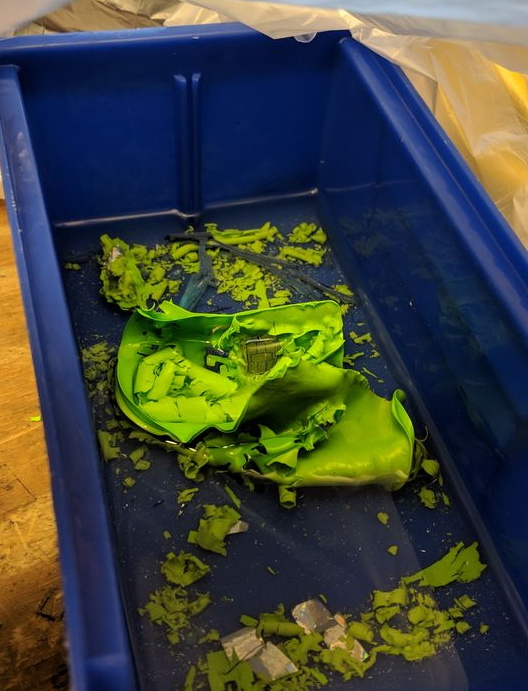
But during the 1940’s, they were important pieces of wartime technology. While powered aircraft such as fighters and bombers were obviously more vital to the larger war effort, balloons still had numerous defensive and reconnaissance applications. They were useful enough that the United States Navy produced a training film entitled History of Balloons which takes viewers through the early days of manned ballooning. Examples of how the core technology developed and matured over time is intermixed with footage of balloons being used in both the First and Second World Wars, and parallels are drawn to show how those early pioneers influenced contemporary designs.

Even when the film was produced in 1944, balloons were an old technology. The timeline in the video starts all the way back in 1783 with the first piloted hot air balloon created by the Montgolfier brothers in Paris, and then quickly covers iterative advancements to ballooning made into the 1800’s. As was common in training films from this era, the various “reenactments” are cartoons complete with comic narration in the style of W.C. Fields which were designed to be entertaining and memorable to the target audience of young men.

While the style might seem a little strange to modern audiences, there’s plenty of fascinating information packed within the film’s half-hour run time. The rapid advancements to ballooning between 1800 and the First World War are detailed, including the various instruments developed for determining important information such as altitude and rate of climb. The film also explains how some of the core aspects of manned ballooning, like the gradual release of ballast or the fact that a deflated balloon doubles as a rudimentary parachute in an emergency, were discovered quite by accident.

When the film works its way to the contemporary era, we are shown the process of filling Naval balloons with hydrogen and preparing them for flight. The film also talks at length about the so-called “barrage balloons” which were used in both World Wars. Including a rather dastardly advancement which added mines to the balloon’s tethers to destroy aircraft unlucky enough to get in their way.

This period in human history saw incredible technological advancements, and films such as these which were created during and immediately after the Second World War provide an invaluable look at cutting edge technology from a bygone era. One wonders what the alternative might be for future generations looking back on the technology of today.

Continue reading “Retrotechtacular: Balloons Go To War”

House Training A Military TA-1024A Field Telephone

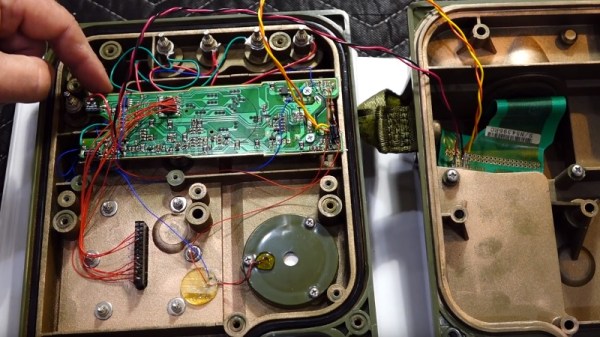
After spotting some interesting military phones at a museum, [CuriousMarc] wondered what it would take to retrofit these heavy duty pieces of telecom equipment for civilian use. He knew most of the internals would be a lost cause, but reasoned that if he could reverse engineer key elements such as the handset and keypad, he might be able to connect them to the electronics of a standard telephone. Luckily for us, he was kind enough to document the process.

There were a number of interesting problems that needed to be solved, but the first and perhaps largest of them was the unusual wiring of the keypad. It wasn’t connected in the way modern hackers like us might expect, and [CuriousMarc] had to end up doing some pretty significant rewiring. By cutting the existing traces on the PCB with a Dremel and drilling new holes to run his wires around the back, he was able to convert it over to a wiring scheme that contemporary touch tone phones could use.

An adapter needed to be fabricated to mount a basic electret microphone in place of the original dynamic one, but the original speaker was usable. He wanted to adapt the magnetic sensor that detected when the handset was off the hook, but in the end it was much easier to just drill a small hole and use a standard push button.

The main board of the phone is a perfect example of the gorgeous spare-no-expense construction you’d expect from a military communications device, but unfortunately it had to go in the bin. In its place is the guts of a lowly RCA phone that was purchased for the princely sum of $9.99. [CuriousMarc] won’t be able to contact NORAD anymore, but at least he’ll be able to order a pizza. The red buttons on the keypad, originally used to set the priority level of the call on the military’s AUTOVON telephone network, have now been wired to more mundane features of the phone such as redial.

While this is fine for a one-off project, we’d love to see a drop-in POTS or VoIP conversion for these phones that didn’t involve so much modification and rewiring. Now that we have some documentation for things like the keypad and hook sensor, it shouldn’t be hard to take their idiosyncrasies into account with a custom PCB. Dragging vintage gear into the modern era is always a favorite pastime for hackers, so maybe somebody out there will be inspired to take on the challenge.

Continue reading “House Training A Military TA-1024A Field Telephone”

Prusa Launches Their Own 3D Model Repository

If you own a 3D printer, you’ve heard of Thingiverse. The MakerBot-operated site has been the de facto model repository for 3D printable models since the dawn of desktop 3D printing, but over the years it’s fallen into a state of disrepair. Dated and plagued with performance issues, many in the community have been wondering how long MakerBot is still going to pay to keep the lights on. Alternatives have popped up occasionally, but so far none of them have been able to amass a large enough userbase to offer any sort of real competition.

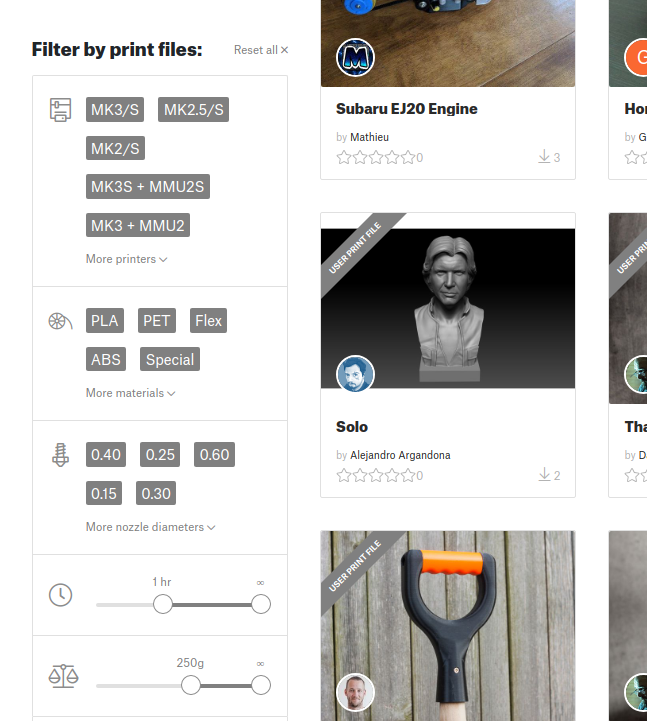
Sorting models by print time and material required.

But that might soon change. [Josef Průša] has announced a revamped community for owners of his 3D printers which includes a brand-new model repository. While clearly geared towards owners of Prusa FDM printers (support for the new SLA printer is coming at a later date), the repository is not exclusive to them. The immense popularity of Prusa’s products, plus the fact that the repository launched with a selection of models created by well known designers, might be enough to finally give Thingiverse a run for its money. Even if it just convinces MakerBot to make some improvements to their own service, it would be a win for the community.

The pessimists out there will say a Prusa-run model database is ultimately not far off from one where MakerBot is pulling the strings; and indeed, a model repository that wasn’t tied to a particular 3D printer manufacturer would be ideal. But given the passion for open development demonstrated by [Josef] and his eponymous company, we’re willing to bet that the site is never going to keep owners of other printers from joining in on the fun.

That being said, knowing that the users of your repository have the same printer (or a variant, at least) as those providing the designs does have its benefits. It allows for some neat tricks like being able to sort designs by their estimated print time, and even offers the ability to upload and download pre-sliced GCode files in place of traditional STLs. In fact, [Josef] boasts that this is the world’s only repository for ready-to-print GCode that you can just drop onto an SD card and print.

Regular Hackaday readers will know that we’ve been rather critical of the decisions made by MakerBot over the last few years, but to be fair we aren’t exactly alone in that respect. The community desperately needs a repository for printable models that’s in somebody else’s hands, and frankly we’re thrilled with the idea it could be [Josef Průša] leading the charge. His printers might not be perfect, and they certainly aren’t cheap, but they definitely don’t fail to impress. Here’s hoping this latest venture will be the same.

Continue reading “Prusa Launches Their Own 3D Model Repository”

3D Printering: The Quest For Printable Food

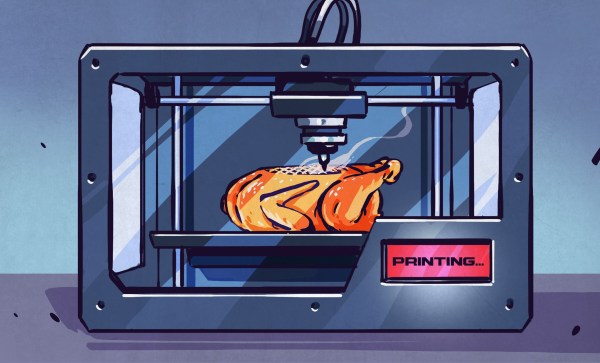
A video has been making the rounds on social media recently that shows a 3D printed “steak” developed by a company called NovaMeat. In the short clip, a machine can be seen extruding a paste made of ingredients such as peas and seaweed into a shape not entirely unlike that of a boot sole, which gets briefly fried in a pan. Slices of this futuristic foodstuff are then fed to passerby in an effort to prove it’s actually edible. Nobody spits it out while the cameras are rolling, but the look on their faces could perhaps best be interpreted as resigned politeness. Yes, you can eat it. But you could eat a real boot sole too if you cooked it long enough.

To be fair, the goals of NovaMeat are certainly noble. Founder and CEO Giuseppe Scionti says that we need to develop new sustainable food sources to combat the environmental cost of our current livestock system, and he believes meat alternatives like his 3D printed steak could be the answer. Indeed, finding ways to reduce the consumption of meat would be a net positive for the environment, but it seems his team has a long way to go before the average meat-eater would be tempted by the objects extruded from his machine.

But the NovaMeat team aren’t the first to attempt coaxing food out of a modified 3D printer, not by a long shot. They’re simply the most recent addition to a surprisingly long list of individuals and entities, not least of which the United States military, that have looked into the concept. Ultimately, they’ve been after the same thing that convinced many hackers and makers to buy their own desktop 3D printer: the ability to produce something to the maker’s exacting specifications. A machine that could produce food with the precise flavors and textures specified would in essence be the ultimate chef, but of course, it’s far easier said than done.

Continue reading “3D Printering: The Quest For Printable Food”