ISS Astronaut Shows Off SpaceX’s Stylish Spacesuit

Beyond the fact that Hollywood costume designer Jose Fernandez was called in to develop its distinctively superhero look, SpaceX hasn’t released a lot of public information about their high-tech spacesuit. But thanks to Japanese astronaut [Soichi Noguchi], Mission Specialist on the first operational Crew Dragon flight and a current occupant of the International Space Station, we now have a guided tour of the futuristic garment. The fact that it was recorded in space is just an added bonus.

As it was released on his personal YouTube account and isn’t an official NASA production, the video is entirely in Japanese, though most of it can be understood from context. You can try turning on the automatic English translations, but unfortunately they seem to be struggling pretty hard on this video. For example as [Soichi] demonstrates the suit’s helmet, the captions read “A cat that is said to have been designed using a 3D printer.” Thanks, Google.

Still, this video provides us with the most information we’ve ever had about how astronauts store, wear, and operate the suit. [Soichi] starts by showing off the personalized bags that the suits are kept in and then explains how the one-piece suit opens on the bottom so the wearer can pull it on over their head. He also points out the three layers the suit is made of: a Teflon-coated outer shell, a fiber-reinforced core for strength, and an inner airtight garment.

Little details are hidden all over the suit, such as a track built into the heel of the boot that’s used to restrain the astronaut’s feet to the Crew Dragon’s seats. [Soichi] also provides what appears to be the first public view of the umbilical connector on the suit. Hidden under a removable cover, the connector features 14-pins for data and power, a wide port for air circulation, and smaller high-pressure port for nitrox that would presumably be used to inflate the suit should the cabin lose pressure while in flight.

It’s taken an incredible amount of work to get commercial spacecraft such as the Dragon to the point that they can begin ferrying crews to the ISS. This close look at all the details that went into something as seemingly mundane as the suit astronauts wear while riding in their craft is a reminder that nothing about human spaceflight is easy.

Continue reading “ISS Astronaut Shows Off SpaceX’s Stylish Spacesuit”

Raspberry Pi Spigot Puts Digits Of Pi On Tap

What did you do for Pi Day? Play with your Raspberry Pi 400? Eat some pizza or other typically round objects and recite all nine digits you’ve got memorized? That’s about where we were at this year. But not [bornach], no. [bornach] went all out and built a spigot that spews digits of Pi well past the first nine decimal places.

This clever spigot sculpture implements the spigot algorithm for generating digits of Pi one-by-one in a stream on to a chain of 8×8 matrices, and does so using a Raspberry Pi (of course). The point of the spigot algorithm is to store as few numbers as possible at any given time by reusing variables. We love the way the digits materialize on the matrix, almost as if they are ink being activated by water. Be sure to check out the build and demo video after the break.

That 10k pot on the top really does control the spigot — since the Pi has no ADC, [bornach] is using the potentiometer to charge a capacitor and using the time it takes to reach the threshold to decide whether the faucet is open or closed. There are a couple of hacks at play here, including the Popsicle-stick LED matrix bracing and the HAT [bornach] fashioned so the daisy-chained 8×8 LED modules could interface with the Pi.

We love Raspberry Pis of all eras around here, especially the darling new Pico. Diminutive as it may be, the Pico can be sliced even smaller with a hacksaw if you don’t mind losing a few GPIO pins.

Continue reading “Raspberry Pi Spigot Puts Digits Of Pi On Tap”

Mercedes Split Turbo Was A Game Changer In Formula 1

In 2014, Formula 1 switched away from V8 engines, electing instead to mandate all teams race with turbocharged V6 engines of 1.6 litres displacement, fitted with advanced energy recovery systems. The aim was to return Formula 1 to having some vague notion of relevance to modern road car technologies, with a strong focus on efficiency. This was achieved by mandating maximum fuel consumption for races, as well as placing a heavy emphasis on hybrid technology.

The Mercedes W05 Hybrid was the first of 7 championship-winning F1 cars from the British-based, German-funded team. It quickly showed the value of the team’s split-turbo technology.

Since then, Mercedes have dominated the field in what is now known as the turbo-hybrid era. The German team has taken home every drivers and constructors championship since, often taking home the crown well before the season is over. Much has been made of the team’s engine as a key part of this dominance, widely considered to be more powerful and efficient than the competition at all but a few select races in the last seven years, and much of the credit goes to the company’s innovative split-turbo system. Today, we’ll explore why the innovation was such a game changer in Formula 1.

Continue reading “Mercedes Split Turbo Was A Game Changer In Formula 1”

Bring A Hack Is Back This Thursday!

As the pandemic edges further into its second year, the tedium of life under lockdown is taking its toll. We may be fighting the spread of infection by staying home and having our meetings over video conferencing software, but it’s hellishly boring! What we wouldn’t do for our hackerspaces to be open, and for the chance to hang out and chew the fat about our lockdown projects!

Here at Hackaday we can bring some needed relief in the form of the Hackaday Remote: Bring-A-Hack held via Zoom on Thursday, April 8th, at 1pm Pacific time. We know you’ve been working hard over the last year, and since you’ve been denied the chance to share those projects in person, we know you just can’t wait to sign up. Last year’s Remoticon showed us the value of community get-togethers online, with both the team soldering challenge rounds and the bring-a-hack being particular event highlights, so it’s time for a fresh dose to keep up our spirits.

It doesn’t matter how large or small your project is, if it interests you other readers will also want to see it. Be prepared to tell the world how you made it, what problems you solved, and a bit about yourself, and then step back, take a bow, and be showered with virtual roses from the adoring masses. There’s a sign-up link if you have a project to show off Looks like we’re full up for planned presenations, but still come and bring your hacks for showing in conversation groups. Don’t hold back if you’re worried it’s not impressive enough, a certain Hackaday scribe has submitted an OpenSCAD library she’s working on.

Open Source Electric Vehicle Charging

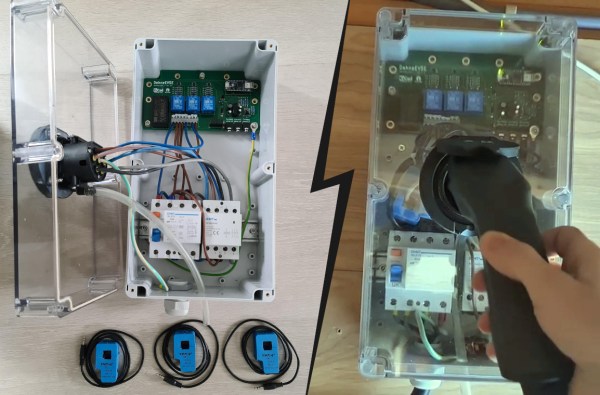
Electric vehicles are becoming more and more common on the road, but when they’re parked in the driveway or garage there are still some kinks to work out when getting them charged up. Sure, there are plenty of charging stations on the market, but they all have different features, capabilities, and even ports, so to really make sure that full control is maintained over charging a car’s batteries it might be necessary to reach into the parts bin and pull out a trusty Arduino.

This project comes to us from [Sebastian] who needed this level of control over charging his Leaf, and who also has the skills to implement it from the large high voltage switching contactors to the software running its network connectivity and web app. This charging station has every available feature, too. It can tell the car to charge at different rates, and can restrict it to charging at different times (if energy is cheaper at night, for example). It is able to monitor the car’s charge state and other information over the communications bus to the vehicle, and even has a front-end web app for monitoring and controlling the device.

The project is based around an Arduino Nano 33 IoT with all of the code available on the project’s GitHub page. While we would advise using extreme caution when dealing with mains voltage and when interfacing with a high-ticket item like an EV, at first blush the build looks like it has crossed all its Ts and might even make a good prototype for a production unit in the future. If you don’t need all of the features that this charging station has, though, you can always hack the car itself to add some more advanced charging features.

Continue reading “Open Source Electric Vehicle Charging”

Death Of The Turing Test In An Age Of Successful AIs

IBM has come up with an automatic debating system called Project Debater that researches a topic, presents an argument, listens to a human rebuttal and formulates its own rebuttal. But does it pass the Turing test? Or does the Turing test matter anymore?

The Turing test was first introduced in 1950, often cited as year-one for AI research. It asks, “Can machines think?”. Today we’re more interested in machines that can intelligently make restaurant recommendations, drive our car along the tedious highway to and from work, or identify the surprising looking flower we just stumbled upon. These all fit the definition of AI as a machine that can perform a task normally requiring the intelligence of a human. Though as you’ll see below, Turing’s test wasn’t even for intelligence or even for thinking, but rather to determine a test subject’s sex.

Continue reading “Death Of The Turing Test In An Age Of Successful AIs”

Flight Of The Pterothopter: A Jurassic-Inspired Ornithopter

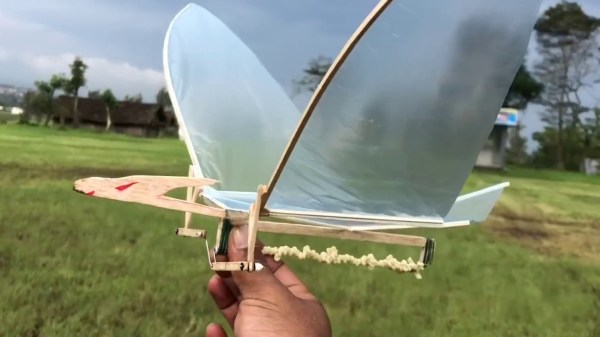
Ornithopters look silly. They look like something that shouldn’t work. An airplane with no propeller and wings that go flappy-flappy? No way that thing is going to fly. There are, however, a multitude of hobbyists, researchers, and birds who would heartily disagree with that sentiment, because ornithopters do fly. And they are almost mesmerizing to watch when they do it, which is just one reason we love [Hobi Cerdas]’s build of the Pterothopter, a rubber band-powered ornithopter modeled after a pterodactyl.

All joking aside, the science and research behind ornithopters and, relatedly, how living organisms fly is fascinating in itself — which is why [Lewin Day] wrote that article about how bees manage to become airborne. We can lose hours reading about this stuff and watching videos of prototypes. While most models we can currently build are not as efficient as their propeller-powered counterparts, the potential of evolutionarily-perfected flying mechanisms is endlessly intriguing. That alone is enough to fuel builds like this for years to come.

As you can see in the video below, [Hobi Cerdas] went through his own research and development process as he got his Pterothopter to soar. The model proved too nose-heavy in its maiden flight, but that’s nothing a little raising of the tail section and a quick field decapitation couldn’t resolve. After a more successful second flight, he swapped in a thinner rubber band and modified the wing’s leading edge for more thrust. This allowed the tiny balsa dinosaur to really take off, flying long enough to have some very close encounters with buildings and trees.

For those of you already itching to build your own Pterothopter, the plans come from the Summer 2017 issue of Flapping Wings, the official newsletter of the Ornithopter Society (an organization we’re so happy to learn about today). You can also find more in-depth ornithopter build logs to help you get started. And, honestly, there’s no reason to limit yourself to uncontrolled flight; we’ve come across some very impressive RC ornithopters in the past.

Continue reading “Flight Of The Pterothopter: A Jurassic-Inspired Ornithopter”