Extinguish Squeaks 24/7 With Refillable WD-40

It’s 10:34PM and you’ve just run out of water displacement formula #40. You could wait until tomorrow to get a new can, or you could spend the rest of the night turning an old, empty fire extinguisher into a refillable and re-pressurizable WD-40 dispenser like [liquidhandwash] did. The part count is pretty low, but it’s awfully specific.

And the emphasis is on empty extinguisher. Part of the deal involves twisting the gauge off, and we wouldn’t want you to get blasted in the face with any last gasps of high-powered firefighting foam. In order to make the thing re-pressurizable, [liquidhandwash] stripped all the rubber from a tire valve and removed the core temporarily so it could be soldered into the fitting where the gauge was. The handy hose is from a large can of WD-40, which is also where the label came from — since it’s no longer a fire extinguisher, it needs to stop bearing resemblance to one, so [liquidhandwash] removed the sticker, painted it blue, and glued the cut-open can to the outside.

To use it, [liquidhandwash] fills it up about halfway and then pressurizes it through the tire valve with a bike pump or compressor. (We think we’d go with bike pump.) Since [liquidhandwash] goes through so much lubricant, now, they can just buy it by the gallon and keep refilling the extinguisher.

Is WD-40 your everything hammer? Variety is the spice of shop life.

Hackaday Forced Into Light Mode

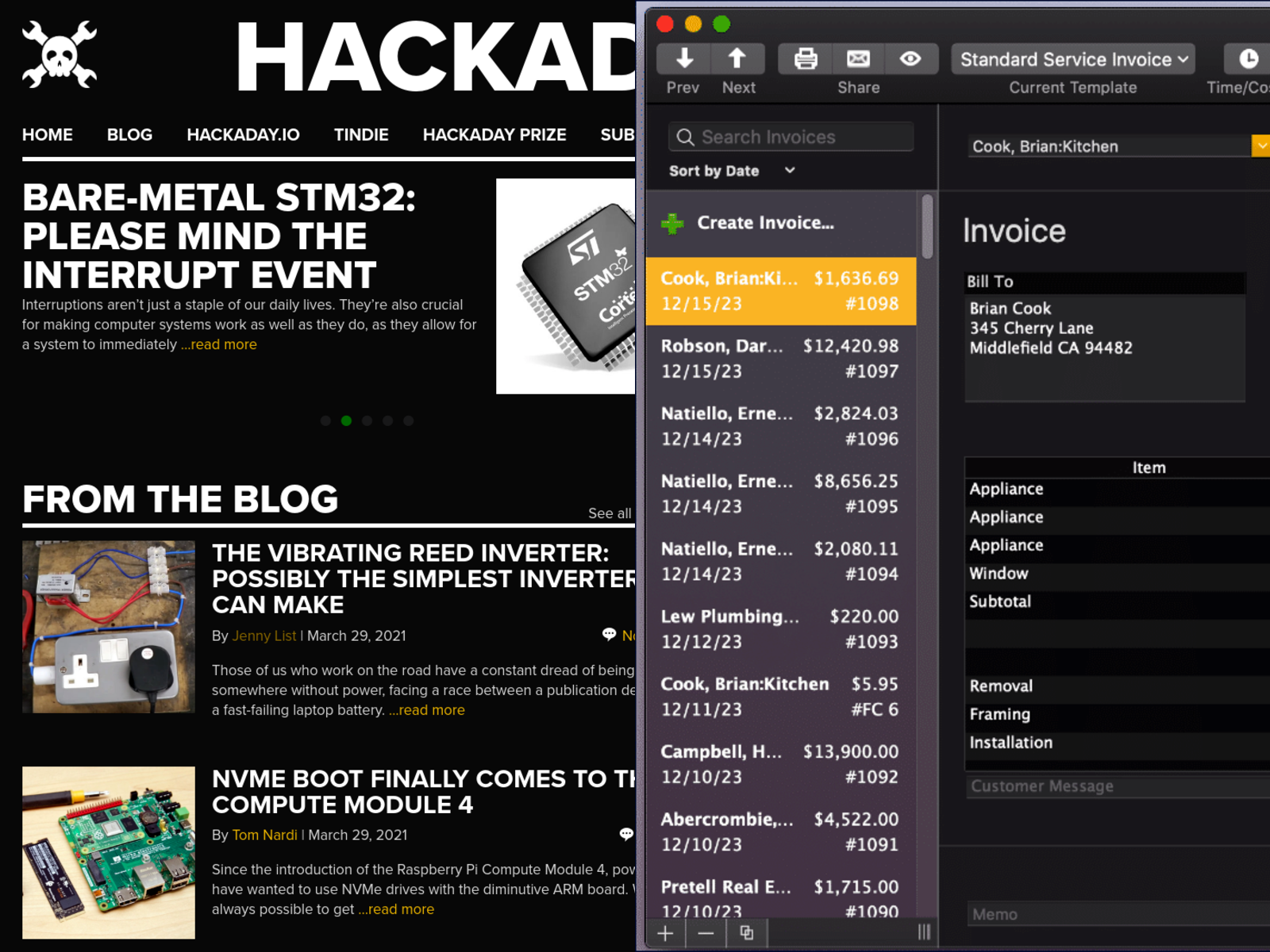
Hackaday has always been dark mode. Gray10 is less jarring when you’re burning the midnight oil on a project, so we give you a lot of it. Fifteen years ago, it was called “reverse video” or “trog mode“, and we were the freaks. We were doing it wrong. We had the colors “backwards”. Dark mode used to be edgy, outré, but dare we say it, a bit sexy.

Hackaday … QuickBooks. Just sayin’.
They even ripped our highlight yellow!

Flash forward, and everyone has come over to the dark side. Facebook has a dark mode. Google has dark mode. Across the Microsoft empire, from Windows 10 to GitHub, you can live your life in the dark. Heck, even the White House has a dark mode! (They call it high-contrast mode, but they’re not fooling anyone.)

Dark mode here, dark mode there. It’s mainstream. Dark mode has become corporate cool which is nobody’s idea of cool.

We’re not saying that all of the aforementioned institutions are biting the Hackaday style, but, well, they’re all biting our style. Where were they when we were the only website on the whole darn Internet with a sensible background color? Huh? Dark-mode-come-latelys!

But Hackaday doesn’t rest on its laurels. We have our fingers on the pulse on the modern hacker. Where previously you would be up late at night researching Hackaday for juicy nuggets of communal wisdom to help out with your current hack, you’re probably “telecommuting” these days — a euphemism for working on your private projects even while the fiery ball is still in the sky. (Wink, wink, nudge, nudge.) It’s only natural that you’d want a lighter background color to match your new lifestyle. We hear you!

So we present you, Hackaday Light Mode™. Enjoy!

[Editor’s note: For historical accuracy, we had phosphor green headings in the very beginning, in place of the jarring white. If you want to relive those glory days of yore, or just to go back to Hackaday in dark mode, there’s always CSS scripting.]

Mining Bitcoin On The Nintendo Game Boy

Mining cryptocurrency is a power intensive business, with big operations hoarding ASIC rigs and high-end GPUs in an endless quest for world domination money. The Bitcoin-mining Game Boy from [stacksmashing] is one of them. (Video, embedded below.)

The hack is relatively straightforward. The Game Boy is hooked up to a PC via a Raspberry Pi Pico and a level shifter to handle the different voltage levels. The Game Boy runs custom software off a flash cart, which runs the SHA hash algorithm on incoming data from the PC and reports results back to the PC which communicates with the Bitcoin network.

[stacksmashing] does a great job of explaining the project, covering everything from the Game Boy’s link port protocol to the finer points of the Bitcoin algorithm in explicit detail. For the technically experienced, everything you need to know to recreate the project is there. While the Game Boy manages just 0.8 hashes per second, trillions of times slower than cutting edge hardware, the project nonetheless is amusing and educational, so take that into consideration before firing off hot takes in the comments below. If you’re really interested in the underlying maths, you can try crunching Bitcoin hashes with pen and paper.

Continue reading “Mining Bitcoin On The Nintendo Game Boy”

JIT Vs. AM: Is Additive Manufacturing The Cure To Fragile Supply Chains?

As fascinating and frustrating as it was to watch the recent Suez canal debacle, we did so knowing that the fallout from it and the analysis of its impact would be far more interesting. Which is why this piece on the potential of additive manufacturing to mitigate supply chain risks caught our eye.

We have to admit that a first glance at the article, by [Davide Sher], tripped our nonsense detector pretty hard. After all, the piece appeared in 3D Printing Media Network, a trade publication that has a vested interest in boosting the additive manufacturing (AM) industry. We were also pretty convinced going in that, while 3D-printing is innovative and powerful, even using industrial printers it wouldn’t be able to scale up enough for print parts in the volumes needed for modern consumer products. How long would it take for even a factory full of 3D-printers to fill a container with parts that can be injection molded in their millions in China?

But as we read on, a lot of what [Davide] says makes sense. A container full of parts that doesn’t arrive exactly when they’re needed may as well never have been made, while parts that are either made on the factory floor using AM methods, or produced locally using a contract AM provider, could be worth their weight in gold. And he aptly points out the differences between this vision of on-demand manufacturing and today’s default of just-in-time manufacturing, which is extremely dependent on supply lines that we now know can be extremely fragile.

So, color us convinced, or at least persuaded. It will certainly be a while before all the economic fallout of the Suez blockage settles, and it’ll probably longer before we actually see changes meant to address the problems it revealed. But we would be surprised if this isn’t seen as an opportunity to retool some processes that have become so optimized that a gust of wind could take them down.

One Bit CPU Runs At A Blistering 60Hz

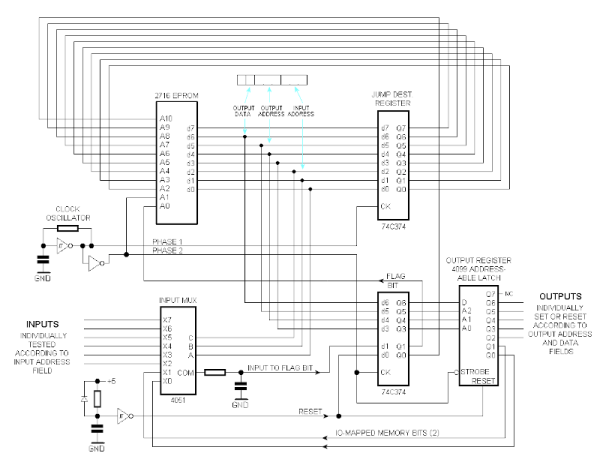
If you really think hard about it, a CPU is just a very general-purpose state machine. Well, most CPUs are, anyway. The MC14500 is a one-bit computer that has only 16 instructions and was meant to serve in simple tasks where a big CPU wouldn’t work for space, power, or budget reasons. However, [Laughton] took the idea one step further and created a single-bit computer with no real instructions to control a printing press. The finished machine uses a clever format in an EEPROM to drive an endless program.

Honestly, we’d say this is more of a state machine, but we like the idea of it being a minimal CPU which is also true. The design uses the EEPROM in an odd way. Each CPU address really addresses a block of four bytes. The byte that gets processed depends on the current phase and the status of the one-bit flag register.

Continue reading “One Bit CPU Runs At A Blistering 60Hz”

Scratch-Built CO2 Laser Tube Kicks Off A Laser Cutter Build

When we see a CO2 laser cutter build around these parts, chances are pretty good that the focus will be on the mechatronics end, and that the actual laser will be purchased. So when we see a laser cutter project that starts with scratch-building the laser tube, we take notice.

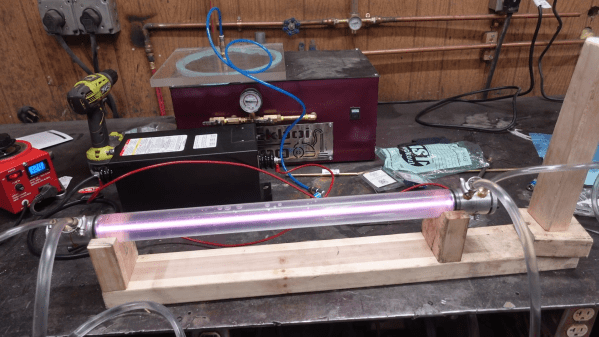
[Cranktown City]’s build style is refreshingly informal, but there’s a lot going on with this build that’s worth looking at — although it’s perhaps best to ignore the sourcing of glass tubing by cutting the ends off of an old fluorescent tube; there’s no mention of what became of the mercury vapor or liquid therein, but we’ll just assume it was disposed of safely. We’ll further assume that stealing nitrogen for the lasing gas mix from car tires was just prank, but we did like the rough-and-ready volumetric method for estimating the gas mix.

The video below shows the whole process of building and testing the tube. Initial tests were disappointing, but with a lot of tweaking and the addition of a much bigger neon sign transformer to power the tube, the familiar bluish-purple plasma made an appearance. Further fiddling with the mirrors revealed the least little bit of laser output — nowhere near enough to start cutting, but certainly on the path to the ultimate goal of building a laser cutter.

We appreciate [Cranktown City]’s unique approach to his builds; you may recall his abuse-powered drill bit index that we recently covered. We’re interested to see where this laser build goes, and we’ll be sure to keep you posted.

Continue reading “Scratch-Built CO2 Laser Tube Kicks Off A Laser Cutter Build”