Garbage Can Takes Itself Out

Home automation is a fine goal but typically remains confined to lights, blinds, and other things that are relatively stationary and/or electrical in nature. There is a challenge there to be certain, but to really step up your home automation game you’ll need to think outside the box. This automated garbage can that can take itself out, for example, has all the home automation street cred you’d ever need.

The garbage can moves itself by means of a scooter wheel which has a hub motor inside and is powered by a lithium battery, but the real genius of this project is the electronics controlling everything. A Raspberry Pi Zero W is at the center of the build which controls the motor via a driver board and also receives instructions on when to wheel the garbage can out to the curb from an Nvidia Jetson board. That board is needed because the creator, [Ahad Cove], didn’t want to be bothered to tell his garbage can to take itself out or even schedule it. He instead used machine learning to detect when the garbage truck was headed down the street and instruct the garbage can to roll itself out then.

The only other thing to tie this build together was to get the garage door to open automatically for the garbage can. Luckily, [Ahad]’s garage door opener was already equipped with WiFi and had an available app, unbeknownst to him, which made this a surprisingly easy part of the build. If you have a more rudimentary garage door opener, though, there are plenty of options available to get it on the internets.


Continue reading “Garbage Can Takes Itself Out”

3D-Printed Thermite Brings The Heat, And The Safety

Thermites are a double-edged sword. Packing a tremendous energy density, and eager to produce tremendous heat when ignited, thermite is great for welding train tracks. But sometimes you might be looking for a little more finesse. A new approach to 3D printing thermites might just be able to tame the beast.

Most of us do our soldering while sitting safely indoors in a comfortable climate. The biggest dangers we’re likely to face are burnt fingertips, forgetting the heat shrink, or accidentally releasing the smoke monster. But outside of our homes and workshops, there’s a lot of extreme joining of metals going on. No matter where it’s done, welding and brazing in the field requires a lot of equipment, some of which is unwieldy and even more difficult to move around in harsh conditions.

Welding railroad tracks with thermite. Image via YouTube

The utility of brazing is limited by all the complex scaffolding of hardware required to support it. This limiting factor and the discovery of thermite led to exothermic welding, which uses an energetic material to provide enough heat to melt a filler metal and join the pieces. Energetic materials can store a lot of chemical energy and forcefully release it in a short period of time.

Thermites are made of metal oxide and metal powder, often iron oxide and aluminium. When ignited by a source of high heat, thermite compounds undergo an exothermic reduction-oxidation (redox) reaction as the aluminium reduces the number of electrons in the iron oxide atoms. More heat makes the reaction run faster, generating more heat, and so on. The result is molten iron and aluminium oxide slag.

Continue reading “3D-Printed Thermite Brings The Heat, And The Safety”

Cell Phone Signal Booster Gets Teardown And Demo

Ever wonder what was inside a cell phone booster, or what it is like to set up or use one? If so, [Kerry Wong]’s got you covered with his teardown of a Cel-Fi Go X Cell Signal Booster by Nextivity. [Kerry] isn’t just ripping apart a cheap unit for laughs; his house has very poor reception and this unit was a carefully-researched, genuine investment in better 4G connectivity.

The whole setup consists of three different pieces: the amplifier unit pictured above, and two antennas. One is an omnidirectional dome antenna for indoors, and the other is a directional log-periodic dipole array (LPDA) antenna for outdoors. Mobile phones connect to the indoor antenna, and the outdoor antenna connects to the distant cell tower. The amplifier unit uses a Bluetooth connection and an app on the mobile phone to manage settings and actively monitor the device, which works well but bizarrely doesn’t seem to employ any kind of password protection or access control whatsoever.

Overall [Kerry] is happy, and reports that his mobile phone enjoys a solid connection throughout his house, something that was simply not possible before. Watch a hands-on of the teardown along with a short demonstration in the video embedded below.

Continue reading “Cell Phone Signal Booster Gets Teardown And Demo”

New Zealand To Test Wireless Power Transmission

Nikola Tesla wanted to beam power without wires. NASA talked about building power-generating satellites that would do the same thing. But now New Zealand’s second-largest power utility — Powerco — is working with a start-up company to beam energy to remote locations. There have been several news releases, but possibly the most technical detail is from an interview [Loz Blain] did with the founder of the startup company.

It isn’t really news that you can send radio waves somewhere and convert the signal back into power. Every antenna does that routinely. The question is how efficient is the power transmission and — when the power levels are high — how safe is it? According to [Greg Kushnir], the founder of Emrod, the technology is about 70% efficient and uses ISM frequencies.

Continue reading “New Zealand To Test Wireless Power Transmission”

A Real Working Lego NES

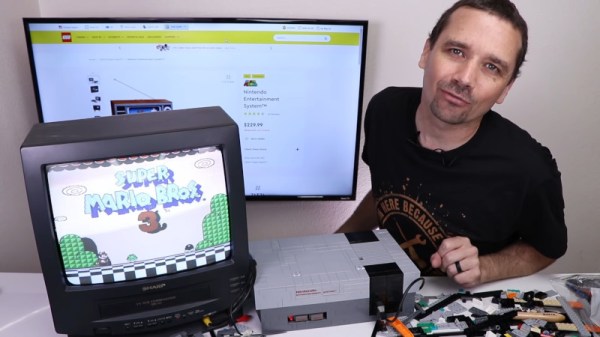
Lego is an entry into the world of engineering for many a youngster, and an enjoyable pursuit for many more. These days, high quality kits are available to make everything from the Tower of Pisa to Nintendo’s venerated NES console. [TronicsFix] picked up the latter set, and decided it needed to be fully functional.

Consisting of 2646 pieces, the official Lego NES is a faithful recreation of the original, albeit at approximately 80% of the size. After building the kit to spec, [TronicsFix] noted that there was no way a cartridge would fit in the slot.

Given this failing, a ground-up rebuild was in order. Starting with the internals from an original NES, [TronicsFix] set about building an appropriately sized base and working from there. Supports were built to mount the various components, with the controller ports being particularly well done, and the video output and power switches being a little more tricky. The many cosmetic pieces from the official kit came in handy here, giving the final product the aesthetic touches it needed to fit the bill.

The final result is an authentic, functional NES in a LEGO case. [TronicsFix] demonstrates as such, showing the console playing Super Mario 3. Nintendo consoles remain a favorite amongst modders; some going so far as to build fire-breathing creations. Video after the break.

Continue reading “A Real Working Lego NES”

Upgraded Infotainment Options On A 14 Year Old Mercedes

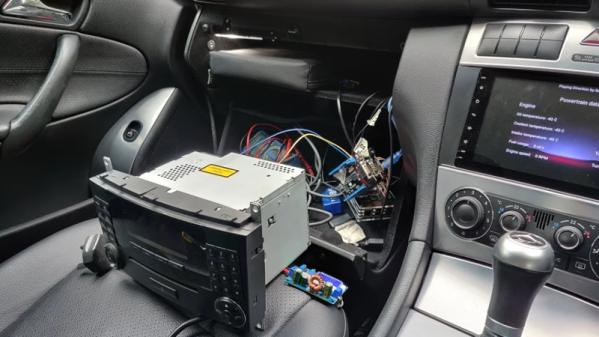
It used to be that upgrading a car stereo was fairly simple. There were only a few mechanical sizes and you could find kits to connect power, antennas, and speakers. Now, though, the car stereo has interfaces to steering wheel controls, speed sensors, rear-view cameras, and more. [RND_ASH] was tired of his 14-year-old system so he took an Android head unit, a tablet, and an Arduino, and made everything work as it was supposed to.

The key is to interface with the vehicle’s CAN bus which is a sort of local area network for the vehicle. Instead of having lots of wires running everywhere, today’s cars are more likely to have less wiring all shared with many devices.

Continue reading “Upgraded Infotainment Options On A 14 Year Old Mercedes”

Digital Pregnancy Tests Use LEDs To Read Between The Lines

[Foone] saw a tweet a few weeks ago alleging that digital pregnancy tests are a rip-off. Regular, cheap tests have an absorbent strip running the length of the plastic, with one end exposed for collecting urine. A few excruciating minutes later, a little plastic window in the middle will show one line, two lines, or a plus or minus sign depending on the presence of human chorionic gonadotropin (HCG) in the urine.

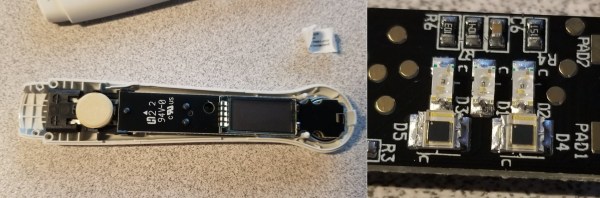
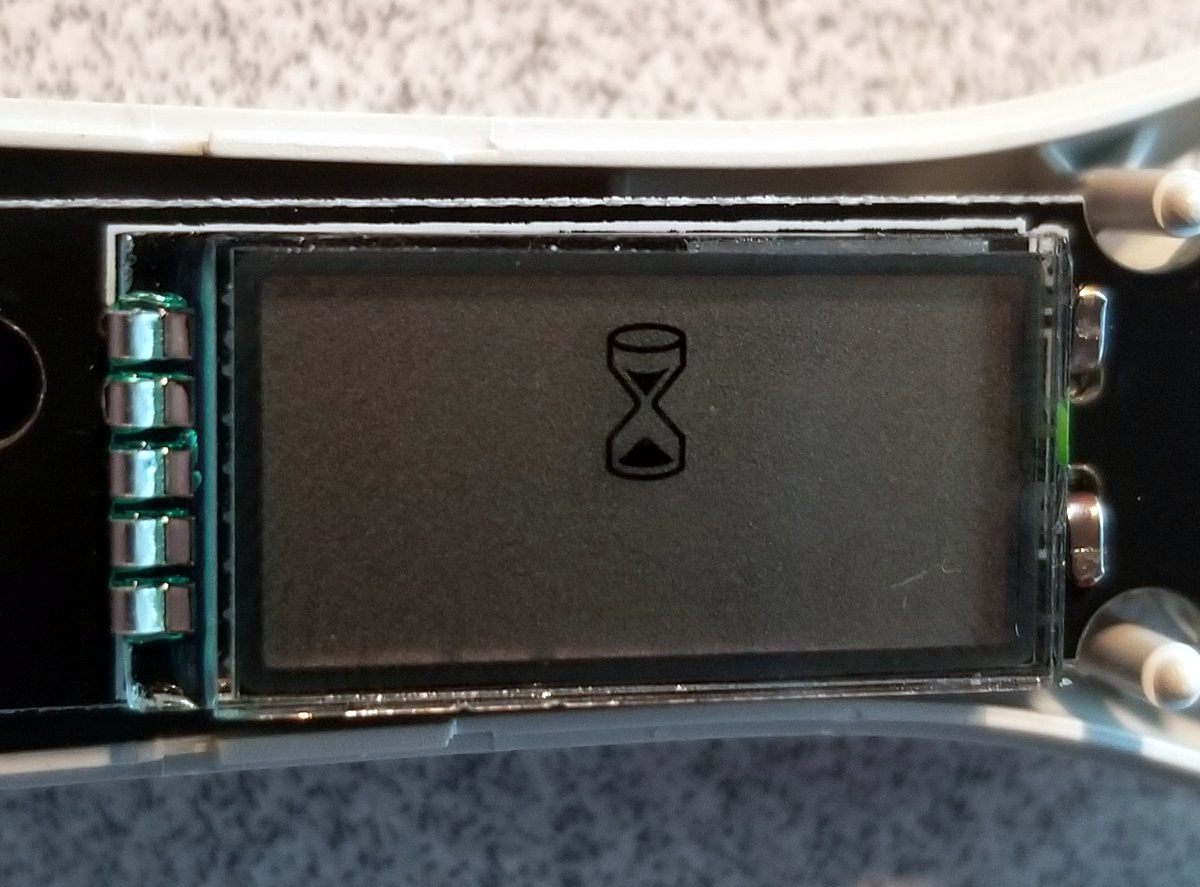
As it turns out, at least two digital tests out there are the exact same thing, but with more steps. Instead of a window, they include circuitry that interprets the lines and publishes the result to a little screen in plain English. It can even tell you if you’re doing it wrong by flashing a little RTFM icon.

[Foone]’s teardown reveals a CR1616 coin cell, an 8-bit microcontroller, and a little phototransistor setup that shines LEDs on the strip and reads the incoming light. Unfortunately, the micro is the mask ROM version, so [Foone] can’t reprogram it to run Doom.

The original tweet’s author is probably not alone in assuming that digital tests are supposed to be more accurate somehow. We think the accuracy claim is more about removing the frazzled and/or incompetent human variable from the equation. If the test interprets the results for you, then there’s no mistaking the results, which is technically a higher degree of accuracy. But if you’re in doubt, you get a test from a doctor.

There’s been some discussion about the e-waste aspect of these all these tests — that it’s a shame to produce a microcontroller just to pee on it and throw it away. Sure, you could look at it that way, but unlike a lot of e-waste, these are tools. It’s unfortunate that this is the industry’s idea of higher accuracy, but what should we expect? It’s just testing for the presence of a hormone in urine. Interpreting the results is up to the viewer. We should probably be astounded that they got the cost down to two for $7.

Many people choose to wait a while to start spreading the news. With a Bluetooth-enabled pregnancy test, everyone can find out together.

Thanks for the tip, [Jay]!