DSP Spreadsheet: FIR Filtering

There’s an old saying: Tell me and I forget, teach me and I may remember, involve me and I learn. I’m guilty of this in a big way — I was never much on classroom learning. But if I build something or write some code, I’m more likely to understand how it works and why.

Circuit simulation and software workbooks like Matlab and Jupyter are great for being able to build things without a lot of overhead. But these all have some learning curve and often use clever tricks, abstractions, or library calls to obscure what’s really happening. Sometimes it is easier to build something in a spreadsheet. In fact, I often do little circuit design spreadsheets or even digital design because it forces me to create a mathematical model which, in turn, helps me understand what’s really going on.

In this article I’m going to use Google Sheets — although you could do the same tricks in just about any spreadsheet — to generate some data and apply a finite impulse response (FIR) filter to it. Of course, if you had a spreadsheet of data from an instrument, this same technique would work, too.

Continue reading “DSP Spreadsheet: FIR Filtering”

Solve Your Precision Woes With A Sliding Angle Grinder

Angle grinders are among the most useful tools for anyone who’s ever had to cut metal. They’re ergonomic, compact, and get the job done. Unfortunately, one of the tradeoffs you usually make when using them is precision.

But thankfully, there’s a DIY solution. YouTuber [workshop from scratch] demonstrated the build process for a sliding angle grinder in a recent video, welding steel beams into a flat frame and attaching fitted beams on top to slide across the rows. Where necessary, spacers are used to ensure that the slider is perfectly fitted to the beam. The contraption holding the angle grinder – a welded piece of steel bolted to the sliding mechanism – has a grip for the user to seamlessly slide the tool across the table.

The operation is like a more versatile and robust chop saw, not to mention the customized angle references you can make to cut virtually anything you like. The build video shows the entire process, from drill pressing and turning holes to welding pieces of the frame together to artfully spray painting the surface a classy black, with familiarity enough to make the project look like a piece of cake.

As the name implies, [workshop from scratch] is all about building your own shop tools, and we’ve previously taken a look at their impressive hydraulic vise and mobile crane builds. These tools, largely hacked together from scraps, prove that setting up your own shop doesn’t necessarily mean you need to break the bank.

Continue reading “Solve Your Precision Woes With A Sliding Angle Grinder”

Floating Power Plants; The Coastal City Solution Sure To Be Increasingly Popular

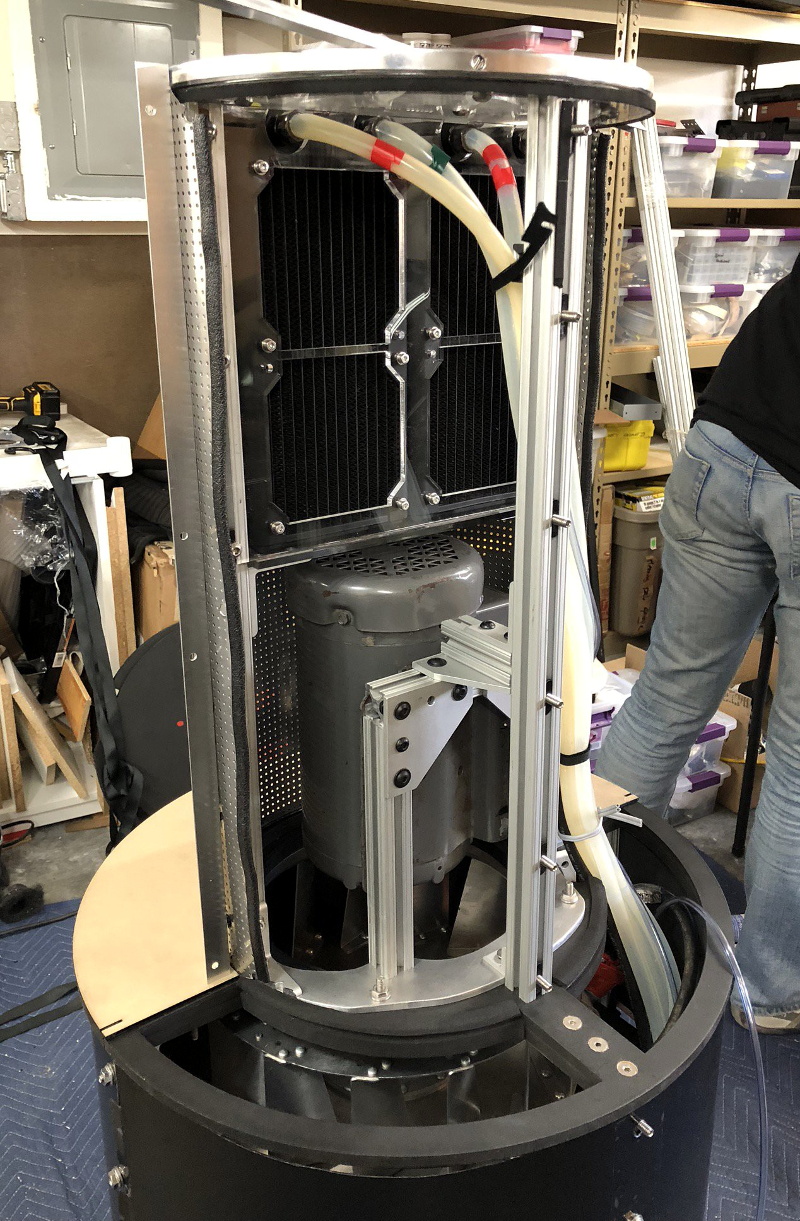
Building new things in an existing city is hard. Usually, new development means tearing down existing structures. Doing so for apartment complexes or new skyscrapers is one thing, but infrastructure is much more complicated, both from an engineering perspective and an economical one. Not only do people not want to foot the tax bill for things they may not see an immediate benefit from, but it can be difficult to find the space for bigger roads, more pipelines, or subway tunnels in a crowded urban area. It’s even harder for infrastructure that most consider an eyesore, like a power plant or electric substation. It’s no surprise then that some of the largest cities in the world have been making use of floating power plants rather than constructing them on dry land.

The latest city to entertain a bid for a new floating power plant (FPP) is New York, which is seeking to augment its current fleet of barge-based power stations already in operation. It already operates the largest FPP in the world at Gowanus in Brooklyn, which is able to output 640 MW of electricity. There’s also a 320 MW plant nearby as well, and the new plants would add eight 76 MW generators to New York City’s grid.

Let’s take a look at what goes into these barge-based generator designs.

Continue reading “Floating Power Plants; The Coastal City Solution Sure To Be Increasingly Popular”

PrintEye Gives You Stats In A Blink

Once upon a time, most things were single-purpose, like the pocket watch. Then somebody made a watch with a date function, and next thing you know, we had TV/VCR combos and Swiss army knives. Now, people pull computers out of their pockets just to check the time or the bed temperature of their RepRap.

[Owen]’s antidote for this multi-function madness is PrintEye, a simple interface that queries his printer and displays its vital signs on a pair of OLED peepers. It’s a parts bin special, and you know how much we love those. PrintEye connects to the Duet controller over UART, and does its firmware whispering with an ATMega328P. The ‘Mega sends a single M-command and gets back all the status and temperature data in JSON format. Then it parses the info and displays it on twin OLED screens.

Want to make one? [Owen]’s got all the files you need over on IO, but offers no hand-holding services. If you’ve never spun a board before, this could be your introduction. Have to have an internet connection? Check out the Octoprint monitor that inspired PrintEye.

Pistol Safe’s Poor Design Means Biometric Sensor Bypassed In Seconds

When it comes to safes, mechanical design and physical layout are just as important as the electronic bits. If care isn’t taken, one element can undermine the other. That appears to be the case with this Amazon Basics branded biometric pistol safe. Because of the mechanical design, the fingerprint sensor can be overridden with nothing more than a thin piece of metal — no melted gummi bears and fingerprint impressions involved.

push button to reset safe fingerprint reader
Small button used to register a new fingerprint. It can be reached by inserting a thin shim in the gap between the door and the frame while the safe is closed and locked.

[LockPickingLawyer] has a reputation for exposing the lunacy of poorly-designed locks of all kinds and begins this short video (embedded below) by stating that when attempting to bypass the security of a device like this, he would normally focus on the mechanical lock. But in this case, it’s far more straightforward to simply subvert the fingerprint registration.

This is how it works: the back of the front panel (which is inside the safe) has a small button. When this button is pressed, the device will be instructed to register a new fingerprint. The security of that system depends on this button being inaccessible while the safe is closed. Unfortunately it’s placed poorly and all it takes is a thin piece of metal slid through the thin opening between the door and the rest of the safe. One press, and the (closed) safe is instructed to register and trust a new fingerprint. After that, the safe can be opened in the usual way.

It’s possible that a pistol being present in the safe might get in the way of inserting a metal shim to hit the button, but it doesn’t look like it. A metal lip in the frame, or recessing the reset button could prevent this attack. The sensor could also be instructed to reject reprogramming while the door is closed. In any case, this is a great demonstration of how design elements can affect one another, and have a security impact in the process.

As for fooling sensors in a more traditional sense, here’s a reminder that we’ve seen a 3D printer and a photo of a fingerprint used to defeat a fingerprint sensor.

Continue reading “Pistol Safe’s Poor Design Means Biometric Sensor Bypassed In Seconds”

Weather Alert Lamp Keeps An Eye On What’s Brewing

Whether you’re getting ready for work in the morning, or heading out on a camping trip in the woods, it’s nice to know what to expect when the weather rolls over the horizon. To keep abreast of things, [natethecoder] built a lamp system to stay across weather alerts.

A Raspberry Pi 3 acts as the heart of the system, with Node Red responsible for running the show. Querying the web every 5 minutes for updated weather data, it keeps track of weather alerts, as well as incoming snowfall. For a basic weather watch, a yellow lamp is lit, while there’s a red lamp for more serious warnings. A Christmas decoration serves as the indicator for snow. The lamps are all controlled by mains-rated solid state relays, making it easy to swap out the lamps for other devices if so desired down the track. There’s also a lamp test subroutine that fires on startup to ensure everything is working correctly.

It’s a handy way to get your weather info at a glance, and would prove useful to anyone living in a storm-prone area. For something more portable, consider this umbrella that tells you the weather.

Bent Electric Field Explains Antenna Radiation

We all use antennas for radios, cell phones, and WiFi. Understanding how they work, though, can take a lifetime of study. If you are rusty on the basic physics of why an antenna radiates, have a look at the very nice animations from [Learn Engineering] below.

The video starts with a little history. Then it talks about charges and the field around them. If the charge moves at a constant speed, it also has a constant electric field around it. However, if the charge accelerates or decelerates, the field has to change. But the field doesn’t change everywhere simultaneously.

Continue reading “Bent Electric Field Explains Antenna Radiation”