Pavlok Gets A Literally Shocking Teardown

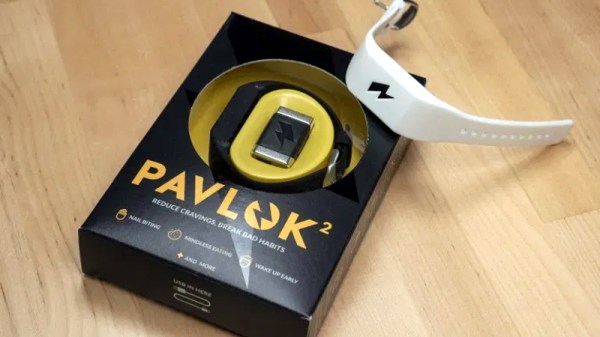
Apparently, there is a wrist-mounted device that delivers electric shocks to the wearer when it receives the appropriate command over Bluetooth. No, it’s not part of some kind of house arrest program. If you can believe it, the gadget is actually intended to help break bad habits or wake up exceptionally deep sleepers. We don’t know which of those problems [Becky Stern] has, but we’re glad to see she decided to take hers apart before the 21st century self-flagellation started.

Called the Pavlok and available for $180 USD from various online retailers, the device looks like a chunky fitness tracker. But in place of the screen that would show you how many steps you’ve taken or your current heart rate, there’s a lighting bolt button that you can press when you want to shock yourself. With the smartphone application, you can control the device remotely with a handy desktop widget that allows you to select the intensity of the shock. No, we aren’t making any of this up. Check out the video after the break to see it in action.
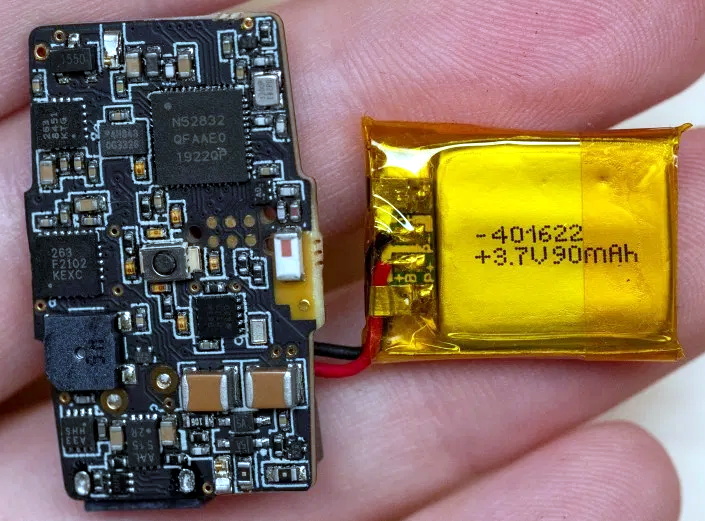
When [Becky] tried to take the Pavlok apart, she found that it was nearly impossible to handle it without inadvertently triggering a shock. So until she could get the case open and physically disconnect the battery, all she could do was turn the intensity down in the application and work through the occasional jolts from the device. We can only hope that more devices don’t adopt a similar sense of self-preservation.

Once inside she found mainly the same kind of hardware you’d expect in a standard, non-masochistic, fitness wearable. There’s a nRF52832 Bluetooth SoC, a MMA8451Q accelerometer, a PCF85063A I2C RTC, and a FXAS21002C gyroscope. What you’re somewhat less likely to find inside your FitBit however is the LPR6235 coupled inductor and beefy capacitors which are used to build up a high-voltage charge from the standard 3.7 V LiPo battery.

We’ve been very interested in the recent projects which are creating custom firmwares for commercially available fitness wearables, as it could be an express route to a hacker-friendly smartwatch. While the Pavlok has some compelling hardware, and the programming header [Becky] identified looks interesting, we don’t like the idea of being one misplaced if statement away from riding the lightning.

Continue reading “Pavlok Gets A Literally Shocking Teardown”

Microcontroller Studies The Blade

Kendo, a Japanese martial art, is practiced with a special sword. It’s not a particularly sharp sword, though, since the “blade” is essentially a length of bamboo. For this reason, Kendo practitioners must rely on correct form and technique in order to make sure their practice is as effective as possible, and Cornell students [Iman] and [Weichen] have made a Kendo trainer that helps the swordsmen in their art.

The core of the project is a PIC32 microcontroller hooked up to a set of three piezoelectric sensors and a LSM9DS1 inertial module. The three piezoelectric sensors are attached to a helmet and the inertial module to the sword, and the sensors work together to determine both the location of the strike and whether or not it had enough strength to be considered a “good” strike (the rules of Kendo are beyond the scope of this article). The trainer can then calculate all of the information and provide feedback to the user on a small screen.

While martial-arts related builds seem to be relatively rare, we did find a similar project from back in 2011 called the Virtual Sensei which used a then-popular Kinect in order to track movements. This PIC32-based project, though, seems to be a little more thorough by including the strength of the strike in the information the computer uses, and is probably less expensive to boot!

Continue reading “Microcontroller Studies The Blade”

Synthfonio Makes Music Easy Like Sunday Morning

This one goes out to anyone who loves music and feels it in their soul, but doesn’t necessarily understand it in their head. No instrument should stand in the way of expression, but it seems like they all do (except for maybe the kazoo).

[FrancoMolina]’s hybrid synth-MIDI controller is a shortcut between the desire to play music and actually doing it. Essentially, you press one of the buttons along Synthfonio’s neck to set the scale, and play the actual notes by pressing limit switches in the controller mounted on the body. If you’re feeling blue, you can shift to minor scales by pressing the relative minor note’s neck button at the same time as the root note, e.g. A+C=Am. Want to change octaves? Just slide the entire controller up or down for a total of three.

All of these switches are muxed to two Arduinos — an MKR1010 for USB MIDI control, and a bare ‘328 to provide the baked-in synth sounds. Power comes from a stepped-up 18650 that can be charged with an insanely cheap board from that one site. [Franco] has all the code and files available, so go have fun making music without being turned off by a bunch of theory. Push that button there to check out the demo.

If ‘portable’ means pocket-sized to you, then let this mini woodwind MIDI controller take your breath away.

Continue reading “Synthfonio Makes Music Easy Like Sunday Morning”

Growing Human Neurons Hooked Up To Electrodes

Philosophers have long mused about the concept of a “brain in a jar”, but thus far, it’s remained the preserve of science fiction rather than reality. However, after reading some scientific papers, [Justin] wanted to attempt the feat himself, so set out to grow some human neurons on an electrode array. 

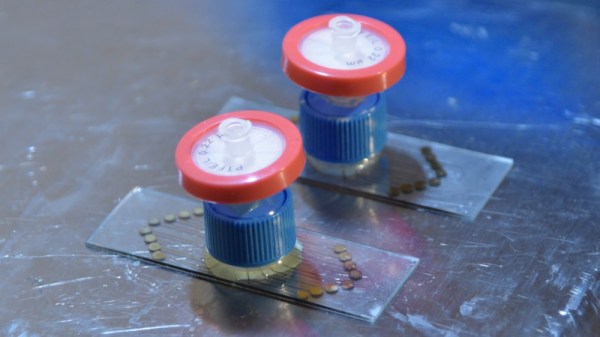
The project builds on [Justin]’s earlier work, using his DC sputtering rig to coat a glass microscope slide with electrodes. The first layer is silver for high conductivity, with an added gold layer for biocompatibility. The screw cap from a Falcon tube is then epoxied on to act as a reservoir for culture media for the neurons. Finally, an air filter is added to allow the biological mixture to breathe.

This was [Justin]’s first attempt at culturing neurons, and there were plenty of hurdles along the way. The custom culture assemblies had issues with the epoxy bonds leaking or failing entirely, leading to only one slide making it through the sterilization process. Additionally, the neurons were accidentally added in too high a quantity. While some growth was observed under the microscope, [Justin] was unable to detect any real signal from the system.

Despite a poor final result, plenty was learned along the way. [Justin] has already put plans into place to fix some of the pitfalls of the original experiment, and we look forward to seeing future updates from the project. Video after the break.

Continue reading “Growing Human Neurons Hooked Up To Electrodes”

A Mini SDR Receiver Using An Audio DSP

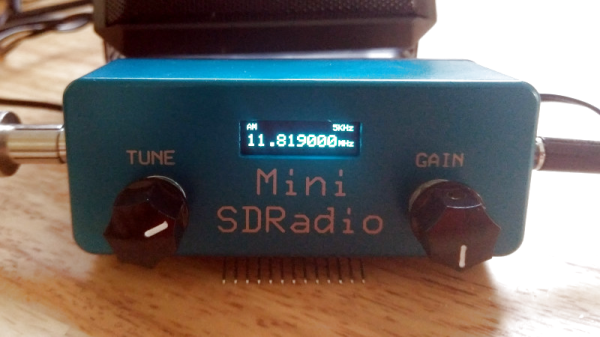
Software defined radio or SDR is the most exciting frontier in the field of radio, transferring as it does all signal functions from the analogue to the digital domain. Radios using SDR techniques can be surprisingly straightforward and easy to understand, and [Ray Ring]’s little SDR receiver manages to combine this with the novel use of an audio DSP rather than a computer to perform its SDR functions.

The front end is a conventional enough direct conversion design with an Si5531 clock generator providing I and Q phase-shifted local oscillator signals to a TS3A5017 analogue switch used as a mixer. An unexpected presence is an LTC6252 op-amp as an RF amplifier, but the special part comes after the I and Q baseband signals have been filtered. The SDR part of this receiver is an audio DSP, but it’s one that might not be an immediate choice. The Spin Semiconductor FV-1 is a dedicated digital reverb chip for musical effects boxes, but it comes with the feature that its internal DSP core can access custom code from an external ROM. [Ray] has written his own code for demodulation of AM, USB, and LSB signals rather than musical effects, and used the device’s left and right audio channels to process I and Q quadrature signals. The use of a single purpose chip to do something its designers never intended gives it the essence of a good hack, and we’re mightily impressed at his spotting the potential for an SDR in a musical effect. Hear it in action in the video below the break.

Meanwhile if the operation of a receiver such as this one is a mystery to you, we published a handy primer back in 2017.

Continue reading “A Mini SDR Receiver Using An Audio DSP”

Art Imitates DNA

It has recently been possible to pay a service a little bit of money and learn more about your own DNA. You might find out you really aren’t Italian after all or that you are more or less susceptible to some ailments. [Paul Klinger] had his DNA mapped and decided to make a sculpture representing his unique genetic code. The pictures are good, but the video below is even better.

The project requires a DNA sequencing, a 3D printer, and a Raspberry Pi Zero. Oh, you can probably guess you need a lot of RGB LEDs, too. Of course, the display doesn’t show the whole thing at one time — your DNA pattern scrolls across the double helix.

Continue reading “Art Imitates DNA”

The Quest To Find A Second Life For Electric Vehicle Batteries

Rechargeable lithium chemistry battery cells found their mass market foothold in the field of personal electronics. The technology has since matured enough to be scaled up (in both physical size and production volume) to electric cars, making long range EVs far more economical than what was possible using earlier batteries. Would the new economics also make battery reuse a profitable business? Eric Lundgren is one of those willing to make a run at it, and [Gizmodo] took a look at his latest venture.

This man is a serial entrepreneur, though his previous business idea was not successful as it involved “reusing” trademarks that were not his to use. Fortunately this new business BigBattery appears to be on far more solid legal footing, disassembling battery packs from retired electric vehicles and repacking cells for other purposes. Typically EV batteries are deemed “worn out” when their capacity drops below a certain percentage (70% is a common bar) but that reduced capacity could still be useful outside of an EV. And when battery packs are retired due to problems elsewhere in the car, or just suffering from a few bad cells, it’s possible to extract units in far better shape.

We’ve been interested in how to make the best use of rechargeable lithium batteries. Ranging from tech notes helping battery reuse, to a comparison of different types, to looking at how their end-of-life recycling will be different from lead-acid batteries. Not to mention countless project wins and fails in between. A recurring theme is the volatility of mistreated or misbehaving batteries. Seeing a number of EV battery packs stacked on pallets and shelves, presumably filled with cells of undetermined quality, fills us with unease. Like the rest of California, Chatsworth is under earthquake risk, and the town was uncomfortably close to some wildfires in 2019. Eric is quick to give assurance that employees are given regular safety training and the facility conforms to all applicable workplace safety rules. But did those rules consider warehouses packed full of high capacity lithium battery cells of unknown quality? We expect that, like the business itself, standards for safety will evolve.

Concerns on safety aside, a successful business here would mean electric vehicles have indeed given battery reuse a profitable economy of scale that tiny little cell phone and laptop batteries could not reach. We are optimistic that Eric and other like-minded people pursuing similar goals can evolve this concept into a bright spot in our otherwise woeful state of e-waste handling.