Hackaday Prize Entry: Remote Control By Head Gestures

Some people may think they’re having a bad day when they can’t find the TV remote. Yet there are some people who can’t even hold a remote, let alone root around in the couch cushions where the remote inevitably winds up. This entry in the Assistive Technologies phase of the 2017 Hackaday Prize seeks to help such folks, with a universal remote triggered by head gestures.

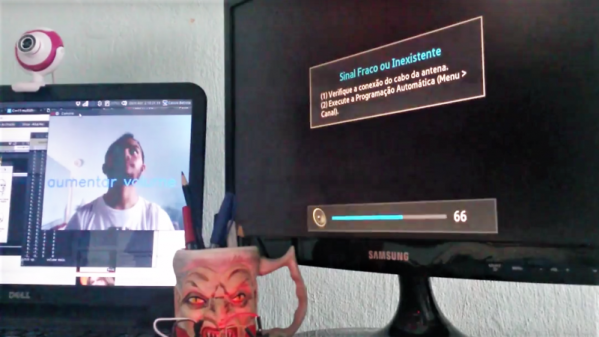
Mobility impairments can range from fine motor control issues to quadriplegia, and people who suffer from them are often cut off from technology by the inability to operate devices. [Cassio Batista] concentrated on controlling a TV for his project, but it’s easy to see how his method could interface with other IR remotes to achieve control over everything from alarm systems to windows and drapes. His open-source project uses a web cam to watch a user’s head gestures, and OpenCV running on a CHIP SBC looks for motion in the pitch, yaw, and roll axes to control volume, channel, and power. An Arduino takes care the IR commands to the TV. The prototype works well in the video below; with the power of OpenCV we can imagine mouth gestures and even eye blinks adding to the controller’s repertoire.

The Assistive Tech phase wraps up tomorrow, so be sure to get your entries in. You’ll have some stiff competition, like this robotic exoskeleton. But don’t let that discourage you.

Continue reading “Hackaday Prize Entry: Remote Control By Head Gestures”
Have Alexa Open Your Garage Door

[yoyotechKnows] built an Alexa-controlled garage door opener after his Liftmaster stopped working. Now all he has to do is holler at his mobile phone and he can raise and lower his garage doors at will.

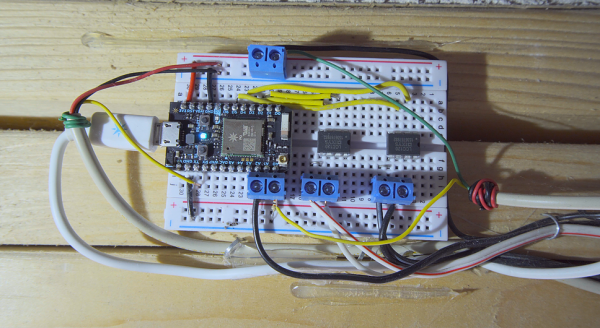
His project is based around a Photon WiFi kit, with a pair of LCC 120 digital relays triggering the two doors, reed switches, and a serial-equipped LCD to display door status, with Alexa, IFTTT, and OpenHab to process the commands. You can find his code in the project writeup.

Currently he has a LCD display informing him of the status of each door, hot glued a reed switch to keep track of whether each one is closed. This might seem a little bit extraneous since he can also just look at the doors from within the garage. However, he’s thinking about putting the display inside his house. But couldn’t he just ask Alexa?

We love us our home automation here at Hackaday, with everything from swimming pools to chicken coops rigged for app control and datalogging.

Continue reading “Have Alexa Open Your Garage Door”

Make Cars Safer By Making Them Softer

Would making autonomous vehicles softer make them safer?

Alphabet’s self-driving car offshoot, Waymo, feels that may be the case as they were recently granted a patent for vehicles that soften on impact. Sensors would identify an impending collision and adjust ‘tension members’ on the vehicle’s exterior to cushion the blow. These ‘members’ would be corrugated sections or moving panels that absorb the impact alongside the crumpling effect of the vehicle, making adjustments based on the type of obstacle the vehicle is about to strike.

Continue reading “Make Cars Safer By Making Them Softer”

How To Select Just About Any Electronic Part

Sometimes you see an excellent post somewhere else on the web, and then discover that it is one of a series of similarly good posts that you completely missed when they were published. If you are a Hackaday scribe you are left wondering how you managed to pass them by, and then why on earth you didn’t think of writing them yourself.

Such is the case with [Sanket Gupta]’s excellent series for Octopart, of posts titled “How to select a…” and then a class of component. It was the latest, “How to select a voltage regulator” that caught our eye first, but then we found the previous installments dealing with capacitors, resistors, inductors, connectors, IC packages and MCUs. Each one provides a basic primer for the engineer, in terms of both parts selection based on capability and on suitability for manufacturing, and while you may think that only an inexperienced reader might find benefit in such pieces the reality is that everybody can learn something.

So if you are involved in choosing electronic parts, no matter at what level, take a look at this series. If you know everything [Sanket] has to say then we congratulate you on your mastery of the field, however we think most readers will find them to be an interesting and useful resource.

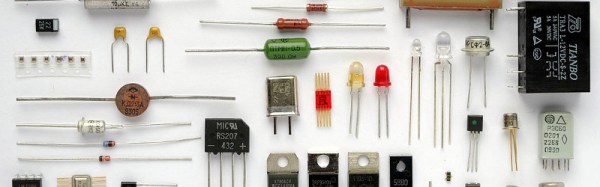
Header image: Kae [Public domain].

Poetry In Motion With A Sand-Dispensing Dot Matrix Printer

Hackaday gets results! Reader [John] saw our recent Fail of the Week post about a “sand matrix printer” and decided to share his own version, a sand-dispensing dot matrix printer he built last year.

Granted, [John]’s version is almost the exact opposite of [Vjie Miller]’s failed build, which sought to make depressions in the sand to print characters. [John]’s Sandscript takes a hopper full of dry, clean sand and dispenses small piles from six small servo-controlled nozzles. The hopper is mounted on a wheeled frame, and an optical encoder on one wheel senses forward motion to determine when to open each nozzle. As [John] slowly walks behind and to the side of the cart, a line of verse is slowly drizzled out onto the pavement. See it in action in the video below.

More performance art piece than anything else, we can see how this would be really engaging, with people following along like kids after the [Pied Piper], waiting to find out what the full message is. There’s probably a statement in there about the impermanence of art and the fleeting nature of existence, but we just think it’s a really cool build.

We’ve featured other sand writers before, like this high-resolution draw bot that also dispenses sandy verses, or this literal beach-combing art bot. Guess there’s just something about sand that inspires artists and hackers alike.

Continue reading “Poetry In Motion With A Sand-Dispensing Dot Matrix Printer”

Tracing A Scene An Old-Fashioned Way

Taking a picture is as simple as tapping a screen. Drawing a memorable scene, even when it’s directly in front of you, is a different skill entirely. So trace it! Well, that’s kind of hard to do without appropriate preparation.

[bobsteaman]’s method is to first whip up a pantograph — it tested well with a felt marker on the end. Next, he built a camera obscura into a small wood box with a matte plexiglass top, which didn’t work quite so well. A magnifying glass above the camera’s pinhole aperture helped, but arduous testing was needed to ensure it was set at perfect position for a clear image. The matte plexiglass was also thrown out and, after some experimentation, replaced with a sheet of semi-transparent baking paper sandwiched between two pieces of clear plexiglass. The result is hard to argue with.

Continue reading “Tracing A Scene An Old-Fashioned Way”

Cryptocurrency Mining Post-Bitcoin

While the age of using your own computer to mine Bitcoin during spare CPU cycles has long passed, average folks aren’t entirely shut out of the cryptocurrency game yet. Luckily, Bitcoin isn’t the only game in town anymore, and with GPUs coming down in price it’s possible to build a mining rig for other currencies like Etherium.

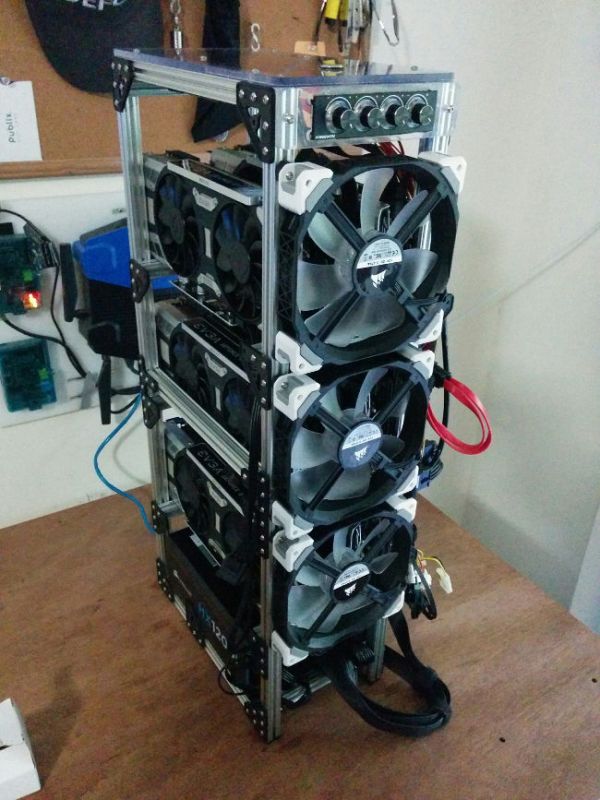
[Chris]’s build starts with some extruded aluminum and a handful of GPUs. He wanted to build something that didn’t take up too much space in the small apartment. Once the main computer was installed, each GPU was installed upwards in the rack, with each set having its own dedicated fan. After installing a fan controller and some plexiglass the rig was up and running, although [Chris] did have to finagle the software a little bit to get all of the GPUs to work properly.

While this build did use some tools that might only be available at a makerspace, like a mill and a 3D printer, the hardware is still within reason with someone with a little cash burning a hole in their pockets. And, if Etherium keeps going up in value like it has been since the summer, it might pay for itself eventually, providing that your electric utility doesn’t charge too much for power.

And if you missed it, we just ran a feature on Etherium.  Check it out.