Robotic Farming, Aussie Style

Australian roboticists from the Queensland University of Technology have developed a prototype agricultural robot that uses machine vision to identify both weed and crop plants before either uprooting or poisoning the weeds or applying fertiliser to the crop.

The machine is a wide platform designed to straddle a strip of the field upon which it is working, with electric wheel motors for propulsion. It is solar-powered, and it is envisaged that a farm could have several of them continuously at work.

At a superficial level there is nothing new in the robot, its propulsion, or even the plant husbandry and weeding equipment. The really clever technology lies in the identification and classification of the plants it will encounter. It is on the success or failure of this in real farm environments that the robot’s future will hinge. The university’s next step will be to take it on-farm, and the ABC report linked above has a wonderfully pithy quote from a farmer on the subject. You can see the machine in action in the video below the break.

Farming robots have a significant following among the hardware hacker community, but it is possible that the machine-vision and plant-identifying abilities of this one would be beyond most hackers. However it is still an interesting project to watch, marking as it does a determined attempt to take the robot out of the lab and into real farm settings.

Continue reading “Robotic Farming, Aussie Style”

Projection Mapping In Motion Amazes

Projection mapping is pretty magical; done well, it’s absolutely miraculous when the facade of a building starts popping out abstract geometric objects, or crumbles in front of our very eyes. “Dynamic projection mapping onto deforming non-rigid surface” takes it to the next level. (Watch the video below.)

A group in the Ishikawa Watanabe lab at the University of Tokyo has a technique where they cover the target with a number of dots in an ink that is only visible in the infra-red. A high-speed (1000 FPS!) camera and some very fast image processing then work out not only how the surface is deforming, but which surface it is. This enables them to swap out pieces of paper and get the projections onto them in real time.

Continue reading “Projection Mapping In Motion Amazes”

Ultra-Polished, Handmade Settlers Of Catan Redux

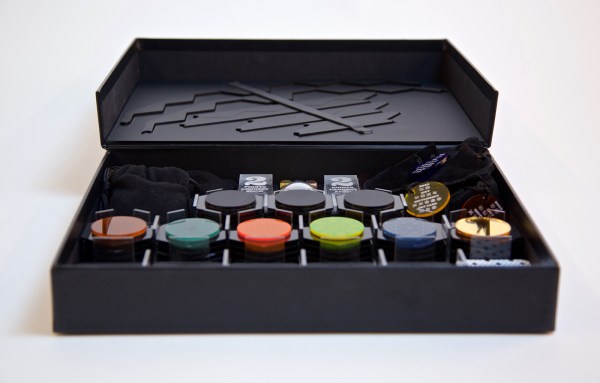
[Fuzzy Wobble] and [Amy Wang]’s Deep Space Settlers project is a one-of-a-kind re-invention of the popular board game Settlers of Catan, and showcases the polished results that are possible with the fabrication tools and methods available in many workshops and hackerspaces today. We reached out to the makers for some of the fabrication details, which they were happy to share.

(For those of you who are familiar with the game, technically this is a remake and slight evolution of the Seafarers expansion to the base Settlers of Catan game. A few rule changes were made, but it is mostly a total remodel and redesign.)

Continue reading “Ultra-Polished, Handmade Settlers Of Catan Redux”

Litter Basket Automation

Sometimes the technology part of a project isn’t the hard part. It is having an idea for something both useful and doable. Sure, a robot butler that would do your cleaning and laundry would be useful, but might be out of reach for most of us. On the other hand, there’s only so many use cases for another blinking LED.

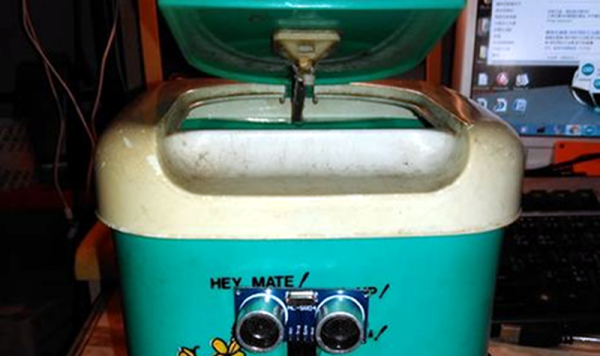
[Martinhui] knows how to use an ultrasonic sensor with an Arduino. Driving a motor isn’t that hard, either. The question is: what do you do with that? [Martin’s] answer: Automate a trash can. You can see a video of the result, below.

Continue reading “Litter Basket Automation”

Primer On Servos Hits All The Basics

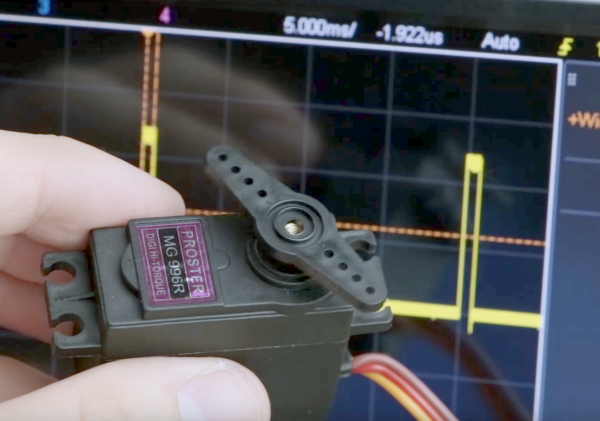
Servos are pretty basic fare for the seasoned hacker. But everyone has to start somewhere, and there’s sure to be someone who’ll benefit from this primer on servo internals. Who knows – maybe even the old hands will pick up something from a fresh perspective.

[GreatScott!] has been building a comprehensive library of basic electronics videos over the last few years that covers everything from using a multimeter to programming an Arduino. The last two installments delve into the electromechanical realm with a treatment of stepper motors along with the servo video below. He covers the essentials of the modern RC-type servo in a clear and engaging style that makes it easy for the newbie to understand how a PWM signal can translate into positional changes over a 180° sweep. He shows how to control a servo directly with an Arduino, with bonus points for including a simple 555-based controller circuit too. A quick look at the mods needed to convert any servo to continuous rotation wraps up the video.

If [GreatScott!]’s video whets your appetite for more, be sure to check out [Richard Baguley]’s deeper dive into servos. And when you’re ready to put your new-found knowledge into practice, maybe a nice project would be to convert a hobby servo into a linear actuator.

Continue reading “Primer On Servos Hits All The Basics”

A Virtual Glimpse Into The Forest

Taking a stroll through the woods in the midst of autumn is a stunning visual experience. It does, however, require one to live nearby a forest. If you are one of those who does not, [Koen Hufkens] has recently launched the Virtual Forest project — a VR experience  that takes you though a day in a deciduous forest.

First off, you don’t need a VR apparatus to view the scenery. Web-browsers and most smart phones are capable of displaying the 360 degree images. The Raspberry Pi 2-controlled Ricoh Theta S camera is enclosed in a glass lamp cover and — with the help of some PVC pipe — mounted on a standard fence post. Power is delivered ingeniously via a Cat5e cable, and a surge protector has also been included in case of lightning strikes.  Depending on when you view the website, you could be confronted with a black screen, or a kaleidoscope of color.

Continue reading “A Virtual Glimpse Into The Forest”

Vintage Radio Transformed Into Custom PC Case

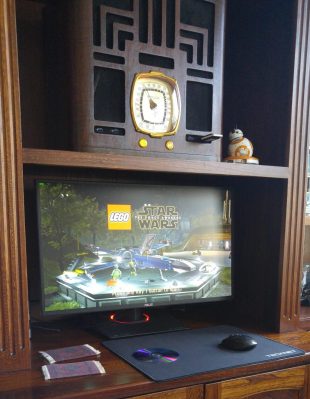
We see a lot of old radio restoration projects around here, and we have to admit to having mixed emotions about some of them. It seems a shame to go through the effort to lovingly restore a vintage Art Deco case only to stuff it with a Raspberry Pi and Bluetooth. Seems like if you’re going to restore a radio, go all the way and bring the original electronics back to life. But this radio “restoration” avoids that issue altogether by cleverly concealing a full PC build in a vintage radio case.

u3nwbpdClearly a labor of love, [SolomonZaraa]’s two-year effort guts the radio but still manages to pay homage to the original beauty of the 1939 vintage Philco 39-80 “tombstone” portable AM radio. The first design decision was to retask the original tuning dial as an analog thermometer using an Arduino and a servo. Then a new back was added with an extension for the motherboard and PSU, a drive cage was added, and a surprise slot for the DVD drive was built into the speaker grille. Nice brass trim and a good refinishing of the case resulted in an impressive and unexpected presentation.

You don’t have to go far in the Hackaday Wayback machine to find an antique radio with updated audio, but we’re pretty sure this is the first antique radio PC case mod we’ve seen. Nicely done, [Solomon]!

[via r/DIY]