New Part Day: Three-dimensional USB Connectors

There’s an old joke that says USB cables do not exist in three-dimensional Euclidian space. Try to plug a USB cable in a socket, and the first try will always be wrong. Flip it, try to plug it in, and that will also be wrong. You will only succeed on the third try, and this is proof that USB connectors exist in higher planes of reality with arcane geometries. The joke is as old as the Pythagoreans, who venerated USB connectors as gods.

The waveform has collapsed, the gods profaned, and USB connectors that exist in only three dimensions have arrived. We’re talking, of course, about reversible USB Type A connector that will plug in the first time, every time. No need for electromancy or the “looking on the cable for the USB logo and plugging it in with that side up” method used by tech plebeians.

This discovery came after going through my daily roundup of crowdfunding press releases, eventually landing me on this idiotic project. It’s a USB charge cable that’s supposed to charge your phone twice as fast, despite the fact that charging speed is a function of current, and that’s determined by whatever you’re charging from, not the cable. Terrible idea, but they do have something interesting: a three-dimensional USB connector.
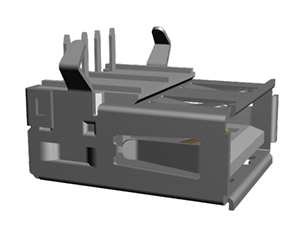
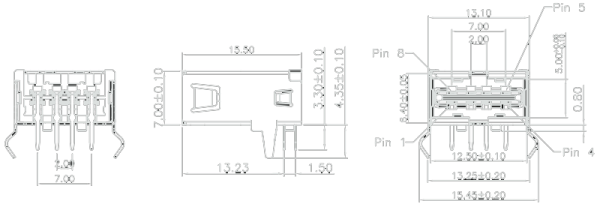
connUSBThe connector isn’t the brand new USB 3.1 Type C connector that will eventually find its way into phones, laptops, wearables of all types. This is your standard Type A USB plug you’ve known and loved for the past eighteen years. The difference here is that the chunky block of plastic that has made the common USB cable non-reversible for so many years is gone. In its place is a tiny strip of plastic that has contacts on both sides. Yes, it took nearly two decades for someone to figure out this would be a marketable idea.

While searching for a source for these three-dimensional USB connectors, the only source I could come up with was Wurth Elektronik, With Farnell/Element14 carrying a selection of connectors, a few available on Digikey, and some available on Mouser. There are even a few pre-made reversible cables available, with Tripp Lite leading the game right now.

For integrating one of these connectors into your build, there’s only one thing to watch out for: the pinout for these plugs is mirrored on each side of the thin strip of plastic going down the middle of the connector. This means your VCC and GND pins will be right next to each other, your D+ and D- signal pins right next to each other, and now you have to do your layout with eight pins instead of only four.

While it may not be groundbreaking and it makes for some confusing PCB layout work, but as told by a highly successful crowdfunding campaign, this can be a real feature for a product.

If you’ve recently come across a component, connector, or part that’s unique, interesting, or downright cool everyone should know about, send it on in and we’ll take a look at it.

Fail Of The Week: Cat6 != Coax

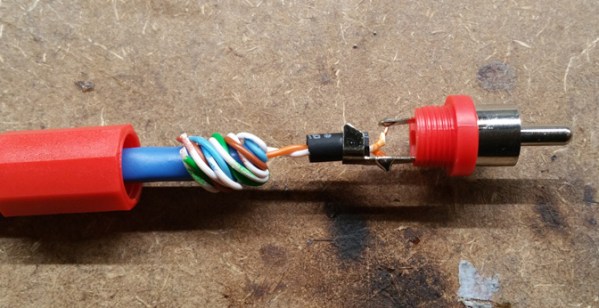
With a new Kenwood 5.1 receiver acquired from questionable sources, [PodeCoet] had no way to buy the necessary coax. He did have leftover Cat6 though. He knew that digital requires shielded cable, but figured hacking a solution was worth a try.

HAD - Coaxfail4To give hacking credit where credit is due, [PodeCoet] spent over a decade enjoying home theatre courtesy of a car amp rigged to his bench supply. Not all that ghetto of a choice for an EE student, it at least worked. To hook up its replacement he pondered if Cat6 would suffice, “Something-something twisted pair, single-sideband standing wave black magic.” Clearly hovering at that most dangerous level of knowledge where one knows just enough to get further into trouble, he selected the “twistiest” (orange) pair of wires in the cables. Reasonable logic, one must select the strongest of available shoelaces for towing a car.

Continue reading “Fail Of The Week: Cat6 != Coax”

Hackaday Links Column Banner

Hackaday Links: January 11, 2015

Listening tests reveal significant sound quality differences between various digital music storage technologies. Finally the audiophile press is tackling the important questions. This listening test looks at the difference between two four-bay NAS boxes, with one making the piano on Scherzo and Trio from Penguin Café Orchestra’s Union Cafe sound more Steinway-like, while another NAS makes it sound more like a Bosendörfer. Yes, your choice of digital storage medium can change the timbre of a piano. Another gem: “Additionally, the two units also had different processor architectures, which might also affect perceived audible differences.” There must be a corollary to Poe’s Law when it comes to audiophiles…

[10p6] has begun a project that can play every old Atari cartridge. Right now it’s just a few bits of plastic that fits every non-Jaguar Atari cartridge, but it’s a start.

The Android IMSI-Catcher Detector. You’ve heard about Stingrays, devices used by law enforcement that are basically fake cell towers. These Stingrays downgrade or disable the encryption present in all cellphones, allowing anyone, with or without a warrant, to listen in on any cell phone conversation. Now there’s an effort to detect these Stingrays. It’s open source, and they’re looking for volunteers.

[Rob] sent in something that’s the perfect application of projection mapping. It’s called Face Hacking, and it’s pretty much just a motion capture systems, a few projectors, a whole lot of CG work, and just a tiny bit of dubstep. It look cool, but we’re wondering what the applications would be. Theatre or some sort of performance art is the best I can come up with.

A while ago, [4ndreas] saw a 3D printed industrial robot arm. He contacted the guy for the files, but nothing came of that. [4ndreas] did what anyone should do – made his own 3D printable industrial robot arm. The main motors are NEMA 17, and printing this will take a long time. Still, it looks really, really cool.

Hacklet 29 – Altoids Mint Tin Projects

Altoids – they’ve been around since King George III was on the throne. These curiously strong mints have had a storied history, a copy of which is included in every tin. They taste pretty good, but most hackers and makers are more interested in the pocket-sized tin than the mints themselves. It may have been the ham radio operators who first used Altoids tins to hold their sensitive transmitter and receiver circuits. The metal case makes a perfect electromagnetic field shield. It wasn’t long before the tins found their way into thousands of projects. This week’s Hacklet features some of the best projects with Altoids (and other mint) tins on Hackaday.io!

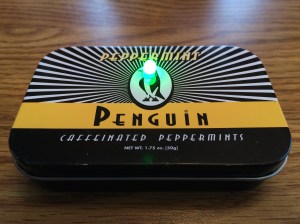
meeting-timerWe start with [Chad Lawson] and the Networking Group Timing Light. [Chad] has a networking meeting where each member has two minutes to introduce themselves. As is the case with most meetings, people tend to be a bit long-winded, running well beyond their allotted two minutes. The timing light contains an RGB LED which changes from green to yellow to red as a speaker’s time ticks away. The timer is reset by simply tilting the mint tin. [Chad] is hoping that the timer will serve as a gentle reminder to keep everyone on track time-wise.


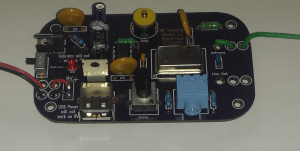
radio2Next up is [Rjpope42] and his AM/FM Transmitter Pair. [Rjpope42] loves vintage tube radios, and wants to send his own signals to his amber glowing projects. Wiring an external audio input to a tube radio is pretty easy, but nothing beats a simple AM transmitter for convenience. Small FM transmitters are commonly available to add an MP3 player input to cars without an AUX audio in, but their AM counterparts have become rare. [Rjpope42] has built AM and FM transmitters, each of which will fit in a Mint Tin case. The AM transmitter can run on 9V or 12V, and even includes a USB power output for charging an MP3 player or phone!

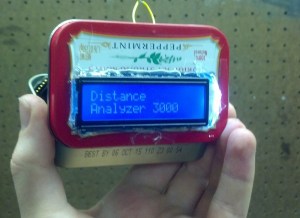
da31k[John Hamann] entered Distance Analyzer 3000 in the Trinket EDC contest. While he didn’t win, it was still a great project, especially since this is [John’s] first serious Arduino project. The idea is to use a rotary encoder with a wheel to measure distances. Think of it like a mini version of a surveyor’s walking wheel. The Pro Trinket counts the pulses from the rotary encoder, then converts this to a distance in feet. We’d love to see [John] continue on the project. An ultrasonic distance sensor would be a great addition for multi-sensor distance reads!


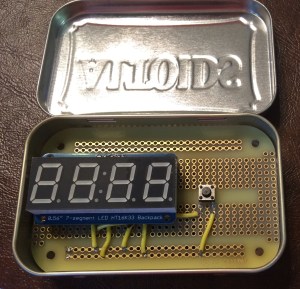
ttotpFinally, we have [colonwq] with TTTOTP, a pro trinket Time based One Time Password (TOTP) generator. [colonwq] used the trinket to implement the well-known time based one time password algorithm. To implement a project like this, you need a stable time source. The ATmega328 isn’t very good at this, so [colonwq] used a Dallas DS1307 clock chip to keep track of things. The actual code is displayed on a 4 digit 7 segment display. When the button is pressed, the first half of the code is displayed. Once the button is released, the second half of the code is displayed for several seconds.


Need more mint? Check out our curiously awesome mint tin project list!

Hackaday.io Update and MeArm Giveaway

Hackaday.io has a few new features, including @username and #projectID. If you mention someone’s username with an @ in front of it, that user will get a notification in their stack. The same goes with mentioning a project ID with a # up front. To celebrate this, we’re giving away a pair of  special edition MeArms. All you have to do is leave a comment using the features on this project log. Huge thanks to [Jasmine] for setting all this up, and to [Ben] for letting us hijack his project for the week!

That’s it for this Hacklet, As always, see you next week. Same hack time, same hack channel, bringing you the best of Hackaday.io!

Tire assembly room of the Brunswick Tire Corporation

Retrotechtacular: Brunswick Shows A Bias For Tires

Somewhere between the early tires forged by wheelwrights and the modern steel-belted radial, everyone’s horseless carriage rode atop bias-ply tires. This week’s film is a dizzying tour of the Brunswick Tire Company’s factory circa 1934, where tires were built and tested by hand under what appear to be fairly dangerous conditions.

It opens on a scene that looks like something out of Brazil: the cords that form the ply stock are drawn from thousands of individual spools poking out from poles at jaunty angles. Some 1800 of these cords will converge and be coated with a rubber compound with high anti-friction properties. The resulting sheet is bias-cut into plies, each of which is placed on a drum to be whisked away to the tire room.

Continue reading “Retrotechtacular: Brunswick Shows A Bias For Tires”

Hackaday Links Column Banner

Hackaday Links: January 4, 2015

Chips as furniture is now a thing. It started off with a 555 footstool from Evil Mad Scientist and moved on to an EPROM coffee table. Now [msvm] over on the War Thunder forums has constructed a Nixie tube driver table. It’s based on the K155, and as a neat little addition, he’s included a real vintage chip under glass in the table.

Have some tongs, an anvil, and a blowtorch? Make some bottle openers out of framing nails. There’s a lot of variety here in the shapes of the bottle openers.

[Stephen] used a solid state relay he found on eBay to drive some Christmas lights. The SSR failed. That meant it was time to see inside of this relay looked like. The short answer is, ‘a lot of goop and epoxy’, but the traces look big enough to support the current it’s rated for.

Imagine a part of your 3D printer breaks. That’s alright, just print another…. oh, yeah. Well, I guess it’s time to make a bearing bracket out of wood.

The Electronica MK-54 and MK-61 (actually the Электроника МК-54) were incredibly popular Soviet programmable calculators. Now there’s an emulator for them.

[Rue Mohr] found a very cheap TFT display on an Arduino shield. The chip for the display was an SPF5408, a chip that isn’t supported by the most common libraries. He eventually got it to work after emailing the seller, getting some libraries, and renaming and moving a bunch of stuff. If you have one of these displays, [Rue] just saved you a bunch of time.