Inside The VIC-20

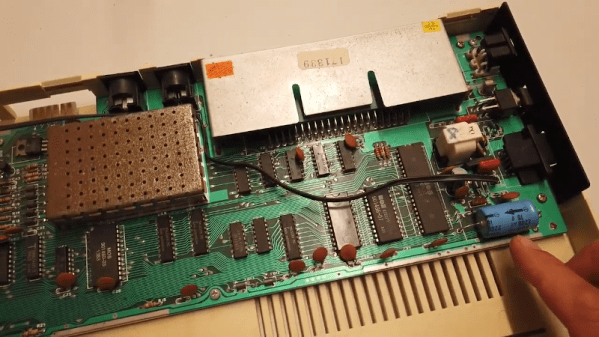
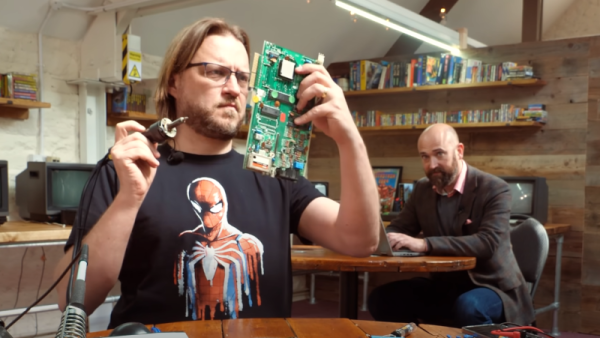
Commodore machines are well-loved around here, but usually when you think Commodore, you think about the Commodore 64, or maybe the PET or Amiga. But the Commodore 64 had an older sister, the VIC 20. This was the first computer to sell a million units and has a lot in common with its better-known successor. The machine was only made for a few years, and [Dubious Engineering] has been restoring one over a few videos. In the video below, he opens it up for a look inside, among other things.

If you want to get straight to the opening, you’ll need to fast forward about 5 and a half minutes. The keyboard pulls off and a nice old-fashioned set of cables made from individual wires connect to the skinny main board with all the smarts on it. No ribbon cables or flex PCBs!

Continue reading “Inside The VIC-20”

Linus Åkesson’s ‘A Mind Is Born’ Commodore 64 Demo In Just 256 Bytes

It would be an understatement to say that the Commodore 64 demo scene is quite amazing. For those who are unaware, a ‘demo’ in this context is essentially a technological demonstration. Usually to show off particular effects or other (visual) properties that either push the limits of the platform on which it is being run, or use its hardware in a special fashion.  In the case of [Linus Åkesson]’s A Mind Is Born demo, the challenge was to do as much as possible in 256 bytes, while providing an audiovisual experience.

Although at first glance 256 bytes may sound like a lot to work with, this code has to generate the entire melody that is output via the Commodore 64’s SID audio chip, while simultaneously generating an attractive visual pattern. This is quite an undertaking, as the video capture of the result (included after the break) makes clear. The secret sauce here is to make use of the C64’s SID audio & VIC-II video chips.

Driven by a 60 Hz timer interrupt, the three voices of the SID are used to play the kick drum and bass, melody and drone respectively, creating the 64 total bars of the music using a linear-feedback shift register (LFSR). This means that the melody is in a sense randomly generated, but deterministically enough to sound pleasing to the human ear.

For the visual side, the C64 runs in Extended Character Mode, using fonts along with a background color to create interesting patterns using what is essentially a cellular automaton algorithm. While there are some visual glitches due overwriting of video data, and a race condition, these end up adding to the charm. The resulting audio track is pretty catchy too, and absolutely worthy of a listen.

Thanks for the tip, Johannes!

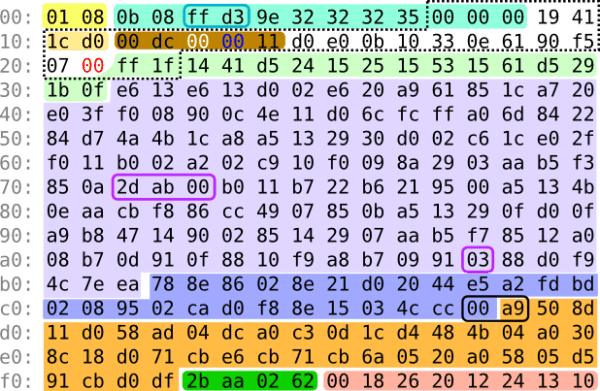
(That banner image?  That _is_ the whole code.)

Continue reading “Linus Åkesson’s ‘A Mind Is Born’ Commodore 64 Demo In Just 256 Bytes”

Repairing A Vintage HP 9825 The Hard Way

[CuriousMarc] is at it again, this time trying to undo the damage from a poorly designed power circuit, that fried the internals of his HP 9825 computer. (Video, embedded below.)

The power supply on this particular model has a failure mode where a dying transistor can lead to 13 V on the 5 V line. This causes all the havoc one would expect on the internals of a 1970s era portable computer. This particular computer is rather rare, so instead of calling it a lost cause, our protagonist decides to replace the faulty transistor, install a proper overvoltage protection circuit, and then start the tedious hunt for which chips actually let their magic smoke out.
Continue reading “Repairing A Vintage HP 9825 The Hard Way”

Retro ISA Card Means Old, Slow Computers No Longer Need Old, Heavy Monitors

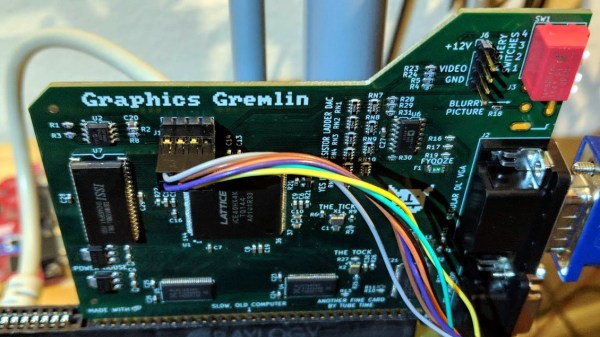
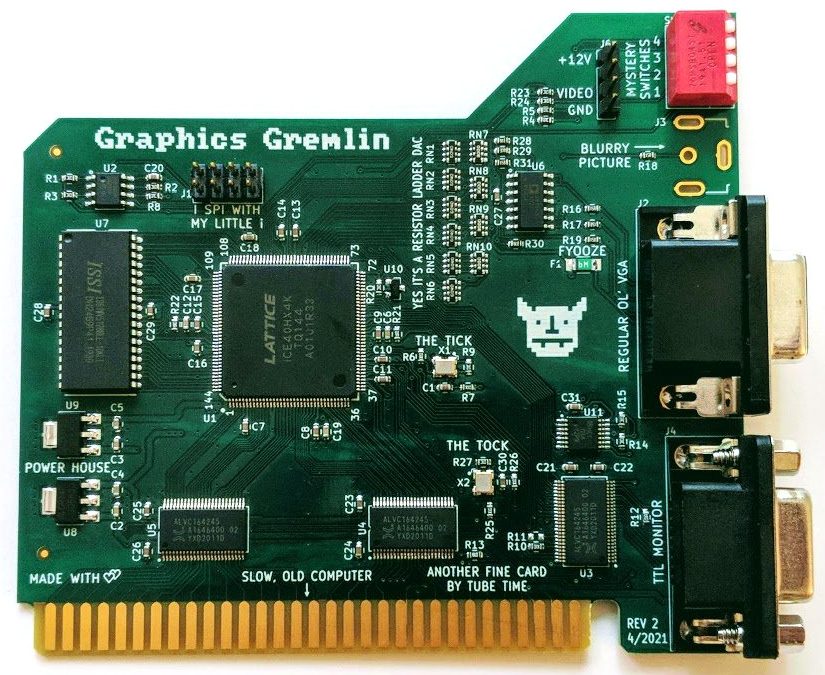
One thing about vintage computers is that they depend greatly on whether or not one can plug a compatible monitor into them. That’s what’s behind [Tube Time]’s Graphics Gremlin, a modern-design retro ISA video card that uses an FPGA to act just like a vintage MDA or CGA video card on the input end, but provides a VGA port for more modern display output options. (Actually, there is also an RGBI connector and a composite video out, but the VGA is probably the most broadly useful.)

Handy silkscreen labels make everything crystal clear. Click to enlarge.

Why bother making a new device to emulate an old ISA video card when actual vintage video cards are still plentiful? Because availability of the old cards isn’t the bottleneck. The trouble is that MDA or CGA monitors just aren’t as easy to come across as they once were, and irreplaceable vintage monitors that do still exist risk getting smashed during shipping. Luckily, VGA monitors (or at least converters that accept VGA input) are far more plentiful.

The board’s design files and assembly notes are all on the project’s GitHub repository along with plenty of thoughtful detail about both assembly and troubleshooting, and the Verilog code has its own document. The Graphics Gremlin is still under development, but you can also watch for the latest on [Tube Time]’s Twitter feed.

Thanks to [NoxiousPluK] for the tip!

A “Disgusting” 1980s Computer Restored

It takes a special eye to see a junkyard car and envision it as your latest hotrod. The guys at RMC found what they termed a “disgusting” Acorn Electron and decided to restore it to its former glory. The Electron was a budget version of the BBC micro with a 6502 running at 2 MHz when executing code from ROM and 1 MHz when it hit the RAM. Apparently, at least some of the bus was operating at 4 bits instead of 8. Go figure.

The 1982 machine was meant to head off the Sinclair ZX and was set to sell for about £200. However, the machine didn’t catch on like the Sinclair and undersold it by around 20 times with a paltry quarter of a million units.

Continue reading “A “Disgusting” 1980s Computer Restored”

Apple Gets CP/M

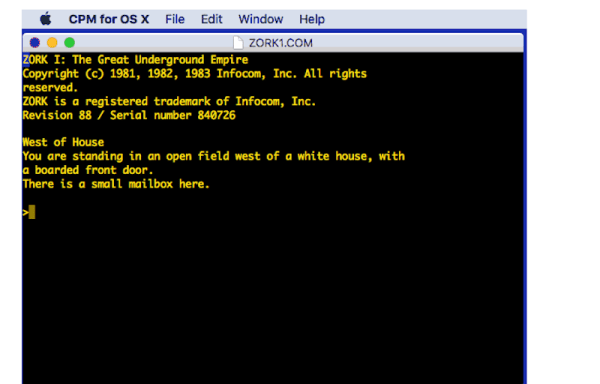
In case you wanted to run WordStar on your Mac, [Tom Harte] offers CP/M for OS/X, and it looks like it would be a lot of fun. Of course you might be happier running Zork or Turbo Pascal, and you can do that, too.

There are plenty of Z80 emulators that can run CP/M, but what we found most interesting about this one is that it is written in Objective C, a language with a deep history in the Mac and NeXT worlds.

Continue reading “Apple Gets CP/M”

Scanner Captures View-Master Discs As Glorious 3D Videos

The toys of the past may have been cheesy, but you can’t deny the creativity needed to build something engaging without any electronics. One stalwart toy from this category is View-Master, the little stereoscopic slide viewer that brought the world to life in seven vibrant scenes. And digitizing these miniature works of art is the purpose of this neat View-Master reel scanner project.

If you haven’t had the pleasure of using a View-Master, the gist is that a flat cardboard disc ringed with 14 color transparencies was inserted into a plastic viewer. Binocular eyepieces showed scenes from opposing pairs of slides, which were illuminated by a frosted screen and room lighting. The scenes were photographed from slightly different angles, leading to a stereoscopic image that was actually pretty good quality.

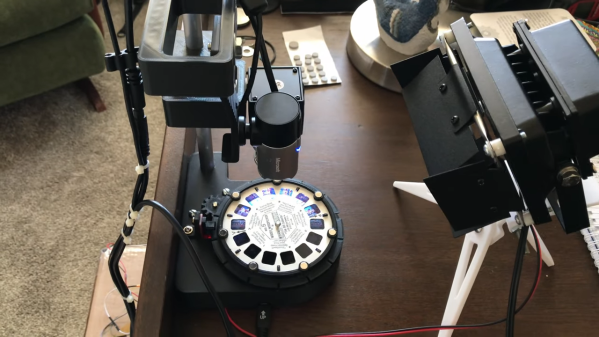
In the video below, project creator [W. Jason Altice] describes View-Master as “the YouTube of the 1950s.” We partially agree; with only seven frames to tell a story, we’d say it’s more like TikTok than YouTube. Regardless, capturing these mini-movies requires quite a bit of complexity. All the parts for the reel carousel are 3D-printed, with a small stepper to advance the reel and an optical sensor to register its position. A ring of RGB LEDs beneath the reel illuminates the slides; being able to control the color of the light helps with color balancing for slides with faded colors. An 8-megapixel camera captures each slide, and some pretty slick software helps with organizing the image pairs, tweaking their alignment, capturing the captions from the disc, and stitching everything into a video.

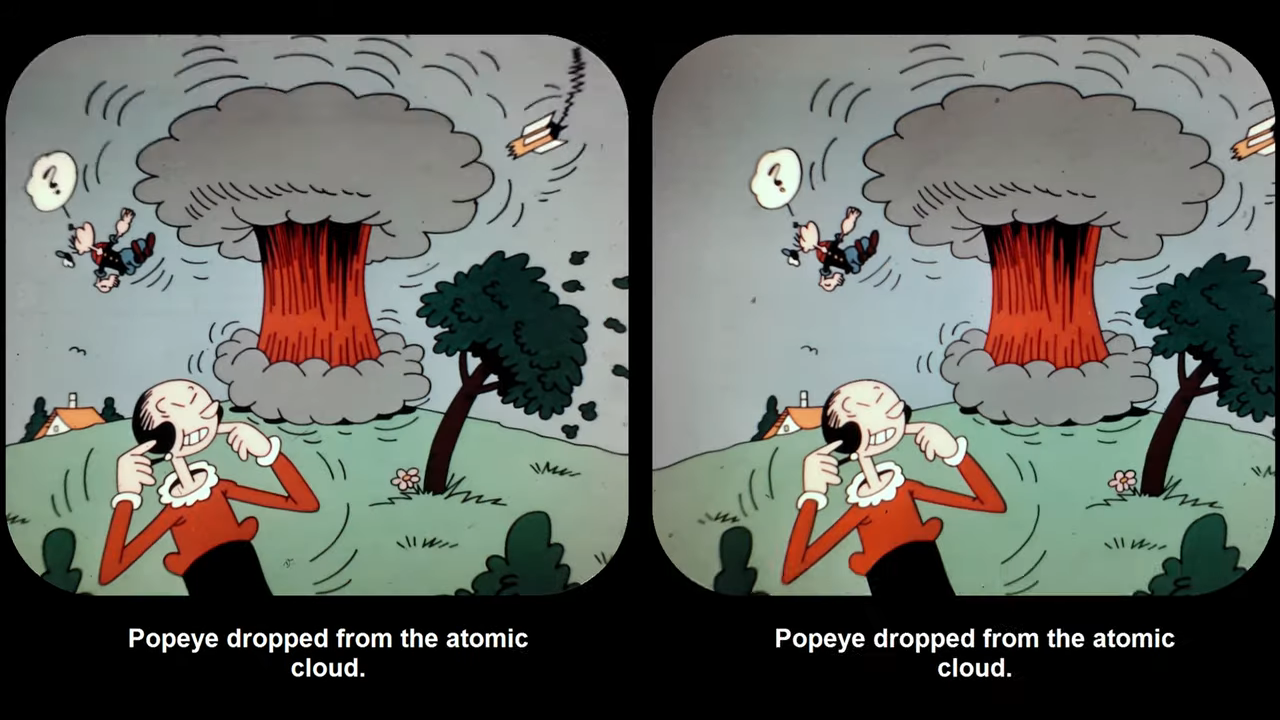
There’s a whole YouTube channel devoted to View-Master captures, which are best viewed with a Google Cardboard or something similar. Even without the 3D effect, it’s still pretty cool to watch [Popeye] beat up a nuke again.

Continue reading “Scanner Captures View-Master Discs As Glorious 3D Videos”