Anatomy Of A Cloned Piece Of Hardware

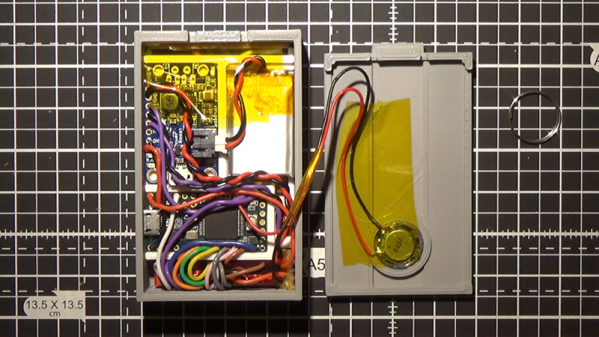
What would you think if you saw a bootleg of a product you design, manufacture, and sell pop up on eBay? For those of us who don’t make our livelihood this way, we might secretly hope our blinkenlight project ends up being so awesome that clones on AliExpress or TaoBao end up selling in the thousands . But of course anyone selling electronics as their business is going to be upset and wonder how this happened? It’s easy to fall into the trap of automatically assigning blame; if the legit boards were made in China would you assume that’s where the design was snagged to produce the bootlegs? There’s a saying about assumptions that applies to this tale.

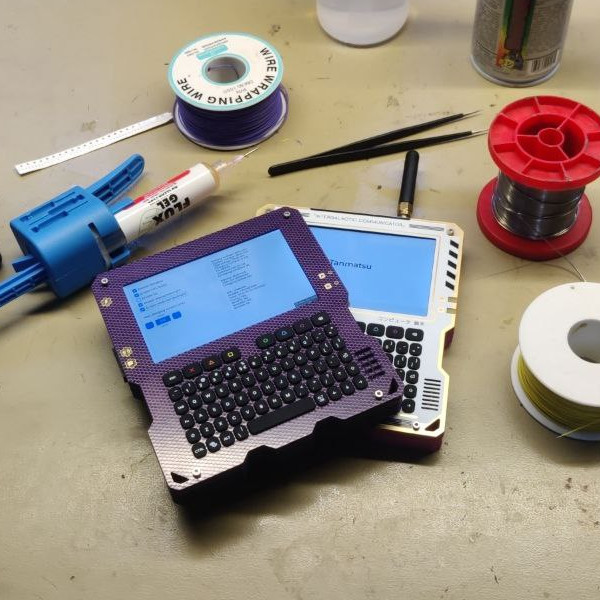
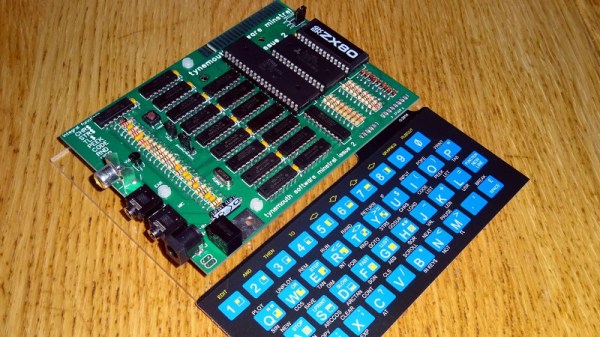
Dave Curran from Tynemouth Software had one of his products cloned, and since he has been good enough to share all the details with us we’ve been able to take a look at the evidence. Dave’s detective work is top notch. What he found was surprising, his overseas manufacturer was blameless, and the bootleg board came from an entirely different source. Continue reading “Anatomy Of A Cloned Piece Of Hardware”

Is That A Vintage Computer In Your Pocket?

There’s a lot of debate over which of several contenders was the first modern computer. One of those first operating computers was the University of Cambridge’s EDSAC — the brainchild of Dr. Maurice Wilkes. The EDSAC scored a lot of firsts and used a serial data path along with mercury delay line memories. Over on Hackaday.io, [David Boucher] wanted to simulate the EDSAC in a much smaller form factor than the original room full of racks.

As you can see in the video below, he succeeded in that task, using a Teensy and a small LCD display. We’re reminded EDSAC was among the first machines so some of the terms we would employ were not in use yet. An order is an instruction, for example. Initial orders are akin to a bootloader. Continue reading “Is That A Vintage Computer In Your Pocket?”

Vintage Audio Gear Gets A Display Upgrade

The lengths the retrocomputing devotee must go to in order to breathe new life into old gear can border on the heroic. Tracing down long-discontinued parts, buying multiple copies of the same unit to act as organ donors for the one good machine, and when all else fails, improvising with current productions parts to get that vintage look and feel.

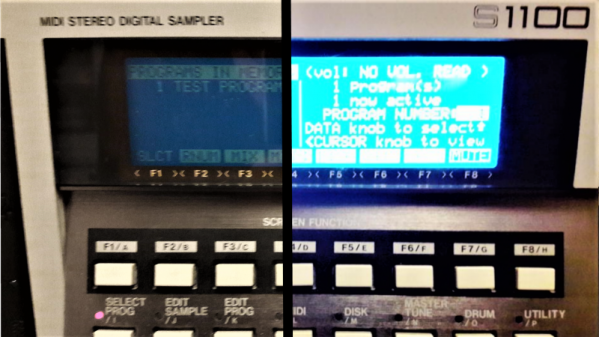
This LCD display backlighting fix for a vintage audio sampler falls into that last category, which was pulled off by [Inkoo Vintage Computer]. The unit in question is an Akai S1100 sampler, a classic from the late 1980s that had already been modified to replace the original floppy drive with a USB reader when the backlight on the LCD began to give out. Replacements for the original electroluminescent backlight are available, but [Inkoo] opted for a cheaper way out. An iPhone 6s 6 Plus backlight was an inexpensive option, if it could be made to fit. Luckily, [Inkoo] was able to trim the diffuser without causing any electrical issues. A boost converter was needed to run the backlight from the sampler’s 5 V DC rail, and interfacing the backlight’s flexible circuitry to the 80s-era copper wiring was a bit fussy, but the results were great. The sampler’s LCD is legible again, and looks just like it might have in the studio back when [Depeche Mode] and [Duran Duran] were using it to crank out hits.

As much as we like this repair, it doesn’t imply that EL is a dead technology. Far from it – [Ben Krasnow] is using it to create unique displays, and EL wire makes for some dazzling wearables. It doesn’t last forever, but while it does, it’s pretty neat stuff.

Blowing The Dust Off Of An IBM AS/400 Server

If you’ve never seen an IBM AS/400 machine, don’t feel bad. Most people haven’t. Introduced in 1988 as a mid-range server line, it used a unique object-based operating system and was geared specifically towards business and enterprise customers. Unless you’re a particularly big fan of COBOL you probably won’t have much use for one today, but that doesn’t mean they aren’t worth playing around with if the opportunity presents itself.

So when a local IT company went belly up and was selling their old hardware, including a late 90’s era IBM AS/400e Series, [Rik te Winkel] jumped at the chance to take this unique piece of computing history home. He knew it was something of a risk, as maintenance and repair tasks for these machines were intended to be done by IBM certified technicians rather than the DIYer, leaving little in the way of documentation or even replacement parts. But in the end it worked out, and best of all, he documented the successful process of dragging this 90’s behemoth into the blinding light of the twenty-first century for all the world to see.
After getting the machine home and sitting through its thirty minute boot process, [Rik] was relieved to see the code 01 B N pop on the server’s display. This meant the system passed all the internal checks and was ready to go, he just had to figure out how to talk to the thing. Built to be a pure server, the machine didn’t offer any video output so he’d have to log into it over the network.

[Rik] noted that there was no new DHCP entry in his router for the server, but of course that was hardly surprising as the machine would have certainly had a static IP when it was in use. So he shut the server down, plugged it directly into his laptop’s Ethernet port, and watched the output of Wireshark as it went through its arduous boot sequence. Eventually he started to pick up packets coming from the IP address 10.10.10.9, and he had his target.

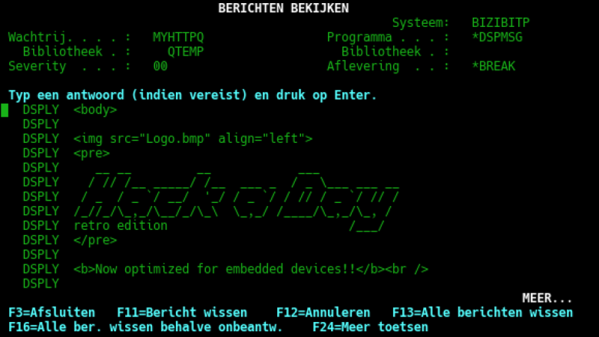
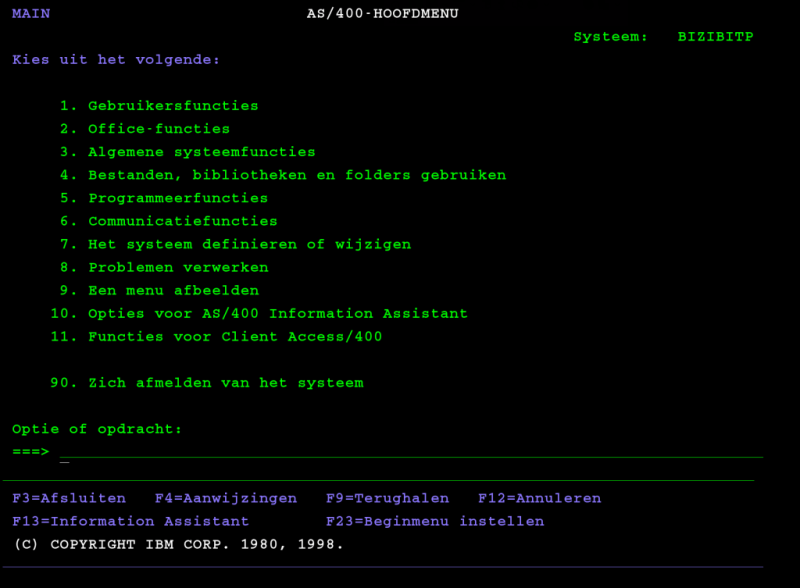
There are a few clients out there that allow you to remotely log into an AS/400, so he downloaded one and pointed it to the server’s IP. He was surprised to see the operating system was apparently in Dutch, but at least he was in. He tried a few common usernames and passwords, helped along by the fact that this OS from a somewhat more innocent era will actually tell you if you have the username right or wrong, and eventually managed to hack the Gibson with the classic admin/admin combo.

So he was in, but now what? [Rik] decided that he couldn’t truly call this machine bested until he could pull up the Hackaday Retro Edition, so he started work on writing a program to let him pull down the page directly on the AS/400 in IBM’s proprietary Report Program Generator (RPG) programming language. You know, as one does. He didn’t quite feel up to writing a whole HTML parser, but he got as far as generating a HTTP GET request, downloading the page’s source, and opening it up as a local file. That’s good enough for us.

Our very own [Al Williams] documented his adventures poking around an Internet-connected AS/400 machine, which might serve as a helpful primer if you ever find one of these delightfully oddball computers kicking around the local recycling center.

35C3: A Deep Dive Into DOS Viruses And Pranks

Oh, the hijinks that the early days of the PC revolution allowed. Back in the days when a 20MB hard drive was a big deal and MS-DOS 3.1 ruled over every plain beige PC-clone cobbled together by enthusiasts like myself, it was great fun to “set up” someone else’s machine to do something unexpected. This generally amounted to finding an unattended PC — the rooms of the residence hall where I lived in my undergrad days were a target-rich environment in this regard — and throwing something annoying in the AUTOEXEC.BAT file. Hilarity ensued when the mark next booted the machine and was greeted with something like an inverted display or a faked hard drive formatting. Control-G was good to me too.

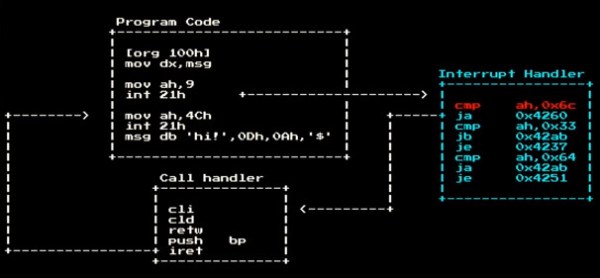
So it was with a sense of great nostalgia that I watched [Ben Cartwright-Cox]’s recent 35C3 talk on the anatomy and physiology of viruses from the DOS days. Fair warning to the seasoned reader that a sense of temporal distortion is inevitable while watching someone who was born almost a decade after the last meaningful release of MS-DOS discuss its inner workings with such ease. After a great overview of the DOS API elements that were key to getting anything done back then, malware or regular programs alike, he dives into his efforts to mine an archive of old DOS viruses, the payloads of most of which were harmless pranks. He built some tools to find viruses that triggered based on the system date, and used an x86 emulator he designed to test every day between 1980 and 2005. He found about 10,000 malware samples and explored their payloads, everything from well-wishes for the New Year to a bizarre foreshadowing of the Navy Seal Copypasta meme.

We found [Ben]’s talk a real treat, and it’s good to see someone from the current generation take such a deep dive into the ways many of us cut our teeth in the computing world.

Continue reading “35C3: A Deep Dive Into DOS Viruses And Pranks”

FPGA Emulates A PDP-1, Breathes New Life Into Classic Video Game

If you’ve ever wanted to sit at the console of the machine that started the revolution in interactive computing, your options are extremely limited. Of the 53 PDP-1 machines that Digital Equipment Corporation made, only three are known to still exist, and just one machine is still in working order at the Computer History Museum. So a rousing game of Spacewar! on the original hardware is probably not something to put on your bucket list.

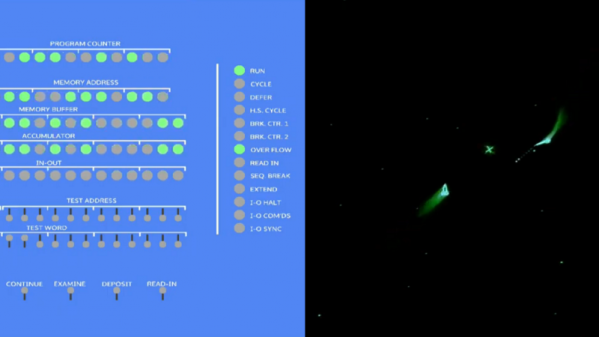
But thanks to [Hrvoje], there’s now an FPGA emulation of the PDP-1 that lets you play the granddaddy of all video games without breaking into the CHM. The project was started simply to give [Hrvoje] a sandbox for learning FPGAs and Verilog, but apparently went much further than that. The emulation features the complete PDP-1 instruction set, 4kB of core memory, and representations of the original paper tape reader, teletype, operator’s console, and the classic Type 30 CRT. All the hardware is displayed on a standard HDMI monitor, but it’s the CRT implementation that really sells this. The original Type 30 monitor used a CRT from a radar set, and had long-persistence phosphors that gave the display a very distinctive look. [Hrvoje] replicated that by storing each pixel as three values (X, Y, and brightness) in a circle of four chained shift registers. As the pixels move through the shift registers, the brightness value is decreased so it slowly fades. [Hrvoje] thinks it doesn’t look quite right, but we’ll respectfully disagree on that point.

We’ve argued before that the PDP-1 is the machine that started hacker culture, and we think this project is a fitting tribute to the machine as we enter the year in which it will turn sixty. Having the chance to play with it through this emulation is just icing on its birthday cake.

Continue reading “FPGA Emulates A PDP-1, Breathes New Life Into Classic Video Game”

Vintage IBM 1403 Printer Problem Evades An Easy Fix

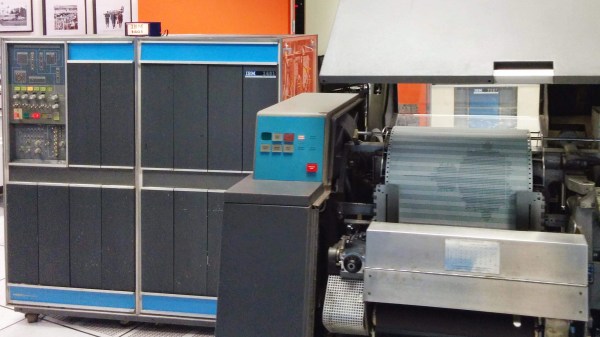
The Computer History Museum in Mountain View has two operational IBM 1401 mainframes, which use IBM 1403 high-speed printers. They aren’t some decades-old notion of “high speed” that barely looks sluggish today, either. These monsters slam out ten lines per second thanks to a rotating chain of type slugs and an array of electromagnetic hammers. Every 11.1 microseconds, a character in the chain would be lined up with a hammer, and if the control circuitry identified it as a character that needed to be printed, the hammer behind the paper would drive the paper into the print ribbon and the slug, putting an imprint of the character onto the paper. When one of these printers failed with a sync error, it kicked off some serious troubleshooting to diagnose the problem.

The IBM 1403’s type chain has a repeating set of characters that spins around at high speed. Unlike a typewriter or label maker, the hammers are not inside this unit. The hammers are on the outside, and work by pressing the paper onto the type slugs as the required characters line up.

Investigation of the problem ultimately led to an intermittent connection in a driver card due to a broken PCB trace, but by then some fuses had been blown as well. In the end the printer was brought back online, but possibly with a slightly damaged coil on one of the hammers.

[Ken]’s writeup on the repair process is highly detailed and walks through the kind of troubleshooting and repairs involved when solving problems with vintage electronics. Electrical fundamentals might be the same, but a deep understanding of not only the architecture but also the failure modes of vintage hardware is needed in order to troubleshoot effectively.

If IBM 1401 mainframes and fixing 1403 printers sounds familiar, it’s because a printer fix has been done before. That was due to a different problem, but still a challenging task to narrow down and fix.