Quantum Computing For Computer Scientists

Quantum computing is coming, so a lot of people are trying to articulate why we want it and how it works. Most of the explanations are either hardcore physics talking about spin and entanglement, or very breezy and handwaving which can be useful to get a little understanding but isn’t useful for applying the technology. Microsoft Research has a video that attempts to hit that spot in the middle — practical information for people who currently work with traditional computers. You can see the video below.

The video starts with basics you’d get from most videos talking about vector representation and operations. You have to get through about 17 minutes of that sort of thing until you get into qubits. If you glaze over on math, listen to the “index array” explanations [Andrew] gives after the math and you’ll be happier.

Continue reading “Quantum Computing For Computer Scientists”

Simple Quadcopter Testbed Clears The Air For Easy Algorithm Development

We don’t have to tell you that drones are all the rage. But while new commercial models are being released all the time, and new parts get released for the makers, the basic technology used in the hardware hasn’t changed in the last few years. Sure, we’ve added more sensors, increased computing power, and improved the efficiency, but the key developments come in the software: you only have to look at the latest models on the market, or the frequency of Git commits to Betaflight, Butterflight, Cleanflight, etc.

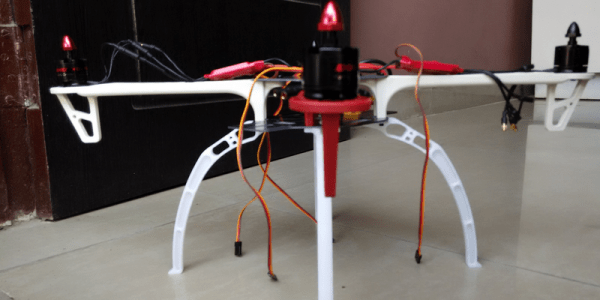
With this in mind, for a Hackaday prize entry [int-smart] is working on a quadcopter testbed for developing algorithms, specifically localization and mapping. The aim of the project is to eventually make it as easy as possible to get off the ground and start writing code, as well as to integrate mapping algorithms with Ardupilot through ROS.

The initial idea was to use a Beaglebone Blue and some cheap hobby hardware which is fairly standard for a drone of this size: 1250 kv motors and SimonK ESCs, mounted on an f450 flame wheel style frame. However, it looks like an off-the-shelf solution might be even simpler if it can be made to work with ROS. A Scanse Sweep LIDAR sensor provides point cloud data, which is then munched with some Iterative Closest Point (ICP) processing. If you like math then it’s definitely worth reading the project logs, as some of the algorithms are explained there.

It might be fun to add FPV to this system to see how the mapping algorithms are performing from the perspective of the drone. And just because it’s awesome. FPV is also a fertile area for hacking: we particularly love this FPV tracker which rotates itself to get the best signal, and this 3D FPV setup using two cameras.

Keep It Close: A Private Git Server Crash Course

At this point, everyone has already heard that Microsoft is buying GitHub. Acquisitions of this scale take time, but most expect everything to be official by 2019. The general opinion online seems to be one of unease, and rightfully so. Even if we ignore Microsoft’s history of shady practices, there’s always an element of unease when somebody new takes over something you love. Sometimes it ends up being beneficial, the beginning of a new and better era. But sometimes…

Let’s not dwell on what might become of GitHub. While GitHub is the most popular web-based interface for Git, it’s not the only one. For example GitLab, a fully open source competitor to GitHub, is reporting record numbers of new repositories being created after word of the Microsoft buyout was confirmed. But even GitLab, while certainly worth checking out in these uncertain times, might be more than you strictly need.

Let’s be realistic. Most of the software projects hackers work on don’t need even half the features that GitHub/GitLab offer. Whether you’ve simply got a private project you want to maintain revisions of, or you’re working with a small group collaboratively in a hackerspace setting, you don’t need anything that isn’t already provided by the core Git software.

Let’s take a look at how quickly and easily you can setup a private Git server for you and your colleagues without having to worry about Microsoft (or anyone else) having their fingers around your code.

Continue reading “Keep It Close: A Private Git Server Crash Course”

Conquering The Earth With Cron

The GOES-R series of Earth observation satellites are the latest and greatest NASA has to offer. As you might expect, part of the GOES-R job description is imaging Earth at high-resolution, but they also feature real-time lighting monitoring as well as enhanced solar flare and space weather capabilities. Four of these brand new birds will be helping us keep an eye on our planet’s condition into the 2030s. Not a bad way to spend around 11 billion bucks.

To encourage innovation, NASA is making the images collected by the GOES-R satellites available to the public through a collaboration with Google Cloud Platform. [Ben Nitkin] decided to play around with this data, and came up with an interactive website that let’s you visualize the Earth from the perspective of GOES-R. But don’t let those slick visuals fool you, the site is powered by a couple cron jobs and some static HTML. Just as Sir Tim Berners-Lee intended it.

But it’s not quite as easy as scheduling a wget command; the images GOES-R collects are separated into different wavelengths and need to be combined to create a false-color image. A cron job fires off every five minutes which downloads and merges the raw GOES-R images, and then another cron job starts a Python script that creates WebM time-lapse videos out of the images using ffmpeg. All of the Python scripts and the crontab file are available on GitHub.

Finally, with the images merged and the videos created, the static HTML website is served out to the world courtesy of a quick and dirty Python web server. The site could be served via something more conventional, but [Ben] likes to keep overhead as low as possible.

If you want to take the more direct route, we’ve covered plenty of projects focused on pulling down images from weather satellites; from using old-school “rabbit ears” to decoding the latest Russian Meteor-M N2 downlink.

Continue reading “Conquering The Earth With Cron”

A Real Time Data Compression Technique

With more and more embedded systems being connected, sending state information from one machine to another has become more common. However, sending large packets of data around on the network can be bad both for bandwidth consumption and for power usage. Sure, if you are talking between two PCs connected with a gigabit LAN and powered from the wall, just shoot that 100 Kbyte packet across the network 10 times a second. But if you want to be more efficient, you may find this trick useful.

As a thought experiment, I’m going to posit a system that has a database of state information that has 1,000 items in it. It looks like an array of RECORDs:

typedef struct
{
  short topic;
  int data;
} RECORD;

It doesn’t really matter what the topics and the data are. It doesn’t really matter if your state information looks like this at all, really. This is just an example. Given that it is state information, we are going to make an important assumption, though. Most of the data doesn’t change frequently. What most and frequently mean could be debated, of course. But the idea is that if I’m sending data every half second or whatever, that a large amount isn’t going to change between one send and the next.

Continue reading “A Real Time Data Compression Technique”

Nvidia Transforms Standard Video Into Slow Motion Using AI

Nvidia is back at it again with another awesome demo of applied machine learning: artificially transforming standard video into slow motion – they’re so good at showing off what AI can do that anyone would think they were trying to sell hardware for it.

Though most modern phones and cameras have an option to record in slow motion, it often comes at the expense of resolution, and always at the expense of storage space. For really high frame rates you’ll need a specialist camera, and you often don’t know that you should be filming in slow motion until after an event has occurred. Wouldn’t it be nice if we could just convert standard video to slow motion after it was recorded?

That’s just what Nvidia has done, all nicely documented in a paper. At its heart, the algorithm must take two frames, and artificially create one or more frames in between. This is not a manual algorithm that interpolates frames, this is a fully fledged deep-learning system. The Convolutional Neural Network (CNN) was trained on over a thousand videos – roughly 300k individual frames.
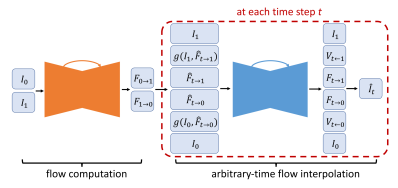
Since none of the parameters of the CNN are time-dependent, it’s possible to generate as many intermediate frames as required, something which sets this solution apart from previous approaches.  In some of the shots in their demo video, 30fps video is converted to 240fps; this requires the creation of 7 additional frames for every pair of consecutive frames.

The video after the break is seriously impressive, though if you look carefully you can see the odd imperfection, like the hockey player’s skate or dancer’s arm. Deep learning is as much an art as a science, and if you understood all of the research paper then you’re doing pretty darn well. For the rest of us, get up to speed by wrapping your head around neural networks, and trying out the simplest Tensorflow example.

Continue reading “Nvidia Transforms Standard Video Into Slow Motion Using AI”

Make A Natural Language Phone Bot Like Google’s Duplex AI

After seeing how Google’s Duplex AI was able to book a table at a restaurant by fooling a human maître d’ into thinking it was human, I wondered if it might be possible for us mere hackers to pull off the same feat. What could you or I do without Google’s legions of ace AI programmers and racks of neural network training hardware? Let’s look at the ways we can make a natural language bot of our own. As you’ll see, it’s entirely doable.

Continue reading “Make A Natural Language Phone Bot Like Google’s Duplex AI”