Tricking A Bike Counter

Some municipalities implement bike counters on cycling routes in order to monitor traffic. [nullpxl] recently investigated how these counters work, and explored methods that can be used to trick the counter into thinking a bike passed over it.

A great many of these devices are built using inductive loop sensors. This involves passing a current through a loop of wire embedded in the ground. When a conductive item such as the metal wheel of a bike passes through the electric field, eddy currents are generated in the item, creating their own magnetic field which reacts with the loop’s field itself. This creates a change in inductance which can be measured, and thus used to log the number of times a conductive item has passed over the sensor. By looking at the signature of the inductance change, a system can be tuned to detect specific objects—for example, two bicycle wheels passing over a sensor will create a signal that varies over time in a characteristic way.

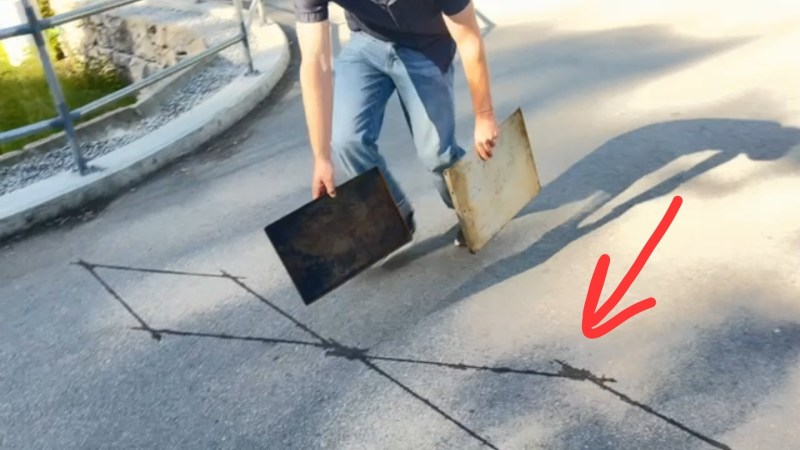
[nullpxl] first tried to recreate a “bike” signal for the inductive loop by running over the area holding two metal pans. This wasn’t close enough, so a new idea was needed. Experiments with a scrap bike then indicated that there was a speed gate involved, and that wheeling one wheel over the sensor and back again could trick the sensor into thinking a bike had passed by. Eventually, [nullpxl] distilled all this learning down to create “the BIKE BASKET.” It’s simply a bag with a bike wheel in it, and swinging it over the sensor twice makes the counter tick up.

Is there any money in tricking the average municipal bike counter in your local city? We doubt it, unless Big Bike is getting increasingly filthy in its lobbying efforts. In any case, we love to see weird sensor hacks around these parts. Continue reading “Tricking A Bike Counter”

Honda Civics And Installing Software With Android Test Keys

As more and more of the ‘smart’ infotainment systems in cars begin to age out of support, it becomes increasingly more relevant to figure out how to do something with that lump of computer-and-display sitting prominently in the dashboard.

Here [Eric McDonald]’s reverse-engineering of the 2012-era Android-based infotainment system in a 2021 Honda Civic is an interesting case study, with recently the discovery made that the head unit of these infotainment systems can be updated via USB by using standard Android Open Source Project (AOSP) test keys as these were left on the file system.

This is a nice update to his initial reverse-engineering back in the innocent days of 2023, when such a facepalm-worthy exploit seemed unimaginable, but then the ‘s’ in ‘infotainment’ has always stood for ‘security’. In this exploit that [Eric] calls the EvilValet attack, it means that anyone with physical access to the USB port inside the car can theoretically run arbitrary code signed with these test keys, as documented in the GitHub project.

So far this rather foolish security issue has only been confirmed on [Eric]’s 2021 Honda Civic, but considering how those – often third-party – infotainment systems tend to get reused and recycled across generations and car variants, it’s quite possible that more Android-based infotainment systems have this vulnerability.

This exploit is obviously a double-edged sword, as on one hand it’s great that an owner of one of these cars can now basically do whatever they want with said infotainment system, but on the other hand it means that anyone who slides into your car with a USB stick can do the same.

DIY CO2 Scrubber In DIY Sub By A Hacker Braver Than Most

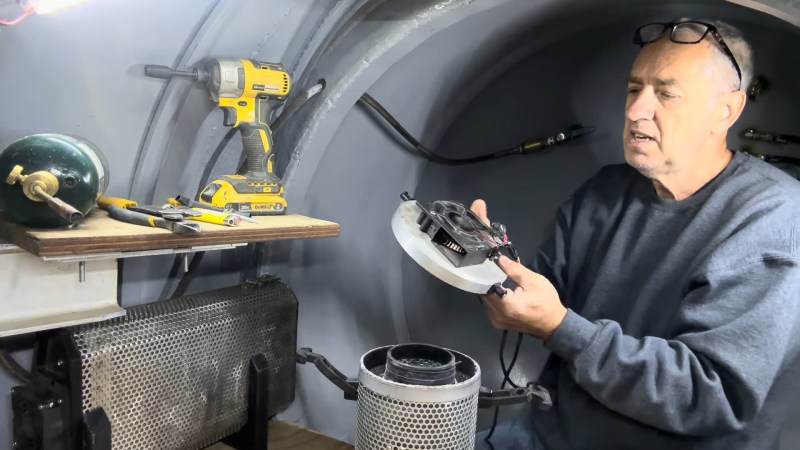
If you look around your environment, you can probably pick off quite a few things that you’ve made, at least if you’ve been at this a while. You probably aren’t reading this from the bottom of a body of water though, which means you lack the incredible confidence of submarine builder [Hank Pronk]. Not only is he building himself a capable-looking diesel-electric submarine over on YouTube, he’s even DIYing CO2 scrubbers for it! Yeah, that’s a man who believes in himself.

Luckily [Hank] is not anywhere near the Caribbean, so needn’t worry about being misidentified as a narco-sub, but he still has to be concerned about his oxygen supply when tooling around beneath the local lakes. Perhaps more important than the oxygen supply in a sub is the build up of CO2. It doesn’t matter how many oxygen tanks you bring down with you if you can’t scrub CO2 out of the air to make room for it. Just like the Apollo missions, he’s using a chemical adsorbent to take carbon dioxide out of the air — and just like Apollo 13, he’s switching from square to round.

Or, rather, from a rather rectangular commercial model to a DIY little round unit. That’s because he doesn’t need the big scrubber in this sub: being diesel-powered, he expects to spend a lot of time at snorkel depth, where both the pilot and the engines can get clean air through the tube. Dives are expected to be short, and in that use case, too big of a CO2 scrubber is really a waste. If for some reason he gets stuck on the bottom, well, the lake isn’t that deep. He can swim to surface, and has a detailed bailout plan. If he wants to stay under overnight to avoid bailing at night, he’s carrying enough extra adsorbent for that.

There’s a reason almost every submarine we’ve featured on this site over the years is an ROV. It’s not that a homemade submarine is automatically a death trap, but you sure do have to be confident in your design.

Continue reading “DIY CO2 Scrubber In DIY Sub By A Hacker Braver Than Most”

Ebike Display Uses Reflective LCD

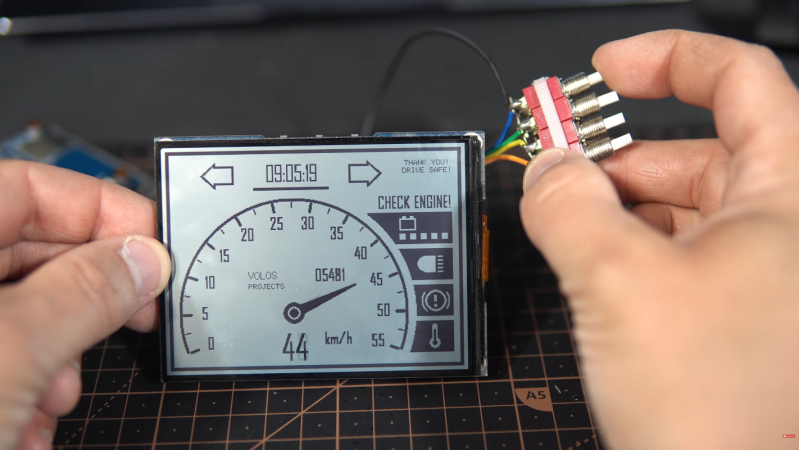
Although LCD displays have been used in almost every type of consumer electronics display over the last two decades, many of these screens have a few downsides that limit their usefulness in certain situations. As any owner of an early digital watch, an early laptop, or an early digital camera will testify, these displays often completely fail in direct sunlight. And, a currently new technology often using inexpensive displays in full sunlight conditions is ebikes, so [Volos Projects] decided to use a unique LCD display to solve this issue.

The display is called a reflective LCD (RLCD) and is actually a fairly old but overlooked piece of technology. Displays like these have a reflective layer that bounces ambient light back to the user, increasing contrast and readability in high light, especially when compared to more common transmissive displays. This build is based on a board from Waveshare, which includes the screen and its driver components, and [Volos Projects] integrated this into a test stand that mimics an ebike’s speed sensor and other hardware like turn signals. The display shows the bike’s speed and a few other indicators, and thanks to the screen, this information can be easily seen in full sun.

Although he doesn’t have it on an actual e-bike yet, he hopes it will be useful for those who want to try out something like this with their substandard e-bike displays. The code he’s used is available on a GitHub page for anyone interested. We’d imagine that a low-cost display like this would pair well with an open-source ebike like this one.

Continue reading “Ebike Display Uses Reflective LCD”

Camping On Unconventional Watercraft

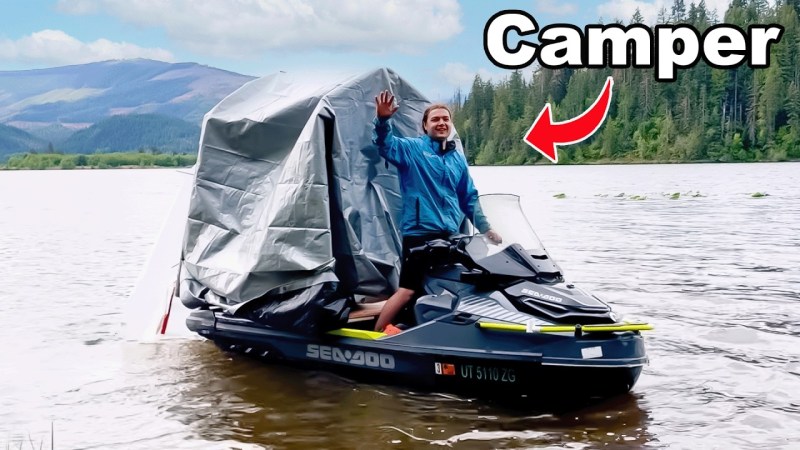
The fjords of Norway are world famous for their beauty, but even though the word itself is Norwegian, there are fjords all over the world in areas that used to be covered in glaciers. One of these areas is the Pacific Northwest of North America, we herit’s actually possible to travel by boat from the Seattle area all the way into Alaska without going to the Pacific Ocean, and although plenty of people make this journey by boat, [Matt] is planning on doing this journey on a jet ski with a custom camper on the back.

Normally a jet ski wouldn’t be the ideal platform for a multi-day on-boat adventure because of their size, but [Matt] found perhaps the largest jet ski ever made and he got a deal on it since it had previously been wrecked. Once he repaired the hull damage, he cut a sheet of plywood in half and put a hinge in the middle so it can unfold over the top of the jet ski but fold it away when he’s traveling. With the basic concept in place he took it right out on the water to a campsite before finalizing the construction of the rest of the tent, including the installation of a door, a window, and some interior lighting.

During that first night, a storm cropped up and pushed the craft out to shore while [Matt] was sleeping, so after realizing, waking up, and motoring back to shore, he made sure to tie the craft to a rock to avoid similar situations before going back to sleep. But besides some motion sickness which prevented him from cooking inside his camper, the rest of the adventure went off without a hitch. Before taking it on the Inside Passage he has been thinking of a few improvements like outriggers to keep it from rocking while he sleeps. [Matt] is no stranger to unusual camper builds, though, we recently featured his other camper which is an electric car converted to explore abandoned railroads.

Continue reading “Camping On Unconventional Watercraft”

A Bicycle Built On An Italian Renaissance Tech Base

There is a drawing of a bicycle in one of Leonarda DaVinci‘s sketchbooks– except it wasn’t drawn by DaVinci, and dates long after his death, so we can’t say the old master invented the bicycle. We can, however, wonder what it would have looked like if he did– and so did the [How To Make Everything] YouTube channel. As you might expect, they investigated the question of a Renaissance Bicycle in the best possible way: they built one.

In some ways the device looks like the first, primitive hobby-horse proto-bicycle of the early 19th century, which is not without reason. From the renaissance to the dawn of the industrial era, there wasn’t a huge change in how europeans worked with wood, and in both eras wood is the obvious choice. Where this bike differs from [Karl Drais]’s invention is that it has both pedals and brakes– both of them using drawings from DaVinci’s sketchbook.

You might be surprised to learn that ball-bearings are period-appropriate, and weren’t even invented by DaVinci. The drum brake, on the other hand, is right out of the Old Master’s notes: a steel band wraps around a drum on the rear break, and is tighened by a lever. With iron rims, no brake would stop on a dime, and this probably works as well as anything while being quite simple to make.

The chain is also based on one in DaVinci’s notes, and honesty it’s a weak point of the design; they’d likely have been better off with a leather belt, or perhaps a stack of gears as we’ve seen before. The hand-made chain just isn’t able to get the bike up to riding speed. Still, this is recognizably a bicycle and entertaining content for anyone who plans on violating the temporal prime directive or wants to get around after the apocalypse.

Continue reading “A Bicycle Built On An Italian Renaissance Tech Base”

An E-Bike Motor From First Principles

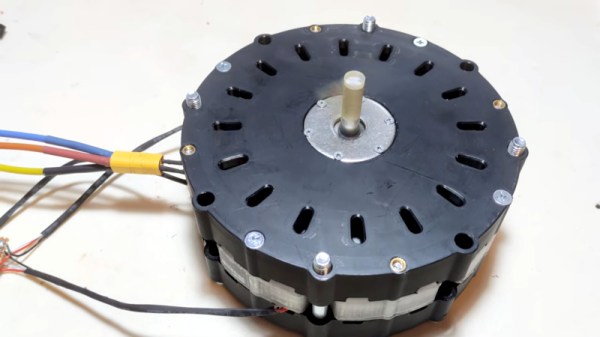
Many of us have made electric transport of some form, whether a Hacky Racer, and e-bike, a go-kart, or whatever. We have invariably bought a motor, or if we are really adventurous, repurposed a car alternator. Not [Birdbrain] though, because she’s designed and built her own from first principles.

The video below goes into significant detail on the design of her motor, looking at cores, wire sixes, and configurations with a useful simulation along the way. We particularly like the way she uses a bandsaw to cut transformer laminations to shape for her core. The 3D printed housing initially isn’t strong enough for the forces induced by the magnets, but she attacks that problem with a new print. The motor works well, and as an added bonus there’s an introduction to the different types of motor driver. It seems the cheap ones don’t deliver a good waveform for the characteristics of the motor. Sadly she doesn’t fit it to a real bike in the video, but it seems this thing might just work.

If you lack the courage to make the whole thing from scratch, we took a quick look at the car alternator route a while back.

Continue reading “An E-Bike Motor From First Principles”