The Precision Upon Which Civilizations Are Built

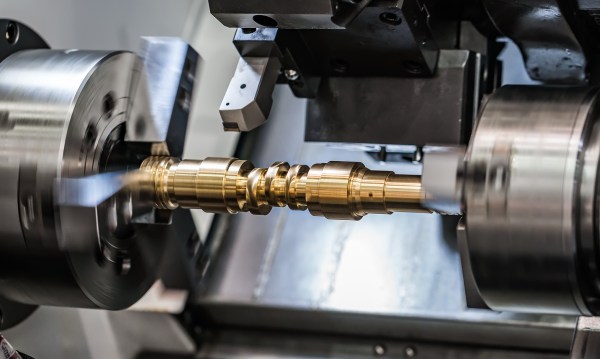
If you’re interested in making things (particularly metal things), you’re on a road that eventually leads to machine tools. Machine tools have a special place in history, because they are basically the difference between subsistence farming and modern civilization. A bold statement, I realize — but the ability to make very precise things is what gave us the industrial revolution, and everything that snowballed afterward. If you want to build a modern life filled with jet airplanes and inexpensive chocolate, start here.

Precision is more than just a desirable property. It’s a product. It has value, there is competition to create it, and our ability to create it as a species has improved over time. When your “precision product” is in the centimeter range, congratulations — you can make catapults and portcullises. Once you get into the millimeter range, guess what? You can make fine millwork in fancy houses, and indoor plumbing. Once you get sub-millimeter, now things get really interesting. It’s time for steam engines and automobiles. Once you get into the micrometer range, well, now we’re talking artificial heart valves and spaceships. Much like materials science, the ability to create precision is the unsung foundation and driving force of our standard of living.

Okay, so assuming I’ve sold you on the value of this product called “precision”, how do we make it? Machine tools are how humans currently get there, despite the dreams of the 3D printer crowd. Yes, drizzled plastic is great and the future is bright, but for right now, subtractive manufacturing is where it’s at when something has to be perfect.

Continue reading “The Precision Upon Which Civilizations Are Built”

Space Escape: Flying A Chair To Lunar Orbit

In the coming decades, mankind will walk on the moon once again. Right now, plans are being formulated for space stations orbiting around Lagrange points, surveys of lava tubes are being conducted, and slowly but surely plans are being formed to build the hardware that will become a small scientific outpost on our closest celestial neighbor.

This has all happened before, of course. In the early days of the Apollo program, there were plans to launch two Saturn V rockets for every moon landing, one topped with a command module and three astronauts, the other one containing an unmanned ‘LM Truck’. This second vehicle would land on the moon with all the supplies and shelter for a 14-day mission. There would be a pressurized lunar rover weighing thousands of pounds. This wouldn’t exactly be a Lunar colony, instead, it would be more like a small cabin in the Arctic used as a scientific outpost. Astronauts and scientists would land, spend two weeks researching and exploring, and return to Earth with hundreds of pounds of samples.

With this, as with all Apollo landings, came a risk. What would happen if the ascent engine didn’t light? Apart from a beautiful speech written by William Safire, there was nothing concrete for astronauts consigned to the deepest of the deep. Later in the Apollo program, there was a plan for real hardware to bring stranded astronauts home. This was the Lunar Escape System (LESS), basically two chairs mounted to a rocket engine.

While the LESS was never built, several studies were completed in late 1970 by North American Rockwell detailing the hardware that would return two astronauts from the surface of the moon. It involved siphoning fuel from a stricken Lunar Module, flying to orbit with no computer or really any instrumentation at all, and performing a rendezvous with an orbiting Command Module in less than one Lunar orbit.

Continue reading “Space Escape: Flying A Chair To Lunar Orbit”

Miss Beatrice Shilling Saves The Spitfire

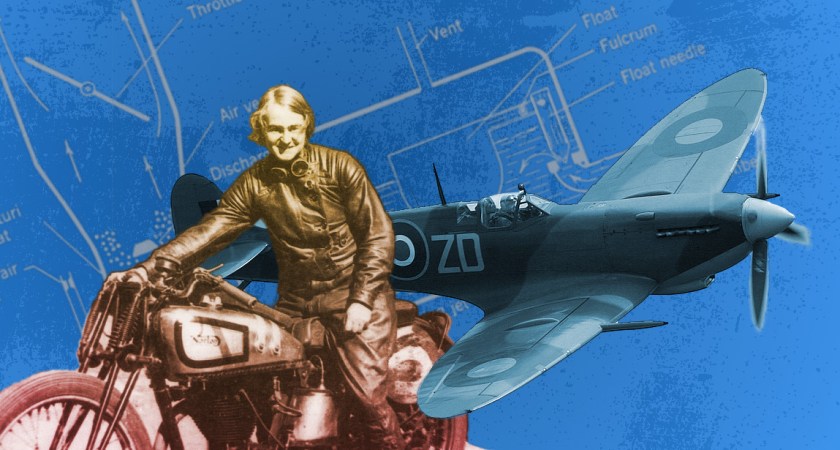
On a bright spring morning in 1940, the Royal Air Force pilot was in the fight of his life. Strapped into his brand new Supermarine Spitfire, he was locked in mortal combat with a Luftwaffe pilot over the English Channel in the opening days of the Battle of Britain. The Spitfire was behind the Messerschmitt and almost within range to unleash a deadly barrage of rounds from the four eight Browning machine guns in the leading edges of the elliptical wings. With the German plane just below the centerline of the gunsight’s crosshairs, the British pilot pushed the Spit’s lollipop stick forward to dive slightly and rake his rounds across the Bf-109. He felt the tug of the harness on his shoulders keeping him in his seat as the nimble fighter pulled a negative-g dive, and he lined up the fatal shot.

But the powerful V-12 Merlin engine sputtered, black smoke trailing along the fuselage as the engine cut out. Without power, the young pilot watched in horror as the three-bladed propeller wound to a stop. With the cold Channel waters looming in his windscreen, there was no time to restart the engine. The pilot bailed out in the nick of time, watching his beautiful plane cartwheel into the water as he floated down to join it, wondering what had just happened.

Continue reading “Miss Beatrice Shilling Saves The Spitfire”

Henrietta Lacks And Immortal Cell Lines

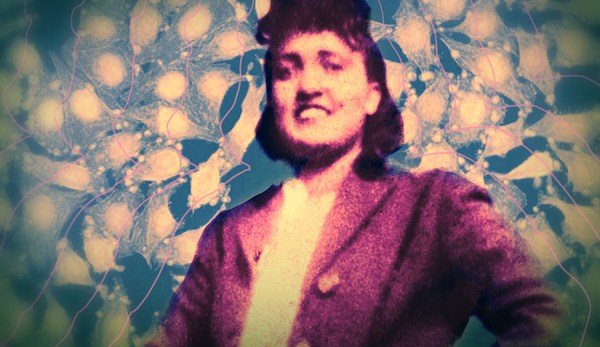
In early 1951, a woman named Henrietta Lacks visited the “colored ward” at Johns Hopkins hospital for a painful lump she found on her cervix. She was seen by Dr. Howard W. Jones, who indeed found a tumor growing on the surface of her cervix. He took a tissue sample, which confirmed Henrietta’s worst fears: She had cancer.

The treatment at the time was to irradiate the tumor with radium tubes placed in and around the cervix. The hope was that this would kill the cancerous cells while preserving the healthy tissue. Unbeknownst to Henrietta, a biopsy was taken during her radium procedure. Slivers of her tumor and of healthy cervix cells were cut away. The cancer cells were used as part of a research project. Then something amazing happened: the cancerous cells grew and continued to grow outside of her body.

As Henrietta herself lay dying, the HeLa immortal cell line was born. This cell line has been used in nearly every aspect of medical research since the polio vaccine. Millions owe their lives to it. Yet, Henrietta and her family never gave consent for any of this. Her family was not informed or compensated. In fact, until recently, they didn’t fully grasp exactly how Henrietta’s cells were being used.

Continue reading “Henrietta Lacks And Immortal Cell Lines”

First Light: The Story Of The Laser

Lasers are such a fundamental piece of technology today that we hardly notice them. So cheap that they can be given away as toys and so versatile that they make everything from DVD players to corneal surgery a reality, lasers are one of the building blocks of the modern world. Yet lasers were once the exclusive province of physicists, laboring over expansive and expensive experimental setups that seemed more the stuff of science fiction than workhouse tool of communications and so many other fields. The laser has been wildly successful, and the story of its development is an intriguing tale of observation, perseverance, and the importance of keeping good notes.

Continue reading “First Light: The Story Of The Laser”

44 Layers Of Katharine Burr Blodgett

Whether you realize it or not, Katharine Burr Blodgett has made your life better. If you’ve ever looked through a viewfinder, a telescope, or the windshield of a car, you’ve been face to face with her greatest achievement, non-reflective glass.

Katharine was a surface chemist for General Electric and a visionary engineer who discovered a way to make ordinary glass 99% transparent. Her invention enabled the low-cost production of nearly invisible panes and lenses for everything from picture frames and projectors to eyeglasses and spyglasses.

Katharine’s education and ingenuity along with her place in the zeitgeist led her into other fields throughout her career. When World War II erupted, GE shifted their focus to military applications. Katharine rolled up her sleeves and got down in the scientific trenches with the men of the Research Lab. She invented a method for de-icing airplane wings, engineered better gas masks, and created a more economical oil-based smokescreen. She was a versatile, insightful scientist who gave humanity a clearer view of the universe.

Continue reading “44 Layers Of Katharine Burr Blodgett”

Barbara McClintock: Against The Genetic Grain

The tale of much of Barbara McClintock’s life is that of the scientist working long hours with a microscope seeking to solve mysteries. The mystery she spent most of her career trying to solve was how all cells in an organism can contain the same DNA, and yet divide to produce cells serving different functions; basically how cells differentiate. And for that, she got a Nobel prize all to herself, which is no small feat either.

Becoming a Scientist

Human chromosomes, long strands of DNA
Human chromosomes, long strands of DNA by Steffen Dietzel CC BY-SA 3.0

McClintock was born on June 16, 1902, in Hartford, Connecticut, USA. From age three until beginning school, she lived with her aunt in Brooklyn, New York while her father strove financially to start up a medical practice. She was a solitary and independent-minded child, a trait she later called her “capacity to be alone”.

In 1919, she began her studies at Cornell’s College of Agriculture and took her first course in genetics in 1921. A year later, due to the interest she showed in genetics, she was invited to take the graduate genetics course at Cornell. It was here that she became interested in the new field of cytogenetics, specifically of maize or corn. Cytogenetics studies how the chromosomes relate to cell behavior, particularly during cell division. Chromosomes are the long strands of DNA within the nucleus of every cell and shown here in the photo at a time when they are condensed, or coiled up.

While still at Cornell she developed a number of methods for visualizing and characterizing maize which ended up in textbooks. She also became the first to describe the morphology of the ten maize chromosomes, basically their form and structural relationships, which then allowed her to discover more about the chromosomes. One of her colleagues observed that ten of the seventeen significant advances made in the field at Cornell between 1929 and 1935 were hers. This was only the first step in what would be the remarkable career of a very well respected scientist.

Continue reading “Barbara McClintock: Against The Genetic Grain”