Our skies are full of satellites, more full than they have been, that is, because SpaceX’s Starlink and a bevvy of other soon-to-launch operators plan to fill them with thousands of small low-earth-orbit craft to blanket the Earth with satellite Internet coverage. Astronomers are horrified at such an assault on their clear skies, space-watchers are fascinated by the latest developments, and in some quarters they’re causing a bit of concern about the security risk they might present. With a lot of regrettable overuse use of the word “hacker”, the concern is that such a large number of craft in the heavens might present an irresistible target for bad actors, who would proceed to steer them into each other can cause chaos.
Invest in undersea cables, folks, the Kessler Syndrome is upon us, we’re doomed!
In the early days, satellites didn’t stick around for very long. After it was launched by the Soviet Union in 1957, it only took about three months for Sputnik 1 to renter the atmosphere and burn up. But the constant drive to push ever further into space meant that soon satellites would remain in orbit for years at a time. Not that they always functioned for that long; America’s Explorer 1 remained in orbit for more than twelve years, but its batteries died after just four months.
Of course back then, nobody was too worried about that sort of thing. When you can count the number of spacecraft in Earth orbit on one hand, what does it matter if one of them stays up there for more than a decade? The chances of a collision were so low as to essentially be impossible, and if the satellite was dead and wasn’t interfering with communication to its functional peers, all the better.
The likelihood of a collision steadily increased over the years as more and more spacecraft were launched, but the cavalier approach to space stewardship continued more or less unchanged into the modern era. In fact, it might have endured a few more decades if companies like SpaceX weren’t planning on mega-constellations comprised of thousands of individual satellites. Concerned over jamming up valuable near-Earth orbits with so much “space junk”, modern satellites are increasingly being designed with automatic disposal systems that help make sure they are safely deorbited even in the event of a system failure.
That’s good news for the future, but it doesn’t help us with the current situation. Thousands of satellites are in orbit above the planet, and they’ll need to be dealt with in the coming years. The good news is that many of them are at a low enough altitude that they’ll burn up on their own eventually, and methods are being developed to speed up the process should it be necessary to hasten their demise.
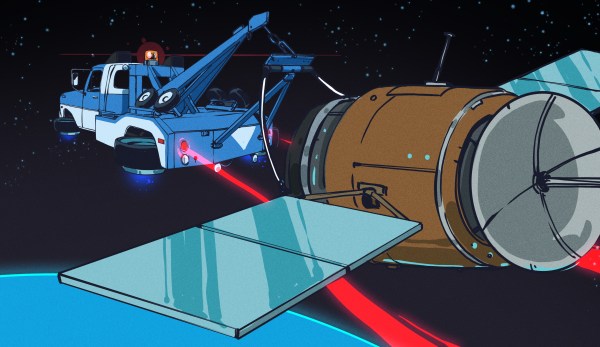
Unfortunately, the situation is slightly more complex with communications satellites in geosynchronous orbits. At an altitude of 35,786 kilometers (22,236 miles), deorbiting these spacecraft simply isn’t practical. It’s actually far easier to maneuver them farther out into space where they’ll never return. But what if the satellite fails or runs out of propellant before the decision to retire it can be made?
But of course these smart speakers are listening all the time, at least locally. How else are they going to know that someone uttered one of their wake words, or something close enough? It would sure help a lot if we could change the wake word to something like ‘rutabaga’ or ‘supercalifragilistic’, but they probably have ASICs that are made to listen for a few specific words. On the Echo for example, your only choices are “Alexa”, “Amazon”, “Echo”, or “Computer”.
So how often are smart speakers listening when they shouldn’t? A team of researchers at Boston’s Northeastern University are conducting an ongoing study to determine just how bad the problem really is. They’ve set up an experiment to generate unexpected activation triggers and study them inside and out.
For some reason, of all the ships that have sailed the oceans, it’s the unlucky ones that capture our imagination. Few ships have been as unlucky as the RMS Titanic, sinking as she did on the night of April 15, 1912 after raking across an iceberg on her maiden voyage, and no ship has grabbed as much popular attention as she has.
During her brief life, Titanic was not only the most elegant ship afloat but also the most technologically advanced. She boasted the latest in propulsion and navigation technology and an innovation that had only recently available: a Marconi wireless room, used both for ship-to-shore and ship-to-ship communications.
The radio room of the Titanic landed on the ocean floor with the bow section of the great vessel. The 2.5-mile slow-motion free fall destroyed the structure of the room, but the gear survived relatively intact. And now, more than a century later, there’s an effort afoot to salvage that gear, with an eye toward perhaps restoring it to working condition. It’s a controversial plan, of course, but it is technologically intriguing, and it’s worth taking a look at what’s down there and why we should even bother after all these years.
I’m writing from a cozy farmhouse just outside of Oxford, UK where we are slowly emerging from a particularly intense Atlantic storm. Some areas have widespread flooding, while fallen tree branches and damaged roofs are countrywide. Our neighbours in the Irish Republic are first in the path of these storms, and receive an especially strong pasting.
In the news following the storm is a merchant ship that was washed up by this storm on the coast of County Cork. The MV Alta is a nearly 2300t and 77m (just over 253 ft) freighter that had been abandoned in 2018 south of Bermuda after a mechanical failure had rendered it incapable of navigation. Its crew had been rescued by the US Coast Guard, and since then — apart from a brief sighting in mid-Atlantic by a Royal Navy polar research vessel — it had passed unseen as a drifting ghost ship before appearing on the Irish coast.
In a very literal sense it had dropped off the radar, but the question for us is how? With the huge array of technological advances in both navigation aids and global sensing available at the end of the 21st century’s second decade, should that even be possible? It’s worth taking a while as land-lubbers to look at how ships are tracked, to try to make sense of the seeming invisibility of something that is after all pretty large and difficult to hide.
A common sight in automobile-congested cities such as New York are parking meters lining the curbs next to parking spots. They’re an autonomous way for the city to charge for the space taken by cars parked along the sidewalk near high-traffic commercial areas, incentivizing people to wrap up their business and move their vehicle out of a costly or time-limited parking space.
The parking meter is such a mundane device most people wouldn’t look at them twice, but on the inside it’s fascinating to see how they’re engineered, how that’s changed through the years, and how a software bug handicapped thousands of digital meters at the start of 2020.
Parking meters were originally commissioned in the 1930s by the government of Oklahoma City, due to the rapidly increasing number of automobiles, and therefore demand for parking space. Up until then, the city used patrolling policemen to regulate parking space, but they couldn’t keep up with the pace of the increased traffic and the lack of available parking space made business drop around downtown shops.
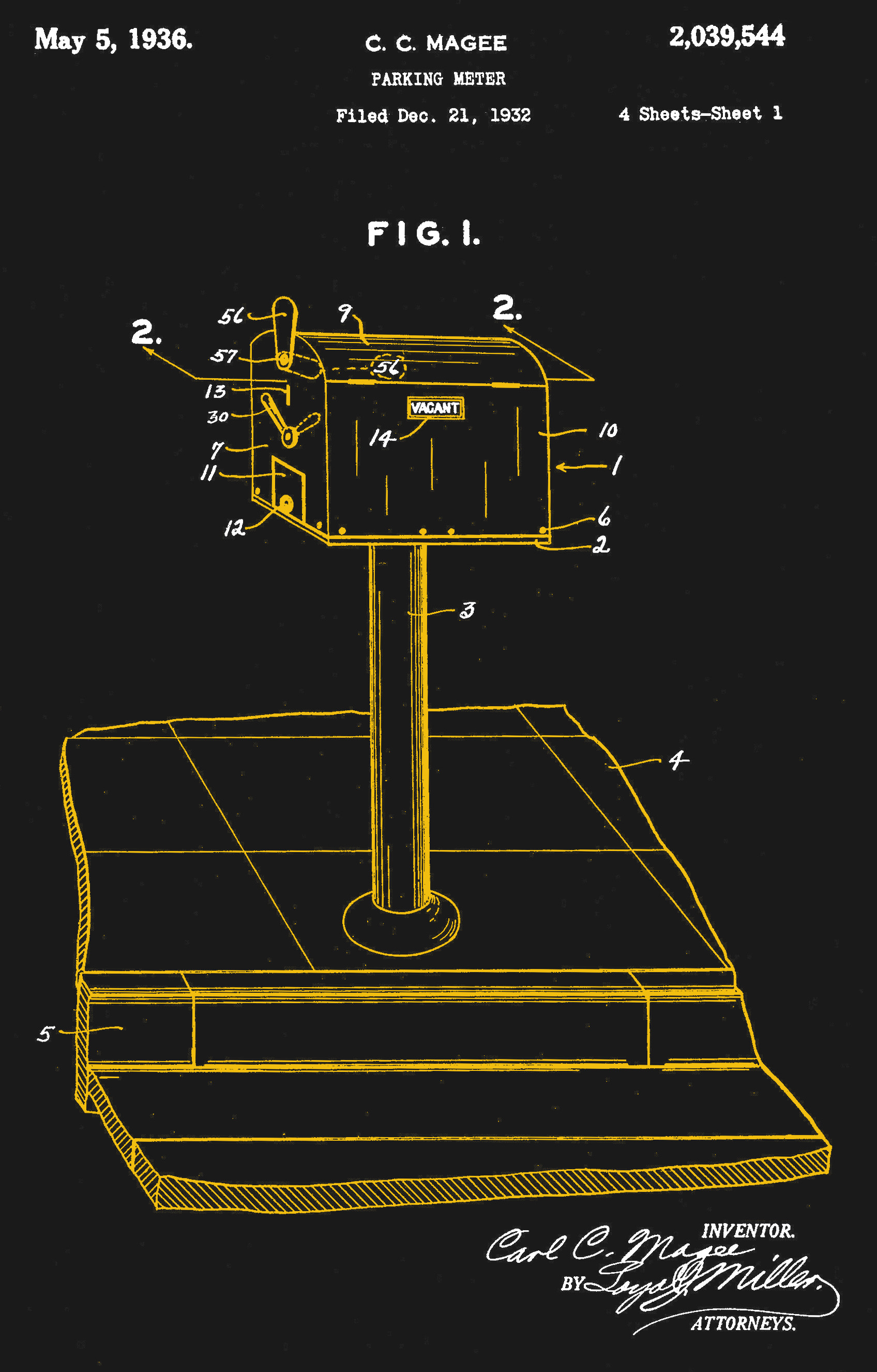
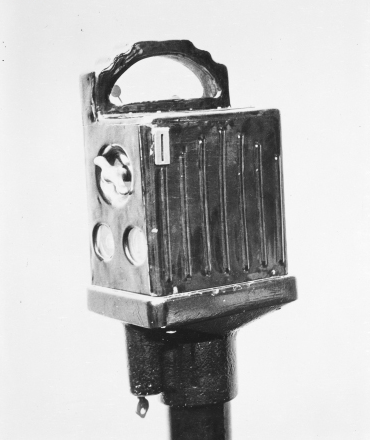
The first widely-adopted parking meter was dubbed “Black Maria”, a machine patented in 1935 by Carl C. Magee and Gerald Hale and first installed in the city in July of that year. This was a completely automated mechanical device made to solve the problem of regulating the time a driver can park their car in a given spot. It would take a nickel as payment, inserted into the mechanism by rotating a handle which also served to wind a clock spring. This clock would then tick down the remaining time the user could remain parked there, which could range from 15 minutes to an hour depending on the location.
An early Black Maria design, circa 1933.
Within days store owners noticed a positive effect in their profits thanks to the increase in customers with the regulated parking. What’s more, the coins collected from the meters also generated revenue for the city, and so, parking meters started spreading throughout the city. And as decades went, the mechanics were improved upon. A window was added into which a patrolling officer could easily look to check if the right amount of money (or money at all) was inserted. Separate panels for the coins to be easily collected without risking damage to the rest of the internal clockwork were also added.
The evolution of parking meters eventually passed through meters that could take care of parking spaces on either side of it, halving the amount of necessary poles per sidewalk. Electronic models starting appearing in the 1990s and eventually connectivity added. With meters all hooked up to the same network, the symbiotic connection between the parking meter and your spot was severed. It didn’t matter where your car was parked anymore; you could simply take your printed ticket and put it on your dashboard to be legally parked. Further advancements led to numbers spots that can be paid from any kiosk in the city, or though a smartphone app. But those digital advancements don’t always translate into reliability…
MakerBot was poised to be one of the greatest success stories of the open source hardware movement. Founded on the shared knowledge of the RepRap community, they created the first practical desktop 3D printer aimed at consumers over a decade ago. But today, after being bought out by Stratasys and abandoning their open source roots, the company is all but completely absent in the market they helped to create. Cheaper and better printers, some of which built on that same RepRap lineage, have completely taken over in the consumer space; forcing MakerBot to refocus their efforts on professional and educational customers.
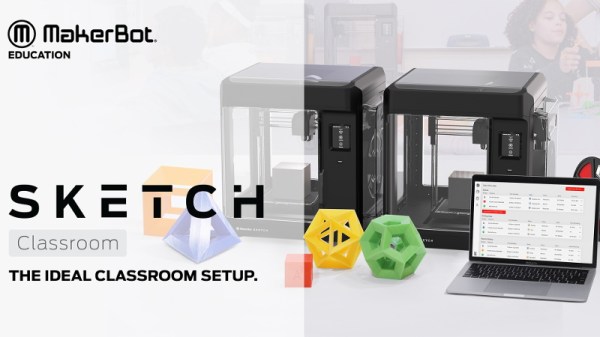
This fundamental restructuring of the company is perhaps nowhere more evident than in the recent unveiling of “SKETCH Classroom”: an $1,800 package that includes lesson plans, a teacher certification program, several rolls of filament, and two of the company’s new SKETCH printers. It even includes access to MakerBot Cloud, a new online service that aims to help teachers juggle student’s print jobs between multiple SKETCH printers.
Of course, the biggest takeaway from this announcement for the average Hackaday reader is that MakerBot is releasing new hardware. Their last printer was clearly not designed (or priced) for makers, and even a current-generation Replicator costs more than the entire SKETCH Classroom package. On the surface, it might seem like this is a return to a more reasonable pricing model for MakeBot’s products; something that could even help them regain some of the market share they’ve lost over the years.
There’s only one problem, MakerBot didn’t actually make the SKETCH. This once industry-leading company has now come full-circle, and is using a rebranded printer as the keystone of their push into the educational market. Whether they were unable to build a printer cheap enough to appeal to schools or simply didn’t want to, the message is clear: if you can’t beat them, join them.