Retrotechtacular: Nuvistor, Vacuum’s Last Gasp

In 2021 all our electronics are solid state, in that they exclusively use semiconductor devices as their active components. Some of us may experiment with vacuum tubes, but only for curiosity or aesthetic purposes. Semiconductors have overtaken vacuum devices in all but the rarest of niche applications due to their easier design requirements, greater reliability, lower cost, and increased performance.

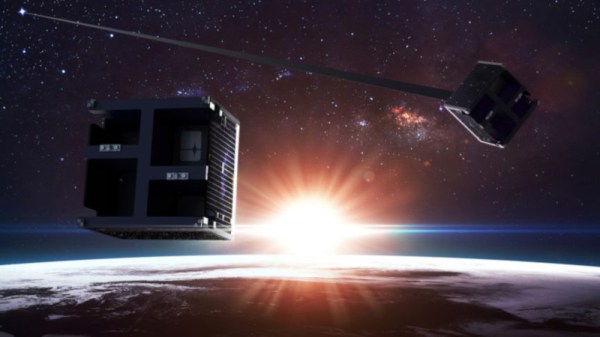
It was not always this way though, and there was a period at the start of the semiconductor era when transistors and vacuum tubes existed together side-by-side and competed directly. Vacuum tube manufacturers continued to create new devices into the 1970s, and in doing so they pushed the boundaries of their art in unprecedented directions. [David W Knight] has a page dedicated to the Nuvistor, something his calls the “final evolution of the thermionic valve”. His comparison photo seen above shows a Nuvistor on the left — a miniature vacuum tube you’ve likely never seen before.

Continue reading “Retrotechtacular: Nuvistor, Vacuum’s Last Gasp”

What Exactly Is A Gaussian Blur?

Blurring is a commonly used visual effect when digitally editing photos and videos. One of the most common blurs used in these fields is the Gaussian blur. You may have used this tool thousands of times without ever giving it greater thought. After all, it does a nice job and does indeed make things blurrier.

Of course, we often like to dig deeper here at Hackaday, so here’s our crash course on what’s going on when you run a Gaussian blur operation. Continue reading “What Exactly Is A Gaussian Blur?”

The Story Behind Ohm’s Law

Do you ever wonder how much of what we do you could figure out from scratch? Tying your shoe might seem simple now, but kids have trouble mastering the skill, and dreaming it up for the first time is even harder. The same holds true for a lot of technology we use every day. Would you think up the computer mouse or even the computer if they didn’t already exist? Surely, though, one of the simplest and most useful math equations that is fundamental to electronics — Ohm’s law — would be easy to figure out, right? It is often the first thing you learn about electronics, but figuring it out that first time turned out to be quite difficult.

The fellow who discovered the relationship was Georg Ohm, a high school math and physics teacher from Köln. What you might not know is that the first time he published it, he got it wrong. But, lucky for us, he figured out his mistake and was able to correct it.

Continue reading “The Story Behind Ohm’s Law”

This Group Of Women Tried To Break Into Astronaut Program In 1960s; One Just Made It

When Mary Wallace “Wally” Funk reached the boundary of space aboard the first crewed flight of Blue Origin’s New Shepard capsule earlier today, it marked the end of a journey she started 60 years ago. In 1961 she became the youngest member of what would later become known as the “Mercury 13”, a group of accomplished female aviators that volunteered to be put through the same physical and mental qualification tests that NASA’s Mercury astronauts went through. But the promising experiment was cut short by the space agency’s rigid requirements for potential astronauts, and what John Glenn referred to in his testimony to the Committee on Science and Astronautics as the “social order” of America at the time.

Continue reading “This Group Of Women Tried To Break Into Astronaut Program In 1960s; One Just Made It”

A Look Back On A Decade Of Kerbal Space Program

Just a few weeks before Atlantis embarked on the final flight of the Space Shuttle program in 2011, a small Mexican company by the name of Squad quietly released Kerbal Space Program (KSP) onto an unsuspecting world. Until that point the company had only developed websites and multi-media installations. Kerbal wasn’t even an official company initiative, it started as a side project by one of their employees, Felipe Falanghe. The sandbox game allowed players to cobble together rockets from an inventory of modular components and attempt to put them into orbit around the planet Kerbin. It was immediately addictive.

There was no story to follow, or enemies to battle. The closest thing to a score counter was the altimeter that showed how far your craft was above the planet’s surface, and the only way to “win” was to put its little green occupant, the titular Kerbal, back on the ground in one piece. The game’s challenge came not from puzzles or scripted events, but from the game’s accurate (if slightly simplified) application of orbital mechanics and Newtonian dynamics. Building a rocket and getting it into orbit in KSP isn’t difficult because the developers baked some arbitrary limitations into their virtual world; the game is hard for the same reasons putting a rocket into orbit around the Earth is hard.

One of my early rockets, circa 2013.

Over the years official updates added new components for players to build with and planets to explore, and an incredible array of community developed add-ons and modifications expanded the scope of the game even further. KSP would go on to be played by millions, and seeing a valuable opportunity to connect with future engineers, both NASA and the ESA helped develop expansions for the game that allowed players to recreate their real-world vehicles and missions.

But now after a decade of continuous development, with ports to multiple operating systems and game consoles, Squad is bringing this chapter of the KSP adventure to a close. To celebrate the game’s 10th anniversary on June 24th, they released “On Final Approach”, the game’s last official update. Attention will now be focused on the game’s ambitious sequel, which will expand the basic formula with the addition of interstellar travel and planetary colonies, currently slated for release in 2022.

Of course, this isn’t the end. Millions of “classic” KSP players will still be slinging their Kerbals into Hohmann transfer orbits for years to come, and the talented community of mod developers will undoubtedly help keep the game fresh with unofficial updates. But the end of official support is a major turning point, and it seems a perfect time to reminisce on the impact this revolutionary game has had on the engineering and space communities.

Continue reading “A Look Back On A Decade Of Kerbal Space Program

The Fix Is In: Hubble’s Troubles Appear Over For Now

Good news this morning from low Earth orbit, where the Hubble Space Telescope is back online after a long and worrisome month of inactivity following a glitch with the observatory’s payload computer.

We recently covered the Hubble payload computer in some depth; at the time, NASA was still very much in the diagnosis phase of the recovery, and had yet to determine a root cause. But the investigation was pointing to one of two possible culprits: the Command Unit/Science Data Formatter (CU/SDF), the module that interfaces the various science instruments, or the Power Control Unit (PCU), which provides regulated power for everything in the payload computer, more verbosely known as the SI C&DH, or Scientific Instrument Command and Data Handling Unit.

In the two weeks since that report, NASA made slow but steady progress, methodically testing every aspect of the SI C&DH. It wasn’t until just two days ago, on July 14, that NASA made a solid determination on root cause: the Power Control Unit, or more specifically, the power supply protection circuit on the PCU’s 5-volt rail. The circuit is designed to monitor the rail for undervoltage or overvoltage conditions, and to order the SI C&DH to shut down if the voltage is out of spec. It’s not entirely clear whether the PCU is actually putting out something other than 5 volts, or if the protection circuit has perhaps degraded since the entire SI C&DH was replaced in the last service mission in 2009. But either way, the fix is the same: switch to the backup PCU, a step that was carefully planned out and executed on July 15th.

To their credit, the agency took pains that everyone involved would be free from any sense of pressure to rush a fix — the 30-year-old spacecraft was stable, its instruments were all safely shut down, and so the imperative was to fix the problem without causing any collateral damage, or taking a step that couldn’t be undone. And further kudos go to NASA for transparency — the web page detailing their efforts to save Hubble reads almost like a build log on one of our projects.

There’s still quite a bit of work to be done to get Hubble back into business — the science instruments have to be woken up and checked out, for instance — but if all goes well, we should see science data start flowing back from the space telescope soon. It’s a relief that NASA was able to pull this fix off, but the fact that Hubble is down to its last backup is a reminder Hubble’s days are numbered, and that the best way to honor the feats of engineering derring-do that saved Hubble this time and many times before is to keep doing great science for as long as possible.

Just What Have We Become?

The world of open source software is one that often sees disputes between developers, some of which spawn lifelong schisms between devotees of different forks, and others mere storms in a teacup that are settled over a few beers. There are a couple of stories of late though that seem to show the worst in the online world, and which all of us should take a moment to think about.

Many of you may have heard two weeks ago of the passing of [near], the software developer and game translator whose bsnes emulator for the Super Nintendo was the go-to platform for retro Nintendo enthusiasts intent on the pursuit of the closest possible match to the original without possessing real Nintendo hardware. The details of their passing are particularly distressing, in that they committed suicide after numerous attacks over several years from users of Kiwi Farms, a website notorious for the worst kinds of trolling.

Hot on the heels of that distressing story comes news that [Cookie Engineer] is stepping down as maintainer of the project that’s now called Tenacity, a fork of the popular but now-controversial Audacity audio editor. They are doing so after being targeted by users of 4chan, the most well-known of online trolling websites, following an ill-advised Simpsons joke in a naming poll for the software. [Cookie Engineer] alleges that the harassers knocked on doors and windows where they live and a real-world knife attack followed.

Nobody deserves to be hounded to death, to suffer the sort of sustained harassment that [near] encountered, or to be confronted with knife-wielding strangers merely because they have stuck their head above the parapet as an open-source developer. There are no excuses to be made, no justifications for this.

All of us who read Hackaday are likely to be regular users of open-source software, many of us will have used bsnes and may yet use Tenacity, but we probably rarely stop for a moment to think of the real people behind them. Countless hours from innumerable highly-skilled people are what makes the open-source world tick, and aside from the immeasurable sadness of suicide or the horror of a knife attack there can only be harm done to open source software as a whole if to be a prominent developer or maintainer is to expose yourself to this.

The Internet will always have raucous communities at its margins and that’s something which still contributes to its unique culture, but when it jumps off the webpage and into damaging real people then perhaps it has become a monster. As a community we can do so much better, and we shouldn’t be prepared to accept anybody who thinks otherwise among our ranks.

We’d like to remind our readers that help exists for those who have reached the point of considering suicide, and that should you suffer from mental health problems you are not alone in this. Everybody, take care of yourselves, and keep an eye out for each other.