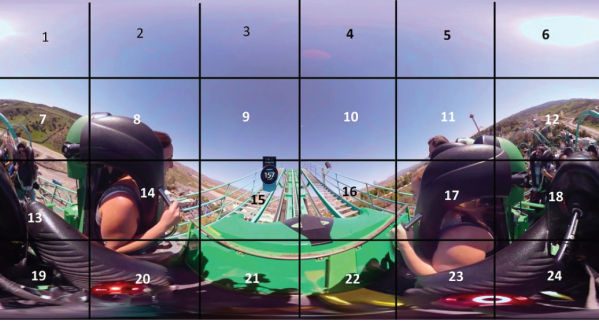
360 Live VR Teleportation Uses Drones, Neural Networks, And Perseverance

This past semester I added research to my already full schedule of math and engineering classes, as any masochistic student eagerly would. Packed schedule aside, how do you pass up the chance to work on implementing 360° virtual teleportation to anywhere in the world, in real-time. Yes, it is indeed the same concept as the cult worshipped Star Trek transporter, minus the ability to physically be at the location. Perhaps we can add a, “beam me up, Scotty” command when shutting down.

The research lab I was working with is the Laboratory for Immersive CommunicatiON (LION). It’s funded by NSF, Microsoft, and Adobe and has been on the pursuit of VR teleportation for some time now.  There’s a lot of cool technologies at work here, like drones which are used as location collection devices. A network of drones will survey landscape anywhere in the world and build the collection assets needed for recreating it in VR. Okay, so a swarm of drones might seem a little intimidating at first, but when has emerging technology not?

Continue reading “360 Live VR Teleportation Uses Drones, Neural Networks, And Perseverance”

Spanning The Tree : Dr Radia Perlman & Untangling Networks

As computer networks get bigger, it becomes increasingly hard to keep track of the flow of data over this network. How do you route data, making sure that the data is spread to all parts of the network? You use an algorithm called the spanning tree protocol — just one of the contributions to computer science of a remarkable engineer, Dr. Radia Perlman. But before she created this fundamental Internet protocol, she also worked on LOGO, the first programming language for children, creating a dialect for toddlers.

Continue reading “Spanning The Tree : Dr Radia Perlman & Untangling Networks”

Smart Plugs Don’t Save You Energy, But Don’t Consume Much Either

Amazon Alexa, Google Home, and just about every electronic device manufacturer are jumping on the bandwagon of connected devices. They promise us the ability to turn on our toaster from another room, unlock our doors just by shouting at them from outside, and change the channel on our TV through perfectly enunciating a sentence instead of mashing the buttons on our remotes like chumps. And yet, despite all this new-fangled finger-less control, there is an unanswered question: does this technology save us energy in the long run?

For years we’ve been hearing about vampire power and all the devices in our home that sit in standby, waiting for their masters to turn them on, quietly burning power to listen for that signal to wake. Fortunately the One Watt Initiative and general awareness and design for energy savings has cut out a lot of this phantom load. So how does the smart home, which essentially adds a bunch of connected vampires to our base load, end up saving money in the long run? And is it better than other alternatives or just good habits? I put these questions to the test with today’s smart power strips and controllable outlets.

Continue reading “Smart Plugs Don’t Save You Energy, But Don’t Consume Much Either”

Hacking When It Counts: The Pioneer Missions

If the heady early days of space exploration taught us anything, it was how much we just didn’t know. Failure after failure mounted, often dramatic and expensive and sometimes deadly. Launch vehicles exploded, satellites failed to deploy, or some widget decided to give up the ghost at a crucial time, blinding a multi-million dollar probe and ending a mission long before any useful science was done. For the United States, with a deadline to meet for manned missions to the moon, every failure in the late 1950s and early 1960s was valuable, though, at least to the extent that it taught them what not to do next time.

For the scientists planning unmanned missions, there was another, later deadline looming that presented a rare opportunity to expand our knowledge of the outer solar system, a strange and as yet unexplored wilderness with the potential to destroy anything humans could build and send there. Before investing billions in missions to take a Grand Tour of the outer planets, they needed more information. They needed to send out some Pioneers.

Continue reading “Hacking When It Counts: The Pioneer Missions”

Ask Hackaday: How Do You DIY A Top-Octave Generator?

One of the great joys of Hackaday are the truly oddball requests that we sometimes get over the tip line. Case in point: [DC Darsen] wrote in with a busted 1970s organ in need of a new top-octave generator, and wondered if we could help. He had found a complicated but promising circuit online, and was wondering if there was anything simpler. I replied “I should be able to get that done with a single Arduino” and proceeded to prove myself entirely wrong in short order.

So we’re passing the buck on to you, dear Hackaday reader. Can you help [DC Darsen] repair his organ with a minimum amount of expenditure and hassle? All we need to do is produce twelve, or maybe thirteen, differently pitched square waves simultaneously.

Continue reading “Ask Hackaday: How Do You DIY A Top-Octave Generator?”

Mechanisms: Solenoids

Since humans first starting playing with electricity, we’ve proven ourselves pretty clever at finding ways to harness that power and turn it into motion. Electric motors of every type move the world, but they are far from the only way to put electricity into motion. When you want continuous rotation, a motor is the way to go. But for simpler on and off applications, where fine control of position is not critical, a solenoid is more like what you need. These electromagnetic devices are found everywhere and they’re next in our series on useful mechanisms.

Continue reading “Mechanisms: Solenoids”

Robert Hall And The Solid-State Laser

The debt we all owe must be paid someday, and for inventor Robert N. Hall, that debt came due in 2016 at the ripe age of 96. Robert Hall’s passing went all but unnoticed by everyone but his family and a few close colleagues at General Electric’s Schenectady, New York research lab, where Hall spent his remarkable career.

That someone who lives for 96% of a century would outlive most of the people he had ever known is not surprising, but what’s more surprising is that more notice of his life and legacy wasn’t taken. Without his efforts, so many of the tools of modern life that we take for granted would not have come to pass, or would have been delayed. His main contribution started with a simple but seemingly outrageous idea — making a solid-state laser. But he ended up making so many more contributions that it’s worth a look at what he accomplished over his long career.

Continue reading “Robert Hall And The Solid-State Laser”