Do you know what time it is? Chances are good that you used a computer or a cell phone to answer that question. The time on your phone is about as accurate as chronometry gets these days. That’s because cell networks are timed from satellites, which are in turn timed from atomic clocks. And these days, it may be that atomic clocks are the only clocks that matter.
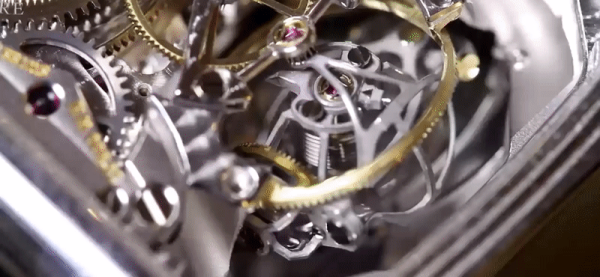
Before this modern era of quartz and atomic accuracy, though, timepieces were mechanical. Clocks were driven by heavy weights that made them impractical for travel. It wasn’t until the mainspring-driven movement came along that timekeeping could even begin to become portable.
But while the invention of the mainspring made portable timepieces possible, it hurt their accuracy. That’s because the driving force of a tightly wound spring isn’t constant like that of an inert, solid weight. So pocket watches weren’t exactly an overnight success. Early pieces were largely ornamental, and only told the hour. Worst of all, they would slow down throughout the day as the mainspring unwound, becoming useless unless wound several times a day. The mainspring wasn’t the only problem plaguing pocket watches, but it was the among the most obvious.
An elderly relative of mine used to get irate at the BBC news. When our Prime Minister [Edward Heath] or another of her bêtes noirs of the day came on, she’d rail at the radio or the TV, expressing her views to them in no uncertain terms. It taught a young me a lot about the futility of shouting at the telly, as well as about making a spectacle of oneself.
The ISS in flight. NASA [Public domain].The other evening though I found myself almost at the point of shouting at a TV programme, and since it’s one with a clear message about technology I feel it’s worth sharing here. The programme in question was one of the Impossible Engineering series, and it was talking about the technology behind the International Space Station. It was recent enough to include last year’s mission involving [Tim Peake], so it was by no means a show dredged from the archives.
All very well, you say. Impossible Engineering‘s format of looking at a modern engineering marvel and tracing the historical roots of some of its innovations would find fertile ground in the ISS, after all it’s one of our most impressive achievements and could easily provide content for several seasons of the show. And I’ll give them this, they did provide an interesting episode.
The trouble was, they made an omission. And it wasn’t just a slight omission, one of those minor cock-ups that when we Hackaday scribes make them the commenters pounce upon with glee, this one was a doozy. They managed to fill an hour of television talking about space stations and in particular a space station that was assembled by multiple countries under an international co-operation, without mention of any of the Russian technology that underpins much of its design. An egregious example among many was their featuring a new Boeing capsule designed to touchdown on land rather than on water as a novel invention, when as far as I am aware every Russian capsule ever made has performed a land-based touchdown.
There are a series of stages to coming down from a festival. After the hectic rush of travel there are the several days of catching up on lost sleep and picking up the threads of your life again, then once a semblance of order has been regained there’s that few weeks of emptiness. Your life will never be the same again, it’s all so mundane.
I’m pleased to say the Hackaday and Tindie stickers were very popular.
It’s now a couple of weeks since the SHACamp 2017 hacker festival in the Netherlands was in full swing, and the write-up below has slowly taken shape over that time amid the other work of being a Hackaday scribe and editor. It’s early morning here in Southern England as I write this, so on the equivalent day while I was at SHACamp at this time I would have been carrying a large pack of stickers for distribution on the swapping table through the rising sunlight of a camp still largely asleep after the previous night’s revelry. Past our German and Dutch immediate neighbours, down the ramp from the dyke, the cardboard tent depot on my left and the food court on my right, to the information tent. Greet the bleary-eyed volunteer at the end of their graveyard shift, and spread plenty of Hackaday and Tindie stickers on the table for the masses. And then? Find a coffee, and sally forth into the field for another day among one of the most stimulating communities on Earth. My community. Your community.
The sticker table is a good place to start if you wish to get a handle on a large hacker camp. On it you will find the logos of a cross-section of the diverse organisations and groups present. There are a few commercial ones like my Jolly Wrenchers and Tindie the puppy, there are some from voluntary organisations or interest groups, but mostly they are the logos of a continent’s — even the wider world’s in some cases — hackspaces and makerspaces. Here you see the breadth of the attendees, as the logos of spaces from thousands of miles away you’ve never encountered before mingle. This isn’t quite a global gathering, but there is a sense of global community around it.
How Do You Describe a Hacker Camp?
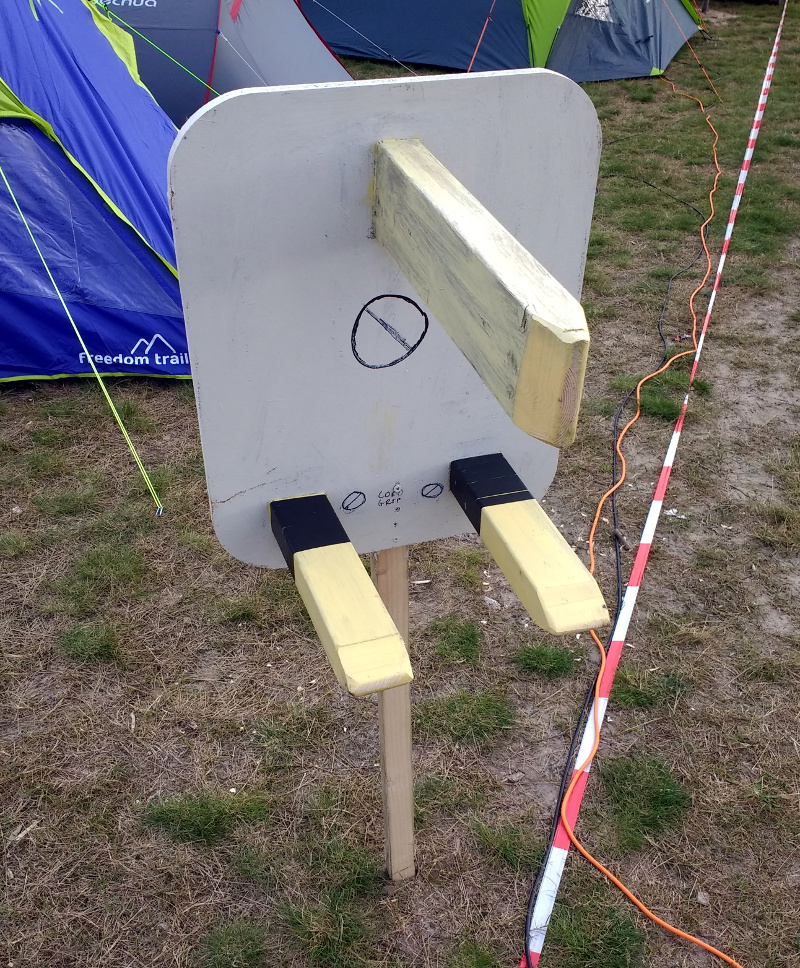
You shall find us by our clearly superior yet dangerous to barefoot pedestrians fused right-angled mains connector.
So before I take you through my experience of SHA, it’s best to start by describing a hacker camp in more general terms. When I’m describing a camp like SHA to the kind of people who don’t read Hackaday, I put it as similar to the music festivals they are used to but without the bands. Instead the audience provides the entertainment through the work they bring to the event or do at the event, and through a comprehensive program of talks and lectures. Oh — and this is the bit that makes their eyes open wide — every structure on site from the smallest one-man tent to the largest marquee has mains power and high-speed Internet. Sometimes people grasp what SHA is from this description, sometimes they don’t.
Different groups, be they individual hackspaces, people from a particular country, or other special interest groups, congregate in villages, collections of tents, marquees, and gazebos in which they set up whatever cool stuff they’ve brought along. My tent with its Hackaday flag was in a village composed of a mix of British hackspaces up on the dyke, which [Michael] from MK Makerspace had marked with a sign consisting of a huge BS1363A mains plug. More than one person pointed out it would have been better lying flat on the ground with pins in the air, ready to catch an unwary Monty Python foot.
Location, location, location — what’s critical to real estate is also critical to eclipse watching, and without sounding too boastful, those of us atop South Menan Butte, an extinct volcano in southeast Idaho, absolutely nailed it. Not only did we have perfect weather, we had an excellent camping experience, great food, a magnificent natural setting, and a perch 800 feet above a vast plain stretching endlessly to the east and west. Everything was set up for a perfect eclipse experience, and we were not disappointed.
This is a solution to global warming. This solution will also produce electricity, produce rain in desertified areas, and transform the Sahara into arable land capable of capturing CO2. How is this possible? It’s simple: all we need to do is build a five-kilometer tall, twenty-meter wide chimney. Hot air, warmed by the Earth’s surface, will enter the base of the chimney and flow through turbines, generating electricity. From there, air will rise through the chimney, gradually cooling and transferring energy from the atmosphere at Earth’s surface to five kilometers altitude. This is the idea behind the Super Chimney, It’s an engineering concept comparable to building a dam across the Strait of Gibraltar, a system of gigantic mirrors in Earth’s orbit, or anything built under an Atoms for Peace project. In short, this is fringe engineering.
This is also, ‘saving the world with wacky waving inflatable arm flailing tube men.’
The idea of building tens of thousands of fabric chimneys, placing them all around the globe, and cooling the Earth while sequestering carbon dioxide is fantastic. Ideas are simple, implementation is something else entirely. There are also obvious problems with the physics presented in the Super Chimney presentation, but these problems don’t actually make a Super Chimney impossible. We need more eyes on this, so we’re opening this one up as an Ask Hackaday. What do you think of this audacious scheme, and is it even possible?
I have storage on the mind, and it comes from two facts in my life:
First, I have tons of stuff in my workshop, far too much for the amount of space I have. A lot of this material is much easier to use if it’s well-organized. Think electronics, robotics, building sets. Modular parts that need to go together a certain way for them to be useful. It is imperative, therefore, that I come up with some sort of organization system to keep the chaos in check.
Second, my favorite tool is the laser cutter, born from my love for building vector designs. I can do art on the computer and have it manufactured in front of my eyes, and share my designs with someone else who can remix it into something even cooler.
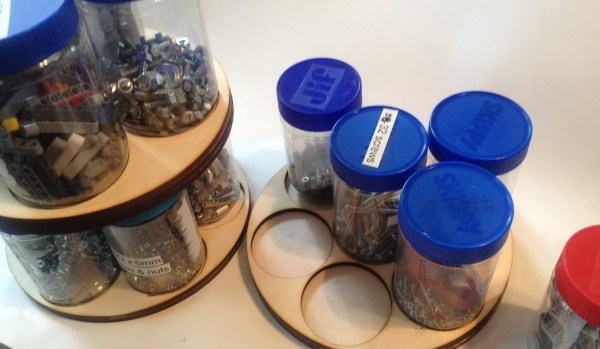
So with those two facts in mind, I set about creating a modular storage system in Inkscape and cutting out the design from pine boards using a laser cutter. Let us go on a journey through my thought process:
The piston engine has been the king of the transportation industry for well over a century now. It has been manufactured so much that it has become a sort of general-purpose machine that can be used to do quite a bit more than merely move people and cargo from one point to another. Running generators, hydraulic systems, pumps, and heavy machinery are but a few examples of that.
Scale production of this technology also had the effect of driving prices for these engines down, and now virtually everyone in the developed world has cheap and easy access to them. In the transportation world, at least, it looks like its reign might finally be coming to a slow, drawn-out conclusion as electric cars capture more and more market share.
Electric motors aren’t the first technology to try to topple the piston engine from its apex position on top of our modern transportation industry, though. In the 1960s another technology, the gas turbine engine, tried to replace it — and failed.