Creating A PCB In Everything: KiCad, Part 1

This is the continuation of a series of articles demonstrating how to Create A PCB In Everything. In this series, we take a standard reference circuit and PCB layout — a simple ATtiny85 board — and build it with different PCB design tools. Already, we’ve taken a look at the pre-history of PCB design with Protel Autotrax, we learned Fritzing is a joke for PCB design, and we’ve done a deep dive into Eagle. Each of these tutorials serves two purposes. First, it is a very quick introduction to each PCB design tool. Second, this series provides an overall comparison between different PCB design tools.

Now, finally, and after many complaints, it’s time for the tutorial everyone has been waiting for. It’s time for KiCad.

No, like the head of the Bajoran clergy

Although KiCad (pronounced ‘Kai-Cad’ like the head of the Bajoran clergy, not ‘Key-Cad’ like the thing that goes in a lock) is the new hotness when it comes to PCB design. The amazing growth of KiCad installations over the past few years is a long time coming. In development since 1992, KiCad has cemented itself as the premier Open Source PCB design suite, and since 2013 CERN has been making contributions to the project. More recently, the KiCad project has been showing off some amazing new features. These include 3D rendering of boards, interactive routing, push-and-shove, simulation, and dozens of other features that put it on a path to being on par with the top of the line EDA suites. Add in some great community contributions, and you have something really, really amazing. All of this is wrapped up in an Open Source license, free as in speech and beer. If you’re looking for the future of PCB design, Eagle is going to get very good but KiCad is almost there now while being Open Source.

Continue reading “Creating A PCB In Everything: KiCad, Part 1”

Smartphone Bench Instrument Apps: Disappointment Or Delight?

If you are interested in electronics or engineering, you’ll have noticed a host of useful-sounding apps to help you in your design and build work. There are calculators, design aids, and somewhat intriguingly, apps that claim to offer an entire instrument on your phone. A few of them are produced to support external third-party USB instrument peripherals, but most of them claim to offer the functionality using just the hardware within the phone. Why buy an expensive oscilloscope, spectrum analyzer, or signal generator, when you can simply download one for free?

Those who celebrate Christmas somewhere with a British tradition are familiar with Christmas crackers and the oft-disappointing novelties they contain. Non-Brits are no doubt lost at this point… the crackers in question are a cardboard tube wrapped in shiny paper drawn tight over each end of it. The idea is that two people pull on the ends of the paper, and when it comes apart out drops a toy or novelty. It’s something like the prize in a Cracker Jack Box.

Engineering-oriented apps follow this cycle of hope and disappointment. But there are occasional exceptions. Let’s tour some of the good and the bad together, shall we?

Continue reading “Smartphone Bench Instrument Apps: Disappointment Or Delight?”

How To Control Your Instruments From A Computer: It’s Easier Than You Think

There was a time when instruments sporting a GPIB connector (General Purpose Interface Bus) for computer control on their back panels were expensive and exotic devices, unlikely to be found on the bench of a hardware hacker. Your employer or university would have had them, but you’d have been more likely to own an all-analogue bench that would have been familiar to your parents’ generation.

A GPIB/IEEE488 plug. Alkamid [CC BY-SA 3.], via Wikimedia Commons
A GPIB/IEEE488 plug. Alkamid [CC BY-SA 3.], via Wikimedia Commons.
The affordable instruments in front of you today may not have a physical GPIB port, but the chances are they will have a USB port or even Ethernet over which you can exert the same control. The manufacturer will provide some software to allow you to use it, but if it doesn’t cost anything you’ll be lucky if it is either any good, or available for a platform other than Microsoft Windows.

So there you are, with an instrument that speaks a fully documented protocol through a physical interface you have plenty of spare sockets for, but if you’re a Linux user and especially if you don’t have an x86 processor, you’re a bit out of luck on the software front. Surely there must be a way to make your computer talk to it!

Let’s give it a try — I’ll be using a Linux machine and a popular brand of oscilloscope but the technique is widely applicable.

Continue reading “How To Control Your Instruments From A Computer: It’s Easier Than You Think”

Medium Over Message: A CD-ROM Multimedia Bubble Survivor’s Tale

Sometimes in the never-ending progression of technology, people take wrong turns. They pursue dead-ends they believe represent a bright future, often in spite of obvious indications to the contrary. IBM doggedly insisting Micro Channel Architecture was the future of PC hardware, for example, or Nokia’s seeming inability to recognise that the mobile phone experience had changed for ever when the first iPhones and Android devices appeared.

Every once in a while, that collective delusion grips an entire industry. All the players in a particular market nail their colours to a technology, seemingly without heed to what seems with hindsight to have been a completely obvious threat from the alternative that sidelined them. It is a tale of personal experience that prompts this line of thought, for the industry that tempted me away from hardware to a career in electronic publishing in the early 1990s was CD-ROM multimedia.

Continue reading “Medium Over Message: A CD-ROM Multimedia Bubble Survivor’s Tale”

The Little Mechanism That Made Precise Time-keeping Possible

There are few things to which we pay as much attention as the passage of time. We don’t want to be late for work, or a date. Even more importantly, we don’t want to age and die. Good time keeping is an all important human activity, and we started to worry about it as soon as we abandoned our hunter-gatherer lifestyle and agriculture and commerce emerged.

By de:Benutzer:Flyout - own work, http://de.wikipedia.org/wiki/Bild:Kerzenuhr.jpg, CC BY-SA 3.0, https://commons.wikimedia.org/w/index.php?curid=1783765
A candle clock

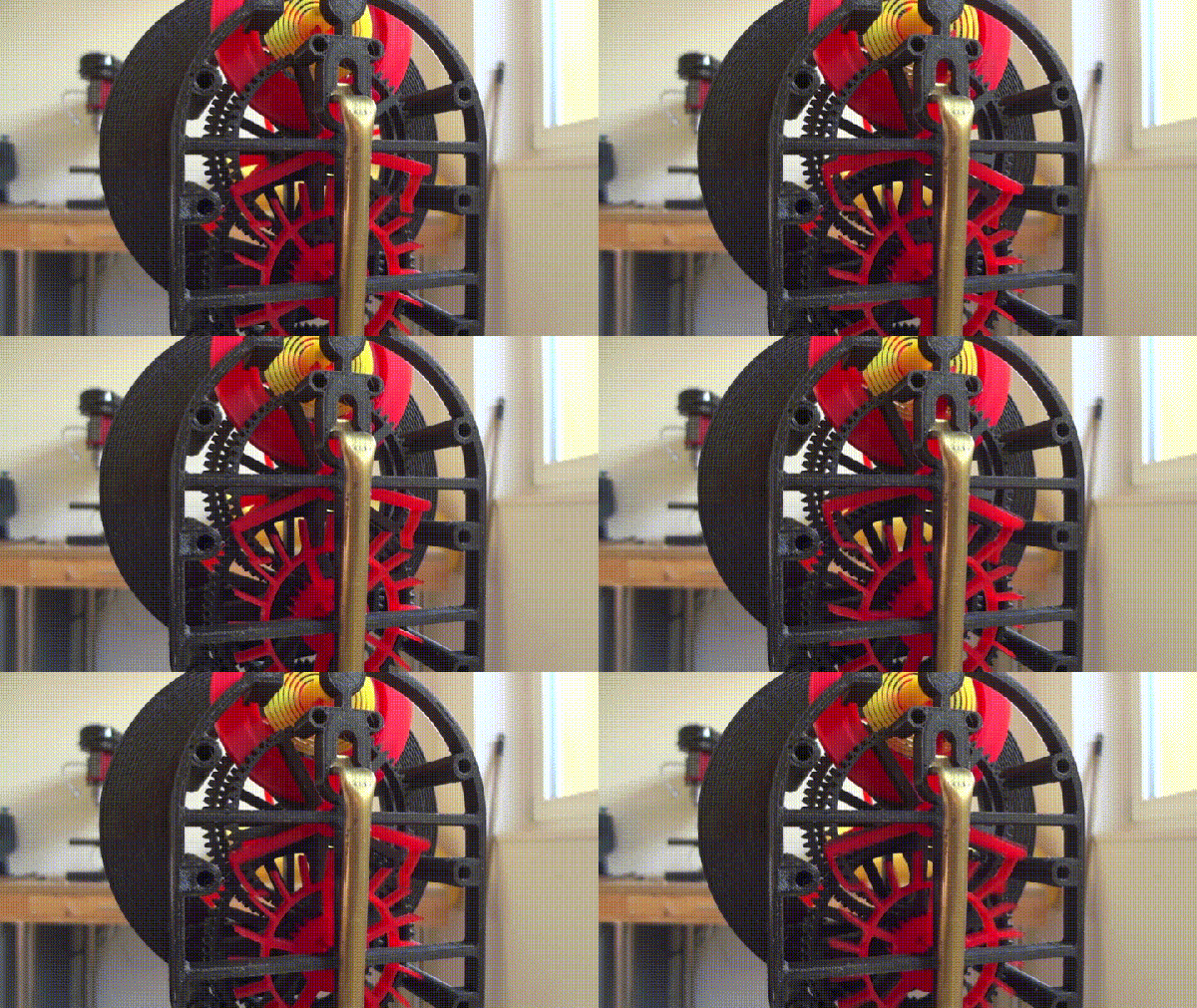
Measuring time needs two things: a repetitive process to mark equal increments of time, and a way of tracking and displaying the result. The first timekeeping devices relied of course on the movement of the sun. Ancient Egyptians, around 3500 BC, built obelisks that, by casting a shadow on the ground at different positions, gave an approximate idea of the time. Next came the use of some medium that was consumed at a regular pace: candle, incense, water and sand clocks are examples. A great advancement came with the advent of the mechanical clock, and here is where the escapement mechanism appears.

Continue reading “The Little Mechanism That Made Precise Time-keeping Possible”

Path To Craftsmanship: Don’t Buy Awful Safety Gear

A while back I tried to make a case for good safety disciple as a habit that, when proactively pursued, can actually increase the quality of your work as a side effect. In those comments and in other comments since then I’ve noticed that some people really hate safety gear. Now some of them hated them for a philosophical reason, “Ma granpap didn’t need ’em, an’ I don’t neither”, or ,”Safety gear be contributin’ to the wuss’ness of the modern personage an’ the decline o’ society.” However, others really just found them terribly uncomfortable and restricting.

In this regard I can help a little. I’ve spent thousands of terrible long hours in safety gear working in the chemical industry. I was also fortunate to have a company who frequently searched for the best safety equipment as part of their regular program. I got to try out a lot.

Continue reading “Path To Craftsmanship: Don’t Buy Awful Safety Gear”

Retrotechtacular: The Golden Book Of Chemistry Experiments

Back in “the old days” (that is, when I was a kid), kids led lives of danger and excitement. We rode bikes with no protective gear. We stayed out roaming the streets after dark without adult supervision. We had toy guns that looked like real ones. Dentists gave us mercury to play with. We also blew things up and did other dangerous science experiments.

If you want a taste of what that was like, you might enjoy The Golden Book of Chemistry Experiments. The book, first published in 1960, offers to show you how to set up a home laboratory and provides 200 experiments. The colorfully illustrated book shows you how to do some basic lab work as well as offering some science history and terminology.

Want to make oxygen? There’s several methods on page 27. Page 28 covers making hydrogen. To test the hydrogen for purity, the suggest you collect a test tube full, invert it, and stick a match up to the tube. If the hydrogen is pure it will burn with a pop noise. If air is mixed it, it will explode. Yeah, that sound safe to us.

Continue reading “Retrotechtacular: The Golden Book Of Chemistry Experiments”