For nearly as long as there has been radio, there have been antennas trained on the sky, looking at the universe in a different light than traditional astronomy. Radio astronomers have used their sensitive equipment to study the Sun, the planets, distant galaxies, and strange objects from the very edge of the universe, like pulsars and quasars. Even the earliest moments of the universe have been explored, a portrait in microwave radiation of the remnants of the Big Bang.
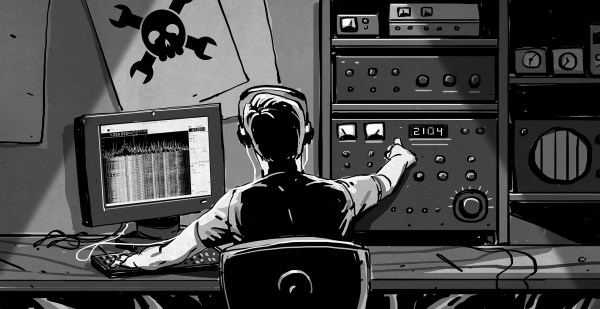
And yet with all these observations, there’s a substantial slice of the radio spectrum that remains largely a mystery to radio astronomers. Thanks to our planet’s ionosphere, most of the signals below 30 MHz aren’t observable by ground-based radio telescopes. But now, thanks to an opportunity afforded by China’s ambitious lunar exploration program, humanity is now listening to more of what the universe is saying, and it’s doing so from a new vantage point: the far side of the moon.
After a decade in development, the Boeing CST-100 “Starliner” lifted off from pad SLC-41 at the Cape Canaveral Air Force Station a little before dawn this morning on its first ever flight. Officially referred to as the Boeing Orbital Flight Test (Boe-OFT), this uncrewed mission was intended to verify the spacecraft’s ability to navigate in orbit and safely return to Earth. It was also planned to be a rehearsal of the autonomous rendezvous and docking procedures that will ultimately be used to deliver astronauts to the International Space Station; a capability NASA has lacked since the 2011 retirement of the Space Shuttle.
Liftoff at 6:36 AM Eastern
Unfortunately, some of those goals are now unobtainable. Due to a failure that occurred just 30 minutes into the flight, the CST-100 is now unable to reach the ISS. While the craft remains fully functional and in a stable orbit, Boeing and NASA have agreed that under the circumstances the planned eight day mission should be cut short. While there’s still some hope that the CST-100 will have the opportunity to demonstrate its orbital maneuverability during the now truncated flight, the primary focus has switched to the deorbit and landing procedures which have tentatively been moved up to the morning of December 22nd.
While official statements from all involved parties have remained predictably positive, the situation is a crushing blow to both Boeing and NASA. Just days after announcing that production of their troubled 737 MAX airliner would be suspended, the last thing that Boeing needed right now was another high-profile failure. For NASA, it’s yet another in a long line of setbacks that have made some question if private industry is really up to the task of ferrying humans to space. This isn’t the first time a CST-100 has faltered during a test, and back in August, a SpaceX Crew Dragon was obliterated while its advanced launch escape system was being evaluated.
We likely won’t have all the answers until the Starliner touches down at the White Sands Missile Range and Boeing engineers can get aboard, but ground controllers have already started piecing together an idea of what happened during those first critical moments of the flight. The big question now is, will NASA require Boeing to perform a second Orbital Flight Test before certifying the CST-100 to carry a human crew?
Let’s take a look at what happened during this morning’s launch.
Macros are meant to make our lives easier, but they live up to this promise with mixed results. Generally speaking, a macro is a special combination of keys on the keyboard that execute a custom task — their goal is to speed up your productivity by getting away from mousing through menus. But once a macro requires more than two keys, they can get a bit cumbersome to input. I have personally found that repeated use of macros that require ctrl+shift can potentially cause problems. I don’t know about you (and your repetitive stress mileage may vary), but personal injury is the polar opposite of what I want from something that’s supposed to be convenient.
I love keyboard shortcuts, and not just because I prefer keyboard navigation in general. A lot of little things about writing for the web can be streamlined with shortcuts, like writing html tags and doing image manipulation. And I’m always looking for a better workflow to pin down my fleeting mental fragments, at least until that dark day that I can turn on Dropbox Thoughts™ and burn my brainwaves directly to disk.
When Isaac Asmiov was writing I, Robot, the field of robotics was still in its infancy. As he notes in The Complete Robot, as the field began to mature, it started showing signs of conforming to the popular ideas held by science fiction writers about what robotics ought to be. Notions of humanoid robots, the functions that robots would have in domestic settings, even the ethical quandaries that AI ethicists face today were all themes of early sci-fi writers.
The idea of a robot – at least of automata – predates the field of robotics. The idea of an independent automata may have existed as early as the ancient Egyptians Chinese, and Greeks, who attempted to build self-operated machines that resembled animals and humans. Myths of clay golems in Jewish legends and clay giants in Norse legends perpetuated the idea of an artificial being that could mimic the actions of living creatures. A 400 BC myth from Crete spoke of a man of bronze who guarded their island from pirates.
You might think it is strange that a story about technology would start off talking about Wonder Woman. When you realize the technology in question is a lie detector, you might think, “Oh, that’s right. Wonder Woman had the lasso of truth, so this is just a lame association.” You might think that, but you’d be wrong. Turns out, Wonder Woman and real life polygraphs have a much deeper connection; both the polygraph and Wonder Woman share a common creator.
It makes a good story to say that William Marston — an internationally famous psychologist — created the polygraph, but as you might expect it wasn’t the result of a single person’s effort. However, Marston played a key role and also was behind promoting the technology. So, too, even though he is credited as Wonder Woman’s sole creator, the truth is probably a bit more complex.
Can you imagine a near future where your family doctor can effectively prick your finger and test you for a dozen or so types of cancer? Currently, cancer detection is a time-consuming and expensive process. Existing methods of screening for cancer usually involve taking a whole lot of blood and running tests that cost thousands of dollars. But Toshiba has created a cancer-detecting machine that sounds like something straight out of science fiction.
The machine is about the size of a small office copier, and it looks like one, too. But this small machine can do some powerful tricks. Toshiba claims that the machine can detect 13 types of cancer from a single drop of blood with 99% accuracy. What’s more impressive is that it can do this under two hours, as opposed to days or weeks depending on laboratory backlog. Most importantly, they are aiming to do this entire battery of tests for about $180. Ideally, this machine will do everything that current blood cancer detection equipment does, just better, faster, and with fewer resources.
Some of the cancers the machine can test for have been previously difficult to detect, like ovarian, pancreatic, and esophageal cancer. But this machine can screen for all three of these — great news for early detection of these ravaging cancers — as well as breast, prostate, gastric, colon, liver, biliary tract, bladder, lung, brain, and sarcoma. The only catch is that the machine can’t pinpoint which cancer exactly, it only knows if microRNA one or more of the 13 came up.
So, how does it work? Cancer cells secrete certain types of microRNA into the bloodstream that healthy cells don’t. The machine works by assessing the different types of microRNA that show up in the sample drop, and studying their concentrations. Their work builds on that of Toray Industries, who announced earlier this year that they had made a cancer-detection chip based on microRNA accumulation that is 95% accurate. Development of this chip follows on the heels of research that finds testing for microRNA in bloodwork has the potential to detect cancers in earlier stages, and in some cases like for bowel cancer, with a much less invasive testing procedure.
Toshiba, in partnership with the National Cancer Center Research Institute and Tokyo Medical University will conduct a trial of the machine next year. If the trial is successful, they hope to commercialize it soon after.
Renewable energy has long been touted as a major requirement in the fight to stave off the world’s growing climate emergency. Governments have been slow to act, but prices continue to come down and the case for renewables grows stronger by the day.
However, renewables have always struggled around the issue of availability. Solar power only works when the sun is shining, and wind generators only when the wind is blowing. The obvious solution is to create some kind of large, grid-connected battery to store excess energy in off-peak periods, and use it to prop up the grid when renewable outputs are low. These days, that’s actually a viable idea, as South Australia proved in 2017.