How Etak Paved The Way To Personal Navigation

Our recent “Retrotechtacular” feature on an early 1970s dead-reckoning car navigation system stirred a memory of another pre-GPS solution for the question that had vexed the motoring public on road trips into unfamiliar areas for decades: “Where the heck are we?” In an age when the tattered remains of long-outdated paper roadmaps were often the best navigational aid a driver had, the dream of an in-dash scrolling map seemed like something Q would build for James Bond to destroy.

And yet, in the mid-1980s, just such a device was designed and made available to the public. Dubbed Etak, the system was simultaneously far ahead of its time and doomed to failure by the constellation of global positioning satellites being assembled overhead as it was being rolled out. Given the constraints it was operating under, Etak worked very well, and even managed to introduce some of the features of modern GPS that we take for granted, such as searching for services and businesses. Here’s a little bit about how the system came to be and how it worked.

Continue reading “How Etak Paved The Way To Personal Navigation”

Linux Fu: Scripting For Binary Files

If you ever need to write a binary file from a traditional language like C, it isn’t all that hard to do. About the worst thing you might have to deal with is attempts to fake line endings across Windows and Linux, but there’s usually a way to turn that off if it is on by default. However, if you are using some type of scripting language, binary file support might be a bit more difficult. One answer is to use a tool like xxd or t2b (text-to-binary) to handle the details. You can find the code for t2b on GitHub including prebuilt binaries for many platforms. You should be able to install xxd from your system repository.

These tools take very different approaches. You might be familiar with tools like od or hexdump for producing readable representations of binary files. The xxd tool can actually do the same thing — although it is not as flexible. What xxd can even reverse itself so that it can rebuild a binary file from a hex dump it creates (something other tools can’t do). The t2b tool takes a much different approach. You issue commands to it that causes it to write an original hex file.

Both of these approaches have some merit. If you are editing a binary file in a scripting language, xxd makes perfect sense. You can convert the file to text, process it, and then roll it back to binary using one program. On the other hand, if you are creating a binary file from scratch, the t2b program has some advantages, too.

I decided to write a few test scripts using bash to show how it all works. These aren’t production scripts so they won’t be as hardened as they could be, but there is no reason they couldn’t be made as robust as you were willing to make them.

Continue reading “Linux Fu: Scripting For Binary Files”

Move Aside Mercury: Measuring Temperature Accurately With An RTD

Temperature is one of the most frequently measured physical quantities, and features prominently in many of our projects, from weather stations to 3D printers. Most commonly we’ll see thermistors, thermocouples, infrared sensors, or a dedicated IC used to measure temperature. It’s even possible to use only an ordinary diode, leading to some interesting techniques.

Often we only need to know the temperature within a degree Celsius or two, and any of these tools are fine. Until fairly recently, when we needed to know the temperature precisely, reliably, and over a wide range we used mercury thermometers. The devices themselves were marvels of instrumentation, but mercury is a hazardous substance, and since 2011 NIST will no longer calibrate mercury thermometers.

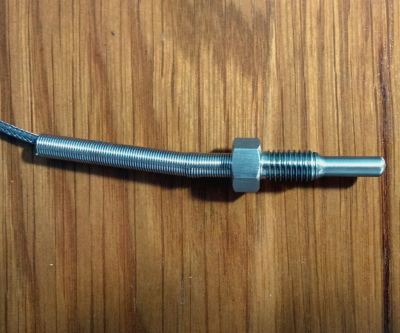
A typical Pt100 RTD probe

Luckily, resistance temperature detectors (RTDs) are an excellent alternative. These usually consist of very thin wires of pure platinum, and are identified by their resistance at 0 °C. For example, a Pt100 RTD has a resistance of 100 Ω at 0 °C.

An accuracy of +/- 0.15 °C at 0 °C is typical, but accuracies down to +/- 0.03 °C are available. The functional temperature range is typically quite high, with -70 °C to 200 °C being common, with some specialized probes working well over 900 °C.

It’s not uncommon for the lead wires on these probes to be a meter or more in length, and this can be a significant source of error. To account for this, you will see that RTD probes are sold in two, three, and four wire configurations. Two-wire configurations do not account for lead wire resistance, three-wire probes account for lead resistance but assume all lead wires have the same resistance, and four-wire configurations are most effective at eliminating this error.

In this article we’ll be using a 3-wire probe as it’s a good balance between cost, space, and accuracy. I found this detailed treatment of the differences between probe types useful in making this decision.

Continue reading “Move Aside Mercury: Measuring Temperature Accurately With An RTD”

Keep It Close: A Private Git Server Crash Course

At this point, everyone has already heard that Microsoft is buying GitHub. Acquisitions of this scale take time, but most expect everything to be official by 2019. The general opinion online seems to be one of unease, and rightfully so. Even if we ignore Microsoft’s history of shady practices, there’s always an element of unease when somebody new takes over something you love. Sometimes it ends up being beneficial, the beginning of a new and better era. But sometimes…

Let’s not dwell on what might become of GitHub. While GitHub is the most popular web-based interface for Git, it’s not the only one. For example GitLab, a fully open source competitor to GitHub, is reporting record numbers of new repositories being created after word of the Microsoft buyout was confirmed. But even GitLab, while certainly worth checking out in these uncertain times, might be more than you strictly need.

Let’s be realistic. Most of the software projects hackers work on don’t need even half the features that GitHub/GitLab offer. Whether you’ve simply got a private project you want to maintain revisions of, or you’re working with a small group collaboratively in a hackerspace setting, you don’t need anything that isn’t already provided by the core Git software.

Let’s take a look at how quickly and easily you can setup a private Git server for you and your colleagues without having to worry about Microsoft (or anyone else) having their fingers around your code.

Continue reading “Keep It Close: A Private Git Server Crash Course”

LEGO: The Kristiansen Legocy

Whether you are young, old, or a time traveling Vulcan, something unites all of us globally: the innocent LEGO blocks that encourage creativity over spoon-fed entertainment. Have you noticed the excess of zombified children and adults alike drooling over their collective screens lately? Back in the ancient times, all a child needed to create hours of joy were plastic interlocking bricks and a place for their parents to trip over them. The LEGO Group harbored the inspiration of our childhood inventiveness, and none of it would have been possible without the founder, Ole Kirk Kristiansen (or Christiansen). The humble carpenter from Denmark forever made his mark on the little Scandinavian country, one brick at a time.

Well, maybe not at first. You see the plastic LEGO bricks we all know and love were initially made of wood. And they were also not actually bricks.

Continue reading “LEGO: The Kristiansen Legocy”

Putting Crimpers To The Test: How Good Are Our Crimp Tools?

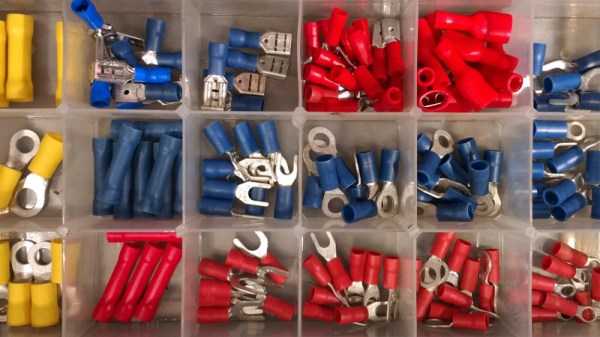
Almost every project of mine from the last quarter century, if it has contained any wiring, has featured somewhere at least one crimp connector. There are a multiplicity of different types of crimp, but in this case I am referring to the ubiquitous variety with a red, blue, or yellow coloured plastic sleeve denoting the wire size they are designed for. They provide a physically robust and electrically sound connection that is resistant to wire fatigue due to vibration, and that can carry hefty currents at high voltages without any problems.

You might expect this to now head off into the detail of crimp connection, but my colleague Dan has already detailed what makes a good or a bad crimp. Instead recently my constant searches for weird and wonderful things to review for your entertainment led me to a new crimp tool, and thence to a curiosity about the effectiveness of different styles of tool. So I’m going to evaluate the three different crimping methods available to me, namely my shiny new ratchet crimp pliers, my aged simple crimp pliers, and for comparison an ordinary pair of pliers. I’ll take a look at the physical strength of each crimping method followed by its electrical effectiveness, but first it’s worth looking at the tools themselves.

Continue reading “Putting Crimpers To The Test: How Good Are Our Crimp Tools?”

Lost In Space Gets 3D Printing Right

When it has become so common for movies and television to hyper-sensationalize engineering, and to just plain get things wrong, here’s a breath of fresh air. There’s a Sci-Fi show out right now that wove 3D printing into the story line in a way that is correct, unforced, and a fitting complement to that fictional world.

With the amount of original content Netflix is pumping out anymore, you may have missed the fact that they’ve recently released a reboot of the classic Lost in Space series from the 1960’s. Sorry LeBlanc fans, this new take on the space traveling Robinson family pretends the 1998 movie never happened, as have most people. It follows the family from their days on Earth until they get properly lost in space as the title would indicate, and is probably most notable for the exceptional art direction and special effects work that’s closer to Interstellar than the campy effects of yesteryear.

But fear not, Dear Reader. This is not a review of the show. To that end, I’ll come right out and say that Lost in Space is overall a rather mediocre show. It’s certainly gorgeous, but the story lines and dialog are like something out of a fan film. It’s overly drawn out, and in the end doesn’t progress the overarching story nearly as much as you’d expect. The robot is pretty sick, though.

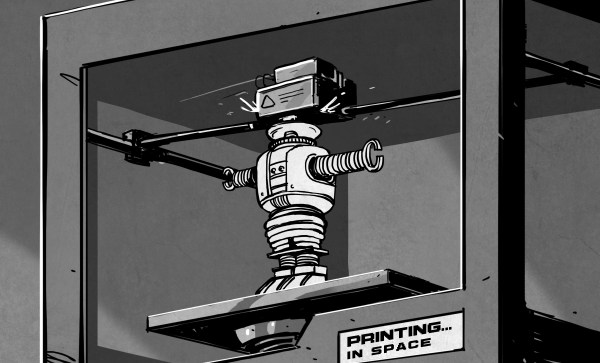
No, this article is not about the show as a whole. It’s about one very specific element of the show that was so well done I’m still thinking about it a month later: its use of 3D printing. In Lost in Space, the 3D printer aboard the Jupiter 2 is almost a character itself. Nearly every member of the main cast has some kind of interaction with it, and it’s directly involved in several major plot developments during the season’s rather brisk ten episode run.

I’ve never seen a show or movie that not only featured 3D printing as such a major theme, but that also did it so well. It’s perhaps the most realistic portrayal of 3D printing to date, but it’s also a plausible depiction of what 3D printing could look like in the relatively near future. It’s not perfect by any means, but I’d be exceptionally interested to hear if anyone can point out anything better.

Continue reading “Lost In Space Gets 3D Printing Right”