DooM Retrospective: 25 Years Of Metal

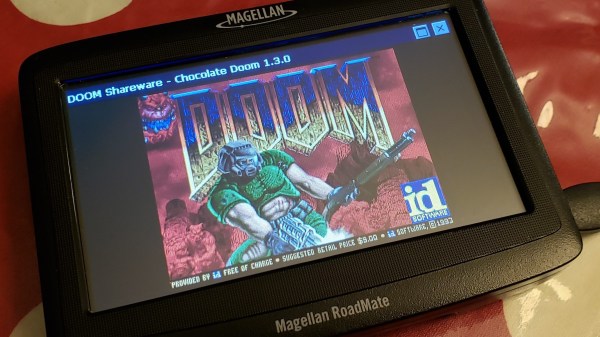
Metal is many things. A material hard and coarse in nature that by forging it in fire becomes sharp enough to cut through anything in its path. The music that bares its namesake is equally cutting and exudes an unyielding attitude that seeks to separate the posers from the true acolytes. Metal is the sentiment of not blindly following the rules, a path less taken to the darker side of the street. In videogame form, there is nothing more metal than Doom.

The creators of Doom, id Software, were always hellbent on changing the perception of PC gaming in the 1990s. Games of the time were rigid and slow in comparison to their console counterparts. The graphical fidelity was technically superior on PC, but no other developer could nail movement in a game like id. The team had made a name for themselves with their Commander Keen series (which came about after a failed Super Mario Bros. 3 PC demo) along with the genre defining Wolfenstein 3D, but nothing topped Doom. In an era that was already soaking with “tude”, Doom established an identity all its own. The moody lighting, the grotesque monster designs, the signature push forward combat, and all the MIDI guitars a Soundblaster could handle; Doom looked and felt a cut above everything else in 1993.

In December of that year, Senators Joe Lieberman and Herb Kohl held a hearing to publicly condemn the inclusion of violence in videogames sold in America. The bulk of the arguments sought to portray the videogame industry and its developers as deviants seeking to corrupt the nation’s youth. Id Software responded as if to raise the largest middle finger imaginable, by releasing Doom to the world the very next day. A quarter of a century later people are still talking about it.

Continue reading “DooM Retrospective: 25 Years Of Metal”

Portmanteau Spewing PunBot

When Python was created, [Guido van Rossum] knew that one day it would be fully realized and take its final form. Clearly, that day has arrived since there now exists a way to send a word query and receive a lengthy list of potential portmanteaus. Some may regard this as merely quaint, but it will be the most important thing to happen in binary until the singularity.

Perhaps we are overpromising a smidge, but it may be fun to spend an afternoon getting your own whimsicalibrated pun resource churning out some eye-roll-worthy word combos. The steps are broken up neatly and explained at a high level with links for more in-depth explanations so a novice can slog through it, but a whiz can wrap it up while the boss is looking the other way.

We truly live in the future, but we may continue writing our own brand of artisanal puns which are number one in someone’s book.

Delicious Vector Game Console Runs Pac-Man, Tetris, And Mario

The only question we have about [mitxela]’s DIY vector graphics game console is: Why did he wait five years to tell the world about it?

Judging by the projects we’ve seen before, from his tiny LED earrings to cramming a MIDI synthesizer into both a DIN plug and later a USB plug, [mitxela] likes a challenge. And while those projects were underway, the game console you’ll see in the video below was sitting on the shelf, hidden away from the world. That’s a shame, because this is quite a build.

Using a CRT oscilloscope in X-Y mode as a vector display, the console faithfully reproduces some classic games, most of which, curiously enough, were not originally vector games. There are implementations of the Anaconda, RetroRacer, and AstroLander minigames from Timesplitter 2. There are also versions of Pac-Man, Tetris, and even Super Mario Brothers. Most of the games were prototyped in JavaScript before being translated into assembly and placed onto EEPROM external cartridges, to be read by the ATMega128 inside the console. Sound and music are generated using the ATMega’s hardware timers, with a little help from a reverse-biased transistor for white noise and a few op-amps.

From someone who claims to have known little about electronics at the beginning of the project, this is pretty impressive stuff. Our only quibbles are the delay in telling us about it, and the lack of an Asteroids implementation. The former is forgivable, though, because the documentation is so thorough and the project is so cool. The latter? Well, one can hope.

Continue reading “Delicious Vector Game Console Runs Pac-Man, Tetris, And Mario”

PIC-Powered Game Console Is Blocky Goodness

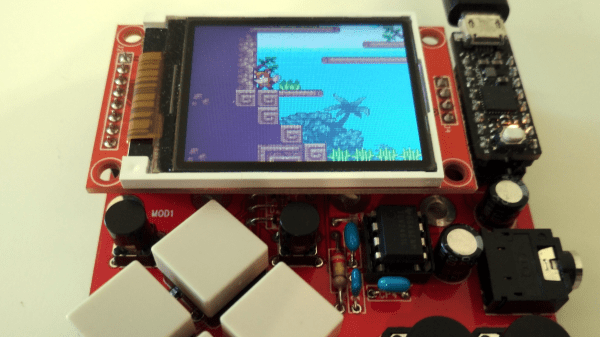
Picking up new skills in the electronics field is often best served by the classic mantra – “learn by doing”. [Juan] and [Leo] did just that, deciding to build a handheld game console for a University project, and delivering the PGC-32.

Built as a final project for the Digital Systems Design course at Cornell University, the PGC-32 takes on a daunting chunk of functionality, and pulls it off in time to get the grades. The team coded a basic block-based game for the hardware, and control is switchable between the analog stick and a built-in accelerometer. Gameplay is displayed on a 320 x 280 color TFT display. Learning to code a basic game is useful, as it teaches student engineers to consider important concepts like timing, race conditions, interrupts, and display routines.

As a university project, it is well documented and the team step through each detail in their code with explanations as to how and why things are done. The internals are particularly neat, too, with a tidy PCB layout and 3D printed case holding everything together.

We’ve seen plenty of work from Cornell’s courses before, too – like this sleep quality monitor.  Video after the break.

Continue reading “PIC-Powered Game Console Is Blocky Goodness”

AI Bot Plays Castlevania So You Don’t Have To

We’re not allowed to have TV here in the Hackaday Wonder Bunker, but occasionally we’ll pool together the bandwidth credits they pay us in and gather ’round the old 3.5 inch TFT LCD to watch whatever Netflix assures us is 93% to our liking. That’s how we found out they’ve made a show based on, of all things, one of the Castlevania games for the NES. We wanted to play the game to understand the backstory, but since it hails from the era of gaming where primitive graphics had to be supplemented with soul-crushing difficulty, we didn’t get very far.

But thanks to a very impressive project developed by [Michael Birken] maybe we’ll have it all figured out by the time we’ve saved enough credits to watch Season 2 (no spoilers, please). The software, which he’s quick to point out is not an example of machine learning, is an attempt to condense his personal knowledge of how to play Castlevania into a plugin for the Nintaco NES emulator. The end result is CastlevaniaBot, which is capable of playing through the original Castlevania from start to finish without human intervention. You can even stop and start it at will, so it can play through the parts you don’t want to do yourself.

[Michael] started this project with a simple premise: if he could make a bot successfully navigate the many levels of Dracula’s castle, then getting it to kill a few monsters along the way should be easy enough. Accordingly, he spent a lot of time perfecting the path-finding for CastlevaniaBot, which included manually playing through the entire game in order to get an accurate map of the background images. These images were then analyzed to identify things like walls and stairs, so the bot would know where it could and couldn’t move protagonist Simon Belmont. No matter what the bot is doing during the game it always considers where it is and where it needs to be going, as there’s a time limit for each stage to contend with. Continue reading “AI Bot Plays Castlevania So You Don’t Have To”

Bust A Move Doesn’t Have To Be Such A Grind

PC gamers have the benefit of the mouse and keyboard, which are highly flexible when it comes to input devices for gaming. What’s more, the freedom of the platform means that it’s easy to whip up whatever mad controller you can dream of to best suit the games you’re playing. Enter [Tom Tilley] with the aptly-named Hipster Game Controller.

Yes, this is a controller made out of a coffee grinder. The hand-crank setup makes it perfect for imitating the game board in that puzzle classic, Bust-A-Move. [Tom] interfaces the controller in a perfectly hacky way – the scroll wheel from a mouse is removed from the case and zip tied to the shaft of the grinder, allowing the rotation of the grinder to turn the wheel. The mouse wheel is then mapped as the aim control in the game – it really is that simple. An arcade button is also fitted into a mug and wired into the left mouse button to act as the trigger.

[Tom] notes that while you can fill the grinder up while you play, it makes playing the game very hard work. It’s a hacky build to show that sometimes, you don’t need a microcontroller and lines of code – just a mouse, some wire, and a healthy dose of ingenuity.

And, as it turns out, [Tom]’s been quite the Bust-a-Move fan for a few years now. Video after the break.

Continue reading “Bust A Move Doesn’t Have To Be Such A Grind”

A Portal Port Programmed For Platforms Of The Past

If you still have a Commodore 64 and it’s gathering dust, don’t sell it to a collector on eBay just yet. There’s still some homebrew game development happening from a small group of programmers dedicated to this classic system. The latest is a Portal-like game from [Jamie Fuller] which looks like a blast.

The Commodore doesn’t have quite the same specs of a Playstation, but that’s no reason to skip playing this version. It has the same style of puzzles where the player will need to shoot portals and manipulate objects in order to get to the goals. GLaDOS even makes appearances. The graphics by [Del Seymour] and music by [Roy Widding] push the hardware to its limits as well.

If you don’t have a C64 laying around, there are some emulators available such as VICE that can let you play this game without having to find a working computer from the 80s. You can also build your own emulator if you’re really dedicated, or restore one that had been gathering dust. And finally, we know it’s not, strictly speaking, a port of Portal, but some artistic license in headlines can be taken on occasion.

Continue reading “A Portal Port Programmed For Platforms Of The Past”