Kitchen Bump Bar Plays Doom Between Orders

For as much as we love reverse engineering projects, we have to admit that we almost passed up on this “kitchen bump bar” hack. Having never had the privilege of working in the food-service industry — well, there was that time working at Chuck E. Cheese’s, but that only lasted for one shift — we were unaware of what a bump bar is, and the whys and hows of hacking one to the point where it can play Doom.

We’re glad we stuck with it, though, because [Kiwa]’s hack is pretty cool, and we got to learn a little about the technology of the modern commercial kitchen. Most fast food and family casual restaurants have what’s known as a “kitchen display system”, which relays orders from the wait staff to the kitchen. You’ve probably seen parts of the KDS, like the touch screens used by the wait staff to enter orders, or the screens dangling in the kitchen that display the pending orders. A bump bar is a small terminal used by the kitchen crew to review orders and move them around in the queue, or “bump” them, as needs dictate.

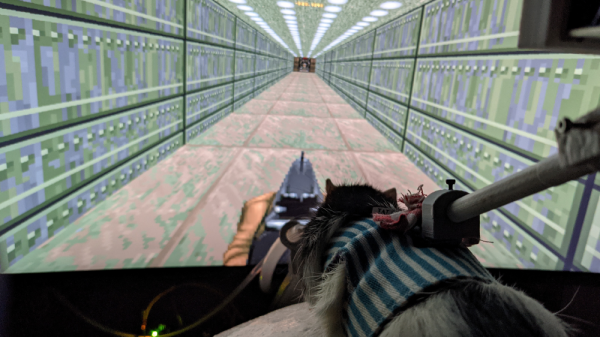
The bump bar [Kiwa] dug into appears to be a model from the early 2000s and very sturdily built, as anything used in a kitchen would need to be. Hooked up to a monitor and a keyboard, [Kiwa] discovered that it booted right into an OS with all the familiar trappings of DOS. After a detour for a teardown and dumping the flash contents, [Kiwa] was able to boot it up and run Doom, albeit somewhat slowly. It also looks like he’s got a couple of different Windows versions running, and even played some Solitaire.

It’s always fun to see what will run Doom — an NES, an oscilloscope, a thermostat, or even a bag of potatoes.

Thanks to [Fritnando] for the tip.

E.T. Video Game Gets Re-Imagined In 10 Lines Of BASIC

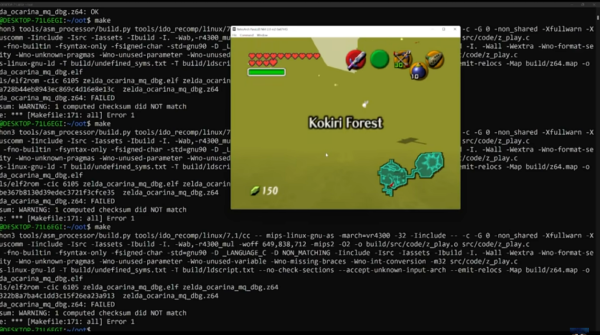
Most people would recognize E.T. The Extra-Terrestrial for the Atari 2600 by its reputation as one of the worst video games of all time. We’ll have more to say about that in a moment, but E.T. was nevertheless chosen as the inspiration behind [Martin Fitzpatrick]’s re-imagining of the game in ten lines of BASIC code for a contest that encourages and celebrates games written in ten lines of BASIC, or less.

Ten lines of BASIC is a big limitation, even when getting clever by stacking multiple statements into a single line, so [Martin]’s game has a much narrower scope than the original Atari 2600 version. Still, the core elements are present: E.T. must find and gather all the parts of the phone in order to contact his ship, after which he must meet the ship in time to escape. All the while, FBI agents attempt to interfere. The game was written in SAM BASIC, used by the SAM Coupé, a British Z80-based home computer from the late 80s with an emulator available for download.

Now, for lovers of “um, actually” topics, do we have a treat for you! Let’s take this opportunity to review a few things about E.T. The Extra-Terrestrial. That it was a commercial flop is no doubt, but the game itself is often badly misunderstood. Way back in 2013 we covered an extraordinary effort to patch improvements into the binary for the 2600 game, and in the process there’s a compelling case made that the game was in many ways far ahead of its time, and actually quite significant in terms of game design. You can jump right in on an analysis of the hate the game receives, and while reading that it’s helpful to keep in mind that In 1982, many of its peers were games like Space Invaders, with self-evident gameplay that simply looped endlessly.

Three Ways To Detect The Silver Ball

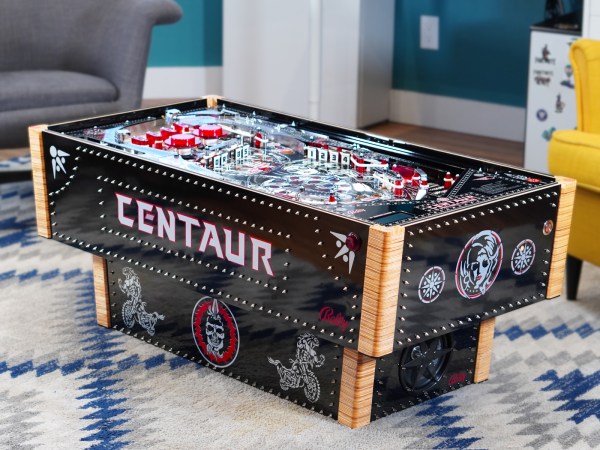
We speak from experience when we say that making pinball targets is harder than you might think. The surface area of the part of the ball that touches is oh-so-small, and you really need to have gravity on your side for best results. Luckily, [TechnoChic] did the work for us and came up with these three versatile sensor designs that would be good for any game, not just pinball. They all use fresh, pristine cardboard from the Bezos Barn and a conductive fabric tape made by Brown Dog Gadgets that they call maker tape.

With the possible exception of not being solderable (can you solder it? ours hasn’t showed up yet), maker tape is seemingly superior to copper tape because it is designed to be conductive in the Z-direction, and if you’ve ever laid out a copper tape circuit, you know that tape overlaps are pretty much par for the course.

First on the list is the track switch, which we think is pretty much necessary. After all, what fun is a pinball machine without at least one pair of rails to ride? Might as well score some points at the same time. This one looks to be the trickiest since the rails have to be consistently spaced, otherwise the ball will fall. The drawbridge target uses a cardboard hinge and the weight of the ball to force two pieces of tape together to complete the circuit.

The flappy hole target is probably our favorite because it’s the most adaptable. You could use it for all kinds of things, like getting the ball to a basement level of a pinball game, or if you want to be evil, set it up in the drain area and deduct points every time you lose the ball, or just use it to trigger the next ball to drop. This one would also be really good for something like Skee-Ball and would really keep the BoM cost down compared to say, IR break-beam targets or coin slot switches.

You can check out these sensors in a brief demo after the break, and then see how [TechnoChic] put these ideas to use in this winter-themed pinball machine we showed you a few weeks ago.

Continue reading “Three Ways To Detect The Silver Ball”

Exhuming An Ancient Game From A Government Warehouse

Many readers will be familiar with the final scene of Raiders Of The Lost Ark, in which the Ark of the Covenant, having been retrieved by Indiana Jones, is placed in a crate and wheeled off to be lost in the seemingly infinite depths of a dusty Government warehouse. Who knows what treasures lurk in such fabled taxpayer-funded repositories, and as if to prove their vast potential, [Arthur O’Dwyer] relates a tale of digital archaeology in which the entire source code of a game thought long-lost was regurgitated with the help of a civil servant.

The game in question is Castlequest, which he had played in the 1980s on the now-defunct GEnie online service. One of very few online references to it came via an entry in the copyright catalog of the US Copyright Office, where copyright holders can choose to register their works. Eventually after some detective work and a conversation with one of the game’s authors, he received copies of the entry. But instead of the expected summary, he was pleasantly surprised to find the full Fortran code of the game. The snag was that it came as a PDF scan of printed pages rather than as code itself, so there followed a tedious process of transcription before it could be published in a GitHub repository and eventually made compilable. The code remains copyrighted as an important part of its story, but should you be interested you can transport yourself back four decades and try your luck at text adventuring.

Maybe there’s more to be found in those dusty copyright warehouses, and searching for it has to be more pleasant than digging up landfills.

Playing The Interview Game

Technical interviews are generally dreaded, just like every other interview. However, technical interviews include many elements that non-technical folks might find mystifying or even pointless, such as whiteboard problem solving, take-home assignments, design sessions, or even just straight brain teasers. [Erik McClure] went a bit off the beaten path and started using the factory builder game Factorio as a technical interview.

Many point to the intent behind the problems and tricky questions inherent in whiteboard coding exercises and assert that the focus is not to complete the problem, but rather to expose how a candidate thinks and problem solves. Factorio is all problem-solving as you work as a team to slowly scale up a humble production line to a massive factory, which makes it a good candidate for assessing these sorts of skills. We doubt that the fine developers who wrote the game ever imagined it being used as an interview.

In all likelihood, you probably won’t have a Factorio interview anytime soon as [Erik] estimated each interview would take between eight and twenty hours. But we love the idea of reimagining the interview from a tedious set of problems to solve to an evolving cooperative game. Of course, you can also read more about getting the experience necessary for a job and what companies are looking for in an interview.

A trailer for Factorio is after the break.

Continue reading “Playing The Interview Game”

Kerbal Space Program Goes To The Movies In Stowaway

Fans of the lusciously voiced space aficionado [Scott Manley] will know he often uses Kerbal Space Program (KSP) in his videos to knock together simple demonstrations of blindingly complex topics such as orbital mechanics. But as revealed in one of his recent videos, YouTube isn’t the only place where his KSP craft can be found these days. It turns out he used his virtual rocket building skills to help the creators of Netflix’s Stowaway develop a realistic portrayal of a crewed spacecraft in a Mars cycler orbit.

The Mars cycler concept was proposed in 1985 by Buzz Aldrin as a way to establish a long-term human presence on the Red Planet. Put simply, it describes an orbit that would allow a vehicle to travel continuously between Earth and Mars while needing only an occasional engine burn for course corrections. The spacecraft couldn’t actually stop at either planet, but while it made a close pass, smaller craft could rendezvous with it to hitch a ride. The concept can be thought of as a sort of interplanetary train: where passengers and cargo are picked up and dropped off at “stations” above Earth and Mars. It’s worth noting that a similar cycler orbit should be possible for Earth-Venus trips, but nobody really wants to go there.

An early KSP proof of concept for Stowaway.

The writers of Stowaway wanted their film to take place on a Mars cycler, and to avoid having to create the illusion of weightlessness, they wanted their fictional craft to also have some kind of artificial gravity. The only problem was, they weren’t sure what that would actually look like. So they reached out to [Scott], who in turn used KSP to throw together a rough idea of how such a ship might work in the real-world.

As you can see in the video below, the CGI spacecraft shown in the film’s recently released trailer ended up bearing a strong resemblance to its KSP prototype. While naturally some artistic license was used, [Scott] is excited by what he’s seen so far. The spinning spacecraft, which uses a spent upper stage to counterbalance its crew module and features a stationery utility node at the center, certainly looks impressive; all the more so with the knowledge that it’s based on sound principles.

While Netflix has had a hand in some surprisingly realistic science fiction in the past, they’ve also greenlit some real groan-worthy productions (if you haven’t watched Away, don’t). So until we can see the whole thing for ourselves, we can only hope that [Scott]’s sage advice will allow the crew of Stowaway to fly safe.

Continue reading “Kerbal Space Program Goes To The Movies In Stowaway

AI Upscaling And The Future Of Content Delivery

The rumor mill has recently been buzzing about Nintendo’s plans to introduce a new version of their extremely popular Switch console in time for the holidays. A faster CPU, more RAM, and an improved OLED display are all pretty much a given, as you’d expect for a mid-generation refresh. Those upgraded specifications will almost certainly come with an inflated price tag as well, but given the incredible demand for the current Switch, a $50 or even $100 bump is unlikely to dissuade many prospective buyers.

But according to a report from Bloomberg, the new Switch might have a bit more going on under the hood than you’d expect from the technologically conservative Nintendo. Their sources claim the new system will utilize an NVIDIA chipset capable of Deep Learning Super Sampling (DLSS), a feature which is currently only available on high-end GeForce RTX 20 and GeForce RTX 30 series GPUs. The technology, which has already been employed by several notable PC games over the last few years, uses machine learning to upscale rendered images in real-time. So rather than tasking the GPU with producing a native 4K image, the engine can render the game at a lower resolution and have DLSS make up the difference.

The current model Nintendo Switch

The implications of this technology, especially on computationally limited devices, is immense. For the Switch, which doubles as a battery powered handheld when removed from its dock, the use of DLSS could allow it to produce visuals similar to the far larger and more expensive Xbox and PlayStation systems it’s in competition with. If Nintendo and NVIDIA can prove DLSS to be viable on something as small as the Switch, we’ll likely see the technology come to future smartphones and tablets to make up for their relatively limited GPUs.

But why stop there? If artificial intelligence systems like DLSS can scale up a video game, it stands to reason the same techniques could be applied to other forms of content. Rather than saturating your Internet connection with a 16K video stream, will TVs of the future simply make the best of what they have using a machine learning algorithm trained on popular shows and movies?

Continue reading “AI Upscaling And The Future Of Content Delivery”