Clearly The Best Way To Organize SMD Parts

Have some plexiglas (acrylic) leftovers lying around? Well, they could be put to good use in making this SMD organizer. It comes in handy if you deal with a lot of SMD components in your work. No longer will you waste your time trying to find a 15K 1206 resistor, or that BAS85 diode… or any other component you can think of soldering on the PCB. The basic idea is fairly straightforword, which helped keep this short.

2SMD resistors are packed in thick paper tapes that don’t bend easily, and thus need larger containers than other components, which are packed mainly in flexible PE tapes. The first version of this organizer was built with a 96mm diameter space for resistors and 63mm diameter for other components, but it seems that there is no need for such large compartments. If I were to make it again, I would probably scale everything down to about 80% of it’s current size.

The best way to join all plexiglass parts is to use four M4 threaded rods. There is also a 1.5mm steel rod which holds SMD tape ends in place and helps to un-stick the transparent tape which covers the components. At the top of the organizer there is a notch for paper, used for components labels. Most SMD components are packed in 8mm wide tapes, making the optimal compartment width 10mm. It is not easy to cut the 10mm thick acrylic and get a neat edge – instead, you could use more layers of thin sheets to make the spacers. Using 5mm acrylic you can combine more layers for any width of tape, which contains wider components, like SMD integrated circuits. The only thing that you have to be careful about, is to keep the distance between the thin steel rod and acrylic, which is marked as “2-4mm” on the drawing. It is good if this space is just a few tenths of a millimeter wider than the thickness of SMD tapes.

smd_orthoThe CorelDraw file that can be used for laser cutting the acrylic parts, is available for download. If you scale the profiles, don’t forget to readjust the hole diameters and some other dimensions which have to remain intact. If you have 5mm acrylic pieces, you should probably use two layers of acrylic for every tape (red parts on the drawing). The barrier layers would be made of thin acrylic — for instance 2mm (the blue parts). Edge layers (green) are once again 5mm thick, and there are also the end pieces (yellow), glued to the previous borders and used to “round up” the whole construction and to protect your hands from the threaded rods and nuts.

While you’re building this for your bench, make a vacuum picking tool for SMDs out of a dispensing syringe with a thick needle. It’s a common trick for hackers to use an aquarium air pump, just turn the compressor unit by 180°, so that it creates vacuum instead of blowing the air outside. This process is described by R&TPreppers in the video below.

Continue reading “Clearly The Best Way To Organize SMD Parts”

Digital Communications 1830s Style

We think of digital communications as a modern invention. But the reality is that semaphores, smoke signals, and Aldis lamps are all types of digital communication. While telegraphs are not as old as smoke signals, they, too, are a digital mode. The problem with all of these is that they require the operator to learn some kind of code. People don’t like to learn code because it is difficult, and employers don’t like to pay high wages to trained operators.

In the late 1830s, a man named William Cooke proposed a complex telegraph to a railway company. The company didn’t care for it and asked for something simpler. The railway didn’t like that either, so Cooke joined up with Charles Wheatstone and patented something that was a cross between a telegraph and a Ouija board.

Continue reading “Digital Communications 1830s Style”

We’re Hiring

Hackaday has been expanding into all kinds of new areas. We find ourselves stretched a bit thin and it’s time to ask for help. Want to lend a hand while making some extra dough to plow back into your projects? These are work-from-home (or wherever you like) positions and we’re looking for awesome, motivated people to help guide Hackaday forward!

Contributors are hired as private contractors and paid for each post. You should have the technical expertise to understand the projects you write about, and a passion for the wide range of topics we feature. If you’re interested, please email our jobs line, and include:

  • Details about your background (education, employment, etc.) that make you a valuable addition to the team
  • Links to your blog/project posts/etc. which have been published on the Internet
  • One example post written in the voice of Hackaday. Include a banner image, at least 150 words, the link to the project, and any in-links to related and relevant Hackaday features

What are you waiting for? Ladies and Gentlemen, start your applications!

The Triumph Of Open Design And The Birth Of A FormLabs Aftermarket

Whilst designing hardware, it’s easy to shut the doors, close the blinds, and bury ourselves deeply into an after-hours design session. Although it’s tempting to fly solo, it’s likely that we’ll encounter bugs that others have handled, or perhaps we’ll realize that we forgot to add a handy feature that someone else could’ve noticed before we sent the darned PCB files out for fab. All that said, if we probe the community around us and ask for feedback, we can produce a project that’s far more functional and feature-complete in less time than if we were to design solo. Who knows? With enough eyes giving feedback on your project, maybe others will get excited enough to want one for themselves! [Andrew Werby] and [Zak Timan] on the FormLabs forums did just that: through months of iterative design and discussion on the FormLabs forums, they’ve created the first 3rd party glass resin tank that’s altogether sturdier, longer-lasting, more scratch-resistant, and less distorting than the original resin tank. And guess what? After months of trials through a few brave customers, you too can be the proud owner such a tank as they’re now up for sale on [Zak’s] website.
Continue reading “The Triumph Of Open Design And The Birth Of A FormLabs Aftermarket”

Learn Resin Casting Techniques: Duplicating Plastic Parts

Resin casting lets you produce parts that would be otherwise impossible to make without a full CNC and injection molding set-up. It costs about as much as a 3d printer, 300 to 600 US dollars, to get a good set-up going. This is for raw material, resin, dye, pressure chamber, and an optional vacuum degassing set-up. A good resin casting set-up will let you produce parts which are stronger than injection molding, and with phenomenal accuracy, temperature resistance, and strength. I will be covering various techniques from the simple to advanced for using resin casting from a hacker’s perspective.

Continue reading “Learn Resin Casting Techniques: Duplicating Plastic Parts”

Retrotechtacular: Cut All The Cables In This Speedy Teleco Switch Upgrade

In this short but intense classic of corporate cinematography, we get to watch as the Pacific Bell central office in Glendale, California is converted to electronic switching in a 47-second frenzy of cable cutting in 1984.

In the 1970s and 1980s, conversion of telephone central office (CO) switch gear from older technologies such as crossbar (XBar) switches or step-by-step (SxS) gear to electronic switching systems (ESS) was proceeding apace. Early versions of ESS were rolling out as early as the 1950s, but telcos were conservative entities that were slow to adopt change and even slower to make changes that might result in service outages. So when the time finally came for the 35,000 line Glendale CO to cutover from their aging SxS gear to ESS, Pacific Bell retained Western Electric for their “Speedy Cutover Service.”

Designed to reduce the network outage time to a minimum, cuts like these were intricately planned and rehearsed. Prep teams of technicians marked the cables to be cut and positioned them for easy access by the cutters. For this cut, scaffolding was assembled to support two tiers of cutters. It looks like the tall guys got the upper deck, and the shorter techs – with hard hats – worked under them.

At 11PM on this cut night, an emergency coordinator verified that no emergency calls were in progress, and the cut began. In an intense burst of activity, each of the 54 technicians cut about 20 cables. Smiles widened as the cut accelerated, and sparks actually flew at the 35.7 second mark. When done, each tech turned around and knelt down so the supervisors knew when everyone was done. At least one tech couldn’t help but whoop it up when the cut was done. Who could blame him? It must have been a blast.

Continue reading “Retrotechtacular: Cut All The Cables In This Speedy Teleco Switch Upgrade”

Get Your Hackaday Belgrade Tickets Now

We have just opened up registration for Hackaday | Belgrade — a hardware conference on April 9th. Get your ticket now and make arrangements to visit Belgrade this Spring. Tickets are inexpensive, travel costs from other parts of Europe are very reasonable, the weather will be beautiful, and the all-day madness that we have planned will make you wish it were a week instead of just sixteen hours. These tickets will sell out so please share this post with your friends so they are not left ticketless.

Packed with Amazing People

mike
If you don’t recognize the name you will almost certainly recognize his internet persona: Mike’s Electric Stuff. He’s been regularly featured on the front page of Hackaday as he churns out a unique body of work like tearing down Flir’s low-end gear to discover it’s identical to their high-end offerings.

Hackaday is a global community and that is what makes Hackaday | Belgrade spectacular. We are still accepting proposals for talks through February 15th but haven’t yet made all of the decisions regarding presenters — you should submit a proposal! We’ll publish an article about all of the presenters once we have wrapped up the call for proposals. Expect to hear back about this around February 22nd.

One thing I am very excited about is that Mike Harrison will be at the conference. His talk will cover his exploration of an absurdly expensive and complicated relic which was used in the 1950’s for large-format video projection. Mike’s ability to unlock understanding of complex (and awesome) electronics is quite amazing; this talk is not to be missed. But Mike is just one of a dozen presenters from all over Europe. Several members of the Hackaday crew will be on hand and the venue will be packed with hundreds of fellow hardware hackers. You won’t want to miss this.

You Will Hack This Badge

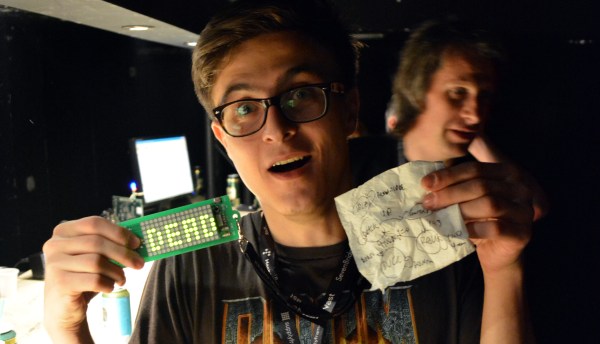
hackaday-belgrade-badge-prototypeThis is the first Hackaday event where we have an active electronic badge. Voja Antonic has been hard at work with the design and just published the first details a few days ago.

The central feature of the badge is an 8×16 LED matrix driven by a PIC microcontroller. It’s running a USB bootloader which will let you flash your own custom code without needing a programmer. We were speaking with some of our friends over at Microchip regarding the bootloader and they offered to supply all the microcontrollers for the badge, an offer we were happy to accept.

Voja has already programmed the first demo application seen here, it’s Tetris written in assembly language. Impressive!

We were overwhelmed by the popularity of badge hacking at the Hackaday SuperConference last November. You can bet that badge hacking will be one of the most popular activities at Hackaday Belgrade. I have written a hardware emulator to work on some animations. It uses the SDL2 library to display the LED matrix and take three button inputs (the final badge design will have four buttons arranged in up/down/left/right configuration). Our hope is to host a demoscene competition that is open to anyone, whether you can attend the conference or not. More on that later.

Live Music and Hacking

As the evening sets in and the talks wind down, we have lined up bands and DJs to take the stage and carry us well into night. You won’t have to stop the badge hacking or anything else that you’re into, but you won’t have to solder in silence either.

As you can tell, this conference goes way beyond talks. This is hardware culture and you’ve just got to be there. Running from 10am until 2am, there’s more than enough to keep you occupied for one day. But make sure to hang out on the event page to get inside information on other non-formalized social events that will happen the night before and the day after. See you in Belgrade!