A Robot Arm For Virtual Beer Pong

Leave it to engineering students to redefine partying. [Hyun], [Justin], and [Daniel] have done exactly that for their final project by building a virtually-controlled robotic arm that plays beer pong.

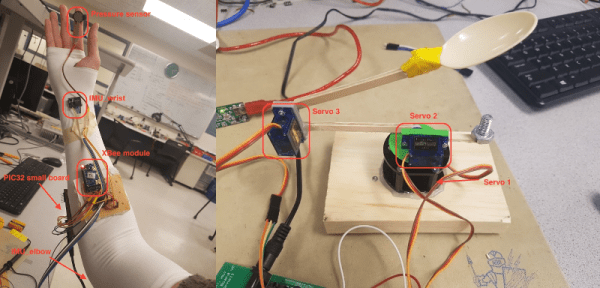
There are two main parts to this build: a sleeve worn by the user, and the robotic arm itself. The sleeve has IMUs at the elbow and wrist and a PIC32 that calculates their respective angles. The sleeve sends angle data to a second PIC32 where it is translated it into PWM signals and sent to the arm.

There’s a pressure sensor wired sleeve-side that’s worn between forefinger and thumb and functions as a release mechanism. You don’t actually have to fling your forearm forward to get the robot to throw, but you can if you want to. The arm itself is built from three micro servos and mounted for stability. The spoon was a compromise. They tried for a while to mimic fingers, but didn’t have enough time to implement grasping and releasing on top of everything else.

Initially, the team wanted wireless communication between the sleeve and the arm. They got it to work with a pair of XBees, but found that RF was only good for short periods of use. Communication is much smoother over UART, which you can see in the video below.

You don’t have to have a machine shop or even a 3-D printer to build a robot arm. Here’s another bot made from scrap wood whose sole purpose is to dunk tea bags.

Continue reading “A Robot Arm For Virtual Beer Pong”

Mount Sopris

Design A Microcontroller With Security In Mind

There are many parts to building a secure networked device, and the entire industry is still learning how to do it right. Resources are especially constrained for low-cost microcontroller devices. Would it be easier to build more secure devices if microcontrollers had security hardware built-in? That is the investigation of Project Sopris by Microsoft Research.

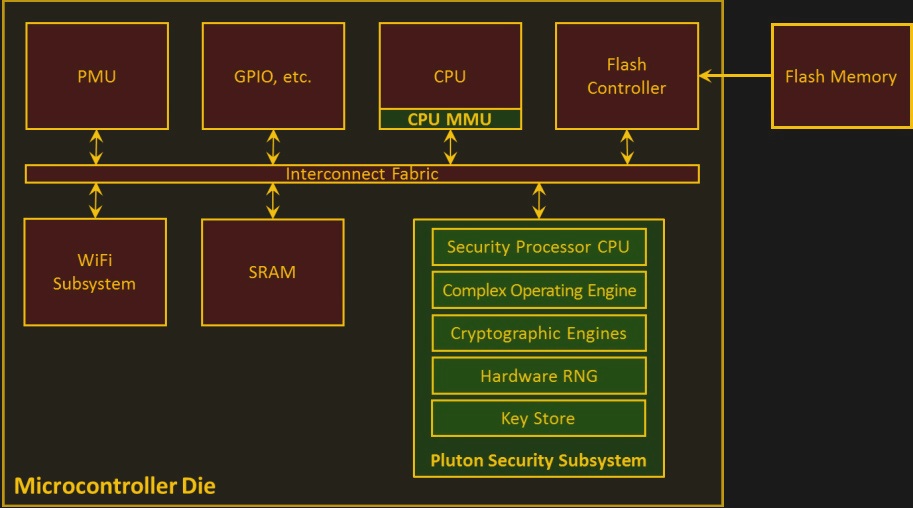
The researchers customized the MediaTek MT7687, a chip roughly comparable to the hacker darling ESP32. The most significant addition was a security subsystem. It performs tasks notoriously difficult to do correctly in software, such as random number generation and security key storage. It forms the core of what they called the “hardware-based secure root of trust.”

Doing these tasks in a security-specific module solves many problems. If a key is not stored in memory, a memory dump can’t compromise what isn’t there. Performing encryption/decryption in task-specific hardware makes it more difficult to execute successful side-channel attacks against them. Keeping things small keeps the cost down and also eases verifying correctness of the code.

But the security module can also be viewed from a less-favorable perspective. Its description resembles a scaled-down version of the Trusted Platform Module. As a self-contained module running its own code, it resembles the Intel Management Engine, which is currently under close scrutiny.

Will we welcome Project Sopris as a time-saving toolkit for building secure networked devices? Or will we become suspicious of hidden vulnerabilities? The researchers could open-source their work to ease these concerns, but value of their work will ultimately depend on the fast-moving field of networked device security.

Do you know of other efforts to add hardware-assisted security to microcontrollers? Comment below or let us know via the tip line!

[via Wired]

Image of Mount Sopris, namesake of the project, by [Hogs555] (CC-BY 4.0)


Dumb Coffee Grinder Gets Smarter With Time

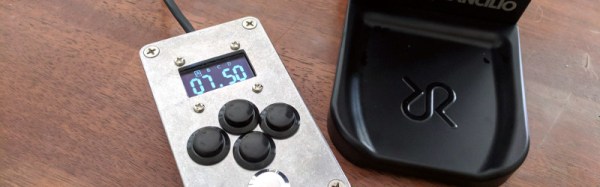
[Forklift] has a Rancilio Rocky, a prosumer-level coffee grinder that’s been a popular mainstay for the last few decades. It’s a simple machine with a direct-drive motor. Rocky has one job, and it will do that job in one of 55 slightly different ways as long as someone is pushing the grind button. What Rocky doesn’t have is any kind of metering technology. There’s no way to govern the grind length, so repeatable results rely on visual estimates and/or an external clock. Well, there wasn’t until [Forklift] designed a programmable timer from the ground up.

The timer interface is simple—there’s a D-pad of buttons for navigation through the OLED screen, and one button to start the grind. The left and right buttons move through four programmable presets that get stored in the EEPROM of the timer’s bare ATMega328P brain. Grind duration can be adjusted with the up/down buttons.

We like that [Forklift] chose to power it by piggybacking on the 240VAC going to the grinder. The cord through the existing grommet and connects with spade terminals, so there are no permanent modifications to the grinder. Everything about this project is open source, including the files for the 7-segment font [Forklift] designed.

Tea aficionados may argue that creating their potion is the more time sensitive endeavor. We’ve got you covered there. Only question is, one button or two?

Will Hack For Espresso

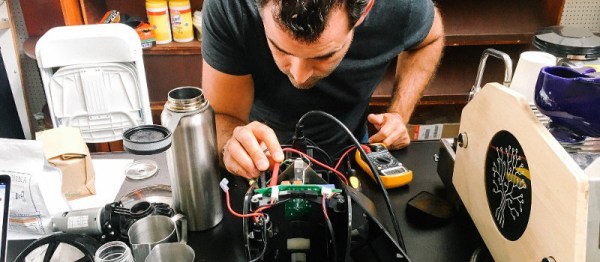
[Avidan Ross] has an unyielding passion for coffee. Brewing a proper espresso is more than measuring fluid ounces, and to that end, his office’s current espresso machine was not making the cut. What’s a maker to do but enlist his skills to brew some high-tech coffee.

For a proper espresso, the mass of the grounds and the brewed output need to be precisely measured. So, the office La Marzocco GS3 has been transformed into a closed-loop espresso machine with a Particle Photon and an Acaia Lunar waterproof scale at its heart.

Continue reading “Will Hack For Espresso”

Guitar Game Plays With Enhanced Realism

There’s a lot more to learning how to play the guitar than just playing the right notes at the right time and in the right order. To produce any sound at all requires learning how to do completely different things with your hands simultaneously, unless maybe you’re a direct descendant of Eddie Van Halen and thus born to do hammer ons. There’s a bunch of other stuff that comes with the territory, like stringing the thing, tuning it, and storing it properly, all of which can be frustrating and discouraging to new players. Add in the calluses, and it’s no wonder people like Guitar Hero so much.

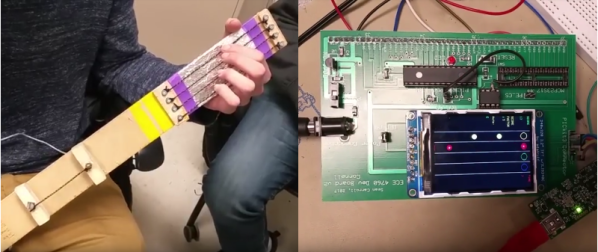
[Jake] and [Jonah] have found a way to bridge the gap between pushing candy colored buttons and developing fireproof calluses and enough grip strength to crush a tin can. For their final project in [Bruce Land]’s embedded microcontroller design class, they made a guitar video game and a controller that’s much closer to the experience of actually playing a guitar. Whether you’re learning to play for real or just want to have fun, the game is a good introduction to the coordination required to make more than just noise.

Continue reading “Guitar Game Plays With Enhanced Realism”

Smart Station Runs Entertainment, Is Entertainment

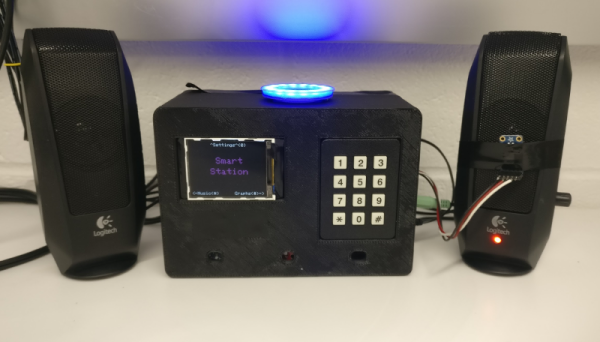
It’s that special time of year—time for the parade of student projects from [Bruce Land]’s embedded microcontroller design course at Cornell. [Timothy], [Dhruv], and [Shaurya] are all into remote sensing and control applications, so they built a smart station that combines audiovisual entertainment with environmental sensing.

As with the other projects in this course, the smart station is built on a PIC32 dev board. It does Bluetooth audio playback via RN-52 module and has a beat-matching light show in the form of a NeoPixel ring mounted atop the 3D-printed enclosure. But those blinkenlights aren’t just there to party. They also provide visual feedback about the environment, which comes from user-adjustable high and low trigger values for the mic, an accelerometer, a temperature and humidity sensor, and a luminosity sensor.

The group wanted to add an ultrasonic wake-up feature, but it refused to work with the 3.3V from the PIC. The NeoPixel ring wanted 5V too, but isn’t as picky. It looks to be plenty bright at 3.3V. Another challenge came from combining I²C, UART, analog inputs, and digital outputs. They had to go to the chip’s errata to verify it, but it’s there: whenever I²C1 is enabled, the first two analog pins are compromised, and there’s no official solution. The team got around it by using a single analog pin and a multiplexer. You can check out those blinkenlights after the break.

Maybe you prefer working in wood. If so, you might like this hexagonal take on audio-visualization.

Continue reading “Smart Station Runs Entertainment, Is Entertainment”

Fully-functional Oscilloscope On A PIC

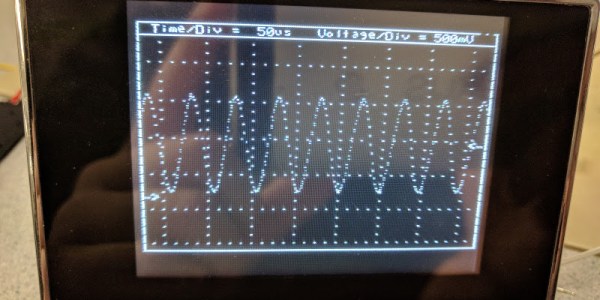
When troubleshooting circuits it’s handy to have an oscilloscope around, but often we aren’t in a lab setting with all of our fancy, expensive tools at our disposal. Luckily the price of some basic oscilloscopes has dropped considerably in the past several years, but if you want to roll out your own solution to the “portable oscilloscope” problem the electrical engineering students at Cornell produced an oscilloscope that only needs a few knobs, a PIC, and a small TV.

[Junpeng] and [Kevin] are taking their design class, and built this prototype to be inexpensive and portable while still maintaining a high sample rate and preserving all of the core functions of a traditional oscilloscope. The scope can function anywhere under 100 kHz, and outputs NTSC at 30 frames per second. The user can control the ground level, the voltage and time scales, and a trigger. The oscilloscope has one channel, but this could be expanded easily enough if it isn’t sufficient for a real field application.

All in all, this is a great demonstration of what you can accomplish with a microcontroller and (almost) an engineering degree. To that end, the students go into an incredible amount of detail about how the oscilloscope works since this is a design class. About twice a year we see a lot of these projects popping up, and it’s always interesting to see the new challenges facing students in these classes.

Continue reading “Fully-functional Oscilloscope On A PIC”