Dumpster Dive Speaker Results In Tube Amplifier

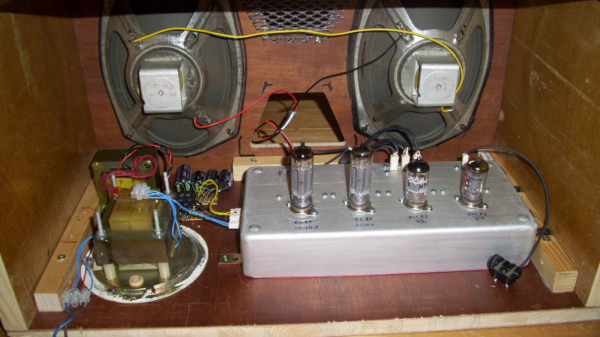
[Michael Wiebusch] found the leftovers of a wrecked vintage tube radio in a pile of electronics junk. Unfortunately, he could not recover any vacuum tubes in it. And to his dismay, it didn’t even have the output transformer, which he figured would have been useful in a guitar amplifier project. The output transformer is not easy to come by nowadays, so he was hoping to at least score that item for his future build. All he could dig out from his dumpster find was a pair of speakers and he ended up building nice Output-Transformer-Less Tube Guitar Amplifier around them.

Valve output stages are generally high-impedance which means they cannot be directly interfaced to low impedance speakers. An impedance matching output transformer is thus used to interface the two. Back in the day when valves were still the mainstay of audio electronics, many cheap amplifier designs would skimp on the output transformer to save cost, and instead use high impedance speakers connected directly to the amplifier output.

[Michael] found a nice reference design of an OTL amplifier for a 620 ohm single speaker. He decided to use the same design but because these speakers were about 300 ohm each, he would have to wire his two speakers in series. At this point, he decided to make his build useful as a proper guitar amplifier by adding a preamplifier stage replicated from another design that he came across. A regular halogen lamp 12V transformer takes care of the heater power supply for all the tubes, and a second, smaller 12V transformer is wired backwards to provide the 300V needed for the plate supply.

The final result is pretty satisfactory, considering that it all started with just a pair of junked speakers. Check out the result in the video after the break.

Continue reading “Dumpster Dive Speaker Results In Tube Amplifier”

Neural Network Composes Music; Says “I’ll Be Bach”

[carykh] took a dive into neural networks, training a computer to replicate Baroque music. The results are as interesting as the process he used. Instead of feeding Shakespeare (for example) to a neural network and marveling at how Shakespeare-y the text output looks, the process converts Bach’s music into a text format and feeds that to the neural network. There is one character for each key on the piano, making for an 88 character alphabet used during the training. The neural net then runs wild and the results are turned back to audio to see (or hear as it were) how much the output sounds like Bach.

The video embedded below starts with a bit of a skit but hang in there because once you hit the 90 second mark things get interesting. Those lacking patience can just skip to the demo; hear original Bach followed by early results (4:14) and compare to the results of a full day of training (11:36) on Bach with some Mozart mixed in for variety. For a system completely ignorant of any bigger-picture concepts such as melody, the results are not only recognizable as music but can even be pleasant to listen to.

Continue reading “Neural Network Composes Music; Says “I’ll Be Bach””

Mechanical Music Maker Throws Stones

When we think of a xylophone we envision hitting the keys from above with mallets. But this robot instrument launches stones from below to play a tune. [Niel] calls the device a Pinger and it is part of a Rock Band — all instruments using rocks.

Although the original post has “xylophone” in it, this musical instrument is technically a glockenspiel because it uses metal keys instead of wood. Either way, it’s a work of art; the instrument’s creator ([Neil Mendoza]) was participating in Adobe’s Autodesk’s Pier 9 artist-in-residence program when he built it.

The keys were cut using a water jet, a process not easily in reach for most of us. But you could make do with a different process in a pinch. On the face of it, fabrication seems simple, but there’s software to calculate the right size for the keys depending on the material. The cuts need to be precise to yield an in-tune instrument.

The circular part is laser-cut acrylic, acting as a base for each key. Below the plate there is a cylinder positioned in the middle of the bar which keeps the stone from getting away. When the solenoid fires, the stone flies up and strikes the key, creating a ringing tone but also adding to the body of sound with a rattle when it falls back down to the base. The entire thing is driven by MIDI, so it can play a lot of tunes besides the biographical “Here Comes the Sun” (since, apparently, the pebbles are out in the sun). Check that out in the video below.

This couldn’t help but remind us of another solenoid-driven xylophone — whose keys were machined out of aluminum stock. There’s also the multixylophoniomnibus.

Continue reading “Mechanical Music Maker Throws Stones”

Talk Like A Game Boy, Sting Like A Beep

Have you ever listened to a song and wondered how they created the robotic-sounding vocals? There’s a huge variety of ways to do so. [scythe1005] decided to take their inspiration from rock history, creating a Game Boy powered talkbox (Japanese, Google Translate recommended for those that don’t speak the language).

Human speech is generated when vibrations from the vocal chords are shaped into intelligible sounds by the motion of the mouth, tongue, and other body parts known as “articulators”. A talkbox creates robotic speech sounds by using the articulators while replacing the vibrations from the vocal chords with alternative source.

A talkbox is a device most typically used with the electric guitar. The signal from the electric guitar is amplified and played through a speaker or transducer connected to a tube that is placed in the user’s mouth. The user then proceeds to mouth the desired words they wish to say, with the vibrations provided by the guitar’s signal instead of the vocal chords. A popular example of this is Peter Frampton’s use of the talkbox in Do You Feel Like We Do.

[scythe1005] used the same basic bones in their design, using a Game Boy to feed sound into a basic audio amplifier kit and a transducer connected to a tube. This gives a very 1980s synth sound to the vocals. It’s a simple build in concept but one we haven’t seen a whole lot of before. Using off-the-shelf modules, you could build something similar in a weekend. Also featured in the video is an ArduinoBoy — a useful way of controlling a Game Boy over MIDI. It’s used here to interface the keyboard to the handheld console. Video below the break.

As we’ve seen before, the Game Boy is an incredibly popular platform for music — chiptune artists regularly modify the device for better sound.

Continue reading “Talk Like A Game Boy, Sting Like A Beep”

Burn Music On To Anything!

If at first you don’t succeed, try, try, and try again. This is especially true when your efforts involve a salvaged record player, a laser cutter, and He-Man. Taking that advice to heart, maniac maker extraordinaire [William Osman] managed to literally burn music onto a CD.

Considering the viability of laser-cut records is dubious — especially when jerry-built — it took a couple frustrating tests to finally see results, all the while risking his laser’s lens. Eventually, [Osman]’s perseverance paid off. The lens is loosely held by a piece of delrin, which is itself touching a speaker blaring music. The vibrations of the speaker cause the lens to oscillate the focal point of the laser into a wavelength that is able to be played on a record player. You don’t get much of the high-end on the audio and the static almost drowns out the music, but it is most definitely a really shoddy record of a song!

Vinyl aficionados are certainly pulling their hair out at this point. For the rest of us, if you read [Jenny’s] primer on record players you’ll recognize that a preamplifier (the ‘phono’ input on your amp) is what’s missing from this setup and would surely yield more audible results.

Continue reading “Burn Music On To Anything!”

Glitchy Synthesizer Meets Honeycomb LED Matrix

Don’t watch [Jason Hotchkiss]’s video if flashing lights or bleepy-bloopy synthesizer noises give you seizures. Do watch, however, if you’re interested in a big honeycomb-shaped LED matrix being driven at audio frequencies through a dedicated square-wave synthesizer that’s built in.

The LED panel in question is housed in a snazzy laser-cut, honeycomb-shaped bezel: a nice change from the standard square in our opinion. The lights are 1/2 watt (whoa!) whites, and the rows and columns are driven by transistor drivers that are in turn controlled by shift registers. We’re not entirely sure how the matrix is driven — we’d love to see a circuit diagram — but it looks like it’s some kind of strange, non-scanning mode where all of the column and row drives are on at once. Whatever, it’s art.

And it’s driven by logic chips making audio-frequency square waves. Two of these are fed into an LFSR and into an R-2R DAC and then into the shift registers. The output is chaos, but the audio and the visuals do seem to influence each other. It’s an audio-visual embodiment of some of my wildest Logic Noise fantasies. Pretty cool. Enjoy the video.

Continue reading “Glitchy Synthesizer Meets Honeycomb LED Matrix”

A Mess Of Wires Turned Into An Analog Synth

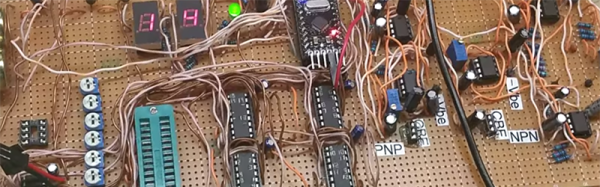
Over on YouTube, [GumpherDM3] built one of the greatest musical projects we’ve seen in a long time. It’s an analog synthesizer that is one of a kind. It’s going to stay one of a kind, too: no one would ever want to copy this mess of wires and perfboard that was successfully turned into a complete musical instrument.

The design of this synth is what you would expect from something that draws its inspiration from semimodular synths such as the Minimoog and Korg MS20. There are four VCOs on this synth, two audio and two used for the LFOs. A four-pole low pass filter, VCA, and two envelope generators round out the purely analog portion of the build. There’s an arpeggiator in there too, which makes for a really great demo video (below).

Inside, this is a true analog synth with the VCOs, filter, and VCA built around the LM13700 transconductance amplifier. The build log shows these chips spread out around half a dozen breadboards before being plugged into sockets soldered to handwired perf board. This synth is a one of a kind instrument – no one would want to build this thing twice.

Additional features include an Arduino with a MIDI in port sending out CV signals to the analog part of the synth. This thing has everything you would expect from a modern take on an analog synthesizer, and it sounds good, too.

Continue reading “A Mess Of Wires Turned Into An Analog Synth”