An Especially Tiny And Perfectly Formed FM Bug

It used to be something of an electronic rite of passage, the construction of an FM bug. Many of us will have taken a single RF transistor and a tiny coil of stiff wire, and with the help of a few passive components made an oscillator somewhere in the FM broadcast band. Connect up a microphone and you were a broadcaster, a prankster, and probably set upon a course towards a life in electronics. Back in the day such a bug might have been made from components robbed from a piece of scrap consumer gear such as a TV or VCR, and perhaps constructed spider-web style on a bit of tinplate. It wouldn’t have been stable and it certainly wouldn’t have been legal in many countries but the sense of achievement was huge.

As you might expect with a few decades of technological advancement, the science of FM bugs has moved with the times. Though you can still buy the single transistor bugs as kits there is a whole range of fancy chips designed for MP3 players that provide stable miniature transmitters with useful features such as stereo encoders. That’s not to say there isn’t scope for an updated simple bug too though, and here [James] delivers the goods with his tiny FM transmitter.

Gone is the transistor, and in its place is a MAX2606 voltage-controlled oscillator. The on-chip varicap and buffer provided by this device alleviate some of the stability issues suffered by the transistor circuits, and to improve performance further he’s added an AP2210 low-dropout regulator to catch any power-related drift. If it were ours we’d put in some kind of output network to use both sides of the differential output, but his single-ended solution at least offers simplicity. The whole is put on a board so tiny as to be dwarfed by a CR2032 cell, and we can see that a bug that size could provide hours of fun.

This may be a small and simple project, but it has found its way here for being an extremely well-executed one. It’s by no means the first FM bug we’ve shown you here, just a few are this one using scavenged SMD cellphone parts, or this more traditional circuit built on a piece of stripboard.

AI Listens To Radio

We’ve seen plenty of examples of neural networks listening to speech, reading characters, or identifying images. KickView had a different idea. They wanted to learn to recognize radio signals (site down but archived). Not just any radio signals, but Orthogonal Frequency Division Multiplexing (OFDM) waveforms.

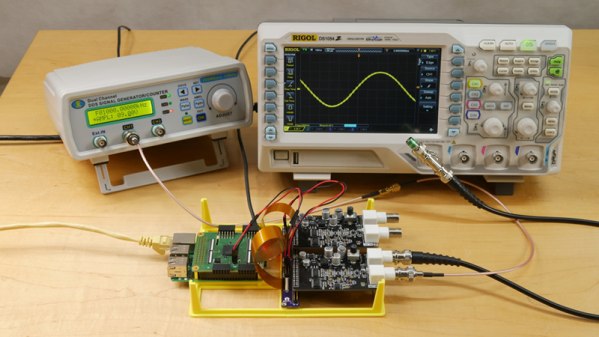
OFDM is a modulation method used by WiFi, cable systems, and many other systems. In particular, they look at an 802.11g signal with a bandwidth of 20 MHz. The question is, given a receiver for 802.11g, how can you reliably detect that an 802.11ac signal — up to 160 MHz — is using your channel? To demonstrate the technique, they decided to detect 20 MHz signals using a 5 MHz bandwidth.

Continue reading “AI Listens To Radio”

This IS Your Grandfather’s Radio

Tube radios have a certain charm. Waiting for them to warm up, that glow of the filaments in a dark room. Tubes ruled radio for many decades. [Uniservo] posted a video about the history and technology behind the 1920’s era Clapp-Eastham C-3 radio. This is a three-tube regenerative receiver and was advanced for its day.

If you are worried he won’t open it up, don’t despair. Around the ten minute mark, your patience will be rewarded. Inside are three big tubes full of getter and bus bars instead of wires. Add to that the furniture-quality case, and this is a grand old radio.

Continue reading “This IS Your Grandfather’s Radio”

Returning A Lost Sheep To The NASA Fold

About three weeks ago, we reported that a satellite enthusiast in Canada found an unexpected signal among his listening data. It was a satellite, and upon investigation it turned out to be NASA’s IMAGE satellite, presumed dead since a power failure in 2005 interrupted its mission to survey the Earth’s magnetosphere.

This story is old news then, they’ve found IMAGE, now move on. And indeed the initial excitement is past, and you might expect that to be it from the news cycle perspective. But this isn’t the Daily Mail, it’s Hackaday. And because we are interested in the details of stories like these it’s a fascinating read to take a look at NASA’s detailed timeline of the satellite’s discovery and subsequent recovery.

In it we read about the detective work that went into not simply identifying the probable source of the signals, but verifying that it was indeed IMAGE. Then we follow the various NASA personnel as they track the craft and receive telemetry from it. It seems they have a fully functional spacecraft with a fully charged battery reporting for duty, the lost sheep has well and truly returned to the fold!

At the time of writing they are preparing to issue commands to the craft, so with luck by the time you read this they will have resumed full control of it and there will be fresh exciting installments of the saga. Meanwhile you can read our report of the discovery here, and read about a previous satellite brought back from the dead.

Picture of IMAGE satellite: NASA public domain.

Plastic Model Emulates The First Untethered Spacewalk

Here’s something really wonderful. [Dave Akerman] wrote up the results of his attempt to use a high-altitude balloon to try to re-create a famous image of NASA’s Bruce McCandless floating freely in space with the Earth in the background. [Dave] did this in celebration of the 34th anniversary of the first untethered spacewalk, even going so far as to launch on the same day as the original event in 1984. He had excellent results, with plenty of video and images recorded by his payload.

80’s “Astronaut with MMU” model kit.

Adhering to the actual day of the spacewalk wasn’t the only hurdle [Dave] jumped to make this happen. He tracked down an old and rare “Astronaut with MMU” (Mobile Maneuvering Unit) plastic model kit made by Revell USA and proceeded to build it and arrange for it to remain in view of the cameras. Raspberry Pi Zero Ws with cameras, LoRA hardware, action cameras, and a UBlox GPS unit all make an appearance in the balloon’s payload.

Sadly, [Bruce McCandless] passed away in late 2017, but this project is a wonderful reminder of that first untethered spacewalk. Details on the build and the payload, as well as the tracking system, are covered here on [Dave]’s blog. Videos of the launch and the inevitable balloon burst are embedded below, but more is available in the summary write-up.

Continue reading “Plastic Model Emulates The First Untethered Spacewalk”

Making Software Defined Radio Portable

While most smartphones can receive at least some radio, transmitting radio signals is an entirely different matter. But, if you have an Android phone and a few antennas (and a ham radio license) it turns out that it is possible to get a respectable software-defined radio on your handset.

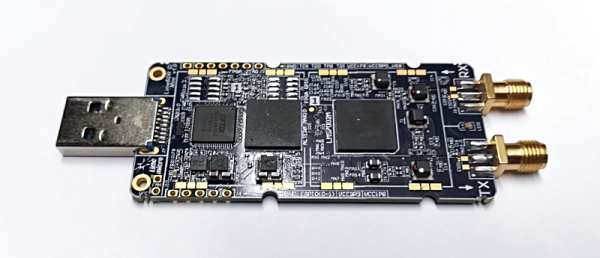
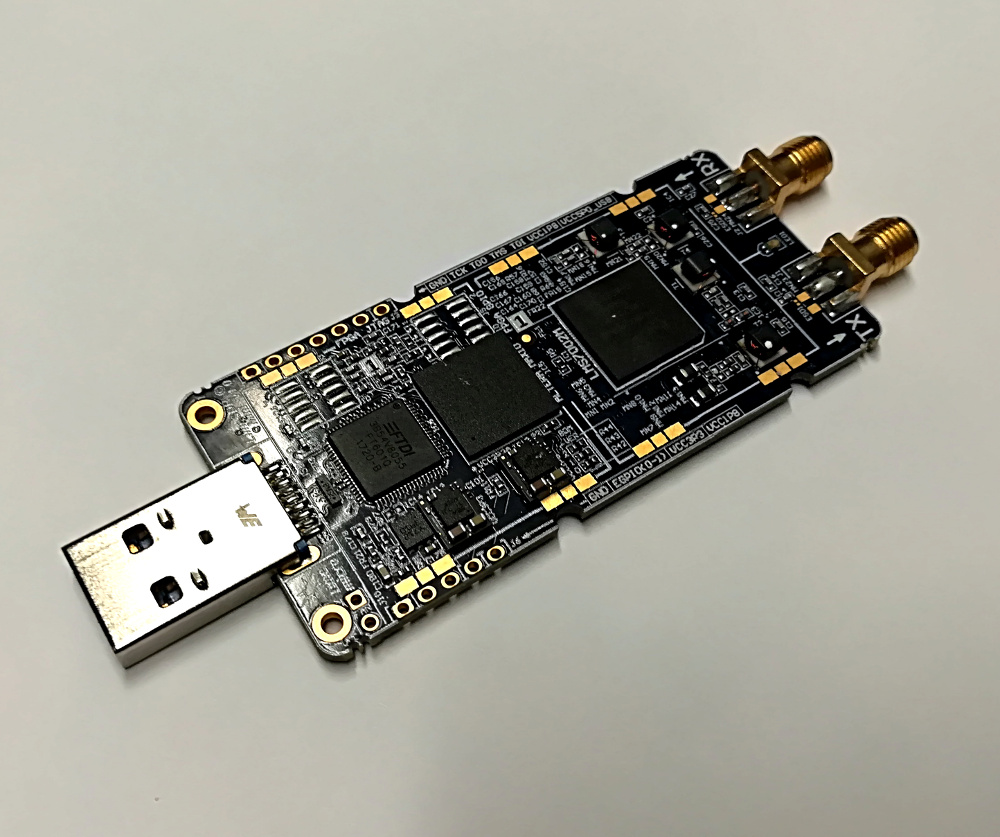
[Adrian] set this up to be fully portable as well, so he is running both the transceiver and the Android phone from a rechargeable battery bank. The transceiver is also an interesting miniaturized version of the LimeSDR, the Lime SDR Mini, a crowdfunded Open Source radio platform intended for applications where space is at a premium. It operates on the 10 MHz to 3.5 GHz bands, has two channels, and has a decent price tag too at under $100.

For someone looking for an SDR project or who needs something very portable and self-contained, this could be a great option. The code, firmware, and board layout files are all also open source, which is always a great feature. If you’re new to SDR though, there’s a classic project that will get you off the ground for even less effort.

Continue reading “Making Software Defined Radio Portable”

ESP32 Makes For World’s Worst Radio Station

We can say one thing for [bitluni]: the BOMs for his projects, like this ESP32 AM radio transmitter, are always on the low side. That’s because he leverages software to do jobs traditionally accomplished with hardware, always with instructive results.

In this case, the job at hand is creating an RF oscillator in the broadcast AM band and modulating some audio onto it. From his previous experience using an ESP32 to watch video on an oscilloscope, [bitluni] knew that the microcontroller’s DACs were up to the task of producing an 800-kHz signal, and he managed to produce a more-or-less sine wave carrier with some clever code. His sketch takes data from a header file, modulates it onto the carrier, and sends it out over the ether using a short stub of wire for an antenna. The range is severely limited, but for what it is, it gets the job done and shows the basics. And as a bonus, [bitluni] included a bit of JavaScript that turns an audio file into a header file that’s ready to go out over the airwaves for all your trolling needs.

If you’re looking for a little more range for your low power transmitter and you’re a licensed amateur operator, you might want to explore the world of QRP radio.

Continue reading “ESP32 Makes For World’s Worst Radio Station”