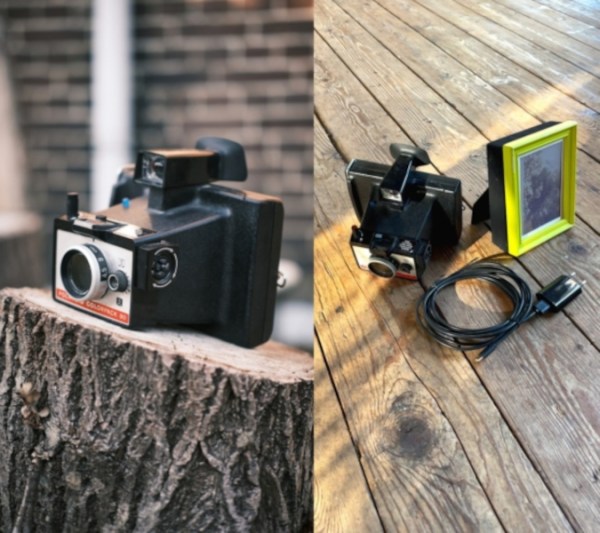
For those who didn’t experience it, it’s difficult to overstate the cultural impact of the Polaroid camera. In an era where instant gratification is ubiquitous, it’s easy to forget that there was a time when capturing a photograph meant waiting for film to be developed or relying on the meticulous art of darkroom processing. Before the era of digital photography, there was nothing as close to instant as the Polaroid. [Max] is attempting to re-capture that feeling with a modified Polaroid which instantly develops its pictures in a remote picture frame.
The build is based on a real, albeit non-functional, Polaroid Land Camera. Instead of restoring it, a Raspberry Pi with a camera module is placed inside the camera body and set up to capture pictures. The camera needs to connect to a Wi-Fi network before it can send its pictures out, though, and it does this automatically when taking a picture of a QR code. When a picture is snapped, it sends it out over the Internet to wherever the picture frame is located, which has another Raspberry Pi inside connected to an e-ink screen. Once a picture is taken on the camera it immediately shows up in the picture frame.
To help preserve the spirit of the original Polaroid, at no point is an image saved permanently. Once it is sent to the frame, it is deleted from the camera, and the next picture taken overwrites the last. And, for those who are only familiar with grayscale e-ink displays as the integral parts of e-readers, there have been limited options for color displays for a while now, as we saw in this similar build which was painstakingly built into a normal-looking picture frame as part of an attempted family prank.