LEGO Components Under X-Ray

[Nico71] works for a company that makes industrial CT scanners. These x-ray machines look inside a piece of equipment, allowing operators to verify assembly and to inspect for material integrity. It also allowed [Nico71] the opportunity to scan a LEGO servo he had lying around, and which no longer worked. The resulting images look fantastic, and really allow you to look into a closed system and pick apart how it works or why it’s not working. In this case, you can see one of the wires has been damaged.

[Nico71] plans to scan a bunch of LEGO components, comparing (for instance) official LEGO products with shanzhai knockoffs. Which is better constructed? It’s one thing to have thinner or cheaper plastic, or a lower grade of steel, but how is the part engineered?

We’ve covered a surprising amount of CT goodness on Hackaday, including this process for turning a CT scan into a 3D print and a post on improving a homebrew CT scanner. Continue reading “LEGO Components Under X-Ray”

Teletype Machine Resurrected

A teleprinter is, at its heart, an automatic typewriter.  It’s electrically controlled and has some smarts to be able to decode an incoming message and has something that will move the keys.   These printers have been in use since the late 1800’s and [AethericLtd] have refurbished an old 1930’s design and given it a bit of steampunk flair.

As is common with older mechanical devices that have been sitting for extended periods of time, the first thing this machine needed was a bath. The machine was separated into its three main parts and soaked in a degreasing solvent. The keyboard was the dirtiest, so it got an overnight soak. Since little of the mechanism was electrical, most of it could be submerged which helped with the cleaning.

The next step in the restoration was lubrication. In order to do a proper job, the manuals (which were available online) were consulted and synthetic motor oil used for lubrication. Once all the hundreds of parts were oiled, [AethericLtd] started working on the wiring. The original wiring in this machine was called Deltabeston – a type of wire by General Electric which uses asbestos insulation. To play it safe, that wire was left alone. The selector magnet required only 4 volts to pull up, but 4 volts wasn’t enough to run the machine. The power supply used was a 120 VDC, 200 mA supply through a 2 KΩ, 10 W resistor.

Once everything was back together and working, [AethericLtd] could take machine out and show it off. The website describes not only the restoration process but also the setup, how to connect to the machine and how to communicate with the machine. Great work! If you are interested in these machines, there have been a few Teleprinter projects on the site before: this one has been modified to connect to a modern modem, and this one prints out tweets.

Continue reading “Teletype Machine Resurrected”

PCB Solder Pad Repair & Cleanup

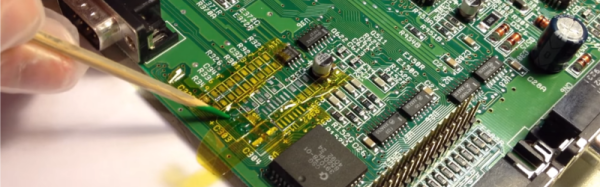
What do you do when your motherboard is covered in electrolytic grime, has damaged pads and traces that are falling apart? You call [RetroGameModz] to work their magic with epoxy and solder.

While this video is a bit old, involved repair videos never go out of style. What makes this video really special is that it breaks from the common trend of “watch me solder in silence” (or it’s close cousin, “watch me solder to loud music”). Instead, [RetroGameModz] walks you through what they’re doing, step by step in their repair of a motherboard. And boy do they have their work cut out for them: the motherboard they’re working on has definitely seen better days. Specifically, it was better before corrosion from a leaking electrolytic capacitor and the well-meaning touch of its owner.

After a quick review of the damage, all of the components are removed from the battle zone. Then the cleaning begins, taking special precautions not to rip pads up. After everything’s cleaned up, things get really interesting. [RetroGameModz] starts to make their own pads from raw copper using the old pads as templates to replace the missing ones on the motherboard. After a bit of epoxy, it’s hard to tell that the pads were handmade, they fit in so well.

This epoxy trick is also used to deal with some heavily damaged traces, cool! During this repair, [RetroGameModz] used an epoxy that is heat resistant up to 315°C for 60 seconds. If you ever find any kind of epoxy on the market that is specified to be heat resistant up to more than 315°C, [RetroGameModz] would be quite happy if you could leave some info in the comment section, as they’ve found high-temperature epoxies quite difficult to source.

This goes to show that some repairs really should be done by professionals. [RetroGameModz] surely agrees, stating that “If you are not a repair technician and your motherboard has stopped working, it would be in the best of your own interest not to attempt a repair that you really cannot handle.” Good advice. But, we can never resist trying to fix things ourselves before handing things off to the more experienced. Call it a vice, or a virtue; we’ll call it fun.

What do you think? Are there some repairs you rely on technicians for? Or do you fix everything yourself? Let us know in the comments.

Continue reading “PCB Solder Pad Repair & Cleanup”

Hacked Sea Scooter Lives Another Day

The Seadoo GTI Sea Scooter is a simple conveyance, consisting of a DC motor and a big prop in a waterproof casing. By grabbing on and firing the motor, it can be used to propel oneself underwater. However, [ReSearchITEng] had problems with their unit, and did what hackers do best – cracked it open to solve the problem.

Investigation seemed to suggest there were issues with the logic of the motor controller. The original circuit had a single FET, potentially controlled through PWM.  The user interfaced with the controller through a reed switch, which operates magnetically. Using reed switches is very common in these applications as it is a cheap, effective way to make a waterproof switch.

It was decided to simplify things – the original FET was replaced with a higher-rated replacement, and it was switched hard on and off directly by the original reed switch. The logic circuitry was bypassed by cutting traces on the original board. [ReSearchITEng] also goes to the trouble of highlighting potential pitfalls of the repair – if the proper care isn’t taken during the reassembly, the water seals may leak and damage the electronics inside.

Overall it’s a solid repair that could be tackled by any experienced wielder of a soldering iron, and it keeps good hardware out of the landfill. For another take on a modified DC motor controller, check out the scooter project of yours truly.


Restoring A Retro 747 Control Display Unit

Anyone who’s into retro aviation gear falls in love with those mysterious displays, dials, keypads, banks of knife switches. There’s a lot of sexy in those devices, built with high standards in a time when a lot of it was assembled by hand.

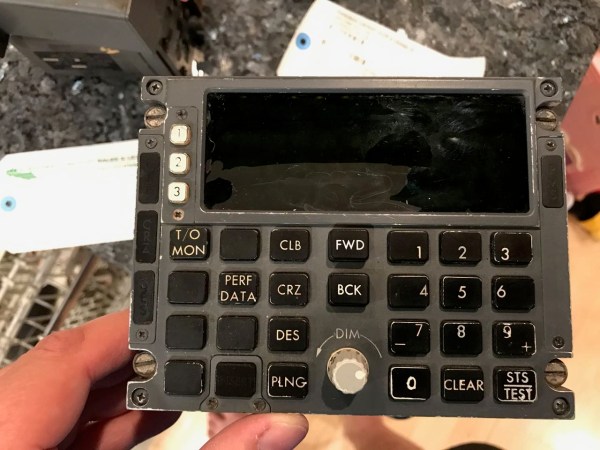
[Jeremy Gilbert] bought a 747-200’s Control Display Unit (CDU)– the interface with the late ’70s in-flight computer–and is bringing it back to life in a Hackaday.io project. His goal is to get it to light up and operate just as if it were installed in a 747.

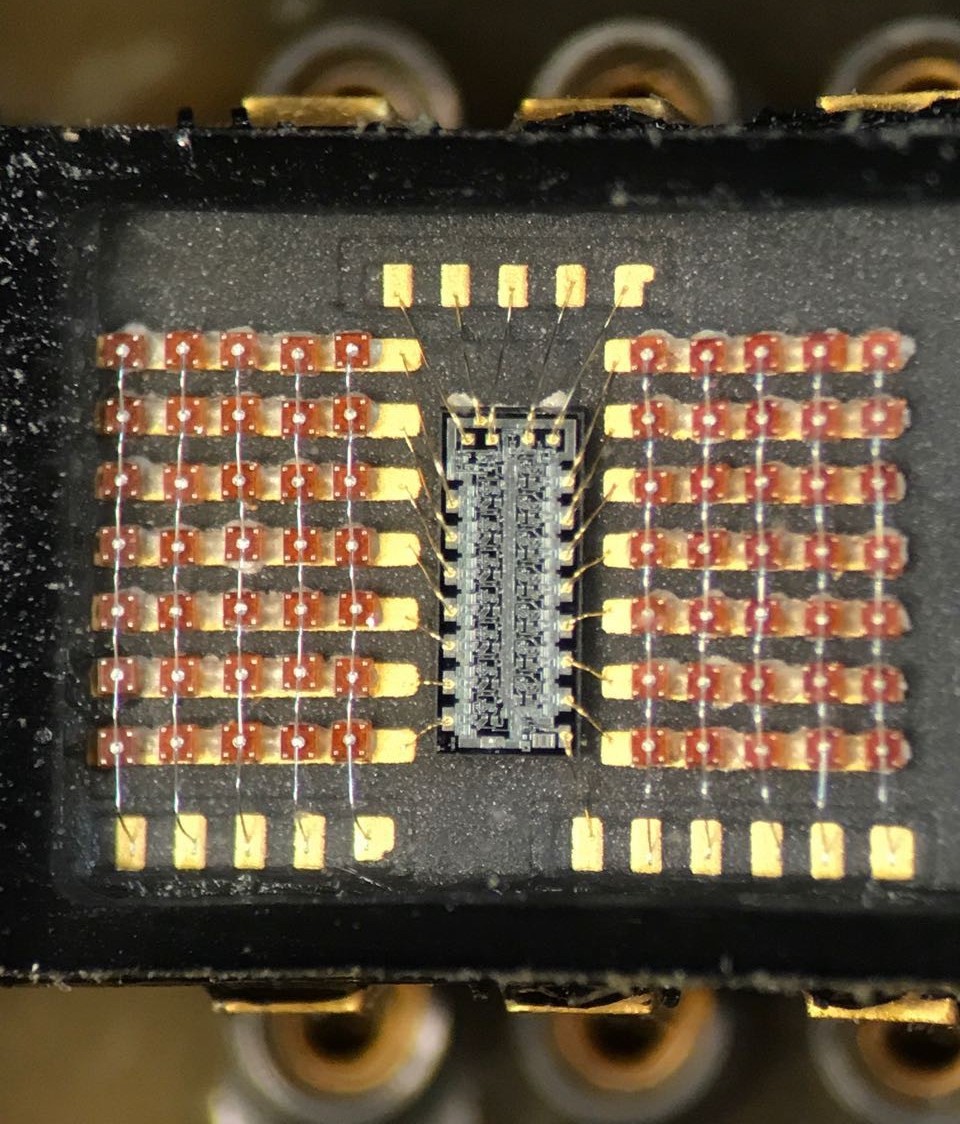
Of particular interest is the display, which turned out to consist of a series of 5×7 matrices (seen on the right) controlled by chips no one uses any more. However, [Jeremy] found a blog post where someone had hacked out Arduino code for a cousin of the chip, saving him a lot of time. However, he’s got a lot more sleuthing yet to do.

If you’re into retro displays, we’ve mentioned a number of good ones, including the legendary Apollo DSKY and an awesome retrocomputer.


Unlikely Cascade Of Failures Leads To Microwave’s Demise

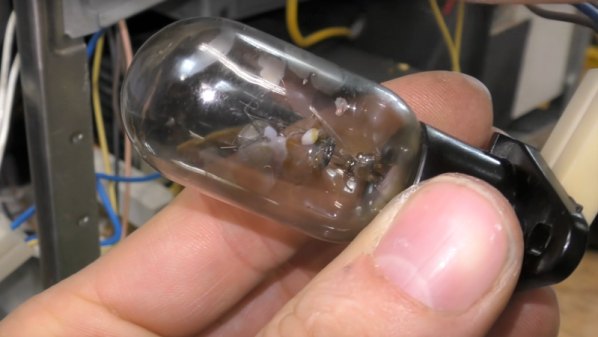
Surely a blown light bulb can’t kill a microwave oven, right? You might not expect it to, but that was indeed the root cause of a problem that [mikeselecticstuff] recently investigated; the cascade of failures is instructive to say the least.

While the microwave that made its way to [mike]’s bench wasn’t exactly engineered to fail, it surely was not designed to succeed. We won’t spoil the surprise, but suffice it to say that his hopes for a quick repair after the owner reported a bang before it died were dashed by an arc across the interior light bulb that put a pulse of mains voltage in places it didn’t belong. That the cascade of failures killed the appliance is a testament to how designing to a price point limits how thoroughly devices can be tested before production runs in the millions are stuffed into containers for trips to overseas markets.

Even though [mike] made his best effort to adhere to the Repair Manifesto, the end result was a scrapped microwave. It wasn’t a total loss given the interesting parts inside, but a disappointment nonetheless unless it forces us to keep in mind edge-case failure modes in our designs.

Continue reading “Unlikely Cascade Of Failures Leads To Microwave’s Demise”

Hand-Wound Brushless Motors Revive Grounded Quad

You’re happily FPVing through the wild blue yonder, dodging and jinking through the obstacles of your favorite quadcopter racing course. You get a shade too close to a branch and suddenly the picture in your goggles gets the shakes and your bird hits the dirt. Then you smell the smoke and you know what happened – a broken blade put a motor off-balance and burned out a winding in the stator.

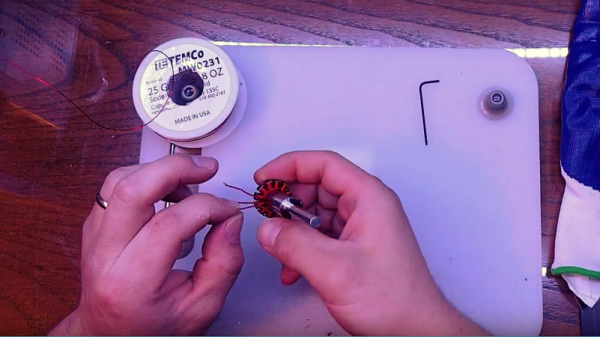
What to do? A sensible pilot might send the quad to the healing bench for a motor replacement. But [BRADtheRipper] prefers to take the opportunity to rewind his burned-out brushless motors by hand, despite the fact that new ones costs all of five bucks. There’s some madness to his method, which he demonstrates in the video below, but there’s also some justification for the effort. [Brad]’s coil transplant recipient, a 2205 racing motor, was originally wound with doubled 28AWG magnet wire of unknown provenance. He chose to rewind it with high-quality 25AWG enameled wire, giving almost the same ampacity in a single, easier to handle and less fragile conductor. Plus, by varying the number of turns on each pole of the stator, he’s able to alter the motor’s performance.

In all, there are a bunch of nice tricks in here to file away for a rainy day. If you need to get up to speed on BLDC motor basics, check out this primer. Or you may just want to start 3D printing your own BLDC motors.

Continue reading “Hand-Wound Brushless Motors Revive Grounded Quad”