The Art Of Blinky Business Cards

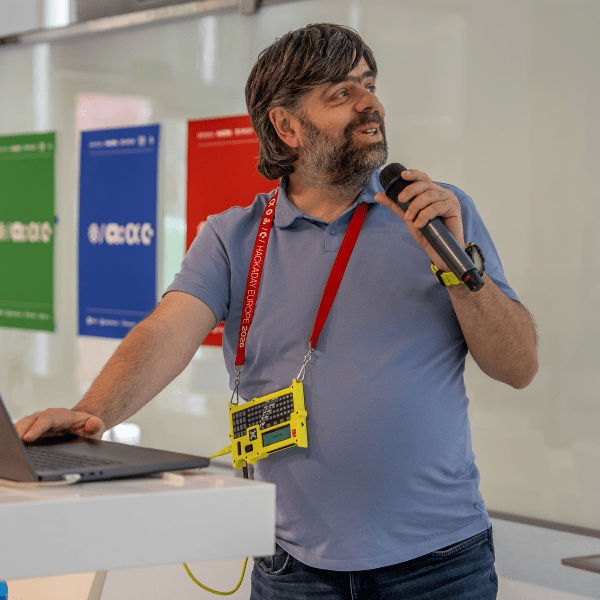
Business cards are stuck somewhere between antiquity and convenience. On one hand, we have very convenient paperless solutions for contact swapping including Bluetooth, NFC, and just saying, “Hey, put your number into my phone, please.” On the other hand, holding something from another person is a more personal and memorable exchange. I would liken this to the difference between an eBook and a paperback. One is supremely convenient while the other is tactile. There’s a reason business cards have survived longer than the Rolodex.

Protocols and culture surrounding the exchange of cards are meant to make yourself memorable and a card which is easy to associate with you can work long after you’ve given your card away. This may seem moot if you are assigned cards when you start a new job, but personal business cards are invaluable for meeting people outside of work and you are the one to decide how wild or creative to make them.

Continue reading “The Art Of Blinky Business Cards”

World’s Largest Telescope Stopped By LED

Earlier this year a simple indicator LED brought the Keck 1 telescope, a 370 tons mass, to a halting stop. How exactly did an LED do this? Simple: it did nothing.

As it so happens, [Andrew Cooper] was just about the leave the summit of Mauna Kea (in Hawaii) when his radio instructed him otherwise: there was an issue. Upon returning, [Andrew] was met by a room of scientists and summit supervisors. “Yeah, this was not good, why are they all looking at me? Oh, h%#*!” The rotor wasn’t moving the telescope, and “no rotator equals no science data.” After being briefed on the problem, [Andrew] got to work. Was it a mechanical issue? No: manual mode worked quite fine, also indicating that the amplifiers and limit switches are functional as well.

Jumping from chip to chip, [Andrew] came across an odd voltage: 9.36V. In the CMOS [Andrew] was investigating, this voltage should have High (15V) or Low (0v) and nowhere in between. Judging by the 9.36V [Andrew] decided to replace the driving IC. One DS3632 later, nothing had changed. Well, maybe is one of the loads pulling the line low? With only two choices, [Andrew] eliminated that possibility quickly. Likely feeling as if he was running out of proverbial rope, [Andrew] remembered something important: “the DS3236 driving this circuit is an open collector output, it needs a pull-up to go high.”

Reviewing the schematic, [Andrew] identified the DS3236’s pull-up: an LED and its current limiting resistor. While the carbon composition resistor was “armageddon proof,” [Andrew] was suspicious of the LED. “Nick, can you get me a 5k resistor from the lab?” Hold the resistor on the pins of the chip and the amplifiers immediately enabled.

[Andrew] summarizes things quite well: “yes… One of the world’s largest telescopes, 370 tons of steel and glass, was brought to a halt because of a bad indicator LED”. It stopped things by doing nothing, or rather, by not turning on.

We love it when we get troubleshooting stories, and if you share our interest in problem-solving, check out this broken power supply troubleshooting or learn what could go wrong with I2C.

Edit: Keck 1 is one of the largest optical telescopes in the world. Thanks to [Josh] for noticing our error.

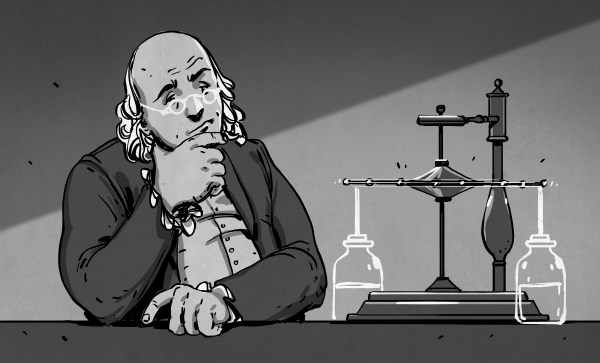
Ben Franklin’s Weak Motor And Other Forgotten Locomotion

Most of the electric motors we see these days are of the electromagnetic variety, and for good reason: they’re powerful. But there’s a type of motor that was invented before the electromagnetic one, and of which there are many variations. Those are motors that run on high voltage, and the attraction and repulsion of charge, commonly known as electrostatic motors.

Ben Franklin — whose electric experiments are most frequently associated with flying a kite in a thunderstorm — built and tested one such high-voltage motor. It wasn’t very powerful, but was good enough for him to envision using it as a rotisserie hack. Food is a powerful motivator.

What follows is a walk through the development of various types of these motors, from the earliest ion propelled ones to the induction motors which most have never heard of before, even an HV hacker such as yours truly.

Continue reading “Ben Franklin’s Weak Motor And Other Forgotten Locomotion”

Books You Should Read: Feynman’s Appendix To The Challenger Disaster Report

It isn’t really a book, but Richard Feynman’s Appendix to the Challenger Disaster Report is still definitely something you should read. It’s not particularly long, but it’s educational and relevant not just as an example of critical thinking in action, but as a reminder not to fool oneself; neither individually, nor on an organizational level. Sadly, while much was learned from the events leading to and surrounding the Challenger disaster, over thirty years later many of us can still find a lot of the same things to relate to in our own professional lives. There isn’t a single magic solution, because these problems are subtle and often masquerade as normal.

Feynman and the Challenger Disaster

Richard Feynman (1918-1988) was a Nobel Prize winning physicist and one of the best-known scientists of his time. In 1986 he somewhat reluctantly agreed to join the Rogers Commission, whose task was to investigate the Challenger disaster. The space shuttle Challenger had exploded a little more than a minute after launch, killing everyone on board. The commission’s job was to find out what had gone wrong and how it had happened, and figure out how to keep it from happening again.

Continue reading “Books You Should Read: Feynman’s Appendix To The Challenger Disaster Report”

We’re Using The Word Firmware Wrong

I had an interesting discussion the other day about code written for an embedded system. I was speaking with Voja Antonic about ‘firmware’. The conversation continued forward but I noticed that he was calling it ‘software’. We later discussed it and Voja told me he thought only the parts of the code directly interacting with the microcontroller were firmware; the rest falls under the more generic term of software. It really had me wondering where firmware stops being firmware and is merely software?

The topic has remained on my mind and I finally got around to doing some dictionary searches. I’m surprised that I’ve been using the word differently and I think most of the people I’ve heard use it are doing the same — at least as far as dictionary definitions are concerned. My go to sources are generally Merriam-Webster and Oxford English dictionaries and both indicate that firmware is a type of software that is indelible:

Permanent software programmed into a read-only memory.

computer programs contained permanently in a hardware device (such as a read-only memory)

According to this definition, I have never written a single bit of firmware. Everything I have written has been embedded software. But surely this is a term that must change with the times as technology progress so I kept digging.

Continue reading “We’re Using The Word Firmware Wrong”

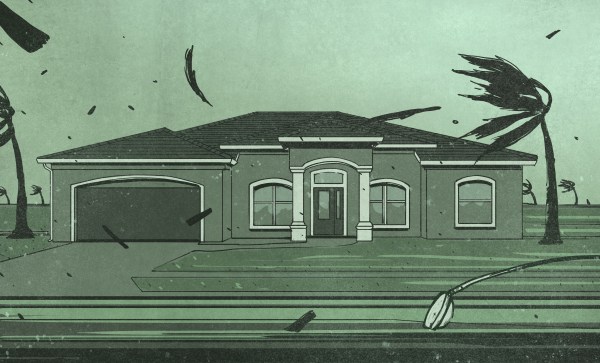
The Engineering That Survives Hurricanes

Florida is a great place to live, especially around January when it’s sunny and 24 degrees outside (76F) while all of your friends from back home are dealing with scraping ice off of their windshields every morning. In the late summer, though, this pleasant tropical paradise can sometimes take a turn for the worse, because Florida is one of the handful of places that frequently see some of the worst storms on the planet: hurricanes. As a Floridian myself, perhaps I can shed some light on some of the ways that the various local governments and their residents have taken to mitigate the destruction that usually accompanies these intense tropical storms when it seems that, to outsiders, it might be considered unwise to live in such a place.

Continue reading “The Engineering That Survives Hurricanes”

Return To The Asus Tinker Board: Have Six Months Changed Anything?

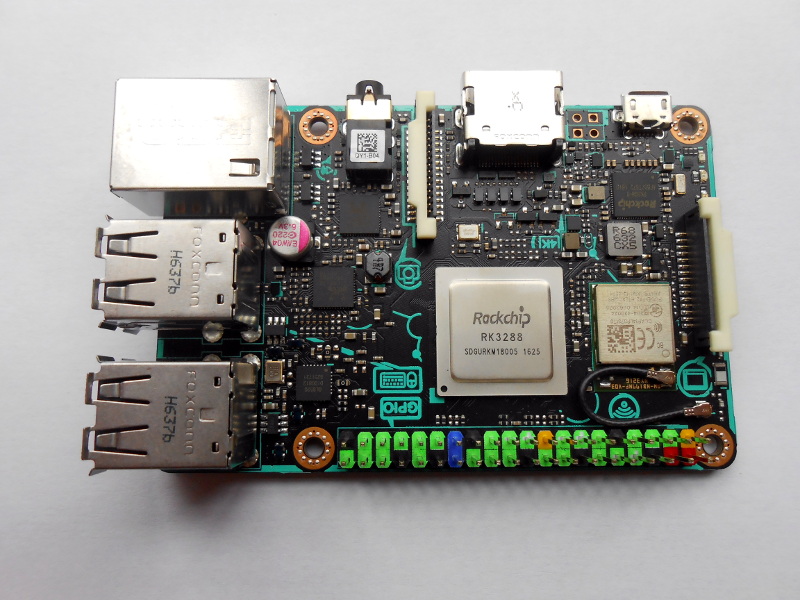
The Asus Tinker Board, in all its glory

Back in February this year, we ordered a new single board computer, and reviewed it. The board in question was the Asus Tinker Board, a Raspberry Pi 3 competitor from the electronics giant in a very well-executed clone of the Raspberry Pi form factor.

Our review found its hardware to be one of the best of that crop of boards we had yet seen, but found serious fault with the poor state of its software support at the time. There was no website, the distro had to be downloaded from an obscure Asus download site, and there was no user community or support channel to speak of. We were then contacted by some of the folks from Asus who explained that the board had not yet been officially launched, and that the unit we’d secured had escaped the fold a little early. Continue reading “Return To The Asus Tinker Board: Have Six Months Changed Anything?”