If you had told 12-year-old me that one day I would be able to listen to pretty much any song I wanted to on demand and also pull up the lyrics as fast as I could type the artist’s name and part of the title into a text box, I would have a) really hoped you weren’t kidding and b) would have wanted to grow up even faster than I already did.
The availability of music today, especially in any place with first world Internet access is really kind of astounding. While the technology to make this possible has come about only recently, the freedom of music listening has been fairly wide open in the US. The closest we’ve come to governmental censorship is the parental advisory sticker, and those are just warnings. The only thing that really stands between kids’ ears and the music they want to listen to is parental awareness and/or consent.
However, the landscape of musical freedom and discovery has been quite different in other corners of the world, especially during the early years of rock ‘n roll. While American teens roller skated and sock-hopped to the new and feverish sounds of Little Richard and Elvis Presley, the kids in Soviet Russia were stuck in a kind of sonic isolation. Stalin’s government had a choke hold on the influx of culture and greatly restricted the music that went out over the airwaves. They viewed Western and other music as a threat, and considered the musicians to be enemies of the USSR.
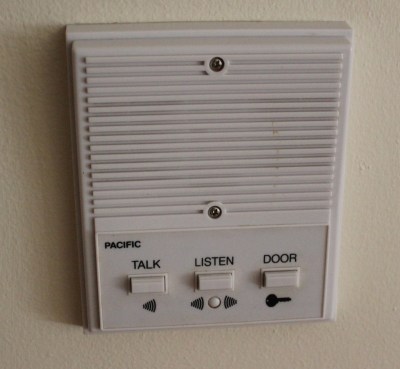
If you’ve been to an apartment complex with a locked front door, you’ve seen the buzzer systems. You press the corresponding button for the apartment you want and can talk to the resident. They can press a button to unlock the door briefly, and then you go up to their apartment and they don’t have to come down to let you in. But what if you’re the resident and you want to go for a run without your keys jingling in your pocket? What if you want to open it using just your smartphone?
I knew this was a silly problem, and everyone I told about it thought that for the amount of time and effort it might save, it was hardly worth it.
Challenge accepted.
How fast can I put this together using only parts I have around the apartment? Turns out about 2 hours.
The modern office has become a sea of LCD monitors. It’s hard to believe that only a few years ago we were sitting behind Cathode Ray Tubes (CRTs). People have already forgotten the heat, the dust, and the lovely high frequency squeal from their flyback transformers.
Image by Søren Peo Pedersen via wikipedia
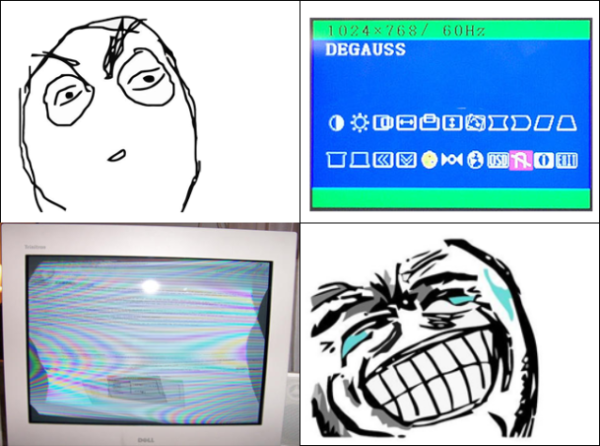
There was one feature of those old monitors which seems to be poorly understood. The lowly degauss button. On some monitors it was a physical button. On others, it was a magnet icon on the On Screen Display (OSD). Pressing it rewarded the user with around 5 seconds of a wavy display accompanied by a loud hum.
But what exactly did this button do? It seems that many never knew the purpose of that silly little button, beyond the light-and-sound show. The truth is that degaussing is rather important. Not only to CRTs, but in many other electronic and industrial applications.
Of Shadow Masks and Aperture Grilles
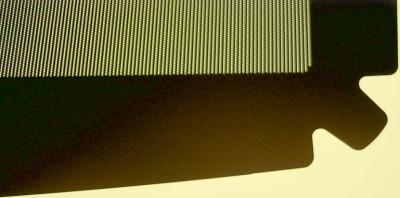
Close up of a shadow mask by Rauenstein via Wikipedia
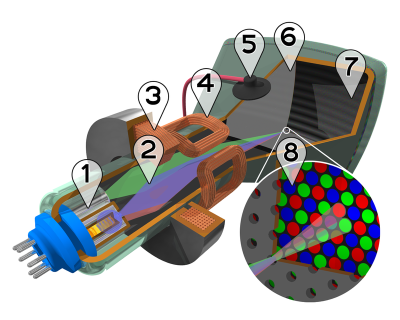
A CRT has quite a few components. There are three electron guns as well as steering and convergence coils at the rear (yoke) of the tube. The front of the tube has a phosphor-coated glass plate which forms the screen. Just behind that glass is a metal grid called the shadow mask. If you had enough money for a Sony screen, the shadow mask was replaced by the famous Trinitron aperture grille, a fine mesh of wires which performed a similar function. The shadow mask or aperture grille’s job is to ensure that the right beams of electrons hit the red, green, or blue phosphor coatings on the front of the screen.
This all required a very precise alignment. Any stray magnetic fields imprinted on the mask would cause the electron beams to bend as they flew through the tube. Too strong a magnetic field, and your TV or monitor would start showing rainbows like something out of a 1960’s acid trip movie. Even the Earth’s own magnetic field could become imprinted on the shadow mask. Simply turning a TV from North to East could cause problems. The official term for it was “Color Purity”.
These issues were well known from the early days of color TV sets. To combat this, manufacturers added a degaussing coil to their sets. A coil of wire wrapped around the front of the tube, just behind the bezel of the set. When the set was powered on, the coil would be fed with mains voltage. This is the well-known ‘fwoomp and buzz’ those old TV sets and monitors would make when you first turned them on. The 50 Hz or 60 Hz AC would create a strong moving magnetic field. This field would effectively erase the imprinted magnetic fields on the shadow mask or aperture grille.
Running high current through the thin degaussing coil would quickly lead to a fire. Sets avoided this by using a Positive Temperature Coefficient (PTC) thermistor in-line with the coil. The current itself (or a small heating coil) would heat up the PTC, causing resistance to increase, and current through the coil to drop. After about 5 seconds, the coil was completely shut down, and the screen was (hopefully) degaussed.
As time went on monitors became embedded systems. The PTC devices were replaced by transistors controlled by the monitor’s main microcontroller. Monitor manufacturers knew that their sets were higher resolution than the average TV set, and thus even more sensitive to magnetic fields. Users are also more likely to move a monitor while using it. This lead the manufacturers to add a degauss button to the front of their sets. A push of the button would energize the coil for a few seconds under software control. Some monitors would also limit the number of times a user could push the button, ensuring the coil didn’t get too hot.
Holding a magnet near the front of a black and white (or a monochrome ‘green screen’) CRT created visible distortion, but no lasting damage. Mid-century hackers who tried the same trick with their first color TV quickly learned that the rainbow effect stayed long after the magnet was moved away. In extreme cases like these, the internal degaussing coil wouldn’t be strong enough to clear the shadow mask.
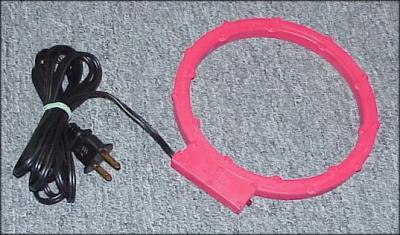
Commercial degaussing coil
When all else failed, a handheld degaussing coil or wand could be used. Literally waving the magic wand in front of the screen would usually clear things up. It was of course possible to permanently damage the shadow mask. Back in 2007, I was working for a radar company which had been slow to switch to LCD monitors. Being a radar shop, we had a few strong magnetron magnets lying around. One of these magnets was passed around among the engineers. Leaving the magnet under your monitor overnight would guarantee rainbows in the morning, and a shiny new LCD within a few days.
Queen Mary, showing her degaussing coil
CRTs aren’t the only devices which use degaussing coils. The term was originally coined in 1945 by Charles F. Goodeve of the Royal Canadian Naval Volunteer Reserve (RCNVR). German mines were capable of detecting the magnetic fields in a naval ship’s steel hull. Coils were used to mask this field. The Queen Mary is one of the more famous ships fitted with a degaussing coil to avoid the deadly mines.
Even mechanical wristwatches can benefit from a bit of degaussing. A watch which has been magnetized will typically run fast. Typically this is due to the steel balance spring becoming a weak magnet. The coils of the spring stick together as the balance wheel winds and unwinds each second. A degaussing coil (or in this case, more properly a demagnetizer) can quickly eliminate the problem.
A story on degaussing wouldn’t be complete without mentioning magnetic media. Handheld or tabletop degaussing coils can be used to bulk erase floppy disks, magnetic tape, even hard disks. One has to wonder if the degaussing coils in monitors were responsible for floppy disks becoming corrupted back in the old days.
So there you have it. The magic degaussing button demystified!
Kickstarter is not a store. Indiegogo is not a store. No matter what crowdfunding platform you’re on, you’re not in a store. This is an undeniable truth, and no matter how angry you are about not being able to bring a cooler with a blender to the beach this summer, you did not buy this cool cooler, you were merely giving someone money to develop this cooler.
This reality may seem strange for the most vocal Internet commenters out there, leading them to the conclusion their pledge for a crowdfunding campaign was an investment. Surely there must be some guarantee in a single pledge, and if it’s not exchanging money for some consumer goods, it is exchanging money for a stake in a company. If that were true, backers of the Oculus Rift would have received several thousand dollars each, instead of a $600 VR headset.
Crowdfunding is not a store, and according to Kickstarter and Indiegogo, it is not an investment, either. Last week, the Securities and Exchange Commission’s rules for “crowdfunded investing”, “Regulation Crowdfunding”, or “Title III Crowdfunding” kicked into gear. Is this the beginning of slack-jawed gawkers throwing their life savings into a pit of despair filled with idiotic consumer products that violate the laws of physics?
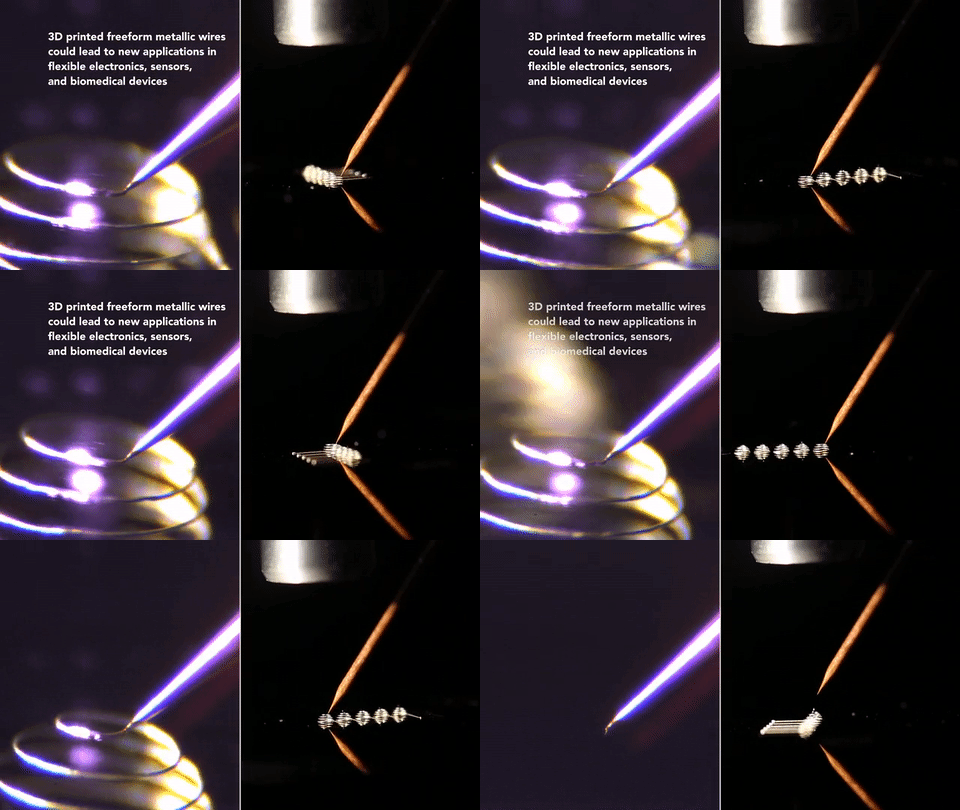
The material is silver nanoparticles extruded out of a nozzle, and shortly after leaving it is blasted with a carefully programmed laser that solidifies the material. The trick is that the laser can’t focus on the tip of the nozzle or else heat transfer would solidify the ink inside the nozzle and clog it. In the video you can see the flash from the laser following slightly behind. The extrusion diameter is thinner than a hair, so don’t expect to be building large structures with this yet.
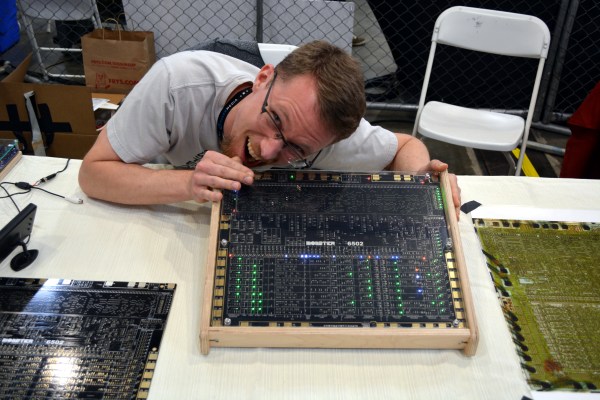
I made a bee line for one booth in particular at this year’s Bay Area Maker Faire; our friend [Eric Schlaepfer] had his MOnSter 6502 on display. If you missed it last week, the unveiling of a 6502 built from discrete transistors lit the Internet afire. At that point, the board was not fully operational but [Eric’s] perseverance paid off because it had no problem whatsoever blinking out verification code at his booth.
I interviewed [Eric] in the video below about the design process. It’s not surprising to hear that he was initially trying to prove that this couldn’t be done. Unable to do so, there was nothing left to do but devote almost six-months of his free time to completing the design, layout, and assembly.
Unpopulated PCB
resistor fix
What I’m most impressed about (besides just pulling it off in the first place) is the level of perfection [Eric] achieved in his design. He has virtually no errors whatsoever. In the video you’ll hear him discuss an issue with pull-up/pull-down components which did smoke some of the transistors. The solution is an in-line resistor on each of the replacement transistors. This was difficult to photograph but you can make out the soldering trick above where the 3-pin MOSFET is propped up with it’s pair of legs on the board, and the single leg in the air. The added resistor to fix the issue connects that airborne leg to its PCB pad. Other than this, there was no other routing to correct. Incredible.
The huge schematic binder includes a centerfold — literally. One of the most difficult pieces of the puzzle was working out the decode ROM. What folds out of this binder doesn’t even look like a schematic at first glance, but take a closer look (warning, 8 MB image). Every component in that grid was placed manually.
I had been expecting to see some tube-based goodness from [Eric] this year. That’s because I loved his work on Flappy Bird on a green CRT in 2014, and Battlezone on a tube with a hand-wound yoke last year. But I’m glad he stepped away from the tubes and created this marvelous specimen of engineering.
While we don’t think this qualifies as a “fail”, it’s certainly not a triumph. But that’s what happens when you notice something funny and start to investigate: if you’re lucky, it ends with “Eureka!”, but most of the time it’s just “oh”. Still, it’s good to record the “ohs”.
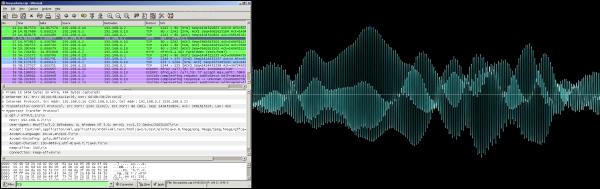
Gökberk [gkbrk] Yaltıraklı was staying in a hotel long enough that he got bored and started snooping around the network, like you do. Breaking out Wireshark, he noticed a lot of UDP traffic on a nonstandard port, so he thought he’d have a look.



 These issues were well known from the early days of color TV sets. To combat this, manufacturers added a degaussing coil to their sets. A coil of wire wrapped around the front of the tube, just behind the bezel of the set. When the set was powered on, the coil would be fed with mains voltage. This is the well-known ‘fwoomp and buzz’ those old TV sets and monitors would make when you first turned them on. The 50 Hz or 60 Hz AC would create a strong moving magnetic field. This field would effectively erase the imprinted magnetic fields on the shadow mask or aperture grille.