Red Bricks: Alphabet To Turn Off Revolv’s Lights

Revolv, the bright red smart home hub famous for its abundance of radio modules, has finally been declared dead by its founders. After a series of acquisitions, Google’s parent company Alphabet has gained control over Revolv’s cloud service – and they are shutting it down.

Customers who bought into Revolv’s vision of a truly connected and automated smart home hub featuring 7 different physical radio modules to connect all their devices will soon become owners of significantly less useful, red bricks due to the complete shutdown of the service on May 15, 2016.
Continue reading “Red Bricks: Alphabet To Turn Off Revolv’s Lights”

Tiny BLE UART Makes Bluetooth Low Energy Simple

Last time I talked about the internals of how Bluetooth Low Energy (BLE) handles data. I mentioned that the way it is set up is meant to conserve power and also to support common BLE devices like heart rate monitors. On the other hand, I also mentioned that you often didn’t need to deal with that because you’d use an abstraction layer.

This time, I want to show you how I used the Hackaday special edition Tiny BLE (from Seeed Studios) and its mbed library to do a quick simple BLE project. If you didn’t read the first part, don’t worry. The abstraction is so good, you probably won’t have to unless you want to circle back around later and get a more detailed understanding of what’s happening under the covers.

I wanted something simple for an example so you could build on it without having to remove much code. For that reason, I decided to allow my phone to control the state of a three-color LED via BLE. To do that, I’m going to use a virtual UART and some off-the-shelf phone software. The whole thing won’t take much code, but that’s the point: the abstraction makes BLE relatively simple.

Continue reading “Tiny BLE UART Makes Bluetooth Low Energy Simple”

Autonomous Tractor Brings In The Harvest

[Matt Reimer] is a farmer in Southwestern Manitoba, Canada. It’s grain country, and at harvest time he has a problem. An essential task when harvesting is that of the grain cart driver, piloting a tractor and grain trailer that has to constantly do the round between unloading the combine harvester and depositing the grain in a truck. It’s a thankless, unrelenting, and repetitive task, and [Matt]’s problem is that labour is difficult to find when every other farmer in the region is also hiring.

His solution was to replace the driver with a set of Arduinos and a Pixhawk autopilot controlling the tractor’s cab actuators, and running ArduPilot, DroneKit, and his own Autonomous Grain Cart software. Since a modern tractor is effectively a fly-by-wire device this is not as annoying a task as it would have been with a tractor from several decades ago, or with a car. The resulting autonomous tractor picks up the grain from his combine, but he reminds us that for now it still deposits the harvest in the truck under human control. It is still a work-in-progress with only one harvest behind it, so this project is definitely one to watch over the next few months.

Writing from the point of view of someone who grew up on a farm and has done her share of harvest-time tractor driving it’s possible to see both the strengths and weaknesses of an autonomous grain cart. His fields on the Canadian prairie are very large and flat, there is plenty of space and the grain makes its way from the field to the elevator in a truck. To perform the same task in the smaller and irregular fields of southern England for example with a mile round trip down country lanes to the grain store would be a much greater challenge. Aside from that it’s worth noting that his John Deere is a 220hp 4WD workhorse that is capable of going over almost any terrain on a farm with very few obstacles able to stop it. This thing can do serious damage to life and property simply by running it over or driving straight through it, so safety has a dimension with an autonomous tractor in a way that it never will with for example a vacuum cleaner or even a lawnmower.

Those observations aside, this kind of technology undeniably represents a step change in farming practice on a par with the move from horse power to tractors in the first half of the last century. However the technological barriers that remain end up being solved, it’s likely that you’ll see plenty more machines like this in the fields of the future.

The video below the break shows the autonomous grain cart in action. Plenty of big-sky tractoring action, and for those of you unfamiliar with farming it should provide some understanding of the task of getting grain from combine to store.

We’ve talked about robotic farming more than once here at Hackaday. The gantry-based Farmbot, the six-legged Prospero robot farmer, or another hexapod confusingly also called Farmbot, for example. But these have all been hacker’s solutions to the problem using the concepts with which they are familiar. What makes [Matt]’s project different is that it is a farmer’s solution to a real farming problem by automating the machinery he already uses to do the job. Farmers have been doing what we would now call hacking at the hardware of their craft since time immemorial, [Matt]’s work is just the latest manifestation of a rich heritage.

Continue reading “Autonomous Tractor Brings In The Harvest”

Reactor Forge Promises Induction Heating For All

Ever want to try your hand at black smithing? Building a forge is expensive and tricky — especially if you live in an apartment! But we’re all tech nerds here — it’s way cooler to use induction heating to heat up your metal for forging. Fire is for cavemen! [Josh Campbell] is working on a kit to bring induction heating to the masses — he calls it the Reactor Forge.

The kit hasn’t launched yet, but you can follow his progress on his GitHub. Induction heating works by magnetically inducing current into the metal, where resistance turns the current into heat without physical contact. The Reactor Forge [Josh] has built runs off of a 220V circuit, and in the following demonstration, heats up a 6″ section of 1/2″ steel bar.

Continue reading “Reactor Forge Promises Induction Heating For All”

A Field Guide To The North American Communications Tower

The need for clear and reliable communication has driven technology forward for centuries. The longer communication’s reach, the smaller the world becomes. When it comes to cell phones, seamless network coverage and low power draw are the ideals that continually spawn R&D and the eventual deployment of new equipment.

Almost all of us carry a cell phone these days. It takes a lot of infrastructure to support them, whether or not we use them as phones. The most recognizable part of that infrastructure is the communications tower. But what do you know about them?

Continue reading “A Field Guide To The North American Communications Tower”

Makerville Knit: Industrial-Strength WiFi Breakout

If you need an industrial-strength IoT product, you need an industrial-strength WiFi chipset. For our own household hacks, we’re totally happy with the ESP8266 chip. But if you need to connect to the big, scary Internet you’ll probably want state-of-the-art encryption. In particular, Amazon insists on TLS 1.2 for their Web Services (AWS), and we don’t know how to get that working on the ESP.

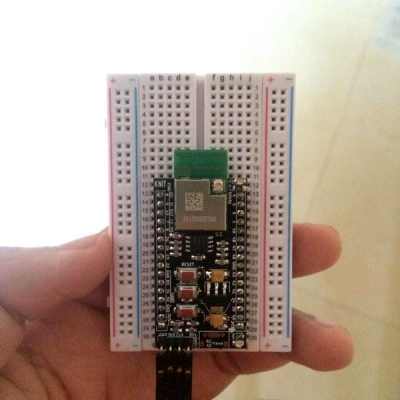
[Anuj] designed a breakout board called the knit which includes a Marvell MW300 WiFi SOC. This chip has an onboard ARM Cortex M4F running at 200 MHz, which means you’ve got a lot of everything to play with: flash memory, RAM, a floating-point unit, you name it. And Marvell’s got an SDK for using AWS that includes things like an operating system and peripheral support and other niceties. TLS 1.2 is included.

Cd_tjKoWwAApnU9_thumbnailBest of all, a MW300 breakout is reasonably affordable (though more expensive than the mass-produced ESP8266 modules, naturally) and it’s an entirely open design. [Anuj] also seems to be setting up for a production run, if you don’t feel like making it yourself.

The MW300 is in all sorts of commercial IoT designs, and it’s a battle-tested go-to for interfacing with “the cloud” securely. The only hobbyist-friendly board that’s similar is the Adafruit WICED WiFi Feather, but it’s more expensive, less powerful, and out of stock at the moment, which just shows the demand for something like this.

Of course, if you need more integrated peripherals, you could just hack up a “Hello Barbie” toy which has the same chip as well as sweet audio codecs and a nice fat flash ROM.

We think it’s neat that [Anuj] would make and test a breakout for this powerful little WiFi SOC. We don’t need one for our projects right now — we’re running in entirely insecure mode — but it’s good to know what your options are. (We’re also looking into esp-open-rtos for the ESP8266 — we know they’ve been working on TLS 1.2 encryption, but we don’t know what their status is at the moment. Anyone?)

Full-size AT-ST Star Wars Build

Think you made a cool tree-house for your kids? Sorry to burst your bubble, but we don’t think anything can top this full-size 1:1 replica of a Star Wars AT-ST — complete with sound effects and moving turrets! Did we mention it seats two?

Built in his backyard, this AT-ST is constructed of wood, plastic, and sheet metal. On the inside it is decked out with joysticks, display panels, and other knobs and buttons for your imagination to go wild with. It even features solar panels on the roof to power two ventilation fans to keep you cool while daydreaming of blowing up Rebel scum on Hoth.

Stay tuned after the break to see a video of it in action.

Continue reading “Full-size AT-ST Star Wars Build”