The Internet is polluted with craziness, and there is no better example than YouTube. If you’ve ever wondered what would happen when you give everyone on the planet the power to show everyone else on the planet their innermost thoughts, desires, and insane ramblings, you need only look at YouTube.
One of the biggest offenders of incoherent ramblings is the subject of spaceflight. Simply search ‘space shuttle’ on YouTube, and you’ll find accusations of the crew of Columbia being abducted by aliens. Crazy, incoherent, and somewhat insulting. Accusations of a moon landing conspiracy are unavoidable in the ‘related videos’ section and are similarly filled with videos from people with either a tenuous grasp of reality or too much time on their hands.
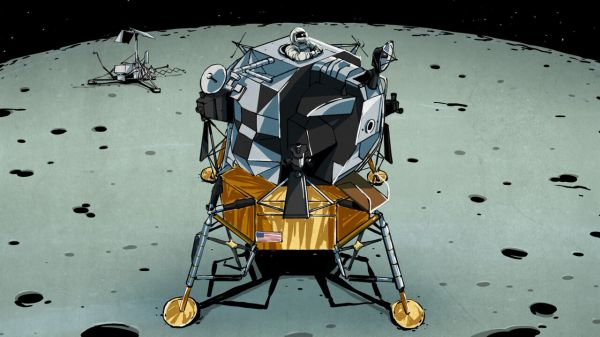
A broken clock is right twice a day, a broken calendar is right every twenty-eight years or so, and every once in a while, simply from the volume of videos on the subject, one conspiracy theorist will present a new and novel idea. Here we present perhaps the only moon landing conspiracy theory that makes sense, is consistent with physical laws, and that may actually be true.
CES, the Consumer Electronics Show, is in full swing. That means the Hackaday tip line is filled to the brim with uninteresting press releases, and notices that companies from the world over will be at CES.
3D printing has fallen off the radar of people who worship shiny new gadgets of late, and this is simply a function of 3D printing falling into the trough of disillusionment. The hype train of 3D printing is stuck on a siding, people are bored, but this is the time that will shape what 3D printing will become for the next ten years. What fascinating news from the 3D printing industry comes to us from CES?
How would you like to have a WiFi connection that covers 10 miles? Or how about an even wider network made up of a mesh of multiple nodes? It is possible, but there is a catch: you probably need a ham radio license to do it (at least, you do in the United States).
What makes it possible is the realization that conventional WiFi channels 1-6 are inside an existing US ham band. That means (if you are a ham) you can elect to use FCC part 97 rules instead of part 15 that governs WiFi routers. That means you can use more power and–even more importantly–better antennas to get greater range.
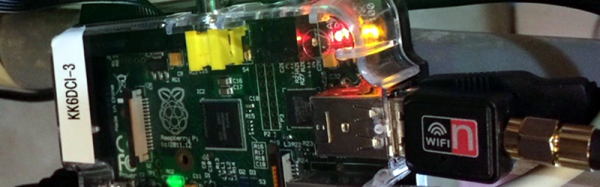
Traditionally, hams have used custom firmware for Netgear routers or Ubiquiti hardware. However, [WZ0W] recently posted his experience using Raspberry Pi boards as mesh nodes. The code (which also works with some other single board computers) is available on GitHub (with details on the project blog). [WZ0W] points out that, unlike using a consumer router, using a Pi provides a reasonably powerful computer for hosting services as well as hosting the network.
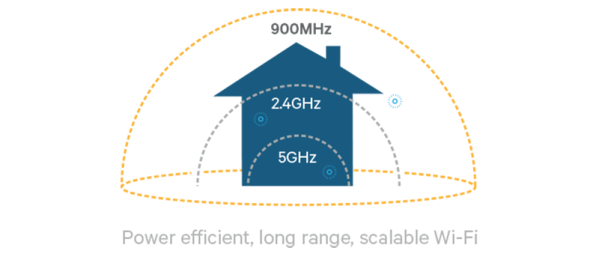
For the last decade or so, wireless networking has been entirely about short range, high speed communications. The type of networking needed by an Internet of things is fundamentally incompatible with WiFi, and the reason for this is due to the frequencies used by WiFi networking gear. 2.4 and 5 GHz are very fast, but cannot penetrate through walls as easily as lower frequencies.
This week the WiFi alliance introduced IEEE 802.11ah into the WiFi spec. It’s called WiFi HaLow (pronounced like angel’s headwear), and unlike other versions of 802.11, WiFi HaLow uses low frequencies for low bandwidth but a much larger range.
WiFi HaLow uses the 900 MHz ISM band to communicate, divided into 26 channels. The bandwidth is low – a mere 100 kbps, but the range is huge: one kilometer, or about four times the approximate range of 802.11n.
This is not the only WiFi spec aimed at the Internet of Things. In 2014, the WiFi alliance introduced 802.11af, a networking protocol operating in unused TV whitespace spectrum between 54 and 790 MHz. 802.11af has a similar range as 802.11ah – about one kilometer – but products and chips utilizing 802.11af have been rare and hard to find.
Anyone who has ever been stuck in gridlock has probably daydreamed about pushing a button on the dashboard that turns their car into a plane. Imagine how much more relaxing a weekend getaway would be if you could take to the open sky instead hitting the congested highway. For as long as there have been aircraft and automobiles, man has tried to combine the two. The proper term for this marriage is ‘roadable aircraft’, and a successful one requires attention to the aerodynamics of flight as well as the rigors of motoring.
[Paddy Neumann] is an Australian physicist and founder of Neumann Space, a space start-up with a record-breaking ion drive.
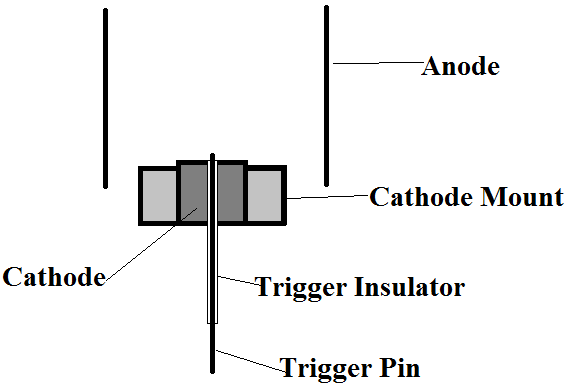
The team at Neumann Space built an ion engine that broke the previous specific impulse (bounce per ounce) record. NASA’s HIPEP thruster previously held this record with a specific impulse of ~9600 seconds (+/- 200 seconds). The Neumann Drive’s specific impulse as recorded by the University of Sydney was ~14,690 seconds (+/- 2,000 seconds). This all equates to better efficiency by the Neumann Drive, however its acceleration does not match that of the HIPEP.
Simplified ion engine diagram courtesy of Neumann Space
The Neumann Drive has another unique advantage in its range of usable fuels. In comparison to the HIPEP which uses Xenon gas as fuel the Neumann Drive accepts a variety of metals including: Molybdenum, Magnesium, Aluminum, Carbon, Titanium, Vanadium, Tin, last and also least according to Neumann Space is Bismuth.
Interestingly, Neumann offered his intellectual property (IP) to the University of Sydney, since the research was done at the University but they passed on the offer. This allowed the IP to be returned to Paddy and he subsequently applied for a patent and began the search for funding for continued research.
No doubt many of you have spent a happy Christmas tearing away layers of wrapping paper to expose some new gadget. But did you stop to spare a thought for the “sticky-back plastic” holding your precious gift paper together?
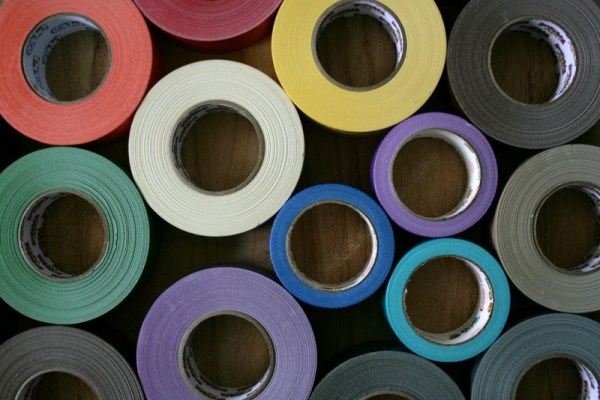
There are a crazy number of adhesive tapes available, and in this article I’d like to discuss a few of the ones I’ve found useful in my lab, and their sometimes surprising applications. I’d be interested in your own favorite tapes and adhesives too, so please comment below!
But first, I’d like to start with the tapes that I don’t use. Normal cellulose tape, while useful outside the lab, is less than ideally suited to most lab applications. The same goes for vinyl-based insulating tapes, which I find have a tendency to fall off leaving a messy sticky residue. When insulation is necessary, heatshrink seems to serve better.
The one tape I have in my lab which is similar to common cellulose tape however is Scotch Magic Tape. Scotch Magic tape, made from a cellulose acetate, and has a number of surprising properties. It’s often favored because of it’s matte finish. It can easily be written on and when taped to paper appears completely transparent. It’s also easy to tear/shape and remove. But for my purposes I’m more interested in it’s scientific applications.
Here’s a neat trick you can try at home. Take a roll of tape (I’ve tried this with Scotch Magic tape but other tapes may work too) to a dark room. Now start unrolling the tape and look at interface where the tape leaves the rest of the roll. You should see a dim blue illumination. The effect is quite striking and rather surprising. It’s called triboluminescence and has been observed since the 1950s in tapes and far earlier in other materials (even sugar when scraped in a dark room will apparently illuminate). The mechanism, however, is poorly understood.
It was perhaps this strange effect that led researchers to try unrolling tape in a vacuum. In 1953 a group of Russian researchers attempted this and bizarrely enough, were able to generate X-rays. Their results were unfortunately forgotten for many years, but were replicated in 2008 and even used to X-ray a researcher’s finger! As usual Ben Krasnow has an awesome video on the topic:
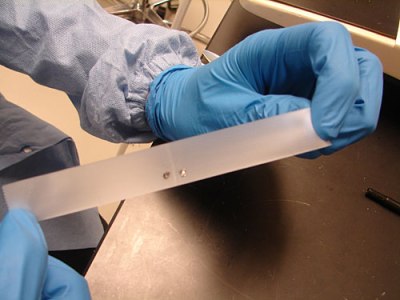
In my lab however I mostly use Scotch tape to remove surface layers. In certain experiments it’s valuable to have an atomically flat surface. Both Mica and HOPG (a kind of graphite) are composed of atomically flat layers. Scotch tape can be used to remove the upper layers leaving a clean flat surface for experimentation.
Researchers have also modified this technique to produce graphene. Graphene is composed of single carbon layers and has a number of amazing properties, highly conductive, incredibly strong, and transparent. For years producing small quantities of graphene provided difficult. But in 2004 a simple method was developed at the University of Manchester using nothing but bulk ordered graphite (HOPG) and a little Scotch tape. When repeatedly pressed between the Scotch tape, the Graphite layers can be separated until eventually only a signal layer of graphene remains.
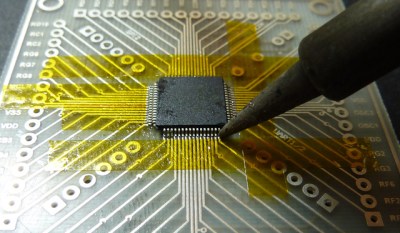
The other non-conductive tape I use regularly in my lab is of course Kapton tape. While Kapton is a Dupoint brand name, it’s basically a polyimide film tape which is thermally stable up to 400 degrees C. This makes it ideal for work holding in electronics (or masking out pins) when soldering. You can also use it for insulating (though it’s inadvisable for production applications). Typically polyimide tape is available under a number of dubious synonyms (one example is Kaptan) from a variety of Chinese suppliers at low cost.
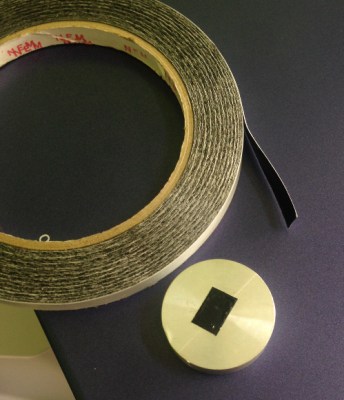
Carbon tape is conductive in all axes. This means it you can create a electrical connection by simply taping to your devices. It’s resistance however is somewhat high. I’ve most commonly come across this when using electron microscopes. Carbon tape is used both to keep a sample in place and create an electrical connection between the sample and the sample mount.
Carbon tape, applied to a SEM mount.
Other conducting tapes are available with lower resistance, creating a electrical connection without soldering is valuable in a number of situations. Particularly when heat might damage the device. One example of this is piezoelectric materials. Not only does solder often bond poorly to ceramic materials, but it may also depole the material removing its piezoelectric properties. I tend to use conductive epoxies in these situations, but conductive tapes appear to be an attractive option.
Aluminum tape is commonly used for (heat) insulation in homes. It’s therefore very cheap and easily available. As well as conducting heat aluminum tape of course also conducts electricity. Around the lab this can be pretty handy. While the adhesive is not conductive, making it less attractive for connection parts, I’ve found aluminum tape great of sealing up holes in shielded enclosures. It also makes a great accompaniment to aluminum foil which is used to provide ad-hoc shielding in many scientific environments. Copper tape is also easily obtained, though slightly more expensive.
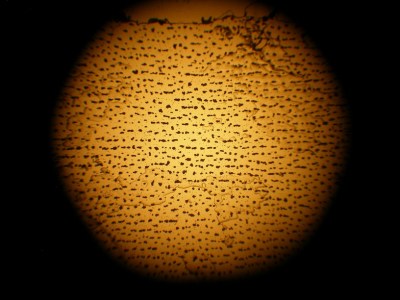
Z tape under a microscope
A much less common, but far cooler conductive tape is so called Z tape. This tape is composed of regular double-sided tape impregnated with spaced conductors. The result is a tape that conducts in only one direction (from the top to the bottom). This makes it similar in structure to a zebra strip, commonly used to connect LCDs. Z tape is unfortunately pretty expensive, a short 100mm strip can cost 5 dollars. What exactly 3M had in mind when creating Z tape is unclear. But it can be used for repairing FPC connectors on LCDs or in other situations where soldering is impractical.
One of the more awesome applications is Jie and Bunnie’s circuit sticker project. The kits are designed to allow kids to assemble circuits simply by sticking components together. Z tape is ideal for this, as it allows multiple connections to be made using the same piece to tape.
I couldn’t write an article on tape without mentioning the somewhat apocryphal “Invisible Electrostatic Wall” incident. A report at the 17th Annual EOS/ESD Symposium describes a “force field” like wall that appeared during the production of polypropylene film. While the story seems slightly dubious, it reminds us of the surprising applications and utility of tapes.
Next time you’re sending off a package or ripping open a package, spare a thought for the humble tape that holds it together.