Is This The Oldest Still-Working Geostationary Satellite?

The LES-5 spacecraft

Regular followers of space news will know that when satellites or space probes reach the end of their life, they either are de-orbited in a fiery re-entry, or they stay lifeless in orbit, often in a safe graveyard orbit where they are unlikely to harm other craft. Sometimes these deactivated satellites spring back into life, and there is a dedicated band of enthusiasts who seek out these oddities. Dead satellite finder extraordinaire [Scott Tilley] has turned up a particularly unusual one, a craft that is quite likely to be the oldest still-working geostationary satellite.

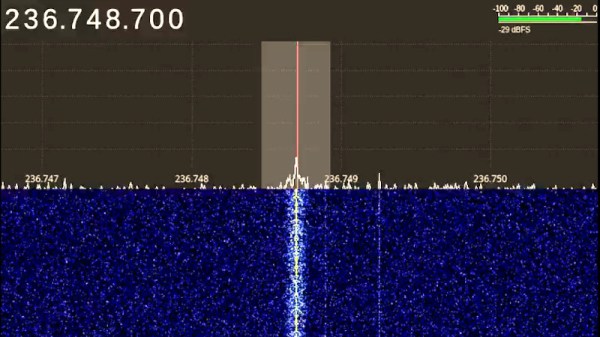
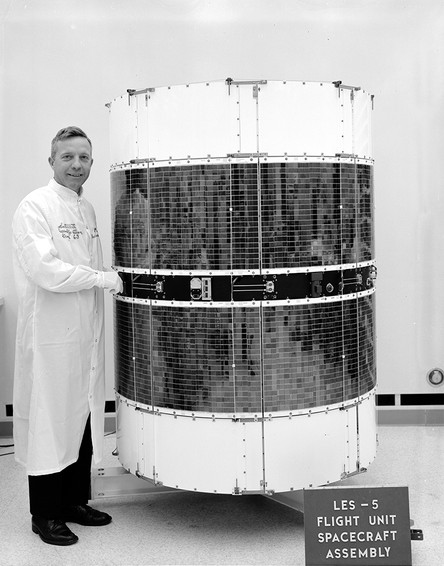
LES-5 is an experimental satellite built by MIT’s Lincoln Labs, launched in 1967, and used to test military UHF communications in a geosynchronous orbit. It had an active life into the early 1970s after which it was placed in a graveyard orbital slot for redundant craft. It’s lain forgotten ever since, until this month when [Scott]  found its beacon transmitting on 236.75 MHz. The Twitter thread is an extremely interesting glimpse into the satellite finder’s art, as first he’s not certain at all that it is LES-5 so he waits for its solar eclipse to identify its exact position.

Whether anything on the craft can find another use today is not certain, as he finds no evidence of its transponder. Still, that something is working again 53 years after its launch is a testament to the quality of its construction. Should its transponder be reactivated again it’s not impossible that people might find illicit uses for it, after all that’s not the first time this has happened.


Star Trackers: Telling Up From Down In Any Space

Keeping track of position is crucial in a lot of situations. On Earth, it’s usually relatively straight-forward, with systems having been developed over the centuries that would allow one to get at least a rough fix on one’s position on this planet. But for a satellite out in space, however, it’s harder. How do they keep their communications dishes pointed towards Earth?

The stars are an obvious orientation point. The Attitude and Articulation Control Subsystem (AACS) on the Voyager 1 and 2 space probes has the non-enviable task of keeping the spacecraft’s communication dish aligned precisely with a communications dish back on Earth, which from deep space is an incomprehensibly tiny target.

Back on Earth, the star tracker concept has become quite popular among photographers who try to image the night skies. Even in your living room,  VR systems also rely on knowing the position of the user’s body and any peripherals in space. In this article we’ll take a look at the history and current applications of this type of position tracking. Continue reading “Star Trackers: Telling Up From Down In Any Space”

Phantom Express: The Spaceplane That Never Was

Even for those of us who follow space news closely, there’s a lot to keep track of these days. Private companies are competing to develop new human-rated spacecraft and assembling satellite mega-constellations, while NASA is working towards a return the Moon and the first flight of the SLS. Between new announcements, updates to existing missions, and literal rocket launches, things are happening on a nearly daily basis. It’s fair to say we haven’t seen this level of activity since the Space Race of the 1960s.

With so much going on, it’s no surprise that not many people have heard of the XS-1 Phantom Express. A project by the United States Defense Advanced Research Projects Agency (DARPA), the XS-1 was designed to be a reusable launch system that could put small payloads into orbit on short notice. Once its mission was complete, the vehicle was to return to the launch site and be ready for re-flight in as a little as 24 hours.

Alternately referred to as the “DARPA Experimental Spaceplane”, the vehicle was envisioned as being roughly the size of a business jet and capable of carrying a payload of up to 2,300 kilograms (5,000 pounds). It would take off vertically under rocket power and then glide back to Earth at the end of the mission to make a conventional runway landing. At $5 million per flight, its operating costs would be comparable with even the most aggressively priced commercial launch providers; but with the added bonus of not having to involve a third party in military and reconnaissance missions which would almost certainly be classified in nature.


Or at least, that was the idea. Flight tests were originally scheduled to begin this year, but earlier this year prime contractor Boeing abruptly dropped out of the program. Despite six years in development and over $140 million in funding awarded by DARPA, it’s now all but certain that the XS-1 Phantom Express will never get off the ground. Which is a shame, as even in a market full of innovative launch vehicles, this unique spacecraft offered some compelling advantages.

Continue reading “Phantom Express: The Spaceplane That Never Was”

Thousands Of Internet-Connected Satellites Above Us, What Could Possibly Go Wrong!

Our skies are full of satellites, more full than they have been, that is, because SpaceX’s Starlink and a bevvy of other soon-to-launch operators plan to fill them with thousands of small low-earth-orbit craft to blanket the Earth with satellite Internet coverage. Astronomers are horrified at such an assault on their clear skies, space-watchers are fascinated by the latest developments, and in some quarters they’re causing a bit of concern about the security risk they might present. With a lot of regrettable overuse use of the word “hacker”, the concern is that such a large number of craft in the heavens might present an irresistible target for bad actors, who would proceed to steer them into each other can cause chaos.

Invest in undersea cables, folks, the Kessler Syndrome is upon us, we’re doomed!

Continue reading “Thousands Of Internet-Connected Satellites Above Us, What Could Possibly Go Wrong!”

Northrop Grumman Tests Space Tow Truck

In the early days, satellites didn’t stick around for very long. After it was launched by the Soviet Union in 1957, it only took about three months for Sputnik 1 to renter the atmosphere and burn up. But the constant drive to push ever further into space meant that soon satellites would remain in orbit for years at a time. Not that they always functioned for that long; America’s Explorer 1 remained in orbit for more than twelve years, but its batteries died after just four months.

Of course back then, nobody was too worried about that sort of thing. When you can count the number of spacecraft in Earth orbit on one hand, what does it matter if one of them stays up there for more than a decade? The chances of a collision were so low as to essentially be impossible, and if the satellite was dead and wasn’t interfering with communication to its functional peers, all the better.

The likelihood of a collision steadily increased over the years as more and more spacecraft were launched, but the cavalier approach to space stewardship continued more or less unchanged into the modern era. In fact, it might have endured a few more decades if companies like SpaceX weren’t planning on mega-constellations comprised of thousands of individual satellites. Concerned over jamming up valuable near-Earth orbits with so much “space junk”, modern satellites are increasingly being designed with automatic disposal systems that help make sure they are safely deorbited even in the event of a system failure.

That’s good news for the future, but it doesn’t help us with the current situation. Thousands of satellites are in orbit above the planet, and they’ll need to be dealt with in the coming years. The good news is that many of them are at a low enough altitude that they’ll burn up on their own eventually, and methods are being developed to speed up the process should it be necessary to hasten their demise.

Unfortunately, the situation is slightly more complex with communications satellites in geosynchronous orbits. At an altitude of 35,786 kilometers (22,236 miles), deorbiting these spacecraft simply isn’t practical. It’s actually far easier to maneuver them farther out into space where they’ll never return. But what if the satellite fails or runs out of propellant before the decision to retire it can be made?

That’s precisely the sort of scenario the Mission Extension Vehicle (MEV) was developed for, and after a historic real-world test in February, it looks like this “Space Tow Truck” might be exactly what we need to make sure invaluable geosynchronous orbits are protected in the coming decades.

Continue reading “Northrop Grumman Tests Space Tow Truck”

Get Your Weather Images Straight From The Satellite

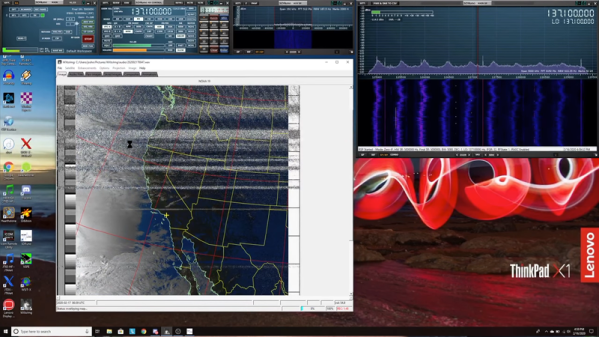
[Josh] has a series called Ham Radio Crash Course and a recent installment covers how you can grab satellite images directly from weather satellites. This used to be more of a production than it is now thanks to software defined radio (SDR). Josh also has another project using a 3D printer to make an antenna suitable for the job. You can see the video below.

The software is the venerable WXtoImg program. This is abandonware, but the community has kept the software available. The program works on Linux, Windows, and Mac. The satellites in question operate around 137 MHz, but that’s easily in the range of even the cheap SDR dongles. [Josh] shows how to use a virtual audio cable on Windows to connect the output of the radio to the input of the WXtoImg program. Under Linux, you can do this with Pulse or Jack very easily without any extra hardware.

There’s some setup and calibration necessary for the software. You’ll also need the current orbital data and the program will tell you when you can find the next satellite passing overhead. Generally speaking you’ll want your antenna outside, which [Josh] solved by taking everything outdoors and having some lunch during the pass. It also takes some time to post-process the data into images and audio.

We know this isn’t new. But we did like [Josh’s] clear and up-to-date guide. We remember watching NOAA 15 as it started to lose its electronic mind.

Continue reading “Get Your Weather Images Straight From The Satellite”

The Legacy Of One Of Science’s Brightest Stars: Freeman Dyson

Of the many well-known names in science, few have been as reluctant to stick to one particular field as Freeman John Dyson. Born in the UK in 1923, he showed a great interest in mathematics and related fields even as a child. By the time he was 15 he had won a scholarship at Trinity College, in Cambridge, where he studied mathematics. Though the war forced him to work at the Air Force’s Operational Research Section (ORS), afterwards he would return to Trinity to get his BA in mathematics.

His subsequent career saw him teaching at universities in the UK and US, before eventually ending up at Cornell University, where he joined the Institute for Advanced Study at the invitation of its head, J. Robert Oppenheimer. Here he would meet up with such people as Richard Feynman with whom he would work on quantum electrodynamics.

Beyond mathematics and physics, Dyson would also express great interest in space exploration — with Dyson spheres being well-known — and genetics, both in the context of the first formation of life and in genetic manipulation to improve plants to deal with issues today. He also worked on the famous Project Orion, which used nuclear bombs for propulsion.

In this article we’ll take a look at these and other parts of Mr. Dyson’s legacy, as well as the influence of his works today.

Continue reading “The Legacy Of One Of Science’s Brightest Stars: Freeman Dyson”