The Space Station Has A Supercomputer Stowaway

The failed launch of Soyuz MS-10 on October 11th, 2018 was a notable event for a number of reasons: it was the first serious incident on a manned Soyuz rocket in 35 years, it was the first time that particular high-altitude abort had ever been attempted, and most importantly it ended with the rescue of both crew members. To say it was a historic event is something of an understatement. As a counterpoint to the Challenger disaster it will be looked back on for decades as proof that robust launch abort systems and rigorous training for all contingencies can save lives.

But even though the loss of MS-10 went as well as possibly could be expected, there’s still far reaching consequences for a missed flight to the International Space Station. The coming and going of visiting vehicles to the Station is a carefully orchestrated ballet, designed to fully utilize the up and down mass that each flight offers. Not only did the failure of MS-10 deprive the Station of two crew members and the experiments and supplies they were bringing with them, but also of a return trip which was to have brought various materials and hardware back to Earth.

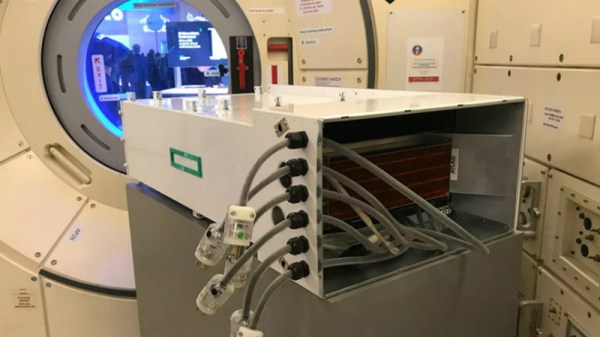
But there’s been at least one positive side effect of the return cargo schedule being pushed back. The “Spaceborne Computer”, developed by Hewlett Packard Enterprise (HPE) and NASA to test high-performance computing hardware in space, is getting an unexpected extension to its time on the Station. Launched in 2017, the diminutive 32 core supercomputer was only meant to perform self-tests and be brought back down for a full examination. But now that its ticket back home has been delayed for the foreseeable future, NASA is opening up the machine for other researchers to utilize, proving there’s no such thing as a free ride on the International Space Station.

Continue reading “The Space Station Has A Supercomputer Stowaway”
Designing Space-Rated PCBs

We’ve reduced printed circuit board design to practice so much that we hardly give a thought to the details anymore. It’s so easy to bang out a design, send it to a fab house, and have ten boards in your hands in no time at all. All the design complexities are largely hidden from us, abstracted down to a few checkboxes on the vendor’s website.

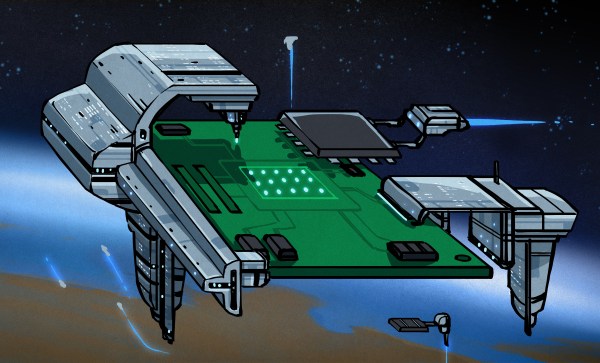
There’s no doubt that making professional PCB design tools available to the hobbyist has been a net benefit, but there a downside. Not every PCB design can be boiled down to the “one from column A, one from column B” approach. There are plenty of applications where stock materials and manufacturing techniques just won’t cut it. PCBs designed to operate in space is one such application, and while few of us will ever be lucky enough to have a widget blasted to infinity and beyond, learning what’s behind space-rated PCBs is pretty interesting.

Continue reading “Designing Space-Rated PCBs”

Flagging Down Aliens With World’s Biggest Laser Pointer

As you’re no doubt aware, humans are a rather noisy species. Not just audibly, like in the case of somebody talking loudly when you’re in a movie theater, but also electromagnetically. All of our wireless transmissions since Marconi made his first spark gap broadcast in 1895 have radiated out into space, and anyone who’s got a sensitive enough ear pointed into our little corner of the Milky Way should have no trouble hearing us. Even if these extraterrestrial eavesdroppers wouldn’t be able to understand the content of our transmissions, the sheer volume of them would be enough to indicate that whatever is making all that noise on the third rock orbiting Sol can’t be a natural phenomena. In other words, one of the best ways to find intelligent life in the galaxy may just be to sit around and wait for them to hear us.

Of course, there’s some pesky physics involved that makes it a bit more complicated. Signals radiate from the Earth at the speed of light, which is like a brisk walk in interstellar terms. Depending on where these hypothetical listeners are located, the delay between when we broadcast something and when they receive it can be immense. For example, any intelligent beings that might be listening in on us from the closest known star, Proxima Centauri, are only just now being utterly disappointed by the finale for “How I Met Your Mother“. Comparatively, “Dallas” fans from Zeta Reticuli are still on the edge of their seats waiting to find out who shot J.R.

But rather than relying on our normal broadcasts to do the talking for us, a recent paper in The Astrophysical Journal makes the case that we should go one better. Written by James R. Clark and Kerri Cahoy,  “Optical Detection of Lasers with Near-term Technology at Interstellar Distances” makes the case that we could use current or near-term laser technology to broadcast a highly directional beacon to potentially life-harboring star systems. What’s more, it even theorizes it would be possible to establish direct communications with an alien intelligence simply by modulating the beam.

Continue reading “Flagging Down Aliens With World’s Biggest Laser Pointer”

Generative Design Algorithms Prepare For Space

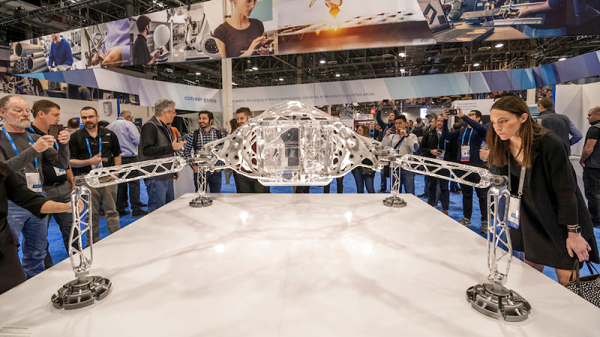
NASA is famously risk-averse, taking cautious approaches because billions of taxpayer dollars are at stake and each failure receives far more political attention than their many successes. So while moving the final frontier outward requires adopting new ideas, those ideas must first prove themselves through a lengthy process of risk-reduction. Autodesk’s research into generative design algorithms has just taken a significant step on this long journey with a planetary lander concept.

It was built jointly with a research division of NASA’s Jet Propulsion Laboratory, the birthplace of many successful interplanetary space probes. This project got a foot in the door by promising 30% weight savings over conventional design techniques. Large reduction in launch mass is always a good way to get a space engineer’s attention! Mimicking mother nature’s evolutionary process, these algorithms output very organic looking shapes. This is a relatively new approach to design optimization under exploration by multiple engineering software vendors. Not just Autodesk’s “Generative Design” but also “Topology Optimization” in SolidWorks, plus others. Though these shapes appear ideally suited to 3D printing, Autodesk also had to prove their algorithm could work with more traditional fabrication techniques like 5-axis CNC mills.

This is leading-edge research technology though some less specialized, customer-ready versions are starting to trickle out of research labs. Starting with an exclusive circle: People with right tiers of SolidWorks license, the paid (not free) tier of Autodesk Fusion 360, etc. We’ve looked at another recent project with nontraditional organic shapes, and we’ve looked at generative designs used for their form as well as their function. This category of CAD tools hold a lot of promise, and we’re optimistic they’ll soon become widely accessible so we can all put them to good use in our earthbound projects.

Possibly even before they fly to another planet.

[via Engadget]

Backyard Planetarium With Magnets

If you are a Hackaday reader, you probably like space in real life, fiction, or both. A trip to a planetarium is a great treat, but what if you could have a planetarium in your backyard? [Ecasill] thought so and used a Zip Tie domes kit to create just such a thing. It takes some sewing and a projector, but there’s a problem. The dome needs to come down if there is going to be bad weather. The answer? Magnetic dowel rods.

Because the magnets are brittle, plastic dip covers them after epoxy sticks them in place. The cloth has steel bolts to adhere, too. All in, the setup cost about $2,000. That includes a projector, a mirror ball, a sound system, and all the construction.

Continue reading “Backyard Planetarium With Magnets”

Soyuz Failure Leaves Questions Unanswered

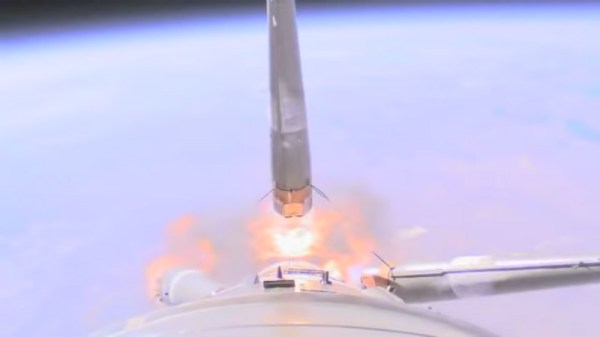
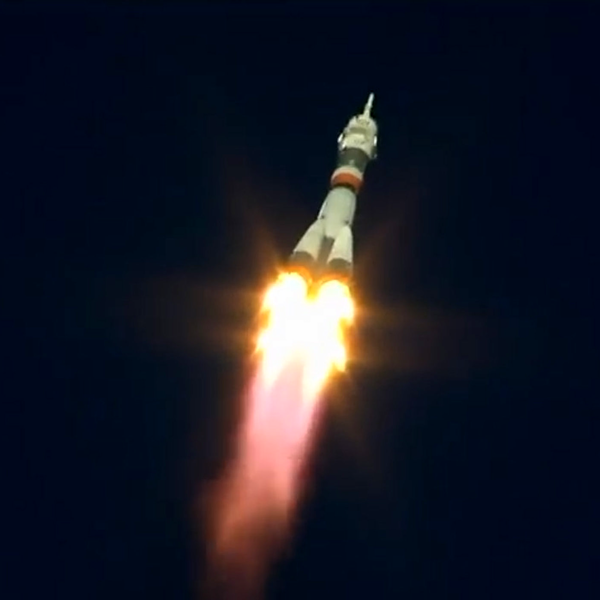
The Russian space program experienced its first serious incident on a manned mission in 35 years when Soyuz MS-10 failed during ascent on October 11th, 2018. The abort system worked as designed, and crew members Aleksey Ovchinin and Nick Hague landed safely approximately 430 km from the launch site in Baikonur. Beyond being put through unusually high G forces, the two men suffered no injuries and will have their mission recycled for a future flight.

From an abort standpoint, the event went as well as could possibly be expected. The fact that the crew walked away unharmed is a testament to the emergency systems on the rocket and spacecraft, and serve as a reminder of why these functions are designed into manned rockets even if they are rarely (if ever) used. The success is especially impressive considering the Soyuz’s launch abort tower, the solid fuel rocket designed to pull the spacecraft away from the failing booster rocket, had already been jettisoned before the event occurred. The spacecraft was instead pulled to safety by the secondary abort thrusters, which were added to the vehicle’s design in 1975 as a contingency and until now had never been used in a real-life scenario.

What Went Wrong?

But while the safe return of the crew was naturally the first priority for all agencies involved, the questions soon turned to the Soyuz itself. What caused the loss of the rocket? Is it a defect which could be present in the other Soyuz rockets currently under construction? Perhaps most importantly, when could the Soyuz fly again? As it’s currently the only way to put humans into space, the International Space Station is completely dependent on regular Soyuz flights, and a delay in the program could endanger the orbiting outpost.

Now, with the initial findings of the Russian incident investigation being made public, we’re starting to get answers on some of those questions. The official report so far agrees with the conclusions many “Armchair Astronauts” made watching the live stream of the launch, and the evidence suggests that the core issue is the same which doomed previous Russian vehicles.

Continue reading “Soyuz Failure Leaves Questions Unanswered”

Did We Just Get Buzzed By Alien Space Junk?

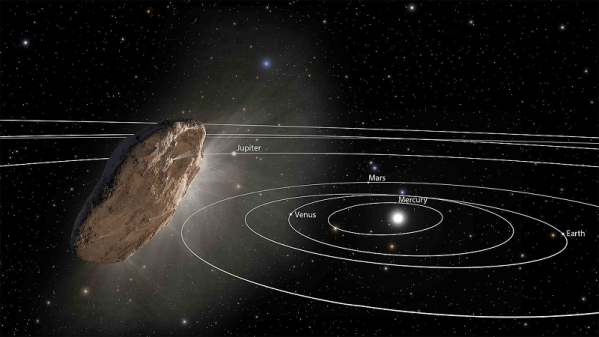
Perhaps you heard about Oumuamua (don’t ask us how to pronounce that). The cigar-shaped object is the first item found by astronomers that is known to have come from outside the solar system and is continuing to pass through, not being captured by the sun’s gravitational field. A recent paper from [Shmuel Bialy] and [Abraham Loeb] from Harvard suggests that the thing could be a discarded light sail from an alien spacecraft.

Of course, it is fun to speculate that anything in space we don’t understand could be alien. However, the paper is doing more than just speculating. The rotation rate of the object suggests it is fairly flat (pancake-like, was the exact phrase used). In addition, it appears to experience “non-gravitational” acceleration — that is, it is accelerating due to some force other than gravity.

Others have suggested that the acceleration is due to material boiling off as the sun warms it. However, there’s no indication of that happening and activity like that ought to also change the spin rate which does not appear to be happening. Solar wind pressure could explain the changes, though. You might think that proves nothing since the solar wind pushes on everything. However, it is just like the wind in the atmosphere — sure it pushes on your car, your house, and a sailboat, but only the sailboat moves appreciably from it.

Continue reading “Did We Just Get Buzzed By Alien Space Junk?”