Iron Man Mask With A HUD!

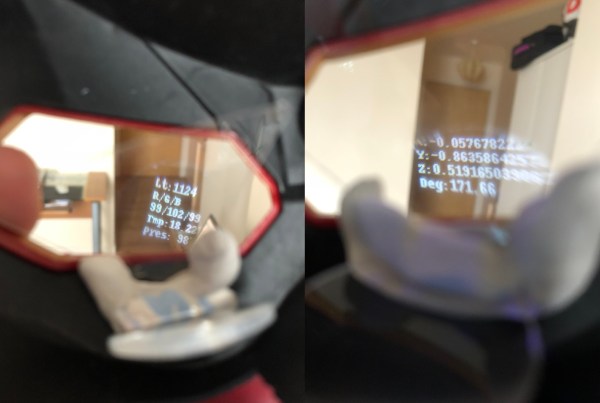
At some point, a child will inevitably dream of being a superhero. Not all children get the chance to see that dream made manifest, but a few take that destiny into their own hands. Redditor [Lord_of_Bone] — seizing at that goal — has built himself an Iron Man mask with an integrated HUD!

Relying on a conceptually similar project he’d previously built, much of the code was rehashed for this ‘Mark II’ version. Pieces of a smartphone holo pyramid act as projection surfaces — using a lens to focus the image to be viewed at such close distances — and a pair of OLED screens displaying the information. It’s a happy bonus that the lack of backlight results in only the text showing in the user’s field of view.

Instead of speaking with J.A.R.V.I.S., [Lord_of_Bone] is using a Raspberry Pi Zero W as the mask’s brain. Working past some I2C troubles between the OLED screens and an Enviro pHat required a whipped-up veroboard and a bit of hardware hacking. Cramming everything into the mask was no easy task — using Blutack and Sugru to bind them in the limited space — but the pHat had to be surface-mounted in the open anyways for atmospheric and light data.

Continue reading “Iron Man Mask With A HUD!”

Inventing The Digital Watch Again And Again And…

In the 1950s, artwork of what the future would look like included flying cars and streamlined buildings reaching for the sky. In the 60s we were heading for the Moon. When digital watches came along in the 70s, it seemed like a natural step away from rotating mechanical hands to space age, electrically written digits in futuristic script.

But little did we know that digital watches had existed before and that our interest in digital watches would fade only to be reborn in the age of smartphones.

Mechanical Digital Watches

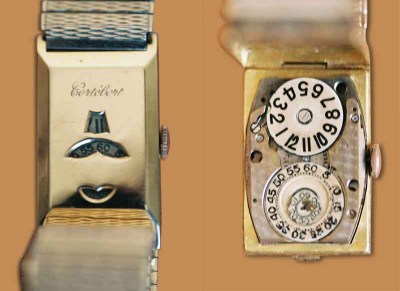
Cortébert jump-hour wristwatch by Wallstonekraft CC-BY-SA 3.0
Cortébert jump-hour wristwatch.
Image by Wallstonekraft CC-BY-SA 3.0

In 1883, Austrian inventor Josef Pallweber patented his idea for a jumping hour mechanism. At precisely the change of the hour, a dial containing the digits from 1 to 12 rapidly rotates to display the next hour. It does so suddenly and without any bounce, hence the term “jump hour”. He licensed the mechanism to a number of watchmakers who used it in their pocket watches. In the 1920s it appeared in wristwatches as well. The minute was indicated either by a regular minute hand or a dial with digits on it visible through a window as shown here in a wristwatch by Swiss watchmaker, Cortébert.

The jump hour became popular worldwide but was manufactured only for a short period of time due to the complexity of its production. It’s still manufactured today but for very expensive watches, sometimes with a limited edition run.

The modern digital watch, however, started from an unlikely source, the classic movie 2001: A Space Odyssey.

Continue reading “Inventing The Digital Watch Again And Again And…”

Bumblebee Breakout, A DIY Wearable Connector

The practice of developing wearable electronics offers a lot of opportunity for new connector designs and techniques for embedding electronics. Questions like these will eventually come up: How will this PCB attach to that conductive fabric circuit reliably? What’s the best way to transition from wire to this woven conductive trim? What’s the best way to integrate this light element into this garment while still maintaining flexibility?

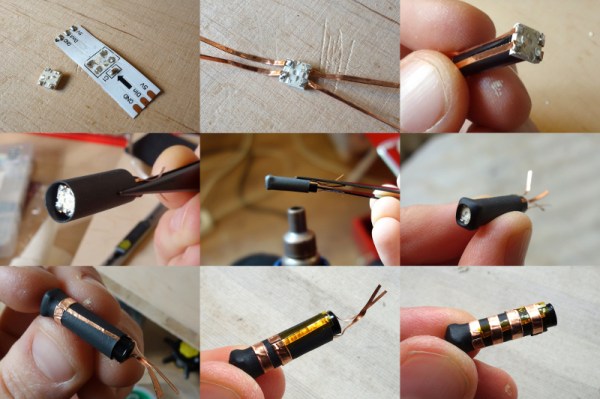
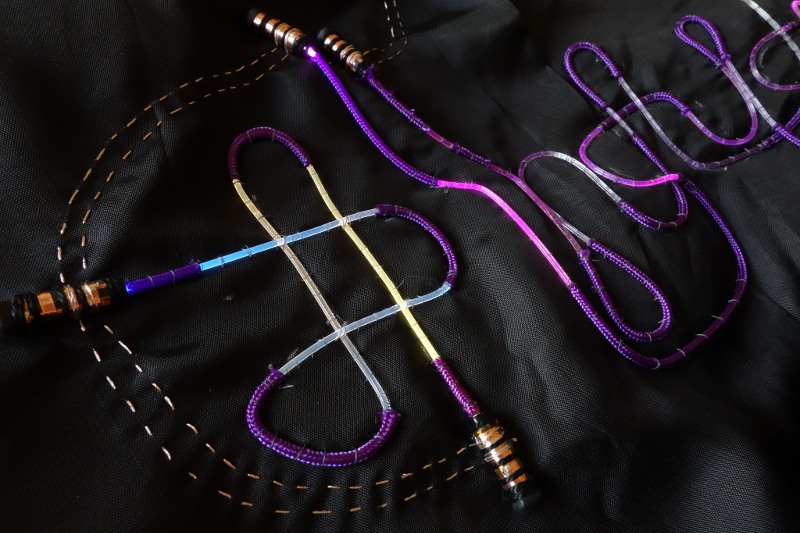
Mika Satomi and Hannah-Perner Wilson of Kobakant are innovators in this arena and inspire many with their prolific documentation while they ask themselves questions similar to these. Their work is always geared towards accessibility and the ability to recreate what they have designed. Their most recent documented connector is one they call the Bumblebee Breakout. It connects an SMD addressable RGB LED, such as Adafruit’s Neopixel, to a piece of side glow fiber optic 1.5mm in diameter. On a short piece of tubing, the four pads of the SMD LED are broken out into four copper rings giving it the look of a striped bumblebee. To keep from shorts occurring while wrapping the copper tape contacts around the tube, they use Kapton tape to isolate each layer as they go.

This connector was originally created to be used in a commission they did out of Koba, their e-textile tailor shop located in Berlin. Fiber optics were applied to jackets for a performance called “All Your Base Are Belong To Us” produced by the Puppetry Department of the Hochschule für Schauspielkunst Ernst Busch.

Peruse more e-textiles techniques and learn how to build a connector transitioning from an embroidered thread bus to a wire and how to knit solderable circuit boards. And make sure to click around Kobakant’s website, it’s full of e-textile DIY tutorials! 

Capacitive And Resistive Touch Sensors For Wearables

When you look at switching solutions for electronic wearables, your options are limited. With a clever application of conductive fabric and thread, you can cobble together a simple switch, but the vast array of switch solutions is much more than that. This one is different. The zPatch from [Paul Strohmeier], [Jarrod Knibbe], [Sebastian Boring], and [Kasper Hornæk] at the Human-Centred Computing Section at the University of Copenhagen gives eTextiles capacitive and resistive input. It’s a force sensor, a pressure sensor, and a switch, all made completely out of fabric.

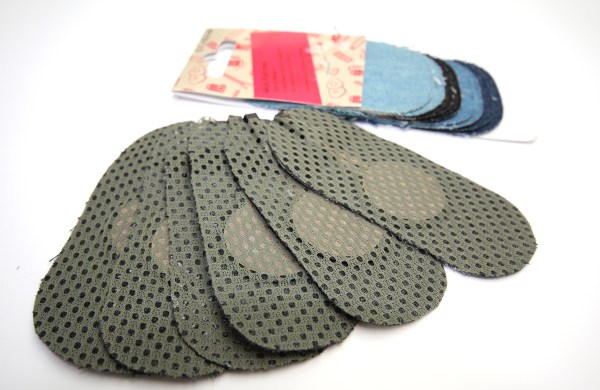
The design of this fabric touch sensor is based around a non-woven resistive fabric made by Eeonyx. This fabric is piezo-resistive when compressed. This material is sandwiched between two layers of silver-plated polyamide fabric, which is then connected to the analog input of a microcontroller. On top of all this is a polyester mesh, with everything held together with iron-on sheets.

Reading this sensor with a microcontroller is extremely similar to a capacitive touch sensor made out of copper and FR4. All the code is available in a repo, and all the materials to reproduce this work can be found in the various links provided by the team. That last point — reproducibility — is huge for an academic work. Not only did the team manage to come up with something interesting, they actually provided enough documentation to reproduce their build.

In the video below, you can see how this sensor can be used to sense a hand hovering, a light touch, a hard press, or anything in between. Only two analog pins are required for each sensor, making the routing and layout of this eTextile should be relatively easy to integrate into clothing. It’s a great build, and we can’t wait to see the community pick up on these really cool sensors.

Continue reading “Capacitive And Resistive Touch Sensors For Wearables”

Print, Rinse, Wear. Nanowire Circuits For Your Microfibre Clothing.

While our bodies are pretty amazing, their dynamic nature makes integrating circuits into our clothing a frustrating process.  Squaring up against this challenge, a team of researchers from North Carolina State University have hit upon a potential boon for wearable electronics: silver nanowires capable of being printed on flexible, stretchy substrates.

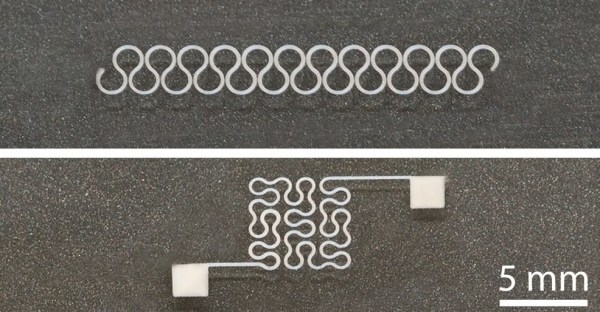
It helps that the properties of silver nanowires lend themselves to the needs of wearable circuits — flexible and springy in their own right — but are not without complications. Silver nanowires tend to clog print nozzles during printing, so the research team enlarged the nozzle and suspended the nanowires in a water-soluble solvent, dramatically cutting the chance of clogging. Normally this would have a negative impact on precision, but the team employed electrostatic force to draw the ink to the desired location and maintain print resolution. Once printed, the solvent is rinsed away and the wearable circuit is ready for use.

By controlling print parameters — such as ink viscosity and concentration — the team are able to print on a wide variety of materials. Successful prototypes thus far include a glove with an integrated heating circuit and an electrocardiograph electrode, but otherwise the size of the printer is the only factor limiting the scale of the print. Until this technique becomes more widely available, interested parties might have to put their stock into more homebrew methods.

[Thanks for the tip, Qes!]

Wireless Protocol Reverse Engineered To Create Wrist Wearable Mouse

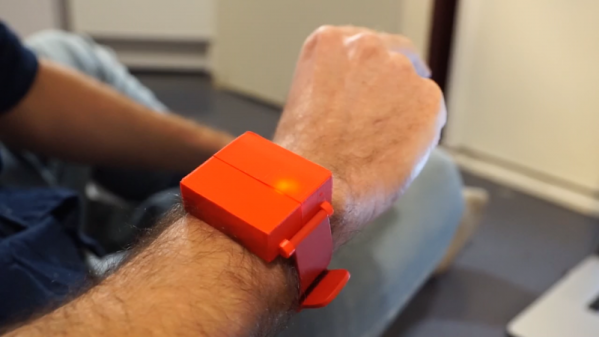
We’ve seen a few near-future sci-fi films recently where computers respond not just to touchscreen gestures but also to broad commands, like swiping a phone to throw its display onto a large flat panel display. It’s a nice metaphor, and if we’re going to see something like it soon, perhaps this wrist-mounted pointing device will be one way to get there.

The video below shows the finished product in action, with the cursor controlled by arm movements. Finger gestures that are very much like handling a real mouse’s buttons are interpreted as clicks. The wearable has a Nano, an MPU6050 IMU, and a nRF24L01 transceiver, all powered by some coin cells and tucked nicely into a 3D-printed case. To be honest, as cool as [Ronan Gaillard]’s wrist mouse is, the real story here is the reverse engineering he and his classmate did to pull this one off.

The road to the finished product was very interesting and more detail is shared in their final presentation (in French and heavy with memes). Our French is sufficient only to decipher “Le dongle Logitech,” but there are enough packet diagrams supporting into get the gist. They sniffed the packets going between a wireless keyboard and its dongle and figured out how to imitate mouse movements using an NRF24 module. Translating wrist and finger movements to cursor position via the 6-axis IMU involved some fairly fancy math, but it all seems to have worked in the end, and it makes for a very impressive project.

Is sniffing wireless packets in your future? Perhaps this guide to Wireshark and the nRF24L01 will prove useful.

Continue reading “Wireless Protocol Reverse Engineered To Create Wrist Wearable Mouse”

Membership Ring Of The Electronic Illuminati

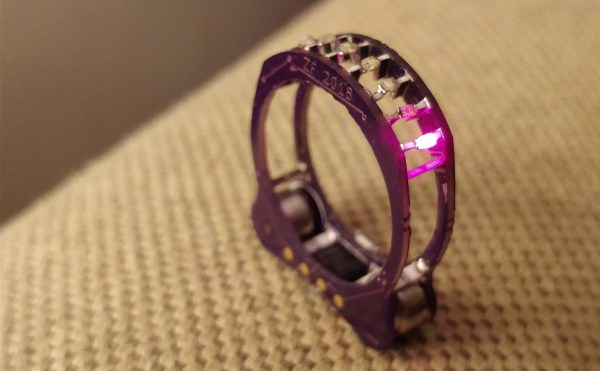
When the cabal of electronic design gurus that pull the invisible strings of the hardware world get together, we imagine they have to show this ring to prove their identity. This is the work of [Zach Fredin], and you’re going to be shocked by the construction and execution of what he calls Cyborg Ring.

The most obvious feature of the Cyborg Ring is the collection of addressable LEDs that occupy the area where gems would be found on a ring. What might not be so obvious is that this is constructed completely of electronic components, and doesn’t use any traditional mechanical parts like standoffs. Quite literally, the surface mount devices are structural in this ring.

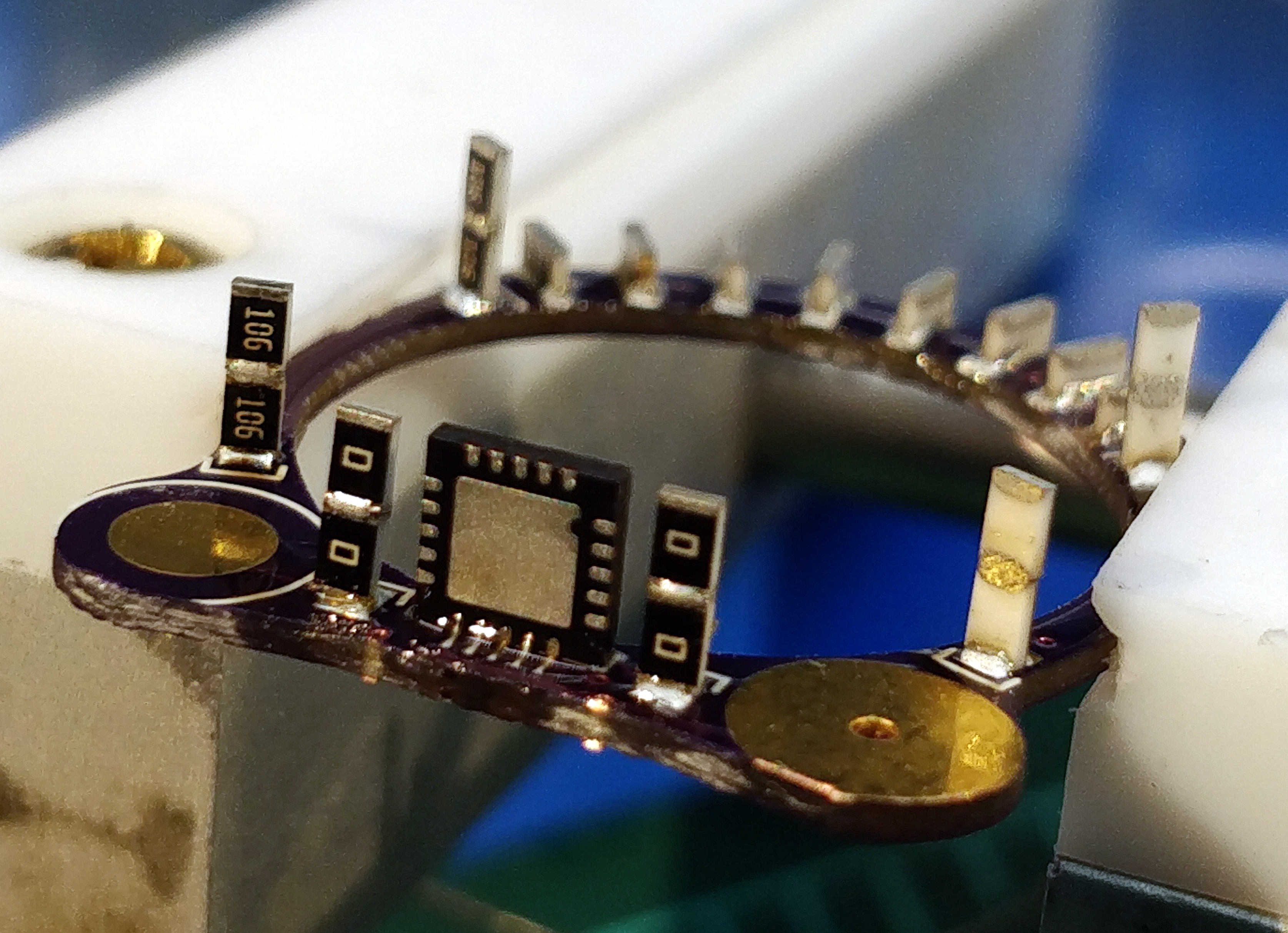
They are also electrical. Here you can see a detail of how [Zach] pulled this off. We are looking at the underside of the ring, the part that goes below your knuckle. One of the two PCBs that are sized to fit your finger has been placed in a Stick Vise while the QFN processor is soldered on end, and the pairs of SMD resistors are put in place.

The precise measurements of each part make it possible to choose components that will perfectly span the gap between the two boards. In the background of the image you can see SMD resistors on their long ends — a technique he used to allow the LEDs themselves to span between one resistor on each of the two PDBs to complete the circuit. Incredible, right?

But it gets better. [Zach] ended up with a working prototype, but has continued to forge ahead with new design iterations. These updates are a delight to read! Make sure you follow his project and check in regularly; if you’ve already looked at this now’s the time to go back and see the new work. The gold pads for the minuscule coin cells which power the ring are being reselected as the batteries didn’t fit well on the original. Some layout problems are being tweaked. And the new spin of boards should be back from fab in a week or so.

Don’t miss the demo video found below. We really like seeing projects that build within the wearble ring form factor. It’s an impressive constraint which [Zach] seems to have mastered. Another favorite of ours is [Kevin’s] Arduboy ring.

Continue reading “Membership Ring Of The Electronic Illuminati”