Impressive Junkyard CNC Made From Fancy Garbage

We’ll just come out and say it, [reboots] has friends with nice garbage. Sure, some of us have friends who are desperately trying to, “gift,” us a CRT monitor, hope dropping like a rock into their stomach when they realize they can’t escape the recycling fee.  [reboots] has friends who buy other people’s poorly thought out CNC projects and then gift him with the parts.

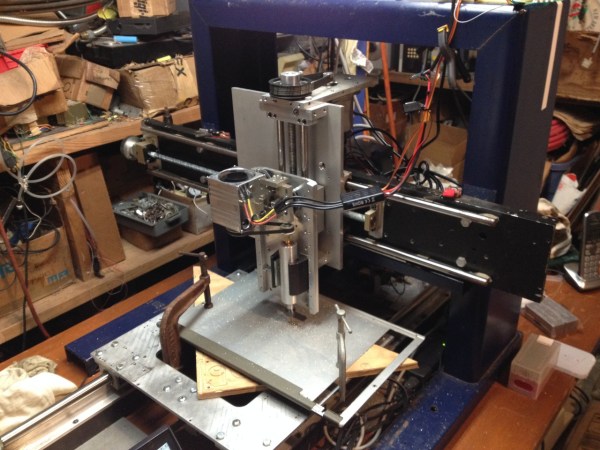
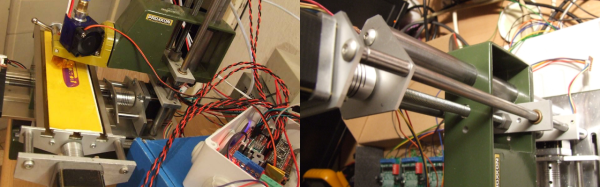
After dismantling the contraption he found himself with nice US and Japanese made linear motion components. However, he needed a CNC controller to drive it all. So he helped another friend clean out their garage and came away with a FlashCut CNC controller.

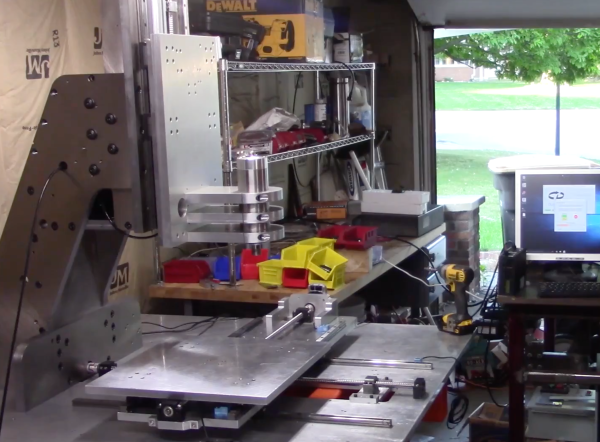
Now that he had a controller and the motion components whirring nicely, he really needed a frame to put it all in. We like to imagine that he was at a friend’s  barbeque having a beer. In one corner of the yard was an entire Boeing 747.  A mouldering scanning electron microscope with a tattered and faded blue tarp barely covering its delicate instrumentation sat in another corner. Countless tech treasures were scattered about in various states. It was then that he spotted a rusting gamma ray spectrometer in the corner that just happened to have the perfect, rigid, gantry frame for his CNC machine.

Of course, his friend obliged and gladly gave up the spectrometer. Now it was time to put all together. The gantry was set on a scavenged institutional door. The linear motion frames were bolted in place. Quite a few components had to be made, naturally, of scrap materials.
spindletest2Most people will start by using a handheld router for the spindle. The benefits are obvious: they’re inexpensive, easy to procure, and generally come with mounts. But, there are some definite downsides, one of the most glaring of which is the lack of true speed control.

Even routers that allow you to adjust the speed (a fairly common feature on new models) generally don’t actually regulate that speed. So, you end up with a handful of speed settings which aren’t even predictable under load. Furthermore, they usually rely on high RPMs to do their work. For those reasons, handheld woodworking routers aren’t the best choice for a mill that you intend to cut metal with.

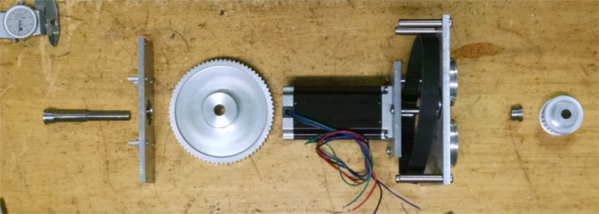
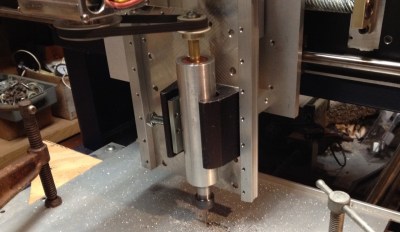
[reboots] noticed this problem while building this machine and came up with an inexpensive way to build a speed-controlled spindle. His design uses a brushless DC motor, controlled through a hobby ESC (electronic speed control), which uses a belt to drive the spindle. The spindle itself is mounted using skateboard bearings, and ends in an E11 collet (suitable for light machining in aluminum).

With the ESC providing control of the brushless motor, he’s able to directly control the spindle speed via software. This means that spindle speeds can be changed with G-code, allowing for optimized feeds and speeds for different operations. The belt-drive increases torque while separating the motor from the spindle, which should keep things cool, and reduce rotating mass on the spindle itself. Now all [reboots] needs to do is add a DIY tool changer!

Much More Than A Desktop Mill: The DIY VMC Build

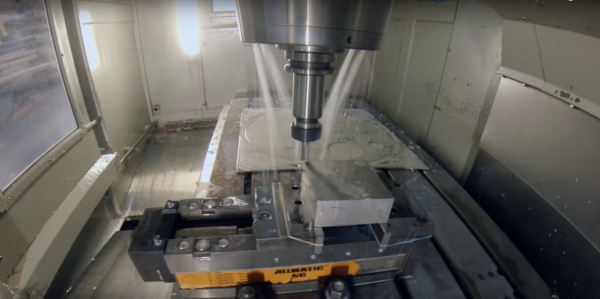
A VMC (vertical machining center) is essentially a CNC vertical milling machine on steroids. Many CNC mills are just manual milling machines that have been converted to CNC control. They work nicely, but have a number of drawbacks when it comes to real world CNC milling: manual tool changes, lack of chip collection, lack of coolant containment, and backlash issues (which a manual machinist normally compensates for).

These problems are solved with a VMC, which will usually have an automatic tool changer, and an enclosure to contain coolant and wash chips down into a collection pan. They are, however, very expensive, very big, and very heavy. Building one from scratch is a massive undertaking, but one which [Chris DePrisco] was brave enough to take on.

Continue reading “Much More Than A Desktop Mill: The DIY VMC Build”

Hackaday Prize Entry: A CNC Plasma Table

CNC routers and 3D printers are cool, but the last time I checked, cars and heavy machinery aren’t made out of wood and plastic. If you want a machine that will build other machines, you want a CNC plasma cutter. That’s [willbaden]’s entry for the Hackaday prize. It’s big, massive, and it’s already cutting.

A plasma CNC machine isn’t that much different from a simple CNC router. [will]’s table controller is just a GRBL shield attached to an Arduino, the bearings were stolen from many copy machines, and your motors and drivers are fairly standard, barring the fact they’re excessively huge for a simple 3D printer.

The real trick up [will]’s sleeve is the controller interface. For this, he’s mounted a Raspberry Pi display, a big, shiny, red button, and all the associated electronics behind a beautifully rusty welded enclosure. This part of the build just sends gcode over to the GRBL shield, and is doing so reliably. Right now [will] is looking for some way to save, arrange, and queue jobs on the Pi, a problem that is almost – but not quite – the same job Octoprint does. A software for big, mean CNCs that spew exotic states of matter is an interesting project, and we can’t wait to see where [will] goes with this one.

Add Robotic Farming To Your Backyard With Farmbot Genesis

Growing your own food is a fun hobby and generally as rewarding as people say it is. However, it does have its quirks and it definitely equires quite the time input. That’s why it was so satisfying to watch Farmbot push a weed underground. Take that!

Farmbot is a project that has been going on for a few years now, it was a semifinalist in the Hackaday Prize 2014, and that development time shows in the project documented on their website. The robot can plant, water, analyze, and weed a garden filled with arbitrarily chosen plant life. It’s low power and low maintenance. On top of that, every single bit is documented on their website. It’s really well done and thorough. They are gearing up to sell kits, but if you want it now; just do it yourself.

The bot itself is exactly what you’d expect if you were to pick out the cheapest most accessible way to build a robot: aluminum extrusions, plate metal, and 3D printer parts make up the frame. The brain is a Raspberry Pi hooked to its regular companion, an Arduino. On top of all this is a fairly comprehensive software stack.

The user can lay out the garden graphically. They can get as macro or micro as they’d like about the routines the robot uses. The robot will happily come to life in intervals and manage a garden. They hope that by selling kits they’ll interest a whole slew of hackers who can contribute back to the problem of small scale robotic farming.

The Othermill Is Something Else

I’ll admit. When I saw the Othermill for the first time I thought it was just another mill with cheap Chinese hardware inside sold as a premium. I’m ashamed to say that I even trash talked it a little bit. It gave me another chance to relearn that I should always do my research before being a jerk, check my assumptions thoroughly, and even then it’s not recommended. Other Machine Company was kind enough to let me swing by the office in Berkeley California. [Danielle], the CEO, led me through the design of the mill as well as the challenges in running the operation.

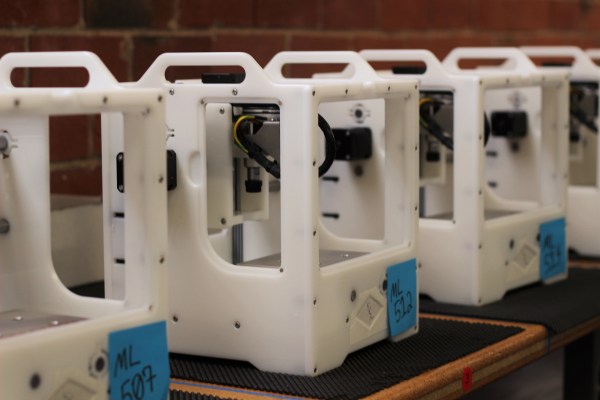
The Othermill is a serious machine, and with the recent release of the Othermill Pro, it’s only getting better. The components are not bargain basement. This is something that could be more obvious, but it’s almost entirely made from US sourced parts, including the custom stepper motors. There aren’t any ball bearings that will start to make strange noises in a year. It can now cut 6mil traces in a PCB all day long. To put it into perspective. The Othermill Pro costs a third of the price of an equivalent machine from LPKF and has the same capabilities.

Continue reading “The Othermill Is Something Else”

Escalating To CNC Through Proxxon’s Tool Line

Proxxon is a mostly German maker of above average micro tools. They do sell a tiny milling machine in various flavors, from manual to full CNC. [Goran Mahovlić] did not buy that. He did, however, combine their rotary tool accessory catalog into a CNC mill.

Owning tools is dangerous. Once you start, there’s really no way to stop. This is clearly seen with Goran’s CNC machine. At first happiness for him was a small high speed rotary tool. He used it to drill holes in PCBs.

In a predictable turn of events, he discovered drilling tiny holes in PCBs by hand is tedious and ultimately boring. So he purchased the drill press accessory for his rotary tool.

Life was good for a while. He had all the tools he needed, but… wouldn’t it be better if he could position the holes more quickly. He presumably leafed through a now battered and earmarked Proxxon catalog and ordered the XY table.

A realization struck. Pulling a lever and turning knobs! Why! This is work for a robot, not a man! So he pestered his colleague for help and they soon had the contraption under CNC control.

We’d like to say that was the end of it, and that [Goran] was finally happy, but he recently converted his frankenmill to a 3D printer. We’ve seen this before. It won’t be long before he’s cleaning out his garage to begin the restoration and ultimate CNC conversion of an old knee mill. Videos after the break.

Continue reading “Escalating To CNC Through Proxxon’s Tool Line”

Super Cheap Super Simple DRO

If you have an old manual lathe, mill, or even a drill press, a digital readout (DRO) is a very handy tool to have. A DRO gives you a readout of how far you’ve cut, milled, or drilled into a piece of work without having to stoop to caveman levels and look down at a dial. Here’s a stupidly cheap DRO for all your machine tools. It should only cost five bucks or so, and if you need it, you already have the tools to manufacture it.

This build is inspired by an earlier build using the same single component – a digital tread depth gauge. This digital tread depth gauge is commonly found in countries that don’t use the US penny as currency to measure the depth of tread on a tire. The throw isn’t that large – only about 27mm – but with a few modifications it can fit on any machine tool.

The modifications include a small bit of metal glued to the back and four tiny neodymium magnets.  For the ‘tool head’ of this DRO, only a tiny plastic collar and another deo magnet are needed.

This digital tire depth gauge looks like – and probably is – the same mechanism found in those super cheap calipers from the far east. In theory, it should be possible to extend this modification to those digital calipers, making for a simple DRO with a much larger throw.

Thanks [Ben] for sending this one in.