TMD-1 Makes Turing Machine Concepts Easy To Understand

For something that has been around since the 1930s and is so foundational to computer science, you’d think that the Turing machine, an abstraction for mechanical computation, would be easily understood. Making the abstract concepts easy to understand is what this Turing machine demonstrator aims to do.

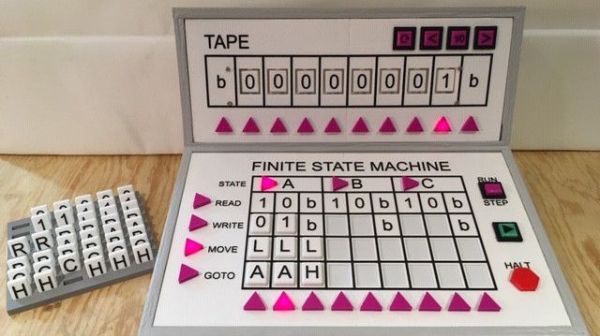
The TMD-1 is a project that’s something of a departure from [Michael Gardi]’s usual fare, which has mostly been carefully crafted recreations of artifacts from the early days of computer history, like the Minivac 601  trainer and the DEC H-500 computer lab. The TMD-1 is, rather, a device that makes the principles of a Turing machine more concrete. To represent the concept of the “tape”, [Mike] used eight servo-controlled flip tiles. The “head” of the machine conceptually moves along the tape, its current position indicated by a lighted arrow while reading the status of the cell above it by polling the position of the servo.

Below the tape and head panel is the finite state machine through which the TMD-1 is programmed. [Mike] limited the machine to three states and four transitions three symbols, each of which is programmed by placing 3D-printed tiles on a matrix. Magnets were inserted into cavities during printing; Hall Effect sensors in the PCB below the matrix read the pattern of magnets to determine which tiles are where. The video below shows the TMD-1 counting from 0 to 10, which is enough to demonstrate the basics of Turing machines.

It’s hard not to comment on the irony of a Turing machine being run by an Arduino, but given that [Mike]’s goal was to make abstract concepts easy to understand, it makes perfect sense to leverage the platform rather than try to do this with discrete logic. And you can’t argue with results — TMD-1 made Turing machines clear to us for the first time.

Continue reading “TMD-1 Makes Turing Machine Concepts Easy To Understand”

Laundry Monitor Won’t Generate Static With Roommates

Laundry. It’s one of life’s inescapable cycles, but at least we have machines now. The downside of this innovation is that since we no longer monitor every step — the rock-beating, the river-rinsing, the line-hanging and -retrieving — the pain of laundry has evolved into the monotony of monitoring the robots’ work.

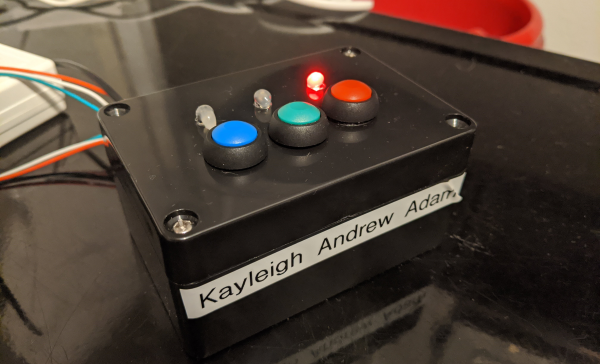
[Adam] shares his wash-bots with roommates, and they aren’t close enough to combine their lights and darks and turn it into a group activity. They needed an easy way to tell when the machines are done running, and whose stuff is even in there in the first place, so [Adam] built a laundry machine monitor that uses current sensing to detect when the machines are done running and sends a text to the appropriate person.

Each machine has a little Hall effect-sensing module that’s carefully zip-tied around its power cable. The signal from these three-wire boards goes high when the machine is running and low when it’s not. At the beginning of the load, the launderer simply presses their assigned button on the control box, and the ESP32 inside takes care of the rest.

Getting a text when your drawers are clean is about as private as it gets. Clean underwear, don’t care? Put it on a scrolling marquee.

Quieting Down A Bandoneon Accordion With MIDI

The bandoneon, known as the tango accordion, is quite a loud instrument to practice within the confines of an apartment, and could possibly lead to some neighborly disputes. [HLB] enjoyed playing his but wanted a way to turn down the volume a bit without, in consideration to his neighbors. Instead of building a whole soundproof room, he decided to throw Arduino’s and MIDI at the problem.

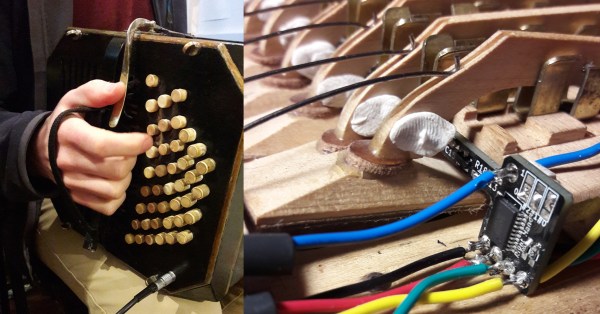
Bandoneons, like all accordions, are operated by pushing air from manually pumped bellows through a series of reeds, which are each opened and closed by a valve mechanism. [HLT] turned each valve lever into a simple on/off switch by attaching a magnet, with hall-effect sensors on long custom PCBs next to each row of valves. The hall effect sensors are connected to I2C I/O expander ICs which connect to an Arduino Nano, one for each side of the instrument, which sends out MIDI messages via serial. Everything is mounted inside what looks like quite an old instrument with Blu Tack to avoid having to make a lot of permanent modifications.

The bandoneon still functions normally with no permanent modifications, so to play with MIDI-only the bellow is simply not pumped. This means [HLB] can’t modulate the MIDI velocity (loudness) while playing, which he admits is a limitation but better than not playing at all. He does, however, note that he could add a pressure sensor inside the bellow if we wanted to add velocity to the midi output when neighbourliness isn’t a consideration. On the audio output side [HLB] built a small stand-alone synthesizer with an Odroid SBC running FluidSynth and a HiFi shield.

Continue reading “Quieting Down A Bandoneon Accordion With MIDI”

Data Glove Gets A Grip On Gesture Input

If we really want wearable computing to take off as a concept, we’re going to need lightweight input devices that can do some heavy lifting. Sure, split ergo keyboards are awesome. But it seems silly to restrict the possibilities of cyberdecks by limiting the horizons to imitations of desk-bound computing concepts.

What we really need are things like [Zack Freedman]’s somatic data glove. This fantastically futuristic finger reader is inspired by DnD spells that have a somatic component to them — a precise hand gesture that must be executed perfectly while the spell is spoken, lest it be miscast. The idea is to convert hand gestures to keyboard presses and mouse clicks using a Teensy that’s housed in the wrist-mounted box. You are of course not limited to computing on the go, but who could resist walking around the danger zone with this on their wrist?

Each finger segment contains a magnet, and there’s a Hall effect sensor in each base knuckle to detect when gesture movement has displaced a magnet. There’s a 9-DoF IMU mounted in the thumb that will eventually allow letters to be typed by drawing them in the air. All of the finger and thumb components are housed in 3D-printed enclosures that are mounted on a cool-looking half glove designed for weightlifters. [Zack] is still working on gesture training, but has full instructions for building the glove up on Instructables.

It’s true: we do love split ergo keyboarded cyberdecks, and this one is out of this world.

Feel The Force With A Pocket Magnetometer

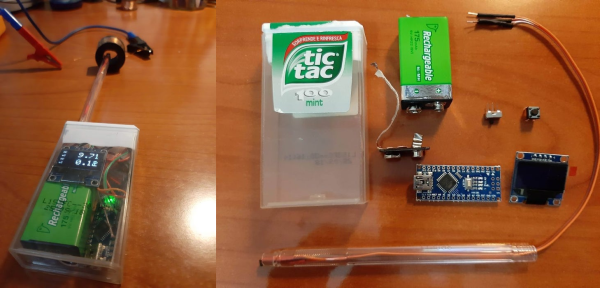
With the rise of affordable 3D printers, we just don’t see the projects in Tic Tac boxes that we used to. That’s kind of a shame. Not only are you upcycling existing plastic when you use one, they’re decently sized component vessels for pocket builds such as [rgco]’s portable magnetometer, especially if you can get the 100-count box. Best of all, they’re see-through!

Sure, you could get a magnetometer app for your phone to test out the strength of your Buckyballs, but this is more fun, and you can use it in more places. This build doesn’t take much — an Arduino Nano reads from a Hall effect sensor and outputs the magnetic flux density in militeslas (mT) on an OLED. Fortifying the sensor by mounting it inside the body of an old (also see-through!) ballpoint pen body is a nice touch.

In order to calibrate it, [rgco] made a solenoid by wrapping a length of PVC with magnet wire. The code for this very portable and low-cost magnetometer measures the magnetic field 2000 times in under three-tenths of a second, and outputs both the mean and the standard deviation of these measurements.

Magnetometers can ID all kinds of things from submarines to Suburbans. Here’s an ESP8266 magnetometer that opens a driveway gate when it detects the car.

Spintronic RAM Gets A Little Closer To SRAM

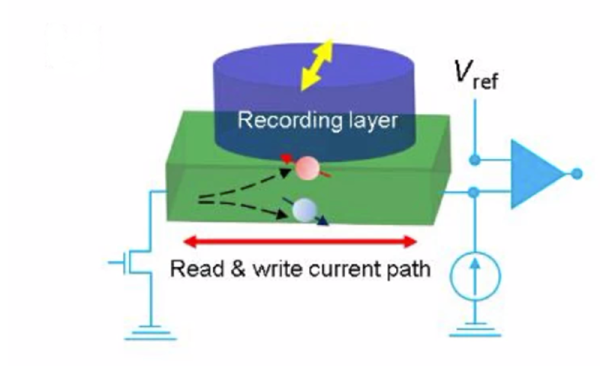
Sometimes it seems as though everything old is new again. The earliest computers used magnetic memory such as magnetic core. As practical as that was compared to making for example each bit of memory be a vacuum tube or relay flip flop, newer technology such as SRAM and DRAM displaced core and similar technologies. However, some of the newest technologies once again use magnetic fields. FRAM or ferroelectric RAM and magnetoresistive or MRAM both use magnetic fields to store data. Now Japanese researchers think they are on track to make MRAM more competitive with traditional RAM chips.

The Tokyo Institute of Technology researchers use new material combinations to make chips that store data based on the spin of electrons — the underlying reason for the way magnets behave. Their recent paper discusses USMR or Unidirectional spin Hall magnetoresistance and using this effect could greatly simplify the construction of MRAM cells.

Continue reading “Spintronic RAM Gets A Little Closer To SRAM”

Better Simulators With Homemade Potentiometers

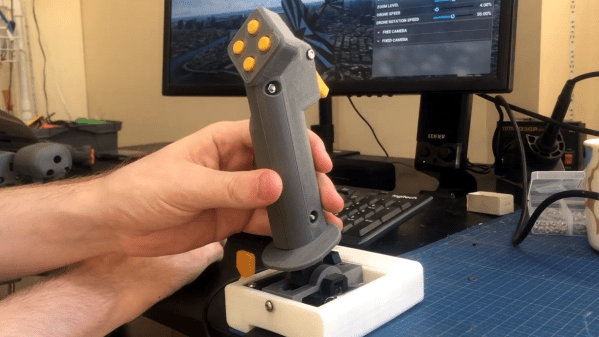
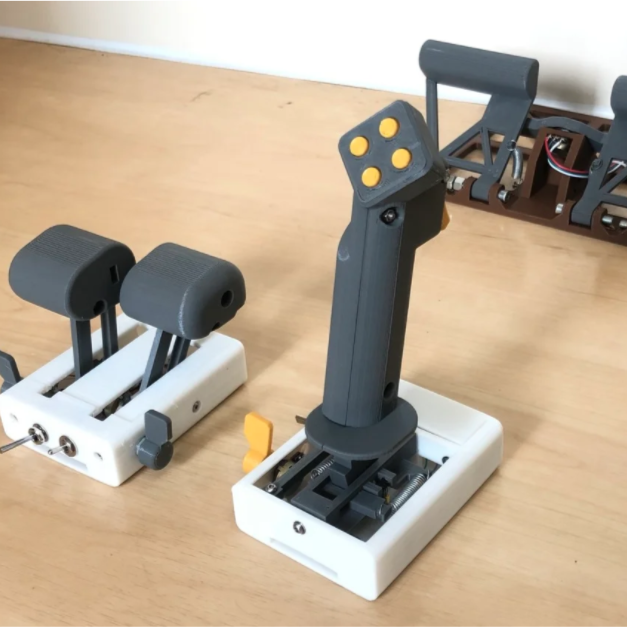
Perhaps you’ve played a flight simulator before, using something like a mouse and keyboard. That’s a fine experience, but like any other activity you can get a lot more out of it if you put a little more effort into the experience. Some will upgrade to a joystick for a modest improvement, and others will build incredible accurate cockpit replicas down to the smallest detail. The builders of these “pits” are always looking for ways of improving their setups, and it’s from this world that we find a method of building specialized, inexpensive hall-effect sensors.

A hall-effect sensor is a circuit that outputs a voltage based on the presence of an external magnetic field. These can be used to make compasses, but with a permanent magnet in close proximity can also be used to create a potentiometer-like device at lower cost and with higher precision than a similarly-priced pot. There was a method of building these in the simulator world using the housing of a Bic pen and some strong glue, but [LocNar] has improved on this method as well. He repurposed some bearings and some stock metal tubing in order to fabricate a professional-level sensor at a fraction of the cost.

This build is essentially a solution for anyone needing a potentiometer that’s easier to build, less expensive, has higher precision, and interacts with a digital input in a much more predictable (and programmable) way. Certainly this has applications in the simulator world, but will work for many other applications. If you’ve never thought about the intricacies (and shortcomings) of potentiometers, some other folks have taken a deep dive into that as well.

Thanks to [Keith O] for the tip!